Overview

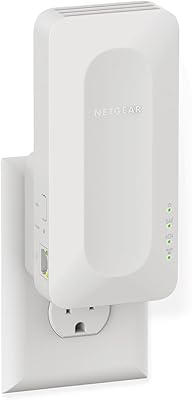
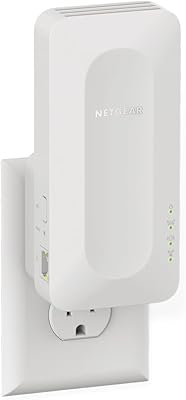
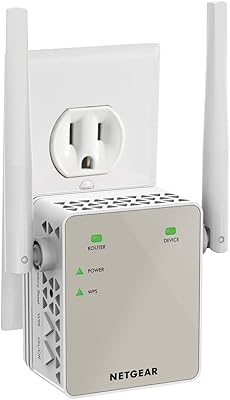
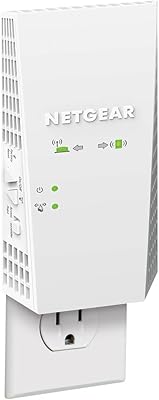
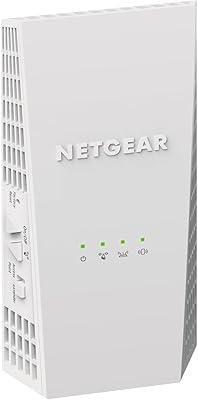
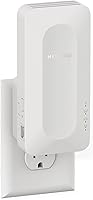
The NETGEAR EAX12 WiFi 6 Range Extender is a wall-plug repeater that slots into any standard outlet — no shelf, no cable, no extra clutter. It joins your existing network under the same name, so devices stay connected as you move through the house without manually switching networks. Released in mid-2021, it occupies the mid-range networking tier, bringing WiFi 6 technology to homes without the cost of a full mesh system overhaul. With over 17,000 Amazon ratings averaging 4.0 stars, that kind of review volume reflects genuine, broad adoption — not just a niche audience.
Features & Benefits

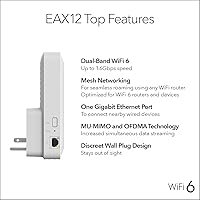
Running on the WiFi 6 standard, this WiFi 6 extender can theoretically push up to 1.6 Gbps across dual bands — in practice, that translates to smooth HD streaming and video calls in rooms your router struggles to reach. The single Gigabit Ethernet port is a quiet but useful addition, letting you wire in a smart TV or gaming console for solid reliability. MU-MIMO and OFDMA help manage traffic when multiple devices connect at once, reducing the slowdowns that plague older extenders. WPA3 security and Smart Connect band steering round out a capable feature set for a unit at this price point.

Best For

This wall-plug repeater makes the most sense for renters or apartment residents who cannot run cables through walls and just need signal where it is currently weak. It is also a strong match for anyone already on a WiFi 6 router who wants to extend coverage without dropping back to older standards. That said, keep expectations grounded: this suits light-to-moderate use — streaming, browsing, video calls — not households running multiple 4K streams at once. The single wired port is a practical bonus for anyone wanting a reliable connection drop in one specific room without pulling ethernet across the house.

User Feedback

With over 17,000 reviews, the EAX12 tells a fairly consistent story. Most satisfied buyers call out how easy the setup is — plug in, connect through the app, done in minutes — and appreciate that devices hand off between router and extender without manual switching. The complaints are worth heeding, though. Throughput drops noticeably versus a direct router connection, which is expected from any repeater but still catches some buyers off guard. Users with non-NETGEAR routers occasionally report spotty compatibility despite the universal claims, and a pattern in low-star reviews points to buyers expecting coverage in large, multi-story homes — well beyond what a single wall-plug extender can realistically handle.

Pros

  • Plug-and-play setup takes minutes with no technical knowledge required.
  • Keeps your existing network name, so devices stay connected as you move through the home.
  • WiFi 6 support means the EAX12 stays relevant as newer devices become standard.
  • Dual-band operation with Smart Connect takes the guesswork out of band selection.
  • MU-MIMO and OFDMA reduce slowdowns when several devices are online at once.
  • Built-in Gigabit Ethernet port adds a wired connection option without running new cable.
  • WPA3 security offers stronger protection than most older extenders in this category.
  • Wall-plug form factor takes up zero shelf or desk space.
  • Over 17,000 real-world reviews provide unusually strong evidence of broad, reliable adoption.
  • Affordable entry point into WiFi 6 extension without committing to a full mesh system upgrade.

Cons

  • Throughput drops noticeably compared to a direct router connection — expect a speed reduction at range.
  • Advertised 1,200 sq. ft. coverage is a best-case figure; walls, floors, and interference reduce this significantly.
  • Some users with non-NETGEAR routers report unreliable performance despite the universal compatibility claim.
  • Only one Ethernet port limits wired connectivity to a single device.
  • No USB port means no option for shared storage or printer connectivity.
  • This wall-plug repeater cannot replicate the intelligent backhaul routing of a true mesh network system.
  • Launched in 2021, so buyers comparing current options may find newer models with improved specs at similar prices.
  • Larger homes or multi-story layouts will likely need more than one unit to address all dead zones.

Ratings

The scores below reflect an AI-driven analysis of thousands of verified global reviews for the NETGEAR EAX12 WiFi 6 Range Extender, with spam, bot-generated, and incentivized feedback actively filtered out to surface genuine buyer sentiment. Each category captures both what users consistently praised and where real frustrations emerged — nothing is glossed over. The result is an honest, balanced picture of where this wall-plug repeater delivers and where it falls short.

Ease of Setup
91%
Getting the EAX12 up and running is one of the most praised aspects across the entire review base. Most buyers report being connected within ten minutes using NETGEAR's app or browser-based setup, with no networking background required. First-time extender users specifically call out how guided and friction-free the process feels.
A small but consistent segment of reviewers hit snags when pairing with certain ISP-provided routers, where the setup flow stalls or requires a factory reset to recover. Users on less common router firmware occasionally find the app unhelpful and have to fall back to manual browser configuration.
WiFi Coverage
73%
27%
In open-plan apartments and single-story homes, this WiFi 6 extender reliably pushes signal into rooms that were previously borderline unusable. Buyers in studio and two-bedroom apartments particularly report that dead zones near back bedrooms or far corners are resolved with a single well-placed unit.
The marketed 1,200 sq. ft. figure is a ceiling measured in ideal open-space conditions, not a guarantee in real homes with brick walls, multiple floors, or dense interference. Reviewers in larger homes or split-level layouts frequently note that coverage falls well short of expectations, sometimes requiring a second unit.
Real-World Speed
67%
33%
For everyday tasks — HD streaming, video calls, general browsing — the EAX12 delivers speeds that feel smooth and consistent when placed in a reasonable position relative to the router. Users upgrading from WiFi 5 extenders notice a meaningful improvement in throughput stability, especially on 5 GHz-capable devices.
Throughput at the extended connection is noticeably lower than what the router delivers directly, which is an inherent trade-off for all traditional repeaters but still catches buyers off guard. Households trying to run multiple simultaneous 4K streams or do large file transfers through the extender frequently report disappointing speed test results.
Router Compatibility
69%
31%
The vast majority of users pairing this wall-plug repeater with mainstream routers from brands like ASUS, TP-Link, and Linksys report no issues at all. It connects cleanly and maintains a stable link, which is reassuring given how many different router configurations buyers bring to the table.
A recurring thread in negative reviews involves inconsistent behavior with certain ISP-supplied gateway devices and less common router models. While NETGEAR claims universal compatibility, some users report intermittent drops or an inability to complete setup without switching to a different router entirely.
Connection Stability
74%
26%
Day-to-day stability is rated positively by the majority of long-term users, particularly those using it for video calls, remote work, or streaming in a specific room. Once the unit is positioned well and paired correctly, most buyers report months of reliable use without needing to reboot or reconfigure.
A meaningful segment of reviewers describes periodic disconnections, especially after router firmware updates or power interruptions. Some users note that the extender occasionally needs a manual power cycle to recover its connection, which becomes frustrating in a set-it-and-forget-it household context.
Band Steering & Smart Connect
71%
29%
Smart Connect handles band assignment automatically, which removes the hassle of managing two separate network names. For most users with a mixed device ecosystem — phones, laptops, tablets — this works well enough that they never have to think about whether a device is on 2.4 GHz or 5 GHz.
Power users who prefer manual band control sometimes find Smart Connect too aggressive in its decisions, occasionally forcing a capable device onto 2.4 GHz when 5 GHz would perform better. There is no straightforward way to override band assignment without disabling Smart Connect entirely.
Wired Ethernet Port
83%
The single Gigabit Ethernet port is a well-appreciated inclusion that many buyers use to hardwire a smart TV, desktop, or game console in a room the router cannot reach. Wired devices connected this way consistently report more stable speeds than WiFi-only alternatives in the same location.
Having only one port is a real limitation for buyers hoping to wire more than one device — a desktop and a console in the same room, for example, requires an additional switch. The absence of a second port is one of the more common feature requests found in otherwise positive reviews.
Device Capacity
76%
24%
For typical households with smartphones, laptops, a smart TV, and a few smart home devices, the EAX12 handles concurrent connections without obvious congestion. MU-MIMO and OFDMA contribute meaningfully to keeping things manageable when several devices are active at once.
In denser environments — a home office doubling as a media room, or a shared rental with many users — buyers start to notice performance degradation once the connected device count climbs toward the upper limit. The 15-device figure is a supported maximum, not a guaranteed comfortable ceiling.
Security
87%
WPA3 support puts this extender ahead of many competitors in its class that still cap out at WPA2. For buyers who prioritize network security — particularly those in dense apartment buildings with many nearby networks — this is a genuine differentiator that does not require any extra configuration.
WPA3 is only as effective as the router it pairs with; if the primary router is older and WPA2-only, the security benefit is capped at that level regardless of the extender. There are no advanced security management tools on the extender itself for users who want more granular control.
Value for Money
78%
22%
Bringing WiFi 6 capability to the extender category at a mid-range price point is one of the clearest reasons buyers choose the EAX12 over older alternatives. For renters or budget-conscious buyers who need a quick signal fix without investing in a full mesh system, the cost-to-capability ratio holds up well.
Given that it launched in mid-2021, newer competitors have entered the market with comparable or better specs at similar prices, which slightly erodes the value proposition for buyers shopping in the current market. Those needing coverage for a large home may end up buying two units, pushing the total outlay closer to entry-level mesh system pricing.
Physical Design
81%
19%
The wall-plug form factor is consistently praised for being unobtrusive — it occupies an outlet without demanding shelf space or a power brick. The unit is neutral enough in appearance to blend into most home environments without drawing attention.
At 14.4 ounces, it is on the heavier side for a wall-plug device and can sit at an awkward angle in certain outlet orientations, particularly in older homes with horizontal outlet configurations. A small number of reviewers note that it partially blocks adjacent outlets depending on wall plate spacing.
App & Management Experience
66%
34%
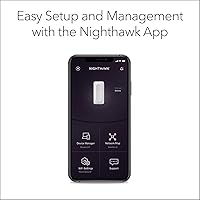
NETGEAR's Nighthawk app provides a clear initial setup flow and gives users a simple dashboard for checking connection status and signal strength. For non-technical buyers, the visual interface is much more accessible than logging into a web admin panel.
Beyond initial setup, the app offers limited ongoing management features compared to what mesh system apps provide. Several reviewers note that the app occasionally fails to detect the extender after setup is complete, forcing them to manage it entirely through the browser-based interface instead.
Roaming Performance
72%
28%
Using the same SSID as the primary router means most devices connect to whichever signal is stronger without the user needing to intervene. In single-story apartments and smaller homes, this works smoothly enough that many buyers describe the experience as feeling like a single unified network.
In practice, the handoff between router and extender is not always instantaneous — some devices, particularly smartphones, tend to cling to a weaker router signal rather than switching to the closer extender. This is partly a client-device behavior issue, but buyers coming from true mesh systems often notice the difference.
Long-Term Reliability
74%
26%
Many reviewers who have owned the EAX12 for over a year report that it continues to perform consistently without hardware degradation. NETGEAR's track record in the networking space provides some confidence in firmware support and longevity compared to lesser-known brands in the same category.
There are enough reviews describing unit failures after 12 to 18 months of use to warrant mention, particularly related to overheating in enclosed outlet locations. NETGEAR's customer support responsiveness receives mixed marks, with some users finding warranty resolution slow or requiring multiple contacts.

Suitable for:

The NETGEAR EAX12 WiFi 6 Range Extender is a practical pick for renters and apartment dwellers who have no option to run ethernet cables and simply need better signal in a bedroom, home office, or living room corner. If you already own a WiFi 6 router and want to stretch its reach without buying entirely new hardware, this wall-plug repeater does that job without forcing you to downgrade to an older wireless standard. It works well for households where the main daily demands are video streaming, video calls, and general browsing across a modest number of devices. The single Gigabit Ethernet port is a quiet but real bonus for anyone who wants one wired device — a desktop, console, or smart TV — in a room the router cannot reliably reach. Anyone upgrading from a WiFi 5 extender will likely notice a tangible improvement in both speed consistency and multi-device handling.
Not suitable for:

The NETGEAR EAX12 WiFi 6 Range Extender is not the right tool for large homes, multi-story layouts, or anyone expecting router-level throughput at range. Like all traditional repeaters, it re-broadcasts the signal it receives, which means real-world speeds at the extended connection will be noticeably lower than what your router delivers directly — that is a fundamental trade-off with the technology, not a flaw unique to this unit. It should not be confused with a mesh node: it does not create a self-managing, backhaul-optimized network the way a dedicated mesh system does. Households running several simultaneous 4K streams, heavy file transfers, or competitive online gaming across multiple devices will likely hit the ceiling of what this wall-plug repeater can handle reliably. Users with non-NETGEAR routers should also temper expectations around compatibility, as a portion of real-world feedback points to inconsistent behavior outside NETGEAR ecosystems.
Specifications

  • WiFi Standard: Operates on WiFi 6 (802.11ax), the current mainstream wireless standard offering improved speed and efficiency over WiFi 5.
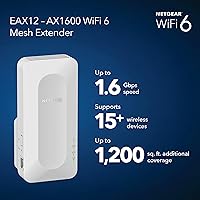
  • Max Speed: Rated at a combined theoretical maximum of up to 1.6 Gbps across both frequency bands under ideal conditions.
  • Frequency Bands: Dual-band design transmits simultaneously on both 2.4 GHz and 5 GHz, balancing range and throughput across devices.
  • Coverage Area: Designed to add up to 1,200 sq. ft. of wireless coverage, though actual range depends heavily on wall materials and interference.
  • Device Capacity: Supports connections from 15 or more devices simultaneously under normal household usage conditions.
  • Wired Port: Includes one Gigabit Ethernet port for connecting a single wired device such as a console, desktop, or streaming player.
  • USB Port: No USB port is included, meaning shared storage or printer connectivity via this unit is not supported.
  • Security: Supports both WPA2 and WPA3 security protocols, with WPA3 providing stronger encryption than the previous generation standard.
  • Key Technologies: Incorporates MU-MIMO, OFDMA, and Smart Connect to improve multi-device performance and automatic band assignment.
  • Simultaneous Streams: Handles up to 4 simultaneous data streams, distributed across connected devices on both bands.
  • Form Factor: Wall-plug design requires only a standard electrical outlet — no shelf space, mounting hardware, or additional cables are needed.
  • Dimensions: Measures 10 x 5 x 4 inches, making it a relatively compact unit for a dual-band WiFi 6 extender.
  • Weight: Weighs 14.4 ounces, which is typical for a wall-plug extender of this class and poses no outlet stress concerns.
  • Model Number: The official model identifier is EAX12-100NAS, useful for locating firmware updates, support documentation, and compatible accessories.
  • Brand: Manufactured by NETGEAR, a well-established networking hardware company with a broad consumer and business product portfolio.
  • Release Date: First made available in July 2021, placing it in the early wave of consumer-grade WiFi 6 extenders.
  • Router Compatibility: Compatible with any standard wireless router or cable modem router, with performance optimized when paired with a WiFi 6 router.
  • Network Mode: Functions as a range extender and repeater, joining and rebroadcasting an existing network rather than creating an independent one.

Related Reviews

NETGEAR EAX17 WiFi 6 Range Extender
76%
88%
Ease of Setup
82%
Signal Coverage
71%
Real-World Speed Performance
78%
Device Handling Capacity
63%
Roaming & Handoff
More
NETGEAR WiFi 6 Mesh Range Extender EAX11
85%
94%
Ease of Setup
88%
WiFi Coverage
91%
Speed & Performance
85%
Compatibility with Routers
79%
Roaming & Signal Consistency
More
NETGEAR EX6120 WiFi Range Extender
74%
83%
Ease of Setup
76%
Signal Coverage
61%
Connection Speed
79%
Value for Money
58%
5GHz Band Performance
More
Linksys RE7310 WiFi 6 Range Extender
84%
89%
Performance
91%
Ease of Setup
88%
Coverage Area
84%
Speed Stability
92%
Compatibility
More
Surncest AX3000 WiFi 6 Range Extender
85%
88%
Value for Money
91%
WiFi Performance
85%
Setup & Installation
89%
Coverage & Range
80%
Build Quality
More
NETGEAR WiFi Mesh Range Extender EX8000
86%
85%
Wi-Fi Performance
88%
Ease of Setup
90%
Coverage Area
84%
Device Support
87%
Streaming & Gaming Performance
More
NETGEAR WiFi Mesh Range Extender EX7500
84%
88%
Performance
91%
WiFi Range Coverage
84%
Speed/Stability
87%
Device Support/Capacity
93%
Ease of Setup
More
Netgear EX6400 WiFi Mesh Range Extender
73%
83%
Signal Coverage
61%
Throughput & Speed Performance
88%
Setup & Installation
58%
Smart Roaming Performance
86%
Wired Ethernet Connectivity
More
NETGEAR EX7000 WiFi Mesh Range Extender
86%
85%
Coverage Performance
90%
Ease of Setup
88%
WiFi Speed
92%
Device Compatibility
87%
Range Extending Efficiency
More
ingabis M-A25 AX3000 WiFi 6 Range Extender
77%
91%
Ease of Setup
78%
Signal Coverage
82%
WiFi Speed Performance
88%
Gigabit Ethernet Port
79%
Multi-Device Handling
More

FAQ

No, the EAX12 works with any modern wireless router, including older WiFi 5 models. That said, you will only get the full WiFi 6 speed and efficiency benefits if your router also supports the WiFi 6 standard. With an older router, it still functions as a capable extender — you just will not unlock the top-tier performance.

The NETGEAR EAX12 WiFi 6 Range Extender uses the same network name as your existing router, so most devices will connect to whichever signal is stronger as you move around. In practice, the handoff is not always instant on every device — smartphones and laptops vary in how aggressively they switch — but for most everyday use you will not need to manually select a network.

Expect a real-world throughput reduction compared to a direct connection to your router. This is not specific to this wall-plug repeater — it applies to all traditional extenders because the unit receives and retransmits the signal, which introduces overhead. For streaming video and video calls this is rarely noticeable, but for large file transfers or latency-sensitive gaming it can be more apparent.

Yes, the unit has one Gigabit Ethernet port on the side, which is genuinely useful for a device like a smart TV, desktop PC, or game console. Wiring a device directly into the extender removes the wireless leg for that device, which typically improves speed consistency and reduces latency compared to connecting over WiFi.

Setup is about as straightforward as it gets. You plug it into an outlet, connect to its temporary network from your phone or browser, and follow the on-screen steps to link it to your existing WiFi. The whole process takes most people under ten minutes. NETGEAR also offers an app that can guide you through it if you prefer a visual walkthrough.

That figure is a best-case estimate measured in open space. In a real home with drywall, brick walls, floors, appliances, and other wireless networks nearby, the effective range will be shorter. Think of 1,200 sq. ft. as a ceiling, not a guarantee. For most apartments and smaller homes it performs well; for larger or multi-story spaces, one unit may not be enough to fill all the dead zones.

It is designed to work with any standard router regardless of brand, and most users with non-NETGEAR routers report no issues. However, a notable portion of user feedback does mention occasional compatibility hiccups with certain third-party routers. If you are using a more unusual or ISP-provided router, it is worth checking community forums for specific compatibility notes before buying.

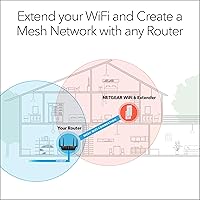
Not quite. A mesh system uses multiple nodes that communicate with each other over a dedicated backhaul, creating a unified and intelligently managed network. This wall-plug repeater rebroadcasts your existing signal but does not have that kind of coordinated backhaul. It is simpler, cheaper, and easier to set up, but a mesh system will generally deliver more consistent speeds across a larger area if your budget allows for it.

The general rule is to place it roughly halfway between your router and the area with weak signal, while still within range of a solid connection from the router. Plugging it in too far from the router means it picks up a weak signal and rebroadcasts that weakness. NETGEAR's setup process includes a signal strength indicator that helps you find a good placement before you commit to a final spot.

Yes, the EAX12 supports WPA3, which is the most current WiFi security standard and more resistant to common password attacks than the older WPA2. It also supports WPA2 for compatibility with older devices. You do not need to configure anything special — it inherits the security settings of your existing network during setup.

Where to Buy