Overview

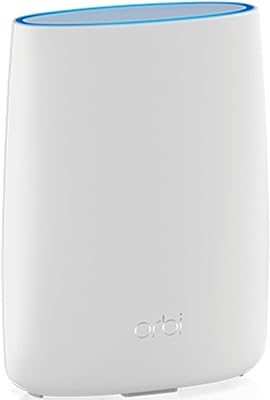
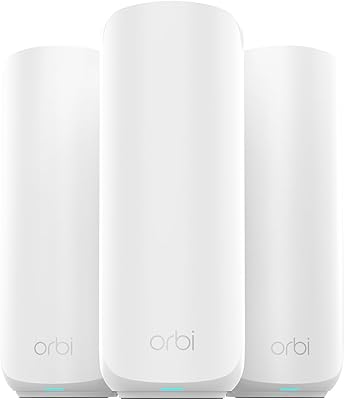
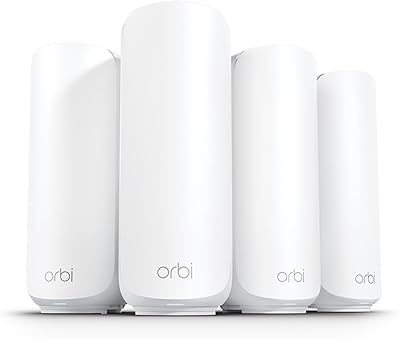
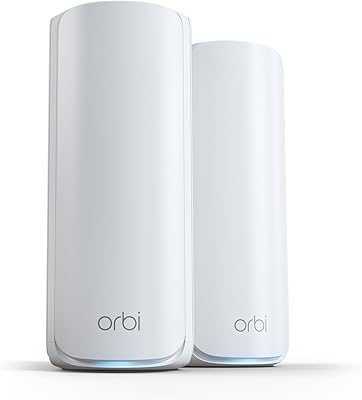
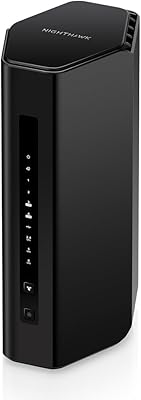
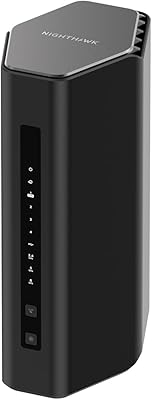
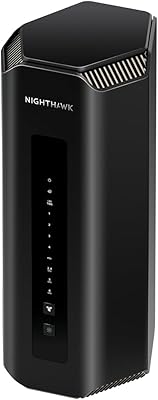
The NETGEAR Orbi 970 WiFi 7 Mesh Router is one of the most capable whole-home networking solutions available today, built around the 802.11be standard that most routers are only beginning to adopt. Its quad-band design pushes combined throughput to a figure that older mesh systems simply cannot approach. A single unit covers up to 3,300 sq. ft., which handles most large homes without needing extra hardware. The cylindrical, understated design is a genuine departure from the bristling antenna towers that defined home routers for years — this one actually looks at home on a shelf. It targets households and power users who refuse to compromise on coverage or speed.

Features & Benefits

WiFi 7 brings something called Multi-Link Operation, which lets devices connect across multiple bands simultaneously — the practical result is noticeably lower latency and more consistent speeds under heavy load. The 10 Gigabit WAN port means the Orbi 970 will not become the bottleneck when multi-gig internet plans eventually reach your neighborhood, or if you already have one. It handles up to 200 connected devices, a number that sounds excessive until you count every phone, tablet, smart bulb, thermostat, and streaming stick in a modern household. Automatic firmware updates and built-in Advanced Router Protection run quietly in the background, keeping the network secure without requiring manual attention. The Orbi app handles day-to-day management cleanly.

Best For

This WiFi 7 mesh router makes the most sense for people living in large or multi-story homes where a single conventional router consistently fails to reach certain rooms. Households running 4K or 8K streams, cloud gaming sessions, and smart home devices in parallel will actually notice the difference, especially as more WiFi 7 client devices enter the market — it is worth noting that the full speed advantages only materialize when the devices connecting to it also support WiFi 7. Home offices and small business setups that depend on reliable, high-throughput connections will find it well-suited. If your ISP has already upgraded you to multi-gig speeds, this is one of the few routers built to genuinely keep up.

User Feedback

This high-end mesh system carries a 3.7-star average across roughly 157 ratings, which signals a divided user base rather than universal acclaim. On the positive side, owners frequently mention noticeable speed improvements over older Orbi hardware and genuinely appreciate the clean, modern build quality. The setup process gets favorable marks from most, though a portion of reviewers ran into firmware issues early on that required patience to resolve. The price draws consistent criticism — not just for the router itself, but because satellite units cost extra, meaning full-home coverage can push the total investment considerably higher. A recurring thread involves occasional connectivity drops, which suggests some variability in unit consistency. For buyers who experience no such issues, satisfaction tends to run high.

Pros

  • Real-world speeds show a meaningful jump over previous Orbi generations, not just on paper.
  • Quad-band architecture keeps fast devices from fighting over bandwidth with slower ones.
  • The 10 Gig WAN port is genuinely rare at this tier and makes the system ready for next-gen ISP speeds.
  • Handles up to 200 connected devices without the network visibly straining under load.
  • The cylindrical design is compact and clean — easy to place in a living space without looking out of place.
  • Automatic firmware updates and built-in security protections run without requiring the owner to think about them.
  • The Orbi app is well-regarded for making setup and ongoing management accessible to non-technical users.
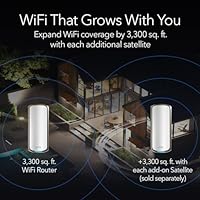
  • Coverage of 3,300 sq. ft. from a single unit removes dead zones in most large single-family homes.
  • Expandable mesh design means you can grow coverage over time without replacing the core hardware.

Cons

  • The base price is steep, and adding satellites to cover larger homes multiplies the cost quickly.
  • A 3.7-star average across ratings suggests inconsistent unit quality that is hard to ignore.
  • Connectivity drop reports from a meaningful subset of users point to reliability issues that are not isolated incidents.
  • WiFi 7 speed benefits are only realized when client devices also support the standard, limiting near-term gains for most buyers.
  • Satellites needed for full-home coverage in larger properties are sold separately and priced at a premium.
  • Some users encountered firmware instability after initial setup, requiring patience and troubleshooting to resolve.
  • No multi-unit kit is included — budgeting for a complete mesh system requires separate purchasing decisions upfront.
  • Competing WiFi 7 routers offer similar core functionality at noticeably lower price points.

Ratings

The scores below reflect an AI-driven analysis of verified global user reviews for the NETGEAR Orbi 970 WiFi 7 Mesh Router, with spam, bot-submitted, and incentivized feedback actively filtered out to preserve accuracy. The ratings capture the full picture — where this high-end mesh system genuinely delivers and where real buyers have run into friction. Both the standout strengths and the recurring pain points are represented transparently in every category.

Wireless Performance
88%
Users upgrading from WiFi 6 or older Orbi generations consistently report tangible speed improvements, particularly in bandwidth-heavy scenarios like 4K streaming on multiple TVs and low-latency cloud gaming. The quad-band setup means devices are not all competing on the same channel, and the real-world difference in a busy household is noticeable.
The headline throughput figures are theoretical maximums that require WiFi 7 client devices to approach in practice. Most households running a mix of older phones, laptops, and smart home gadgets will not see the full benefit for some time, which can make the performance gap over a good WiFi 6E router feel smaller than expected.
Coverage & Range
83%
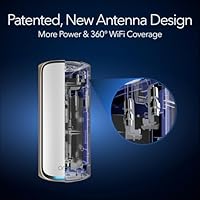
A single unit blanketing up to 3,300 sq. ft. is a genuine strong point, and reviewers in large single-story homes or open-plan layouts report that dead zones they had lived with for years simply disappeared after installation. The 360-degree antenna design handles awkward room layouts better than many directional competitors.
Multi-story homes or properties with thick concrete walls often still need a satellite to fill gaps, and those satellites are priced separately at a significant premium. Buyers who assume the base unit will cover a sprawling two-story home without help may be in for a surprise.
Value for Money
51%
49%
For a narrow group of buyers — those with multi-gig fiber already active, WiFi 7 devices on hand, and a large home — the hardware genuinely justifies itself as a single long-term investment rather than a series of incremental upgrades. The 10 Gig WAN port alone is rare at any consumer price point.
For the majority of buyers, the price is very difficult to rationalize given that competing WiFi 7 routers offer broadly similar coverage and speeds at meaningfully lower costs. When you factor in the additional outlay for satellites to cover a larger property, the total system cost can feel steep relative to the performance gains actually experienced day-to-day.
Setup & Installation
74%
26%
The Orbi app guides most users through initial setup without requiring them to touch a web interface or understand networking terminology, and a large portion of reviewers had everything running within 15 to 20 minutes. Guest network creation and basic device management through the app are consistently described as intuitive.
A meaningful subset of buyers, particularly early adopters, encountered firmware issues during setup that required restarts, manual updates, or support calls to resolve. The experience is not universally smooth, and users who are less comfortable troubleshooting networking problems may find the occasional hiccup frustrating.
Network Stability
62%
38%
When the Orbi 970 is performing at its best, long-term users describe a rock-solid connection that handles simultaneous heavy usage — streaming, gaming, and video calls running in parallel — without the periodic slowdowns that plagued their previous routers. Uptime over weeks and months is praised by satisfied owners.
Connectivity drops are the single most repeated complaint across negative reviews, and they appear in enough independent accounts to suggest this is not just user error. The 3.7-star aggregate rating is partly driven by this issue, and it implies some degree of unit-to-unit variability that buyers should factor into their decision.
Build Quality & Design
91%
The cylindrical white enclosure is one of the few home routers that reviewers actually describe wanting to display on a shelf rather than hide behind a TV cabinet. Build materials feel premium, and the physical fit and finish draw frequent positive comparisons to the plastic-heavy designs of older networking hardware.
The unit is relatively large and heavy at nearly 6 pounds, which limits placement flexibility compared to flatter or wall-mountable alternatives. A small number of users also noted that the white finish shows dust and scuffs more readily than they anticipated.
App & Management
77%
23%
Day-to-day tasks like setting up a guest network, checking which devices are connected, or prioritizing bandwidth for a gaming console are handled cleanly within the app. The interface is generally considered one of the more polished among major mesh router brands, and it does not require a desktop browser for most functions.
Advanced users looking for granular controls — custom DNS, detailed QoS rules, or VLAN configuration — will find the app limiting and need to dig into the web admin portal, which is less intuitive. Some users also report that the app occasionally loses connection to the router and requires a restart to re-sync.
Security Features
82%
18%
Automatic firmware updates mean the router patches known vulnerabilities without the owner needing to remember to check, which is genuinely useful for a device that runs continuously. The built-in Advanced Router Protection provides a baseline layer of threat monitoring that goes beyond what most consumer routers offer by default.
The more robust Armor security subscription, which adds deeper malware filtering and device protection, is an optional paid add-on rather than included outright. Buyers expecting enterprise-grade security protections out of the box without any additional cost may find the base offering less comprehensive than anticipated.
Device Capacity
86%
Households with a dense mix of smart home devices — thermostats, cameras, bulbs, speakers, tablets, and consoles — consistently report that the Orbi 970 manages them all without the network visibly degrading. The 200-device ceiling gives it practical headroom that most competing routers at lower price points cannot match.
The real-world experience with very high device counts depends heavily on the traffic those devices generate; 200 idle smart plugs behave very differently from 50 active streaming devices. A small number of users with unusually demanding setups noted occasional slowdowns that suggested the stated ceiling is optimistic under certain conditions.
ISP & Hardware Compatibility
89%
Works with any internet provider out of the box — cable, fiber, or hybrid — without requiring ISP-specific configuration, which removes a common source of frustration during setup. The 10 Gig WAN port makes it one of the few consumer routers that will not throttle a multi-gig fiber plan.
Users on standard 1 Gbps or slower plans will never utilize the 10 Gig port, which means they are partly paying for capability they cannot access today. There is also no built-in modem functionality, so buyers still need a separate modem or ONT to connect to their ISP.
Expandability
73%
27%
The push-button pairing process for adding Orbi 970 satellites is straightforward, and the mesh backhaul is optimized to maintain strong throughput between the router and satellite units. For buyers who start with just the router and want to expand later, the path to doing so is technically clean and well-supported.
Expansion comes at a steep cost since Orbi 970 satellites are priced at a premium and are not interchangeable with older Orbi generations, meaning buyers cannot repurpose existing hardware. This closed ecosystem approach frustrates users who feel they are locked into a single brand's pricing for every future upgrade.
Latency & Gaming Performance
84%
Gamers within the user base specifically call out the low-latency benefits of Multi-Link Operation, particularly in competitive titles where milliseconds matter. Cloud gaming performance over WiFi is described as noticeably more consistent compared to previous routers, with fewer mid-session packet loss events.
The latency improvements are most pronounced on WiFi 7 client devices, and users on older gaming laptops or consoles that top out at WiFi 6 or 5 will see a more modest difference. Wired connections to the router still outperform wireless for the most latency-sensitive competitive gaming use cases.
Documentation & Support
66%
34%
The Orbi app includes in-app guidance for common tasks, and NETGEAR offers both phone and chat support channels that users generally describe as reachable. The quick start guide included in the box is sufficient for straightforward installations.
Several reviewers felt that NETGEAR support quality was inconsistent — helpful for simple issues but slow to resolve deeper firmware problems that required escalation. Online documentation for advanced configuration is scattered across older support articles that do not always reflect the Orbi 970 specifically.

Suitable for:

The NETGEAR Orbi 970 WiFi 7 Mesh Router is purpose-built for households where network demands are genuinely intense and non-negotiable. If you live in a large home — think 2,500 sq. ft. and up — and have consistently dealt with dead zones, sluggish speeds in far rooms, or a router that buckles under the weight of too many devices, this system addresses all of that directly. It is also an excellent fit for early adopters who are already investing in WiFi 7 laptops, phones, and smart devices, since they will actually extract the full speed potential the hardware offers. Home office professionals who depend on rock-solid uptime for video calls and large file transfers will appreciate the stability and device headroom it provides. And if your ISP has delivered a multi-gig connection to your door, this is one of the very few consumer routers with a 10 Gig WAN port capable of putting that bandwidth to real use.
Not suitable for:

The NETGEAR Orbi 970 WiFi 7 Mesh Router is a hard sell for anyone who does not genuinely need what it offers. Buyers in apartments, small homes, or spaces under 1,500 sq. ft. will find the coverage capability wasted and the cost impossible to justify against far more affordable alternatives. If your device lineup is still predominantly WiFi 5 or WiFi 6, the performance leap will be largely theoretical — the speed gains of WiFi 7 only materialize when both the router and the connecting device support the new standard. The base unit price is already substantial, and budgeting for satellite expansion to cover a larger property pushes the total outlay into territory that many households simply cannot rationalize. Those who have had frustrating experiences with firmware instability on previous Orbi generations should also be aware that some early adopters of this model reported similar growing pains at launch.

Specifications

  • WiFi Standard: Operates on the 802.11be (WiFi 7) standard, the latest generation of wireless networking technology available in consumer hardware.
  • Band Configuration: Quad-band design separates traffic across four simultaneous radio bands to reduce congestion and improve per-device throughput.
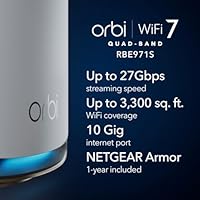
  • Max Throughput: Combined theoretical throughput reaches 27.0 Gbps across all bands, classified under the BE27000 performance tier.
  • WAN Port: Equipped with a single 10 Gigabit Ethernet WAN port to support current and future multi-gig internet service tiers.
  • Coverage Area: A single router unit covers up to 3,300 sq. ft., with the option to expand by adding Orbi 970 Series satellite units sold separately.
  • Device Capacity: Supports up to 200 simultaneously connected devices without significant degradation in network performance.
  • Security: Includes automatic firmware updates and NETGEAR Advanced Router Protection to help guard against external threats and vulnerabilities.
  • Setup Method: Initial configuration and ongoing network management are handled through the Orbi mobile app, available for both iOS and Android.
  • Expandability: The mesh system can be scaled by pairing the router with additional Orbi 970 Series satellites, each sold as a separate purchase.
  • ISP Compatibility: Works with any internet service provider and supports both multi-gig cable and fiber connections.
  • Dimensions: The router unit measures 12.64 x 8.5 x 6.1 inches, with a cylindrical form factor designed to sit on a shelf or surface.
  • Weight: The unit weighs 5.99 pounds, reflecting its solid internal construction relative to typical consumer routers.
  • Color: Available in White, with a clean, minimalist exterior finish intended to blend into modern home environments.
  • Model Number: The official model designation is RBE971S-100NAS, which should be referenced when seeking firmware updates or support.
  • In the Box: Package includes one Orbi WiFi 7 Router unit, one power adapter, and a printed quick start guide; no satellite is included.
  • ASIN: The Amazon Standard Identification Number for this product is B0CT44DQRM, useful for verifying the correct listing when purchasing.
  • First Available: This router was first made available for purchase on February 5, 2024, making it an early entrant in the consumer WiFi 7 market.
  • Manufacturer: Designed and manufactured by NETGEAR, a networking hardware company with an established line of consumer and business mesh products.

Related Reviews

NETGEAR Orbi LBR20 4G LTE WiFi Router
71%
71%
Cellular Connectivity
74%
WiFi Coverage
86%
Setup Experience
58%
Value for Money
78%
Mesh Expandability
More
NETGEAR Orbi 370 RBE373 WiFi 7 Mesh System (3-Pack)
84%
88%
Wireless Performance
91%
Coverage & Range
93%
Setup & Installation
79%
App Experience
87%
Multi-Device Handling
More
NETGEAR Orbi 370 Series WiFi 7 Mesh System RBE374
88%
92%
Performance
89%
Ease of Setup
93%
Coverage Area
88%
Speed/Throughput
87%
Security Features
More
NETGEAR Orbi 770 Series Tri-Band WiFi 7 Mesh System RBE772
86%
91%
Overall Performance
94%
WiFi Speed & Reliability
89%
Coverage Area
85%
Ease of Setup
88%
Security Features
More
NETGEAR Nighthawk RS500 WiFi 7 Tri-Band Router
77%
88%
Wireless Performance
74%
Coverage & Range
83%
Setup & Ease of Use
67%
Value for Money
86%
Device Handling
More
NETGEAR Nighthawk RS600 WiFi 7 Tri-Band Router
81%
91%
Wireless Performance
76%
Coverage & Range
88%
Setup & Onboarding
67%
Value for Money
83%
Build Quality & Design
More
NETGEAR Nighthawk RS700S WiFi 7 Tri-Band Router
81%
93%
Wireless Speed & Throughput
88%
Multi-Device Performance
81%
Coverage & Range
91%
Wired Connectivity
82%
Setup & App Experience
More
NETGEAR Nighthawk BE17000 WiFi 7 Router
79%
91%
Wireless Performance
88%
Setup Experience
74%
Coverage & Range
72%
Value for Money
86%
Device Handling
More
NETGEAR Nighthawk RS180 WiFi 7 Router
86%
92%
WiFi Performance
90%
Gaming Performance
88%
Streaming Quality
89%
Coverage Area
85%
Ease of Setup
More
NETGEAR Nighthawk RS90 WiFi 7 Router
79%
84%
Wireless Performance
67%
Coverage & Range
91%
Setup & Ease of Use
83%
Value for Money
78%
Build Quality & Design
More

FAQ

Not necessarily, but the most significant speed improvements will only show up on devices that also support WiFi 7. Older WiFi 5 and WiFi 6 devices will still connect and work fine — they just will not unlock the faster multi-link speeds. Think of it as buying ahead; as you upgrade your phones, laptops, and other hardware over the next few years, the router will already be ready for them.

It is just the router unit, a power adapter, and a quick start guide. Satellites for expanding coverage are sold separately as part of the Orbi 970 Series lineup. If you have a home larger than 3,300 sq. ft. or one with a particularly tricky layout, you will want to budget for at least one satellite on top of the base unit cost.

Most users find the Orbi app walks them through the process clearly enough that prior networking knowledge is not required. That said, a portion of early buyers ran into firmware hiccups right after launch that added some friction. If you do hit a snag, NETGEAR offers phone and chat support, and most issues reported by users were resolved through a firmware update or a router restart.

Yes, the Orbi 970 is compatible with any ISP, whether you are on cable, fiber, or a hybrid service. The 10 Gig WAN port means it can handle multi-gig plans that many providers are beginning to roll out, so you are not paying for an internet tier the router cannot actually use.

It is worth taking seriously. The NETGEAR Orbi 970 WiFi 7 Mesh Router carries a 3.7-star average, and connectivity drops are one of the more consistent complaints in the lower-rated reviews. That said, many owners report no such problems at all, which suggests this may be a quality control inconsistency rather than a universal flaw. If you purchase and experience this, contacting NETGEAR support early tends to be the most productive path.

Yes, the Orbi app includes guest network creation, device prioritization, and basic access scheduling. It is not the most granular parental control system on the market, but it covers the essentials for most households. For more advanced filtering, NETGEAR also offers its Armor security subscription as an add-on.

The Orbi 970 competes in a small but growing field of high-end WiFi 7 mesh systems. Its quad-band configuration and 10 Gig WAN port put it among the more capable options, but some competing models offer comparable performance at a lower price point. The Orbi brand carries a track record in mesh networking, which matters for long-term firmware support and ecosystem reliability.

For most people right now, it is forward-looking rather than immediately useful. The majority of residential ISP plans top out well below 10 Gbps. However, multi-gig plans of 2 Gbps and above are becoming more accessible, and having a 10 Gig port means this router will not become your bottleneck as those plans become mainstream. It is an investment in not having to replace the router again in two or three years.

NETGEAR has not published explicit noise specifications for the Orbi 970. Based on its design class and user feedback, it operates passively or near-silently under typical loads, which is standard for consumer mesh routers. It is not the kind of device that will hum audibly in a quiet room.

No, the Orbi 970 Series uses a dedicated satellite ecosystem and is not backward compatible with older Orbi satellite generations. If you are upgrading from a previous Orbi system, you would need to either keep the old system running separately or replace the satellites with Orbi 970 Series units to build out the new mesh network.

Where to Buy