Overview

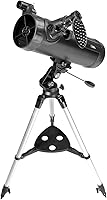
The National Geographic Explorer 114mm Reflecting Telescope sits in an interesting spot — capable enough to reward genuine curiosity, yet approachable enough that a complete newcomer won't feel lost on night one. National Geographic brings real educational credibility here; this isn't a toy-store scope dressed up in fancy packaging. The carbon-fiber wrap tube is an immediate visual standout, and it serves a practical purpose too, keeping the optical tube lighter and more thermally stable than a standard painted-metal design. Consistently ranked among the top reflector sellers on Amazon, it has earned that position through solid, repeatable performance — not marketing. Just keep expectations calibrated: this is a strong starter instrument, not a research-grade tool.
Features & Benefits

The 114mm aperture mirror is the real workhorse here. That 4.5-inch opening pulls in enough light to reveal the Moon's craters in crisp relief, Jupiter's cloud bands, and on a steady night, Saturn's rings with satisfying clarity — all without requiring dark-sky conditions. The fast f/4.4 focal ratio keeps fields of view wide, which matters a lot when you're still learning to navigate the sky. Two Plössl eyepieces combined with the included 2x Barlow lens give a practical magnification range right out of the box. The alt-azimuth pan-handle mount is genuinely intuitive — just point and track — and the red-dot finder makes locating targets far less frustrating than a traditional finderscope for someone just starting out.

Best For

This reflector telescope is squarely aimed at first-time astronomers — roughly age 12 through adult — who want real views of real objects without a steep learning curve. It's a natural gift choice for parents who want something that actually educates rather than collects dust after three uses. If you're observing from a suburban backyard or balcony with modest light pollution, the 114mm aperture gives you enough to keep sessions genuinely interesting: the Moon, visible planets, and some brighter deep-sky objects. Students and hobbyists who want a grab-and-go setup will appreciate how quickly it assembles. The smartphone adapter is a nice bonus for capturing the occasional lunar snapshot, though serious astrophotography is well beyond its scope.

User Feedback

Most buyers come away impressed by the out-of-the-box views — lunar detail and Saturn's rings in particular tend to generate genuinely enthusiastic first reactions. The accessory bundle is consistently praised as strong value, especially since comparable scopes often ship with inferior eyepieces. That said, honest reviewers flag a few friction points. The alt-azimuth mount can become noticeably wobbly at high magnification, making fine tracking frustrating when pushing past the 9.7mm eyepiece. Some intermediate users also note that mirror collimation can drift after transport and requires periodic adjustment. A handful of comments mention the focuser feeling slightly stiff. None of these are deal-breakers at this price tier, but worth knowing before your first night out.

Pros

  • The 114mm mirror delivers genuinely sharp Moon and Saturn views straight out of the box.
  • Fast f/4.4 optics give wide, forgiving fields of view — ideal when you are still learning the sky.
  • The included accessory bundle is exceptional for the price tier: two Plössl eyepieces, a Barlow lens, and a smartphone adapter.
  • Alt-azimuth pan-handle mount is intuitive enough that most beginners are tracking objects within minutes.
  • Carbon-fiber wrap tube keeps the whole package noticeably lighter than comparable metal-tube reflectors.
  • Red-dot finder makes locating targets far less frustrating than a traditional pinhole finderscope.
  • Assembly is straightforward and quick — a real advantage for younger users or impatient first-timers.
  • National Geographic branding adds educational credibility and makes it a confident gift choice.
  • Thermal stabilisation from the tube design means less waiting around before optics settle on cold nights.
  • Consistent top-20 ranking among reflector telescopes reflects genuine buyer satisfaction over time.

Cons

  • The alt-azimuth mount becomes noticeably wobbly when pushing higher magnifications, making fine adjustments difficult.
  • Mirror collimation can drift after transport and needs periodic re-alignment — not hard, but unexpected for some buyers.
  • The focuser action feels stiff on some units and may need light maintenance to achieve smooth operation.
  • Smartphone adapter is strictly entry-level; do not expect usable deep-sky astrophotography results from it.
  • No motorized tracking means the scope cannot compensate for Earth's rotation, limiting extended observation sessions.
  • The tripod, while full-height, lacks the rigidity of dedicated astronomy mounts and can transmit vibration.
  • This beginner telescope will feel limiting relatively quickly for observers who progress fast in the hobby.
  • No carry case is included, which makes transporting the scope to dark-sky sites less convenient than it should be.

Ratings

The scores below were generated by our AI system after analyzing thousands of verified global buyer reviews for the National Geographic Explorer 114mm Reflecting Telescope, with spam, incentivized, and bot-flagged submissions actively filtered out before any scoring took place. The result is an honest, data-driven picture of where this beginner reflector genuinely excels and where real buyers ran into frustration. Both sides of the story are reflected here — nothing is glossed over.

Optical Performance
83%
For a scope at this price tier, the 114mm mirror consistently impresses first-time users. Lunar craters, Saturn's rings, and Jupiter's cloud bands are all clearly visible on a steady night, which is exactly what beginners need to stay motivated and keep coming back outside.
At higher magnifications — particularly when using the 9.7mm eyepiece with the Barlow — image sharpness can soften noticeably, especially if the mirrors are even slightly out of collimation. Experienced observers will notice the optical limits fairly quickly compared to longer focal-length instruments.
Value for Money
88%
Buyers repeatedly call out the accessory bundle as a standout strength — two Plössl eyepieces, a Barlow lens, a red-dot finder, and a smartphone adapter together represent genuine added value that comparable scopes in this tier rarely match without extra spending.
A handful of users who progressed quickly in the hobby felt the scope had a shorter useful lifespan than the price implied, noting they outgrew it within a year. For a pure beginner the value equation is strong, but intermediate buyers may find the cost-to-longevity ratio less convincing.
Mount Stability
61%
39%
The altazimuth pan-handle design is genuinely intuitive — new users consistently praise how natural it feels to point and track objects compared to the confusing polar-alignment requirements of an equatorial mount. For casual lunar sessions, it gets the job done without friction.
This is where the most consistent criticism lands. At higher magnifications the mount introduces vibration that takes several seconds to damp out after any adjustment, making fine planetary viewing frustrating. More than a few buyers specifically wish the tripod legs were sturdier.
Ease of Setup
91%
First-night assembly is one of this beginner telescope's clearest strengths — most buyers report being outside and observing within 20 to 30 minutes of opening the box. The instructions are clear enough that parents and younger users can manage the process together without needing outside help.
A small number of users found the initial collimation check confusing, particularly because the manual does not explain the concept in enough depth for a true newcomer. If the mirrors shift during shipping, that first experience can be unexpectedly frustrating.
Build Quality
74%
26%
The carbon-fiber wrap tube is a genuine quality differentiator at this price point — it feels noticeably more premium than bare plastic tubes, and the thermal stabilisation benefit is real: the scope reaches usable temperature faster on cool evenings than heavier metal alternatives.
The focuser and mount hardware feel noticeably less robust than the tube itself. Several buyers reported stiff focuser action straight out of the box, and the plastic components in the mount assembly do not inspire long-term confidence if the scope is transported regularly.
Portability
82%
18%
At just under 11 pounds fully assembled and with a relatively compact tube, this reflector telescope is easy enough to carry from a hallway to a backyard or load into a car for a short drive to a dark field. The carbon-fiber tube keeps overall weight sensible compared to heavier steel alternatives.
No carrying case is included, which is a real oversight for a product positioned as a grab-and-go option. Without a bag, transporting the scope and its loose accessories to a dark-sky site requires improvisation that buyers should not have to deal with at this price level.
Accessories Quality
79%
21%
The Plössl eyepieces perform well above expectations for bundled optics — the 26mm in particular gives genuinely comfortable, wide views for casual sky sweeping. The red-dot finder is easy to use and aligns reliably, which matters a lot on your first few nights.
The 2x Barlow lens is functional but not exceptional — some users noticed slight edge softness when used in combination with the 9.7mm eyepiece. The smartphone adapter works for bright lunar shots but requires patience to align correctly each time, which can break the flow of an observing session.
Collimation Ease
63%
37%
The collimation screws on the secondary mirror are accessible and do not require a collimation cap or special tool for basic adjustments, which means once a user learns the process it becomes a quick five-minute check before sessions rather than a major undertaking.
For buyers with zero prior telescope experience, the collimation learning curve is steep and the included documentation is inadequate. Several reviewers noted that after transport or accidental bumps the mirrors shifted enough to noticeably affect image quality, catching them off-guard.
Lunar Viewing
93%
Lunar performance is arguably the strongest single use-case for the National Geographic 114mm scope — the combination of aperture and the 9.7mm eyepiece produces crisp, detailed views of crater walls, mountain ranges, and the terminator line that consistently impress first-time observers.
At very high magnification the Moon can appear slightly washed out due to the lack of any included Moon filter, and some buyers noted glare when the Moon is near full phase. A basic filter — not included — would make the experience meaningfully better for dedicated lunar observers.
Planetary Viewing
77%
23%
Saturn's rings and Jupiter with its four Galilean moons are reliably visible on clear nights, which delivers the wow-factor moments that keep beginners engaged. Mars showing a disc during opposition is also achievable, giving this beginner telescope a respectable planetary checklist for casual observers.
Fine planetary detail — equatorial belts on Saturn, the Cassini Division in the rings, surface features on Mars — sits right at the edge of what this scope can resolve under typical conditions. Atmospheric turbulence over suburban areas frequently limits the views more than the optics themselves do.
Smartphone Photography
54%
46%
The included adapter makes it easy enough to snap a quick photo of a crescent Moon or Jupiter through the eyepiece, and when conditions are cooperative the results can be surprisingly satisfying as a casual keepsake from an observing session.
Aligning the phone camera precisely over the eyepiece is a fiddly process, and any slight movement of the mount during shooting introduces blur. This is firmly an entry-level novelty feature — buyers with genuine astrophotography ambitions will outgrow its limitations almost immediately.
Deep-Sky Capability
58%
42%
Bright Messier objects — the Orion Nebula, Andromeda Galaxy, and the Pleiades — are genuinely enjoyable through the 26mm eyepiece from a reasonably dark suburban location, offering enough visual reward to keep curious beginners exploring the wider sky beyond the solar system.
Fainter deep-sky targets are largely beyond this scope's reach under typical suburban skies, and the fast focal ratio makes the field of view less forgiving for faint, extended objects. Users in light-polluted areas will find the deep-sky experience noticeably underwhelming compared to lunar sessions.
Educational Value
87%
The National Geographic branding carries genuine educational weight — the associated star-map and software tie-in give younger users structured context that a generic no-name scope cannot provide. Parents consistently praise this aspect as a reason the scope gets used repeatedly rather than sitting in a corner.
The physical manual leans light on astronomy fundamentals, focusing more on assembly than on teaching beginners how to find objects or understand what they are seeing. A more comprehensive starter guide would significantly improve the educational experience for independent learners.
Focuser Performance
66%
34%
Once broken in, the rack-and-pinion focuser achieves a workable range of travel that covers most standard eyepieces without issue, and fine focus on the Moon is achievable without excessive back-and-forth adjustment once you learn the mechanism's feel.
Out of the box, a noticeable number of units have a stiff focuser that requires more force than is comfortable, particularly when wearing gloves on cold nights. There is no tension adjustment, so buyers who find the action too stiff must resort to light lubrication as a workaround.

Suitable for:

The National Geographic Explorer 114mm Reflecting Telescope is a natural fit for anyone taking their first serious step into amateur astronomy — particularly beginners aged 12 and up who want real, rewarding views without spending months learning complicated equipment. Parents searching for a meaningful educational gift will find the National Geographic name reassuring, and the scope genuinely delivers on that promise with planetary views capable of sparking lasting interest in science. Suburban backyard observers are well served here: the 114mm aperture punches above its weight for lunar and planetary targets even under imperfect skies, and the full-height tripod means no awkward crouching during a session. Students and hobbyists who want something portable enough to take to a dark field but quick enough to set up on a weeknight will appreciate how little fuss is involved from box to first star. Anyone mildly curious about entry-level lunar photography will also get genuine value from the included smartphone adapter.

Not suitable for:

The National Geographic Explorer 114mm Reflecting Telescope is not the right tool for astronomers who have already outgrown a starter scope and are chasing faint deep-sky objects, fine planetary detail at high power, or any serious astrophotography work. The alt-azimuth mount, while intuitive, lacks the motorized tracking that even casual imaging demands, and it can feel physically unstable when you push magnification beyond what the included eyepieces provide. Experienced observers accustomed to equatorial mounts will likely find the pan-handle motion limiting for methodical sky surveys. Buyers expecting a maintenance-free experience should also know that reflector mirrors require periodic collimation — a simple skill, but one that catches some owners off-guard. If you already own a decent beginner scope and are looking for a meaningful upgrade, the jump in capability here may not justify the switch.

Specifications

  • Aperture: The primary mirror measures 114mm (4.5″) in diameter, giving the scope meaningful light-gathering ability for lunar and planetary observation.
  • Focal Length: The optical tube has a 500mm focal length, which contributes to wide, accessible fields of view well suited to beginners scanning the night sky.
  • Focal Ratio: At f/4.4, this is a fast reflector that prioritises broad sky coverage over the narrow, high-contrast views associated with slower, longer focal ratios.
  • Eyepieces: Two Plössl eyepieces are included — a 26mm for low-power wide-field viewing and a 9.7mm for higher magnification on planets and the Moon.
  • Barlow Lens: A 2x Barlow lens is included, effectively doubling the magnification of each eyepiece and extending the usable range without additional purchases.
  • Mount Type: The scope ships with an altazimuth pan-handle mount that allows intuitive up-down and left-right motion, requiring no polar alignment to operate.
  • Tripod: A full-height adjustable tripod is included in the package, supporting stable outdoor use without requiring a separate purchase.
  • Finderscope: A reflex red-dot finder is included, running on a single AAA battery and making it considerably easier to initially locate targets in the sky.
  • Tube Design: The optical tube features a carbon-fiber wrap finish that reduces overall weight and helps the tube reach thermal equilibrium faster in changing outdoor temperatures.
  • Smartphone Adapter: An included smartphone adapter attaches to the eyepiece for basic afocal photography, compatible with most modern smartphones for casual lunar shots.
  • Focus Mechanism: Focusing is achieved manually via a rack-and-pinion focuser on the eyepiece drawtube, requiring no batteries or electronic assistance.
  • Product Weight: The complete assembled unit weighs approximately 10.65 pounds, making it portable enough to carry to a backyard or a nearby dark-sky site.
  • Dimensions: The optical tube measures 27.2″ in length with a 6.5″ width and 11.3″ height, fitting comfortably in most car boots or storage closets.
  • Power Source: The only battery required is a single AAA cell for the red-dot finder; the telescope optics themselves require no power source.
  • Manufacturer: The scope is manufactured and distributed under the National Geographic brand, which is known for educational science and nature products.

Related Reviews
National Geographic 8x42 Binoculars
87%
89%
Value for Money
85%
Build Quality
92%
Usability & Comfort
87%
Optical Performance
90%
Portability & Size
More
Celestron StarSense Explorer DX 102AZ Refractor Telescope
77%
88%
Ease of Setup
81%
StarSense App Performance
84%
Optical Clarity
61%
Deep-Sky Performance
67%
Mount Stability
More
Celestron StarSense Explorer LT 114AZ
74%
88%
App Navigation Experience
83%
Optical Clarity
86%
Ease of Setup
61%
Mount Stability
79%
Value for Money
More
Celestron StarSense Explorer LT 80AZ Refractor Telescope
77%
88%
App Navigation Experience
83%
Optical Clarity
91%
Ease of Setup
61%
Build Quality
86%
Value for Money
More
Celestron StarSense Explorer DX 5″ Telescope
73%
88%
Ease of Setup
83%
App Navigation Accuracy
79%
Optical Performance
61%
Mount Stability
57%
Manual Tracking Experience
More
Celestron AstroFi 130 Reflecting Telescope
69%
86%
Optical Performance
71%
App & Connectivity
62%
Mount Stability
67%
Ease of Setup
78%
Value for Money
More
Celestron StarSense Explorer 8″ Dobsonian Telescope

79%
91%
Optical Performance
88%
App Navigation Accuracy
86%
Ease of Use
84%
Build Quality
79%
Value for Money
More
National Geographic Kids Digital Handheld Microscope
81%
88%
Ease of Use for Kids
83%
Image & Screen Quality
71%
Magnification Performance
79%
Battery Life
91%
Kit Completeness & Value
More
Celestron StarSense Explorer 8″ Dobsonian Telescope
81%
91%
Ease of Use
88%
Optical Performance
86%
StarSense App & Technology
89%
Mount Stability
83%
Value for Money
More
Garmin inReach Explorer+ Satellite Communicator
76%
93%
Satellite Reliability
88%
Two-Way Messaging
96%
SOS & Emergency Response
78%
Navigation & Mapping
61%
Value for Money
More

FAQ

Most users get it ready to observe in under 30 minutes on the first attempt. After that, reassembly typically takes around 10 to 15 minutes. The instructions are straightforward, and no tools are required for standard setup.

Yes, and it is genuinely one of the most rewarding first views you can get. On a steady night with good seeing conditions, the rings are clearly distinguishable from the planet's disc using the 9.7mm eyepiece or the Barlow combination. Do not expect Hubble-level detail, but it is more than enough to impress a first-timer.

It is designed with beginners aged 12 and up in mind, but a motivated 10 or 11 year old with some adult guidance during setup and initial alignment should manage fine. The pan-handle mount is easy enough for younger users to operate, though they may need help collimating the mirror.

Collimation is the process of aligning the telescope's mirrors so light focuses correctly. On the National Geographic Explorer 114mm Reflecting Telescope, the mirrors can shift slightly during transport or after extended use, causing blurry views. It sounds technical, but there are straightforward video guides online, and the adjustment screws are accessible without special tools. Checking it every few months or after a bumpy journey is a good habit.

Only at a very basic level. The included smartphone adapter works reasonably well for lunar shots — craters come through with decent detail. However, the altazimuth mount has no motorized tracking, so anything beyond quick snapshots of bright objects will result in blurred images due to Earth's rotation. If astrophotography is a priority, you would need a different mount entirely.

At low magnifications with the 26mm eyepiece it is perfectly stable. The wobble becomes noticeable once you push to higher magnifications — using the 9.7mm plus the Barlow, for instance. Any vibration from nudging the tube takes a few seconds to settle. It is manageable, but if you are serious about high-power planetary work, the mount is the weakest link in this package.

It can show you the brighter deep-sky targets — the Orion Nebula, the Andromeda Galaxy, and open star clusters all look nice through the 26mm eyepiece from a reasonably dark site. Faint galaxies and emission nebulae require darker skies and more aperture than this beginner telescope offers. For a first look at the Messier catalogue, though, it is genuinely capable.

A general rule for reflectors is that useful magnification tops out at roughly twice the aperture in millimetres — so around 228x for this scope. In practice, atmospheric turbulence usually limits you to well below that. The supplied eyepiece and Barlow combination gets you to around 103x, which is a sensible working maximum for most nights.

Some users do report that the focuser feels stiffer than expected, particularly when new. It typically loosens slightly with use. A tiny amount of appropriate lubricant on the rack can smooth the action if it feels resistant. It is not a premium focuser by any measure, but it does the job reliably once broken in.

No carry case is included in the box. You get the tube, mount, tripod, and accessories, but no dedicated bag for transporting everything together. If you plan to take it to dark-sky sites regularly, picking up a padded telescope bag or a large duffel separately is worth the small added expense to protect the optics.