Overview

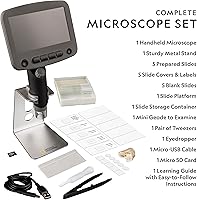
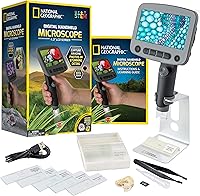
The National Geographic Kids Digital Handheld Microscope sits in an interesting spot — it carries the weight of a trusted science brand while being genuinely designed for hands-on use by kids aged 8 to 16. That brand recognition is not just marketing; it signals a real commitment to educational quality that separates this handheld microscope from the cheap plastic scopes you will find at dollar stores. It costs more than a toy, and it should — you are getting a complete 40-piece kit with prepared slides, a metal lab stand, and storage right out of the box. Think of it as a capable starter science tool, not a professional lab instrument.
Features & Benefits

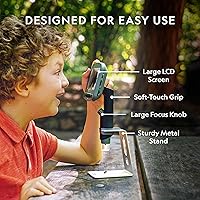
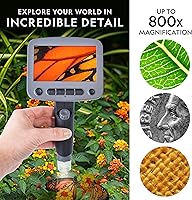
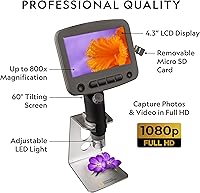
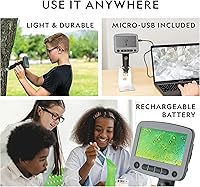
The headline number is 800x magnification, reached via push-button zoom paired with a large focus dial that even younger kids can manage without frustration. What really sets this apart from traditional eyepiece scopes is the 4.3-inch tilt-adjustable LCD screen — no squinting, no awkward neck angles, just a clear live view the whole family can gather around. Capture 1080p photos and video directly to the included micro SD card, then transfer everything to a computer over USB. The built-in battery lasts a genuine six hours on a charge, which makes outdoor use — examining insects, pebbles, or leaves — completely practical. LED lighting handles low-light specimens without any fuss.

Best For

This kids' digital microscope is squarely aimed at curious 8-to-16-year-olds who are ready to do real science rather than just play at it. It makes a strong gift choice for birthdays or the holidays — the complete kit means there is nothing extra to buy before a child can get started. Homeschool families will find it especially useful since the portability and built-in screen make it easy to fold into biology or earth science lessons at the kitchen table or out in the yard. That said, the National Geographic scope is not the right pick for serious teenage hobbyists who need PC-tethered analysis software or significantly higher magnification. Know your audience.

User Feedback

Parents consistently highlight the screen clarity and how quickly kids learn to use this handheld microscope independently — the included slide kit earns genuine praise as a real learning resource rather than padding. Battery life tends to hold up close to the six-hour claim in everyday use, which earns points with families who take it outside. The honest caveat worth noting: effective magnification often feels lower than the 800x ceiling, particularly for beginners still developing proper focusing technique. Some buyers have flagged that the build feels less rugged than the price tier suggests. For most parents, though, the overall educational value lands comfortably above what they expected to get.

Pros

  • The complete 40-piece kit means kids can start exploring immediately — no extra purchases needed.
  • The 4.3-inch LCD screen makes viewing a shared experience the whole family can enjoy together.
  • Cordless operation with a six-hour battery is genuinely practical for outdoor use in parks or on hikes.
  • The metal body gives this handheld microscope a noticeably more substantial feel than plastic toy alternatives.
  • 1080p photo and video capture lets kids build a real collection of their discoveries over time.
  • Push-button zoom and a large focus dial are approachable enough for kids to operate independently.
  • Prepared biological slides paired with a full-color learning guide provide structured scientific context, not just hardware.
  • LED illumination handles indoor low-light viewing cleanly without washing out specimen detail.
  • Parents consistently report kids return to this scope weeks after unboxing — it holds attention longer than most science gifts.

Cons

  • Real-world effective magnification falls noticeably short of the 800x headline figure for most specimens.
  • The included 128MB micro SD card fills up fast and almost always needs immediate replacement.
  • No wireless transfer or companion app makes sharing captures feel clunky compared to modern kids' devices.
  • The LCD screen can wash out in direct sunlight, limiting outdoor viewing quality despite the portable design.
  • Heavy video recording drops battery life significantly below the six-hour claim.
  • The learning guide lacks depth for older or more advanced kids who quickly outgrow the introductory content.
  • Some buyers report minor loosening of buttons and housing components after several months of daily use.
  • Younger kids on the edge of the recommended age range often need adult help to save and transfer files.
  • No brightness control for the LED means reflective or highly polished specimens can be tricky to view cleanly.
  • The scope does not fit easily in a jacket pocket, so carrying it outdoors always requires a bag.

Ratings

The scores below reflect an AI-driven analysis of verified global buyer reviews for the National Geographic Kids Digital Handheld Microscope, with spam, incentivized, and bot-flagged submissions actively filtered out before scoring. Each category captures what real parents, educators, and young users experienced across hundreds of hands-on sessions — from kitchen-table slide examinations to outdoor nature hunts. Both the standout strengths and the recurring frustrations are weighted transparently into every number you see here.

Ease of Use for Kids
88%
Most kids aged 8 and up can get this scope running and focused within a few minutes of unboxing — no manual-reading required. The push-button zoom and oversized focus dial are genuinely child-friendly, and the live LCD screen removes the coordination challenge of aligning an eye to a tiny eyepiece.
Younger kids on the lower end of the recommended age range sometimes struggle to hold the device steady while simultaneously adjusting focus, leading to blurry captures. A small number of parents noted that the menu navigation for saving photos felt slightly unintuitive at first.
Image & Screen Quality
83%
The 4.3-inch LCD delivers a bright, reasonably sharp live view that genuinely impresses for a kids-oriented device. Families report gathering around the screen together to watch a bug leg or plant cell come into focus, which adds a fun shared-discovery dimension that a single eyepiece simply cannot match.
At higher zoom levels the image can soften noticeably, and some buyers felt the screen washes out slightly in direct outdoor sunlight. The 1080p capture looks solid on a phone or tablet screen but does not hold up as crisply when viewed on a larger monitor.
Magnification Performance
71%
29%
For everyday specimens — fabric threads, coins, insect wings, salt crystals — the working magnification range delivers clear and genuinely exciting results. Kids exploring nature finds like leaves, bark, or feathers get satisfying detail that feels like a real discovery.
The 800x figure is the optical ceiling, and in practice most users find the effective sweet spot is considerably lower before image quality degrades. Parents expecting lab-grade cellular detail from biological slides have reported some disappointment, and this is the single most common criticism across verified reviews.
Battery Life
79%
21%
Real-world battery performance tends to align reasonably well with the six-hour claim under normal mixed use — zooming, viewing, and occasional photo capture. For a full afternoon of outdoor exploration or a long homeschool session, most users did not need to reach for the charger.
Heavy continuous video recording drains the battery faster than casual users expect, dropping closer to three to four hours in those conditions. A handful of reviewers also noted that the battery indicator is not granular enough, making it hard to gauge how much charge remains mid-session.
Kit Completeness & Value
91%
The 40-piece kit is one of the most consistently praised aspects across all buyer feedback — the prepared biological slides, blank slides, mini geode, metal lab stand, and organized storage case make this feel like a complete science experience rather than a bare device in a box. Parents frequently call it out as a genuine reason the price feels justified.
The included 128MB micro SD card fills up quickly, especially if kids record video, and most buyers replace it almost immediately. A few users also felt the full-color learning guide, while helpful for beginners, could go deeper for older or more advanced kids.
Portability & Form Factor
86%
At under two pounds with a cordless design, this kids' digital microscope travels easily to parks, nature trails, and camping trips. The self-contained build means there are no loose cables or external power bricks needed during field use, which parents with active kids particularly appreciate.
The device is bulkier than a standard handheld magnifier, and it does not slip easily into a jacket pocket — a small bag or backpack is needed. The protruding LCD screen also makes it slightly awkward to pack without the risk of scratching the display.
Build Quality & Durability
67%
33%
The metal body construction gives this scope a more substantial, quality feel compared to the all-plastic alternatives at lower price points. Most buyers noted it feels noticeably sturdier on a desk or lab stand than they expected from a product aimed at children.
Despite the metal body, the LCD screen housing and zoom buttons have drawn concern from parents whose kids use it daily — some report minor cracking or loosening of components within a few months of active use. It holds up fine with careful handling but is not truly drop-resistant for rough-and-tumble younger users.
Photo & Video Capture
76%
24%
Being able to save what you are looking at — and then share it on a computer — adds a layer of engagement that keeps kids coming back to the scope repeatedly. Several parents noted their children built small collections of micro-photography that became the basis for school projects.
The micro SD card slot and USB transfer process can be fiddly for younger users without adult help, and the included cable is on the short side. There is also no wireless transfer option, which feels like a missed opportunity given how kids typically interact with digital content today.
LED Illumination
81%
19%
The built-in LED lighting does its job cleanly for most indoor slide viewing, keeping specimens well-lit without the washed-out glare that cheaper ring lights often produce. Kids using prepared slides at night or in a dim room consistently report crisp, evenly lit views.
Outdoors in bright daylight the LED contributes almost nothing useful, and at the maximum zoom range some users noticed slight uneven lighting across the specimen field. There is no brightness adjustment, which limits fine-tuning for reflective subjects like metallic minerals.
Educational Value
89%
The National Geographic scope earns strong marks here from parents and homeschool educators alike — the combination of prepared slides, a structured learning guide, and real capture capability creates genuine science habits rather than a one-day curiosity. Multiple reviewers mentioned their kids returned to it weeks and months after the initial excitement.
The learning guide, while useful as a starting point, does not scale well with a child's growing knowledge — more advanced users quickly outgrow it. There is no companion app or digital curriculum tied to the product, which feels like an untapped opportunity given the brand's educational reputation.
Setup & Assembly
84%
Out of the box, most families have the scope up and running within 15 minutes — the metal lab stand assembles easily, and the instructions are clear enough for kids to follow with minimal adult involvement. The slide storage case also clips in neatly, keeping everything organized from day one.
The SD card and USB cable setup occasionally trips up less tech-comfortable parents, and the instructions for transferring files to a PC could be more explicit. A small number of buyers received units with the SD card pre-installed incorrectly from the factory.
Age-Appropriateness
82%
18%
The recommended 8-to-16 age window holds up well in practice — the device strikes a useful balance between being approachable for a curious 9-year-old and genuinely engaging enough to hold the interest of a 13 or 14-year-old. The screen-based interface feels modern to kids who have grown up with tablets.
At the upper end of that age range, more scientifically minded teenagers will likely hit the ceiling of what this scope can offer within a year and want something with greater capability. It also slightly underserves kids younger than 8 who show early science interest but lack the fine motor control the focus dial requires.
Value for Money
74%
26%
For buyers who treat this as an educational investment rather than a toy purchase, the overall package — screen, battery, capture capability, and complete kit — offers a reasonable return. Parents who compared it to cheaper single-item scopes consistently felt the included accessories justified the step up in price.
At its price tier, a segment of buyers expected more optical performance than they received, particularly around maximum effective magnification. Those who purchased it primarily chasing the 800x headline number tend to feel the value proposition is weaker than those who bought it for the full kit experience.

Suitable for:

The National Geographic Kids Digital Handheld Microscope is a strong match for kids aged 8 to 16 who have moved past idle curiosity and actually want to explore the world up close — the kind of child who will spend an afternoon collecting insects, pebbles, or flower petals to examine rather than leaving the device in a drawer after a week. Homeschool families will find it especially practical since the built-in screen, cordless battery, and complete slide kit turn any table or backyard into a functional science station without needing extra equipment. It also works well as a meaningful gift for science-oriented kids — the all-in-one nature of the kit means a child can start doing real things with it immediately, which matters a lot when attention spans are short on birthdays and holidays. Parents who value educational substance over flashy toy appeal will feel the price is justified once they see how the prepared slides and learning guide hold a child's interest beyond the first session. Outdoor-minded families who camp, hike, or garden regularly will get extra mileage from the six-hour battery and portable form factor.
Not suitable for:

The National Geographic Kids Digital Handheld Microscope is not the right tool for teenagers who are already serious about science and need a scope that can keep pace with their ambitions — the effective magnification has a practical ceiling well below the advertised maximum, and there is no PC-tethered software for deeper analysis or measurement. Very young children under 8 will likely struggle with the fine motor demands of the focus dial and the slightly complex file-saving process, making it more of a frustration than a learning tool at that age. Buyers chasing high-magnification cellular imagery — thinking they will clearly resolve individual cells on homemade wet slides — should manage their expectations carefully, as that level of detail is beyond what this handheld scope reliably delivers. It is also a poor fit for households where equipment routinely gets dropped or thrown into a bag without a case, since the build, while solid for casual use, is not rugged enough to absorb repeated rough handling. Anyone expecting wireless photo transfer or a companion app will find the USB-only, no-software setup feels dated for the price.
Specifications

  • Magnification: Adjustable up to 800x via push-button zoom, with a large manual dial for fine focus control.
  • Display: 4.3-inch LCD screen with a tilt-adjustable mount, allowing comfortable viewing from multiple angles without an eyepiece.
  • Video Resolution: Records and captures images at 1080p full HD resolution directly to the micro SD card.
  • Battery: Built-in rechargeable lithium polymer battery rated for up to 6 hours of continuous wireless operation.
  • Storage: Saves files to a micro SD card (128MB card included); data transfers to PC or Mac via included USB cable.
  • Light Source: Built-in LED illumination system designed to light specimens evenly in low-light or indoor conditions.
  • Weight: 1.75 pounds, making it light enough for extended handheld use or carrying in a backpack during outdoor activities.
  • Dimensions: Measures 7.2″ long by 5.6″ wide by 12.06″ tall when assembled with the included metal lab stand.
  • Body Material: Primary housing is constructed from metal, providing more structural rigidity than fully plastic alternatives in the same category.
  • Kit Contents: Includes 40 pieces total: 10 prepared biological slides, 10 blank slides, 10 slide covers and labels, a mini geode, a 23-slide storage container, and a metal lab stand.
  • Recommended Age: Designed and tested for children aged 8 to 16 years, balancing usability with educational depth appropriate for that range.
  • Connectivity: USB cable included for both battery charging and transferring captured photos and videos to a computer.
  • Power Input: Operates at 3.7 volts via the integrated lithium polymer cell; no AA or AAA batteries required.
  • Wireless Use: Fully cordless during operation — no power cable connection needed once the battery is charged.
  • Brand & Manufacturer: Sold under the National Geographic brand, manufactured by JMW Sales, Inc., and distributed by Blue Marble.
  • Model Number: Official model identifier is NGHANDMICRO, released in October 2020.
  • Angle of View: Real angle of view is 45 degrees, which determines how wide a field is visible at any given zoom level.
  • Learning Guide: Includes a full-color printed learning guide covering the prepared biological slides and basic microscopy concepts for beginners.

Related Reviews

LINKMICRO LM112 500X Handheld Digital Microscope for Kids and Adults
82%
86%
Magnification Performance
92%
Portability & Design
78%
Battery Life
72%
Display Quality
88%
Ease of Use
More
Andonstar AD203 Handheld Digital Microscope
83%
89%
Value for Money
93%
Portability & Ease of Use
82%
Magnification Quality
85%
Image & Video Quality
80%
Battery Life
More
Celestron Deluxe Handheld Digital Microscope
74%
81%
Image Quality at Low Magnification
51%
Image Quality at High Magnification
88%
Ease of Setup
54%
Software Compatibility
74%
Build Quality & Durability
More
APEXEL MS008 Handheld Digital Microscope
77%
91%
Ease of Use
68%
Image Quality
62%
Build Quality
93%
Portability
74%
Battery Life
More
Ashfly Digital Microscope for Kids 200X Magnification
82%
88%
Ease of Use for Kids
91%
Portability
78%
Image Quality
75%
Magnification Strength
67%
Screen Size
More
Evil Eye 800X Handheld Digital Microscope
78%
91%
Ease of Use
68%
Image Quality
94%
Portability
61%
Build Quality
76%
Battery Life
More
BEAVERLAB Darwin M2B Handheld Digital Microscope
76%
88%
Display Quality
84%
Portability & Form Factor
63%
Magnification Performance
79%
RGB Lighting System
81%
LED Illumination Control
More
TOMLOV P10 Evo Handheld Digital Microscope
78%
93%
Portability
91%
Ease of Use
74%
Optical Clarity
82%
Display Quality
54%
Battery Life
More
TOMLOV DM702 Digital Coin Microscope 10-inch
78%
88%
Display Quality
74%
Magnification Performance
83%
Build Quality & Durability
86%
Lighting System
84%
Stand & Working Space
More
National Geographic 8x42 Binoculars
87%
89%
Value for Money
85%
Build Quality
92%
Usability & Comfort
87%
Optical Performance
90%
Portability & Size
More

FAQ

For most 8-year-olds, yes — the push-button zoom and large focus dial are designed to be handled by smaller hands without much instruction. The LCD screen removes the tricky eyepiece alignment that makes traditional microscopes frustrating for younger kids. That said, saving photos to the SD card and transferring files via USB may need a quick walkthrough from a parent the first time.

800x is the optical ceiling, but in everyday use most specimens look best at lower magnification settings where the image stays sharp and stable. For things like insect parts, fabric fibers, coins, or salt crystals, the working range delivers genuinely impressive detail. If you push to the maximum zoom on a homemade wet slide hoping to see cells clearly, results are inconsistent — it is not a replacement for a lab-grade biological microscope.

The National Geographic Kids Digital Handheld Microscope comes with a 128MB card, which fills up quickly — especially with video. Most standard micro SD cards up to 32GB are compatible, and upgrading immediately is something nearly every buyer ends up doing. Just make sure you format the new card in the device before use.
No — there is no HDMI output or streaming software included. The live view is displayed only on the built-in 4.3-inch LCD screen during use. You can transfer captured photos and videos to a PC or Mac via USB after the fact, but real-time connection to an external screen is not supported.

Under mixed use — zooming, viewing, and occasional photo capture — most users get close to the six-hour claim. If you are recording long stretches of continuous video, expect that to drop to three or four hours. The battery indicator on screen is somewhat coarse, so it is worth getting into the habit of charging after each long session rather than waiting for a low-battery warning.

The metal body holds up well for typical outdoor use like hiking, gardening, or camping trips when packed with a bit of care. It is not drop-proof or ruggedized, though — the LCD housing in particular is a weak point if the scope gets tossed around or dropped repeatedly. A padded pouch is worth picking up if your child tends to be rough with gear.

Not really — the kit is genuinely complete for getting started. The prepared slides, lab stand, and learning guide give a child something meaningful to do within minutes of unboxing. The one practical upgrade most families make early on is swapping out the small included SD card for a larger one, especially if video capture is part of the plan.

Yes, the kit includes 10 blank slides, 10 slide covers, and labels specifically so kids can prepare their own specimens — a thin slice of onion, a strand of hair, a bit of pollen, whatever curiosity leads to. The included learning guide touches on basic slide preparation techniques as a starting point.

It depends on the teen. A casual science enthusiast will find plenty to explore with it for a year or more. A seriously science-focused teenager who wants to do structured experiments, measure specimens, or connect to analysis software will likely hit the ceiling of what this scope offers within several months and want something more capable.

Blue Marble, the distributor, backs their products with a customer service guarantee and has a reputation for replacing or refunding units when issues arise. The standard Amazon seller warranty also applies. If you encounter a defect — loose components, a non-functioning button, or a screen issue — reaching out directly to Blue Marble customer support tends to get a faster resolution than going through a third-party retailer.