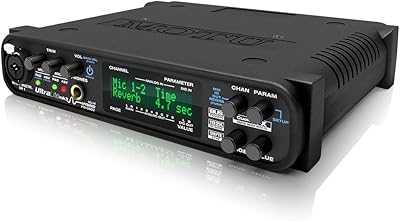




Overview
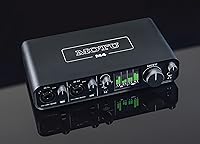
The MOTU M4 represents a significant shift in what we expect from entry-level hardware by packing high-end internals into a portable desktop format. While many devices in this price bracket cut corners on conversion, this USB-C interface utilizes ESS Sabre32 Ultra technology to deliver a level of clarity typically reserved for much more expensive rack-mounted gear. The construction is equally impressive, featuring a rugged metal chassis that feels substantial enough to survive a life on the road. It manages to balance professional-grade audio transparency with exceptionally low latency, making it a reliable backbone for any modern recording setup. By focusing on conversion quality rather than just adding more buttons, the four-channel unit offers a pure signal path that satisfies both budding engineers and seasoned pros alike.
Features & Benefits
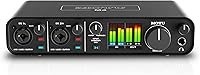
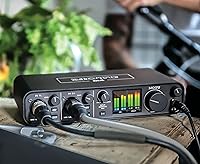
One of the standout elements of this desktop audio hub is the inclusion of a full-color LCD metering screen, which provides clear visual feedback that is far superior to standard clipping LEDs. Having the ability to monitor every input and output level in real time helps you maintain a clean signal throughout your session. For those working in content creation, the dedicated loopback channels are a massive advantage, allowing you to mix computer audio with live microphones without complex software workarounds. The dual preamps offer plenty of clean gain, and the inclusion of DC-coupled outputs makes this USB-C interface a secret weapon for modular synth enthusiasts who need to send control voltages directly from their computer. It is a thoughtfully designed piece of gear that prioritizes both function and high-fidelity performance.
Best For
This desktop audio hub is a perfect match for home studio producers who are ready to move beyond basic gear and require accurate monitoring for critical mixing decisions. Because of its reliable loopback capabilities, it is also a top choice for podcasters and streamers who need a straightforward way to capture guest audio or game sounds without latency issues. Solo musicians will find the low-latency monitoring particularly helpful when tracking vocals over dense instrumental projects, as it removes the distracting delay that often plagues cheaper units. Furthermore, the four-channel unit is excellent for mobile creators who need a bus-powered solution that works across Mac, PC, and even iOS devices without needing a separate power supply. It offers enough versatility to grow with your needs as your production skills and studio requirements expand.
User Feedback
Owners of this USB-C interface frequently highlight the premium preamp quality, noting that the sound remains clean and transparent even when pushed. Many users have mentioned that the plug-and-play experience on macOS is incredibly smooth, though Windows users should remember to install the specific drivers for the best performance. While the front-panel visual feedback receives constant praise for its brightness and utility, some have pointed out that the rear-mounted power switch can be a bit awkward to reach if the four-channel unit is tucked away in a tight desk space. Despite this minor ergonomic quirk, the consensus is that the audio transparency outperforms almost everything else in the sub-$300 range. It is widely considered a smart investment for anyone who values sonic accuracy over flashy marketing gimmicks or unnecessary bundled software.
Pros
- The ESS Sabre32 Ultra DAC provides high-end audio transparency and a wide dynamic range rarely found at this price.
- The full-color LCD screen offers exceptionally clear and responsive metering for both inputs and outputs.
- Built-in hardware loopback simplifies complex audio routing for live streaming and recording online interviews.
- A rugged metal chassis makes this desktop audio hub feel professional and ready for travel.
- Individual 48V phantom power switches for each mic input prevent accidental damage to sensitive ribbon microphones.
- The MOTU M4 achieves impressively low round-trip latency for a smoother recording and monitoring experience.
- DC-coupled outputs allow for advanced control of modular synthesizers via control voltage signals.
- Independent volume controls for the main monitors and headphones provide convenient and precise tactile adjustment.
Cons
- The power switch is located on the rear panel, which can be hard to reach in cramped desk setups.
- This four-channel unit is very lightweight, causing it to slide or tilt when using heavy, high-gauge XLR cables.
- Windows users often face a more complex initial driver installation process compared to the seamless Mac experience.
- The headphone amplifier may struggle to provide adequate volume for audiophile headphones with impedance over 250 ohms.
- Heavy bus-power consumption can quickly drain the battery life of connected mobile devices like iPads.
- The MOTU M4 lacks a dedicated software control mixer, which some power users might miss for complex monitoring setups.
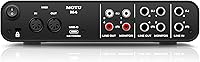
- Inputs 3 and 4 on the back lack dedicated gain knobs, limiting their flexibility for certain line-level sources.
- Small meter sizes on the LCD can be difficult to read from across a larger studio room.
Ratings
Our analysis of the MOTU M4 reflects a detailed synthesis of global user experiences, specifically filtered to remove biased or incentivized feedback. These scores represent the authentic performance of this USB-C interface in real-world studio environments, highlighting both its professional-grade internal components and its specific ergonomic trade-offs.
Audio Conversion Quality
Visual Monitoring
Latency Performance
Build Quality
Loopback Functionality
Preamplifier Transparency
Ease of Setup (macOS)
Driver Stability (Windows)
Ergonomics
Value for Money
iOS Compatibility
Headphone Output Drive
Suitable for:
The MOTU M4 is an ideal choice for home studio producers and serious hobbyists who want high-end audio conversion without the four-figure price tag. Its integrated loopback functionality makes it a standout solution for streamers and podcasters who need to capture guest audio or system sounds with minimal fuss. Musicians who frequently track vocals and instruments simultaneously will benefit from the ultra-low latency, which ensures a natural performance feel. Additionally, the DC-coupled outputs make it a specialized tool for modular synth users looking to control their hardware via CV from a computer. For Mac users, the class-compliant drivers offer a reliable plug-and-play experience that is hard to beat for mobile recording sessions.
Not suitable for:
While highly capable, the MOTU M4 might not be the right fit for absolute beginners on a shoestring budget who only need a single input for a basic USB microphone. Professional studios requiring more than four simultaneous inputs or advanced internal digital routing will likely find the fixed hardware configuration too restrictive. Windows users who are not comfortable troubleshooting occasional USB power settings or installing specific ASIO drivers might prefer a more consumer-oriented interface with simpler software. Furthermore, the reliance on USB bus power means it can be a significant drain on tablet batteries during long mobile sessions. If you have very high-impedance headphones, you may also find that the built-in headphone amp lacks the necessary headroom to drive them to satisfying levels.
Specifications
- Audio Channels: This unit features a 4-input and 4-output configuration for versatile recording and monitoring.
- Connectivity: The device uses a high-speed USB-C port for data transfer and power delivery.
- DAC Technology: It is equipped with ESS Sabre32 Ultra DAC technology for high-end audio conversion.
- Microphone Inputs: Two XLR/TRS combo jacks provide high-quality preamplification for mics, line-level sources, or guitars.
- Line Inputs: Two additional balanced 1/4-inch TRS line inputs are located on the rear panel.
- Line Outputs: Four balanced 1/4-inch TRS line outputs allow for multiple monitor pairs or outboard routing.
- Visual Metering: A full-color LCD provides detailed real-time level meters for all inputs and outputs.
- Phantom Power: Individual +48V phantom power switches are provided for each of the two microphone inputs.
- MIDI Interface: Standard 5-pin MIDI In and Out ports are included for connecting external controllers and synths.
- Headphone Output: A dedicated 1/4-inch stereo headphone jack is driven by its own ESS converter.
- Power Source: The interface is fully bus-powered via the included USB-C to USB-A cable.
- Output Coupling: The 1/4-inch outputs are DC-coupled, enabling the transmission of control voltage (CV) signals.
- Monitoring: Hardware monitoring includes a dedicated blend knob and mono/stereo switching.
- Dimensions: The physical footprint measures approximately 8.25 x 4.25 x 1.75 inches.
- Weight: The total weight of the metal chassis is 1 pound.
Related Reviews
MOTU Audio Express USB Audio Interface

MOTU MIDI Express 128 USB MIDI Interface
MOTU 896mk3 Hybrid USB/FireWire Audio Interface
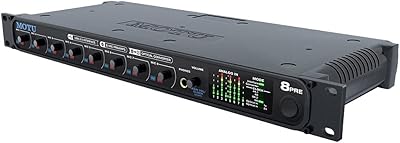
MOTU 8pre USB Audio Interface
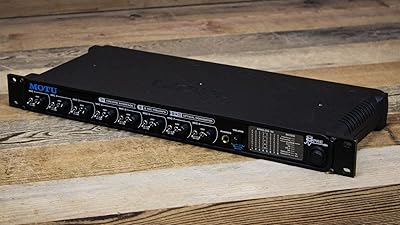
MOTU 8pre Firewire Audio Interface
Xtrfy M4 Wireless Ultralight Gaming Mouse
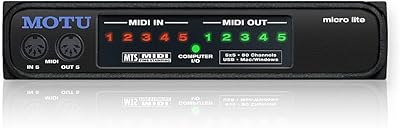
MOTU Micro Lite 5-Port USB MIDI Interface
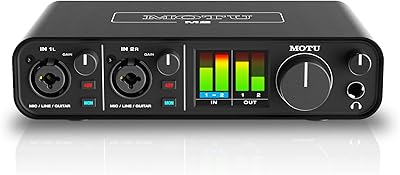
MOTU M2
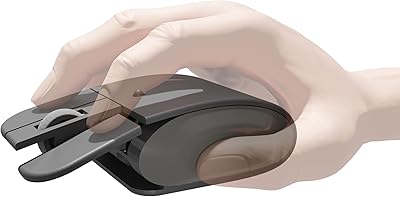
Elasto M4 Ergonomic Wireless Mouse