Overview

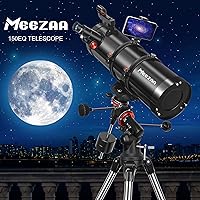
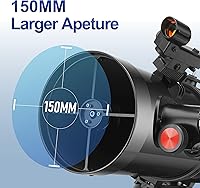
The MEEZAA 150EQ Reflector Telescope sits in an interesting spot — substantial enough to deliver genuinely rewarding views, yet designed for people who are serious about learning but not quite ready for observatory-grade equipment. The headline spec is the 150mm aperture, which is meaningfully larger than the 60–114mm tubes typically found at this level, and that extra light-gathering capacity opens the door to fainter deep-sky targets like nebulae and star clusters, not just the moon. It also ships with a German equatorial mount, adding real tracking capability but demanding patience to set up correctly. MEEZAA is a relatively new name in optics, so buyers should go in with open eyes, though the spec sheet holds up well against more established competitors.
Features & Benefits

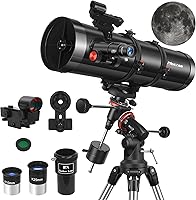
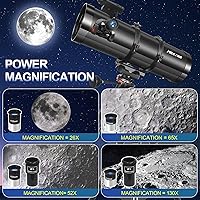
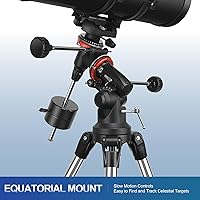
At f/4.3, this 150mm scope leans toward wide-field observation rather than ultra-high planetary magnification, which suits beginners well — you spend less time hunting objects and more time actually seeing them. The two included eyepieces (25mm and 10mm) combined with the 2x Barlow lens produce a usable magnification range of roughly 26x to 130x, covering casual moon-gazing and closer planetary views without requiring extra purchases right away. The slow-motion control cables on the equatorial mount are a genuine asset once you learn the polar alignment process — they allow smooth object tracking rather than constantly nudging the tube by hand. Fully multi-coated optics help maximize contrast and light throughput, while the red dot finderscope makes initial target acquisition far less frustrating than a traditional crosshair finder.

Best For

This reflector telescope is a strong match for adults or older teens who've already caught the astronomy bug and want hardware that rewards continued learning. If you've outgrown a department-store refractor or a small Dobsonian, the step up in aperture and mount quality here is noticeable. It performs well for suburban backyard stargazing — the 150mm aperture pulls in enough light to reveal lunar craters in satisfying detail, track Jupiter's moons, and pick out bright nebulae under reasonably dark skies. Households wanting a scope that won't hit a ceiling in a year or two will appreciate the EQ mount's long-term scalability. The included phone adapter adds some casual astrophotography potential, though it's best treated as a bonus feature rather than a core capability.

User Feedback

With 174 ratings averaging 4.5 stars, the MEEZAA 150EQ has earned broadly positive reception. Owners frequently praise lunar and planetary clarity, and several note that the accessory bundle feels more complete than expected at this price tier. That said, criticism clusters around two consistent points: the equatorial mount's polar alignment process is genuinely tricky for first-time users, and some units arrive needing collimation out of the box — a normal reality with Newtonian reflectors, but one that catches unprepared buyers off guard. Tripod stability gets mixed marks, with some users finding it solid and others noting wobble under the tube's weight. Documentation quality appears inconsistent, which compounds the mount learning curve for those without any prior experience.

Pros

  • The 150mm aperture delivers noticeably brighter, more detailed views than typical entry-level scopes in this category.
  • Fully multi-coated optics produce strong contrast and color fidelity on lunar and planetary targets.
  • The German equatorial mount enables smooth celestial tracking once polar alignment is mastered.
  • Slow-motion control cables allow precise object centering without physically grabbing the tube.
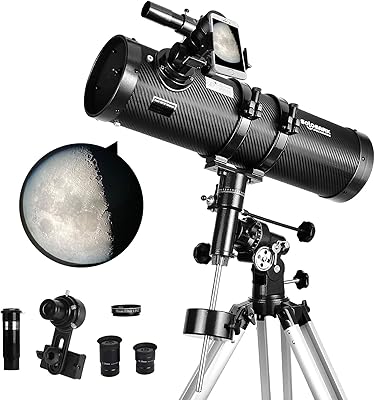
  • The included accessory bundle — moon filter, phone adapter, two eyepieces, and Barlow lens — reduces the need for immediate extra spending.
  • The red dot finderscope makes locating targets significantly easier for beginners than traditional crosshair finders.
  • This 150mm scope holds real long-term value; it is not a scope most users will outgrow quickly.
  • Build quality on the optical tube itself is solid and consistently praised relative to the price tier.
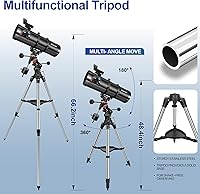
  • The adjustable stainless steel tripod provides a stable platform at moderate viewing angles.

Cons

  • Polar alignment is poorly explained in the included manual, leaving many first-time users reliant on third-party tutorials.
  • Several units arrive requiring collimation before delivering sharp views — an unpleasant surprise for unprepared buyers.
  • At over 31 pounds with no carry case included, transport and storage require extra planning and investment.
  • Tripod stability degrades noticeably when the tube is pointed steeply upward or the legs are fully extended.
  • The 10mm eyepiece shows edge-of-field softness, and most enthusiasts budget for aftermarket upgrades relatively quickly.
  • MEEZAA's brand support infrastructure is thin compared to established telescope manufacturers, with inconsistent warranty experiences reported.
  • The phone adapter fits some smartphone models poorly, introducing vibration that reduces image quality.
  • No motorized tracking is included, making any serious long-exposure astrophotography impractical with this setup.
  • The finder bracket and secondary accessories feel noticeably less refined than the optical tube itself.

Ratings

The scores below for the MEEZAA 150EQ Reflector Telescope were generated by our AI engine after analyzing verified purchase reviews from buyers worldwide, with spam, bot-submitted, and incentivized feedback actively filtered out. Each category reflects the full spectrum of real ownership experiences — not just the highlights — so both the genuine strengths and the recurring frustrations are represented transparently.
Optical Performance
83%
Users consistently report sharp, detailed views of the moon and bright planets like Jupiter and Saturn, with the 150mm aperture pulling in noticeably more light than smaller entry-level tubes. On clear nights with steady seeing, the image quality surprises even skeptical buyers at this price tier.
At higher magnifications approaching the 130x ceiling, views can soften depending on atmospheric conditions and collimation state. Some users note chromatic fringing on very bright targets, a known trait of fast Newtonian reflectors at f/4.3.
Aperture & Light Gathering
89%
The 150mm opening is a genuine step up from the 70–114mm scopes most beginners start with, and that difference shows. Owners report being able to spot fainter deep-sky objects like the Orion Nebula and Andromeda Galaxy as more than just smudges, even from suburban backyards.
A 150mm Newtonian tube is physically large and relatively heavy, which limits spontaneous use. Taking it out for a quick 20-minute session requires more setup commitment than a compact refractor, which some casual users find off-putting.
Equatorial Mount Usability
61%
39%
Once polar alignment clicks, users who invest the time praise the slow-motion cables for keeping objects centered without the jerky nudging that alt-azimuth mounts require. For anyone willing to learn, the EQ mount adds real observing efficiency during longer sessions.
This is the most divisive aspect of ownership. A significant share of reviewers find the polar alignment process genuinely confusing, especially without a polar scope, and the included instructions do not adequately bridge the gap. True beginners frequently report frustration in the first few sessions.
Collimation Out of the Box
58%
42%
Buyers who are already familiar with Newtonian reflectors treat collimation as routine maintenance and report that the mirror cell adjustments are accessible and reasonably straightforward once you understand the process.
Multiple reviewers note that the optics arrived out of collimation and needed adjustment before delivering sharp views. For first-time owners who did not anticipate this, it creates an unnecessarily rocky initial experience that damages first impressions significantly.
Tripod Stability
67%
33%
The stainless steel tripod legs feel solid at moderate heights, and most users report acceptable stability when the scope is pointed at low to mid elevations. Height adjustability is appreciated for comfortable seated or standing use.
At full extension or when the tube is angled steeply toward the zenith, vibration dampening becomes noticeably weaker. Some owners report that a passing vehicle or even a gentle tap on the tripod introduces wobble that takes several seconds to settle.
Eyepiece & Barlow Quality
74%
26%
The 25mm eyepiece in particular earns praise for delivering wide, comfortable views that are great for locating targets and scanning star fields. The 2x Barlow effectively triples the versatility of the included eyepiece set without an immediate need for extra purchases.
The 10mm eyepiece shows some edge-of-field softness, and the Barlow, while functional, is not optically exceptional. Enthusiasts who spend time at higher magnifications often find themselves budgeting for aftermarket eyepieces within the first few months.
Red Dot Finderscope
78%
22%
Reviewers broadly appreciate having a red dot finder over a traditional optical finder for quick target acquisition. For beginners learning their way around the sky, it reduces the frustration of star-hopping considerably and makes the first few sessions more rewarding.
The finder bracket feels a bit lightweight relative to the rest of the scope, and alignment can drift after transport. A small number of users report the red dot brightness adjustment being sticky or inconsistent over time.
Moon Filter
76%
24%
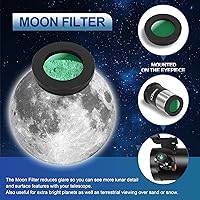
The included moon filter is a practical addition that genuinely improves comfort during lunar observation. Users note it reduces eye fatigue during extended sessions when the moon is full and otherwise uncomfortably bright through a 150mm aperture.
The filter threading is functional but not precision-engineered — some users report it fits loosely on one of the eyepieces. It handles its job adequately, but dedicated observers often replace it with a higher-quality variable polarizing filter over time.
Phone Adapter & Astrophotography
54%
46%
For casual moon shots shared on social media, the phone adapter performs well enough to produce recognizable, enjoyable images. Several users express pleasant surprise at being able to capture lunar craters on a smartphone without any additional equipment.
Serious astrophotography is not realistic with this setup. The manual equatorial mount lacks motorized tracking, which means longer exposures blur quickly. The adapter also fits some phone models more securely than others, introducing vibration at the moment of capture.
Build Quality & Materials
77%
23%
The optical tube feels well-constructed with a quality that exceeds what most buyers expect at this price point. The focuser drawtube is smooth, and the overall fit and finish of the scope itself draws positive comments in a majority of reviews.
Some of the secondary accessories — particularly the eyepiece rack and finder bracket — feel noticeably less refined than the main tube. A few users also mention that the mount casting has minor cosmetic inconsistencies, though these appear to be aesthetic rather than functional.
Setup & Assembly Experience
63%
37%
The physical assembly of the scope onto the mount and tripod is manageable and completed by most buyers within 30 to 45 minutes on the first attempt. Components connect in a logical sequence, and the hardware is included without obvious omissions.
The included instruction manual is widely criticized as thin and poorly illustrated, particularly for EQ mount setup and polar alignment. Buyers with no prior telescope experience frequently turn to YouTube tutorials to fill in the gaps, which is an avoidable friction point.
Portability & Storage
59%
41%
The scope breaks down into manageable components — tube, mount head, and tripod legs — making car transport feasible for a dark-sky trip. Users who transport it to parks or rural locations report the process is workable with some practice.
At over 31 pounds total and with a tube exceeding 32 inches in length, this is not a grab-and-go instrument. No carry bag or case is included, so owners need to arrange their own storage and transport solution, which adds cost and inconvenience.
Value for Money
81%
19%
Taken as a complete package — aperture, mount type, and accessory bundle — the MEEZAA 150EQ offers more hardware per dollar than most comparable named-brand alternatives at this tier. Buyers who do their homework consistently rate the value proposition as strong.
The value equation shifts somewhat once you factor in likely add-ons like a collimation tool, better eyepieces, and potentially a polar scope. The base price is competitive, but a realistic total investment for a well-equipped setup runs meaningfully higher.
Brand Support & Documentation
55%
45%
Some buyers report responsive email support from MEEZAA when issues arose, and the brand appears to be actively engaged with its customer base on certain platforms, which is reassuring for a newer market entrant.
MEEZAA lacks the established support infrastructure of heritage telescope brands. Warranty claim experiences appear inconsistent across reviews, and the absence of a robust knowledge base or community forum means buyers largely depend on third-party resources for troubleshooting.

Suitable for:

The MEEZAA 150EQ Reflector Telescope is built for adults and older teenagers who are genuinely curious about astronomy and ready to invest real time in learning the craft — not just point a tube at the sky and hope for the best. If you've already owned a small refractor or a basic tabletop Dobsonian and felt limited by its aperture, this 150mm scope represents a meaningful upgrade that opens up fainter targets like nebulae and globular clusters. It suits suburban stargazers well, since the light-gathering advantage of a 150mm mirror helps cut through moderate sky glow better than smaller instruments. Families who want a single telescope that can grow alongside a developing astronomer will find the German equatorial mount a worthwhile long-term investment, even if the learning curve demands patience upfront. Anyone who enjoys the process of learning — polar alignment, manual tracking, collimation — will find that the hands-on nature of this scope is part of the appeal rather than a drawback.
Not suitable for:

The MEEZAA 150EQ Reflector Telescope is a poor match for anyone expecting an effortless, plug-and-play experience on night one. If you're buying a first telescope for a young child or a casual observer who wants to glance at the moon occasionally and pack it away in five minutes, the equatorial mount setup and the weight of this instrument will create more friction than enjoyment. It is also not the right choice for buyers with serious astrophotography ambitions — without motorized tracking, long-exposure imaging is essentially off the table, and the included phone adapter is better understood as a fun bonus than a capable imaging tool. Apartment dwellers or those without a car may find the bulk and weight impractical for regular transport to darker sites. Buyers who are not prepared to learn basic collimation — an occasional but necessary maintenance task for Newtonian reflectors — should also reconsider, since skipping it means noticeably degraded image sharpness.
Specifications

  • Telescope Type: Newtonian reflector design uses a parabolic primary mirror to gather and focus light rather than glass lenses.
  • Aperture: Primary mirror measures 150mm (approximately 6 inches) in diameter, determining the scope's light-gathering capacity.
  • Focal Length: Optical tube has a focal length of 650mm, producing an f/4.3 focal ratio suited to wide-field and deep-sky viewing.
  • Magnification Range: Using the supplied eyepieces and 2x Barlow lens, achievable magnification spans from 26x up to 130x.
  • Eyepieces Included: Two eyepieces are provided: a 25mm for low-power wide-field views and a 10mm for higher-magnification planetary observation.
  • Barlow Lens: A 2x Barlow lens doubles the effective magnification of any eyepiece inserted, expanding the usable magnification range without additional purchases.
  • Lens Coating: All optical surfaces are fully multi-coated to maximize light transmission, minimize reflective loss, and improve image contrast.
  • Mount Type: German equatorial mount with graduated setting circles and dual-axis slow-motion control cables for precise manual celestial tracking.
  • Finderscope: Red dot reflex finderscope is included for quick, non-magnified target acquisition and initial alignment with the sky.
  • Tripod Material: Height-adjustable tripod is constructed from stainless steel for rigidity and corrosion resistance during outdoor use.
  • Focus Type: Manual rack-and-pinion or Crayford-style focuser requires hand adjustment to achieve sharp focus at any magnification.
  • Product Dimensions: Assembled unit measures approximately 32.68″ in depth, 18.7″ in width, and 12.6″ in height.
  • Item Weight: Complete setup weighs approximately 14.22 kg (31.3 lbs) including the optical tube, mount head, and tripod.
  • Moon Filter: A threaded neutral-density moon filter is included to reduce glare and improve surface detail during bright lunar observation.
  • Phone Adapter: A universal smartphone adapter attaches to the eyepiece barrel, enabling basic afocal photography through the telescope with a compatible device.
  • Accessories Included: Full package includes two eyepieces, a 2x Barlow lens, red dot finderscope, moon filter, phone adapter, tripod, and a printed instruction guide.
  • Power Source: Two batteries are required and included, likely used to power the illuminated red dot finderscope reticle.
  • Compatible Devices: The included phone adapter is designed to accommodate smartphones for basic lunar and planetary photography.
  • Manufacturer: Designed and sold by MEEZAA, a newer entrant in the consumer telescope market with a growing product line.
  • Availability Date: This model was first made available for purchase in August 2023.

Related Reviews

Celestron ExploraScope 114AZ Reflector Telescope
78%
83%
Optical Performance
91%
Ease of Setup
78%
Mount Usability
62%
Included Accessories
57%
Focuser Quality
More
SOLOMARK Polaris 130EQ
69%
88%
Optical Clarity
91%
Aperture & Light Gathering
74%
German Equatorial Mount
82%
Build Quality & Materials
61%
Ease of Assembly
More
Celestron Omni XLT 150 Reflector Telescope
84%
91%
Optical Clarity
89%
Ease of Setup
85%
Mount Precision
88%
Build Quality
84%
Included Accessories
More
Zoomion Philae 114/500 EQ Reflector Telescope
65%
78%
Optical Performance
54%
Mount Stability
61%
Collimation Out of Box
57%
Assembly Experience
74%
Value for Money
More
Gskyer AZ90600 90mm Refractor Telescope
72%
83%
Optical Clarity
79%
Value for Money
91%
Ease of Assembly
58%
Tripod Stability
76%
Mount Usability
More
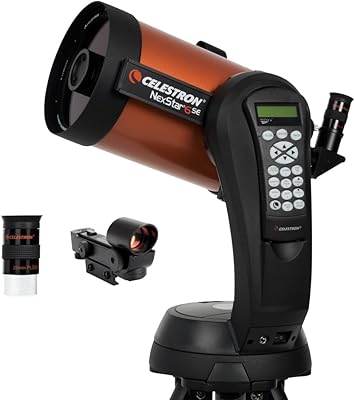
Celestron NexStar 6SE Computerized Telescope
72%
88%
Optical Performance
83%
GoTo Mount Accuracy
86%
SkyAlign Ease of Use
61%
Mount Stability
81%
Portability & Setup Time
More
Celestron PowerSeeker 60AZ Refractor Telescope
71%
78%
Optical Clarity
62%
Mount & Tracking
54%
Tripod Stability
67%
Eyepiece Quality
83%
Value for Money
More
Celestron AstroMaster 90AZ Refractor Telescope
75%
83%
Optical Clarity
91%
Ease of Setup
78%
Mount Usability
62%
Tripod Stability
76%
Value for Money
More
ToyerBee 70mm Refractor Telescope
71%
76%
Optical Clarity
63%
Build Quality
54%
Tripod & Mount Stability
71%
Magnification Range
82%
Ease of Assembly
More
Celestron PowerSeeker 114EQ Reflector Telescope
73%
83%
Optical Performance
61%
Mount Quality
57%
Ease of Setup
74%
Included Accessories
81%
Value for Money
More

FAQ

The MEEZAA 150EQ Reflector Telescope is best described as a beginner-to-intermediate scope rather than a true starter instrument. The optics and aperture are very accessible, but the German equatorial mount has a real learning curve — polar alignment in particular takes patience and some study. If you are a complete first-timer, budget a few evenings just for learning the mount before expecting rewarding views.
From a typical suburban backyard, you can expect excellent views of the moon, including fine crater and mountain detail. Jupiter's cloud bands and its four main moons are readily visible, as is Saturn's ring system. Under reasonably dark skies, brighter deep-sky objects like the Orion Nebula, the Andromeda Galaxy, and globular clusters become accessible. Light-polluted city skies will limit deep-sky performance, but lunar and planetary viewing holds up well regardless.

Quite possibly, yes. Newtonian reflectors at this price tier commonly ship with the mirrors slightly out of alignment due to vibration during transport. Before your first serious session, it is worth checking collimation using a collimation cap or a laser collimator — neither of which is included. The process is not complicated once you learn it, but new owners who skip this step often report softer-than-expected views and mistakenly blame the optics.

Polar alignment is genuinely the steepest part of the learning curve with this scope. The basic method involves pointing the mount's polar axis toward Polaris (the North Star), but dialing it in precisely enough for smooth tracking takes practice. The included instructions cover this only superficially, so most users recommend supplementing with online tutorials. Once it clicks, the slow-motion cables make tracking a real pleasure — but expect a few frustrating nights first.

Basic lunar and planetary snapshots through a smartphone are very doable using the included phone adapter, and results can be genuinely impressive for sharing online. However, long-exposure deep-sky astrophotography is not realistic here — the mount has no motorized tracking drive, so stars will trail in exposures longer than a few seconds. If imaging is your primary goal, you would need a motorized equatorial mount, which is a separate and significant investment.

At moderate heights and when pointing at lower elevations, the stainless steel tripod is acceptably stable. The issue tends to appear when the tube is angled steeply toward the zenith or the legs are extended to their maximum height — under those conditions, vibration takes several seconds to settle after touching the scope. Touching the focuser carefully and waiting a moment before viewing helps considerably.

The 25mm and 10mm eyepieces combined with the 2x Barlow lens give you four effective focal lengths to work with, which is a solid starting set. Most users find the 25mm excellent for general use. The 10mm is functional but shows some softness at the edge of the field. Enthusiasts tend to add a quality mid-range eyepiece — something in the 15–18mm range — within the first few months, but it is not an urgent purchase from day one.

At just over 31 pounds fully assembled, this is not a lightweight setup. It breaks down into separate components — tube, mount head, and tripod — which makes car transport manageable, but it is not something you will casually carry to a dark field on foot. No carrying bag or case is included, so you will want to arrange your own padding or storage solution, especially if you plan to transport it regularly.

MEEZAA is a relatively new name in the telescope market and does not have the decades-long track record of brands like Sky-Watcher or Celestron. That said, the product quality for the price tier is competitive, and many buyers report satisfactory experiences. Warranty coverage and support responsiveness appear inconsistent based on reviews — some users report smooth resolutions, others find it slow. It is worth registering your purchase promptly and keeping packaging in case a return or exchange is needed.

The red dot finderscope is a small non-magnifying sight mounted on the tube that projects a faint red dot onto a window, helping you point the telescope roughly at your intended target before looking through the main eyepiece. It is much easier to use than traditional crosshair optical finders, especially for beginners still learning the sky. You will need to align it with the main scope during initial setup, which is a quick one-time process.