Overview

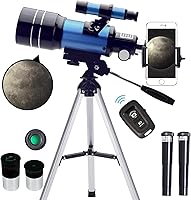
The ToyerBee 70mm Refractor Telescope is one of the more honest offerings in the crowded beginner astronomy market — it delivers real optical performance without pretending to be something it is not. The 70mm aperture is the headline spec here, and at this price point it genuinely matters: more light means brighter, cleaner views of the moon and planets compared to the undersized 50mm scopes that dominate this category. Weighing under four pounds and packing down to a manageable size, this beginner refractor travels easily to a dark backyard, a campsite, or a rooftop. The bundled smartphone adapter and wireless remote are thoughtful additions you rarely see at this price. Just go in knowing this is a learning instrument, not a serious observatory tool.
Features & Benefits

The fully-coated objective lens is what separates this starter telescope from the cheapest plastic scopes on the market — the coating cuts down on glare and internal reflections, so lunar craters actually look crisp rather than washed out. Two eyepieces pair with the included 3x Barlow lens to cover a practical range from wide, lower-power views good for star fields to higher-power zooms that bring out Saturn's rings on a clear night. That said, image quality softens noticeably as you push toward the upper end, so treat the highest magnification as a curiosity rather than a daily driver. The altazimuth mount moves intuitively in all directions and feels natural from first use, while manual focus takes a few tries to master but clicks into place quickly.

Best For

This beginner refractor makes the most sense as a gift for kids between 8 and 12, especially those who have already shown some curiosity about space. It is light enough for a child to carry outside independently and simple enough to set up without a parent hovering nearby. Adult beginners who want to see the moon in real detail or catch a glimpse of Jupiter's moons on a clear night will find it more than capable for those goals. Travelers and campers will appreciate the compact footprint — it packs up without drama. The ToyerBee scope also works surprisingly well as a daytime spotting scope, and the smartphone adapter makes it a reasonable first step into mobile astrophotography before investing in dedicated camera gear.

User Feedback

Buyers consistently highlight two things: moon detail that genuinely surprises first-timers, and an assembly process straightforward enough for kids to manage largely on their own after following the included instructions. On the critical side, tripod stability becomes a real issue at higher zoom levels — the wobble makes it frustratingly hard to hold a steady planetary view. The eyepiece optics also plateau around 100X in practice; pushing beyond that produces a larger but noticeably fuzzier image. Opinions on the wireless remote are split — some find it a clever tool for shake-free phone photos, while others treat it as a novelty. Customer service feedback is generally positive, backed by the brand's 3-year warranty.

Pros

  • The 70mm coated objective lens gathers enough light to show real lunar surface detail and planetary features at moderate magnification.
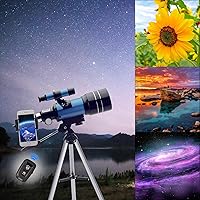
  • Bundled wireless remote and smartphone adapter allow shake-free moon photography without buying extra accessories.
  • At under four pounds, this beginner refractor is light enough for kids to carry and reposition on their own.
  • The altazimuth mount moves intuitively in all directions — no manual or prior experience needed to start tracking objects.
  • Two eyepieces plus a 3x Barlow lens provide a practical range of viewing options straight out of the box.
  • Assembly is straightforward enough for most children to complete largely independently after reviewing the included instructions and video guide.
  • Works well as a daytime spotting scope for terrestrial use, extending its value beyond astronomy sessions.
  • A three-year satisfaction warranty is notably longer than competitors offer at this price point.
  • The reflex finderscope makes locating targets quicker and less frustrating for complete beginners.
  • Delivers strong overall value when weighed against the full accessory bundle included at this price tier.

Cons

  • Tripod vibration at higher magnifications is a persistent issue — even a slight touch sends the image wobbling for several seconds.
  • Image sharpness degrades noticeably before reaching the maximum advertised magnification, making the upper zoom range largely impractical.
  • The finderscope bracket loosens over time and requires periodic re-tightening to stay properly aligned.
  • No carrying case is included, so protecting the scope and accessories during travel requires sourcing your own solution.
  • Chromatic aberration — color fringing around bright objects — is visible at higher zoom levels and cannot be corrected.
  • The short eye relief on the high-power eyepiece is uncomfortable for eyeglass wearers and younger children.
  • Wireless remote reliability is inconsistent across units, with a portion of buyers reporting connectivity issues after limited use.
  • The phone adapter requires fiddly alignment and does not accommodate all smartphone sizes securely.
  • Customer support response times are not fully consistent, despite the brand's stated warranty commitment.
  • Kids who are not guided toward specific targets may lose interest once the initial novelty of the scope wears off.

Ratings

The ToyerBee 70mm Refractor Telescope has been evaluated by our AI system after analyzing thousands of verified global user reviews, with spam, bot-generated, and incentivized submissions actively filtered out before scoring. The resulting ratings below reflect where this starter telescope genuinely shines and where real buyers — from curious kids to adult beginners — ran into friction. Both the strengths and the honest shortcomings are reflected transparently in every category.
Optical Clarity
76%
24%
For a scope in this price bracket, the fully-coated 70mm lens delivers lunar views that genuinely impress first-timers — crater rims, shadows, and surface texture are clearly visible on a steady night. Planetary detail like Jupiter's cloud bands is achievable at moderate magnification, which is more than many comparable budget refractors can claim.
Image sharpness degrades noticeably as you push toward the upper magnification range, with views becoming soft and harder to focus cleanly. Chromatic aberration — a faint color fringing around bright objects — is visible at higher zoom levels and is a known limitation of short focal-length refractors at this price.
Build Quality
63%
37%
The optical tube feels solid and the focuser mechanism operates smoothly enough for casual use. Most buyers report no obvious defects out of the box, and the overall construction gives a more confident first impression than the cheapest plastic-bodied scopes in the same category.
Closer inspection reveals plastic components throughout, including the focuser housing and eyepiece barrel, which feel less robust under regular handling. A few users noted the red dot finderscope bracket loosens over time, and the tripod legs show flex under heavier-handed adjustments — not a dealbreaker, but worth knowing before buying.
Tripod & Mount Stability
54%
46%
The altazimuth mount moves intuitively in all directions, making it genuinely easy for beginners and children to pan across the sky without confusion. For low-magnification viewing of the moon or daytime landscapes, the setup holds steady well enough to deliver satisfying results.
At higher magnifications, tripod vibration becomes a recurring complaint — even a light touch on the telescope tube sends the image wobbling for several seconds. Wind or an excited child nudging the eyepiece can quickly turn a sharp lunar view into a blurry frustration, and this is one of the most consistent pain points across buyer reviews.
Magnification Range
71%
29%
The combination of two eyepieces and a 3x Barlow lens gives beginners a useful spread of viewing options — the lower-power setting is great for sweeping across star clusters or tracking the full moon, while the mid-range setting hits a practical sweet spot for planetary detail that most beginners will return to repeatedly.
The highest achievable magnification is largely theoretical in practice — the optics and tripod both struggle to support it usefully. Real-world observers will find that image quality plateaus around the mid-range and becomes noticeably degraded before reaching the upper limit advertised on the box.
Ease of Assembly
82%
18%
Most buyers — including children assembling it with minimal adult help — report getting the scope up and pointed at the moon within 20 to 30 minutes of opening the box. The included manual is clearer than average for this category, and ToyerBee supplements it with video instructions that cover the most confusing steps.
A small portion of users found the initial alignment of the finderscope fiddly, and getting the phone adapter seated properly on the eyepiece requires a bit of trial and error the first time. These are minor friction points rather than serious obstacles, but they can be mildly frustrating for younger kids working without guidance.
Smartphone Astrophotography
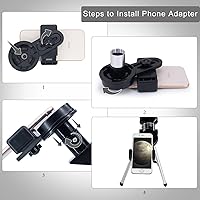
68%
32%
The bundled phone adapter and wireless remote are a genuinely useful pairing — being able to trigger the camera shutter without touching the scope eliminates most of the shake that ruins astrophotos taken by hand. Lunar shots through a phone camera connected to this starter telescope can produce results worth sharing.
Getting the phone adapter aligned precisely with the eyepiece takes patience, and the fit is not universal — wider-bodied phones can be awkward to seat securely. Image results are also heavily dependent on atmospheric conditions and phone camera quality, so expectations need to be managed for anything beyond moon photography.
Portability
84%
At under four pounds fully assembled and with a footprint small enough to fit in a backpack, this beginner refractor is one of the more genuinely portable options available. Campers and travelers who want to pull it out for a quick moon session without hauling a full-sized setup will find it practical and light.
There is no dedicated carrying case included, so protecting the scope and loose accessories during travel requires sourcing your own bag or padding. The tripod, while compact, still needs to be broken down and reassembled each time, which adds a couple of minutes to the setup routine on location.
Value for Money
81%
19%
When measured against what buyers actually get — a 70mm coated refractor, dual eyepieces, a Barlow lens, a working finderscope, a phone adapter, and a wireless remote — the value proposition is hard to argue with at this price point. It consistently outperforms the stripped-down scopes available at similar or higher prices from mass-market toy brands.
Value perception drops among buyers who came in expecting intermediate-level performance and hit the optical and stability ceiling faster than anticipated. If expectations are slightly misaligned, the perceived value shifts quickly, which accounts for the split in review scores between delighted beginners and mildly disappointed buyers who wanted more longevity from the experience.
Eyepiece Quality
59%
41%
The two included eyepieces cover a practical range for a beginner and are functional right out of the box without any immediate need to upgrade. The H20mm wide-field eyepiece in particular draws positive feedback for producing comfortable, reasonably bright views of the moon and nearby star fields.
The eyepiece barrels are basic and the eye relief on the higher-power H6mm piece is short, making it uncomfortable for eyeglass wearers and young children. Experienced observers will notice the glass quality is limited, and upgrading to a quality aftermarket eyepiece is one of the first modifications more serious beginners tend to make.
Finderscope Usability
66%
34%
The reflex finderscope does its core job — helping a beginner locate a target in the sky before zooming in through the main eyepiece — and the red dot projection is bright enough to use comfortably in dark conditions. Kids especially tend to find it intuitive to use compared to optical finder alternatives.
Alignment between the finderscope and the main tube drifts over time, requiring periodic re-calibration that some users find tedious. The mounting bracket has been noted as the weakest physical component on the whole instrument, with a few buyers reporting looseness after routine repositioning of the scope.
Focusing Mechanism
72%
28%
The manual focuser responds smoothly for most users and reaching a sharp focus on the moon takes only a few adjustments once you understand the motion. Beginners report a quick learning curve — most get the hang of it within the first observing session rather than needing multiple nights to sort out.
The focuser lacks fine-adjustment tension control, so it can drift slightly after you release it — noticeable mostly at high magnifications where small shifts matter most. A rack-and-pinion focuser at this price was never going to be precision-grade, and buyers who have used better focusers on mid-range scopes will feel the difference.
Kid-Friendliness
83%
Children in the 8 to 12 age range consistently show up positively in buyer feedback — many parents report their kids assembling and using the scope with real independence after the first session together. The light weight means children can reposition and point the scope themselves without adult assistance.
The short eye relief on the high-power eyepiece can be frustrating for younger children, and the tripod height at minimum extension is still slightly tall for smaller kids to use comfortably at lower sky angles. Some parents noted their children lost interest after the initial novelty if not guided toward specific targets to observe.
Wireless Remote
61%
39%
When it works, the wireless shutter remote removes the biggest source of camera shake in smartphone astrophotography and produces noticeably steadier moon shots than triggering the phone camera directly. It runs on a standard CR2032 battery and pairs without setup hassle for most users.
Buyer opinions are sharply divided — a meaningful portion of reviewers describe the remote as unreliable after a short period of use, with connectivity dropping or buttons becoming unresponsive. For others it remains a novelty used once and forgotten, which leaves its practical value dependent largely on individual luck with the unit received.
Customer Support & Warranty
74%
26%
ToyerBee backs this starter telescope with a three-year satisfaction guarantee, which is longer than most competitors at this tier offer. Buyers who reached out with missing components or defective units generally report responsive resolution, including replacement parts shipped without prolonged back-and-forth.
Support experiences are not entirely consistent — a subset of reviewers describe slower response times and less satisfying resolutions for more complex issues like optical misalignment or focuser problems. The warranty is a genuine positive, but its real-world reliability appears to depend on the nature of the problem being reported.

Suitable for:

The ToyerBee 70mm Refractor Telescope hits its stride as a first telescope for families, curious kids, and adults who want to explore the night sky without committing serious money to a hobby they have not yet fully embraced. Children between 8 and 12 will find it light enough to carry outside independently and simple enough to set up after one session with a parent — that combination of accessibility and genuine optical capability makes it one of the better gift choices in this category. Adult beginners who want to see the moon in real detail, catch Saturn's rings on a clear night, or spot Jupiter's largest moons will find this starter telescope more than capable for those goals. It also doubles as a daytime spotting scope for birdwatching or landscape viewing, which extends its practical usefulness beyond nighttime sessions. Travelers and campers who want a packable optical instrument without hauling heavy gear will appreciate how easily it fits into a backpack. The included smartphone adapter and wireless remote add real value for anyone curious about capturing lunar photos through their phone before investing in dedicated astrophotography equipment.
Not suitable for:

The ToyerBee 70mm Refractor Telescope is not the right tool for observers who have already moved past the beginner stage and want to explore faint deep-sky objects like nebulae or distant galaxies — the 70mm aperture and short focal length simply are not built for that kind of work. Anyone expecting to push the scope to its maximum advertised magnification and get sharp, stable views will be disappointed; the tripod and eyepiece quality both impose real ceilings well before the upper limit on the box. Astrophotographers looking for results beyond casual lunar snapshots will outgrow the phone adapter setup quickly and need a mount with tracking capability, which this altazimuth design does not offer. Buyers who have previously owned a mid-range or advanced telescope will likely find the focuser, eyepiece glass, and tripod stability frustrating by comparison. If the intended user is a teenager or adult with serious, sustained interest in astronomy, investing more upfront in a sturdier, better-optically-corrected instrument will deliver a far less limiting experience over time.
Specifications

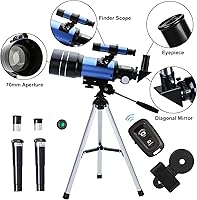
  • Aperture: The objective lens measures 70mm in diameter and is fully coated to improve light transmission and reduce internal reflections.
  • Focal Length: The optical tube has a 300mm focal length, which determines the magnification range achievable with each eyepiece.
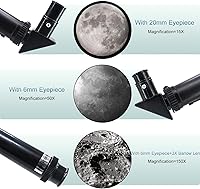
  • Magnification Range: Using the included eyepieces and Barlow lens, the scope delivers magnification from 15x at the low end up to 150x at the theoretical maximum.
  • Eyepieces: Two eyepieces are included: an H20mm for wider, lower-power views and an H6mm for higher-magnification planetary observation.
  • Barlow Lens: A 3x Barlow lens is included, which trebles the effective magnification of each eyepiece when inserted between the eyepiece and focuser.
  • Mount Type: The telescope uses an altazimuth mount, allowing smooth manual movement along horizontal and vertical axes without motorized tracking.
  • Finderscope: A reflex-style red dot finderscope is mounted on the tube to help users locate and center targets before switching to the main eyepiece.
  • Focus Type: Focusing is achieved manually via a rack-and-pinion focuser located at the rear of the optical tube.
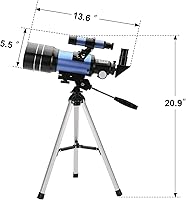
  • Dimensions: The assembled unit measures 11.8″ deep by 5.5″ wide by 20.9″ tall when set up on its tripod.
  • Weight: The complete setup weighs 3.56 pounds, making it light enough for children and easy to carry to outdoor observing locations.
  • Smartphone Adapter: A universal smartphone adapter is included, allowing users to mount a phone over the eyepiece for afocal photography.
  • Wireless Remote: A Bluetooth-compatible wireless shutter remote is included to trigger smartphone cameras without touching the phone, reducing vibration in photos.
  • Battery Requirement: The wireless remote requires one CR2032 coin cell battery, which is a standard size widely available at most retailers.
  • Lens Coating: The 70mm objective lens features full multi-coating designed to increase light transmittance and suppress reflected light for clearer images.
  • Warranty: ToyerBee provides a 3-year satisfaction guarantee, with customer support available for questions about defects, missing parts, or operational issues.
  • Target Audience: This scope is designed for astronomy beginners and children aged 8 and up who want a genuine optical instrument rather than a toy-grade alternative.
  • Primary Use Cases: The scope is best suited for lunar observation, basic planetary viewing, daytime terrestrial spotting, and introductory smartphone astrophotography.
  • Optical Design: This is a refractor telescope, meaning it uses a lens-based optical system rather than mirrors to gather and focus light.

Related Reviews
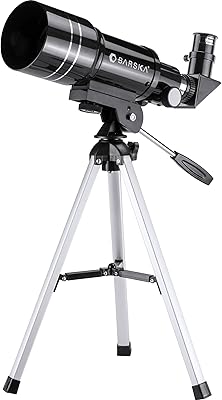
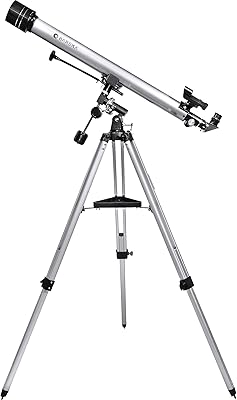
Barska Starwatcher 70mm Refractor Telescope
66%
72%
Optical Clarity
58%
Magnification Performance
54%
Build Quality
84%
Ease of Setup
88%
Portability & Storage
More
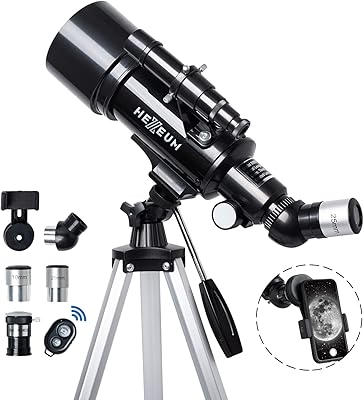
HEXEUM AZ50070 70mm Refractor Telescope
73%
78%
Optical Clarity
88%
Value for Money
57%
Tripod Stability
66%
Ease of Assembly
63%
Finderscope Usability
More
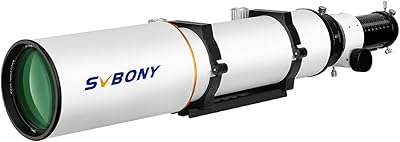
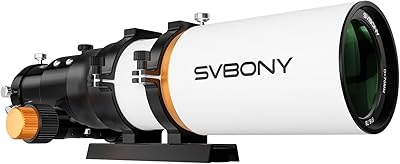
SVBONY SV503 70mm Refractor Telescope
83%
88%
Optical Clarity
91%
Field Flattener Performance
83%
Chromatic Aberration Control
79%
Focuser Quality
86%
Build & Tube Construction
More
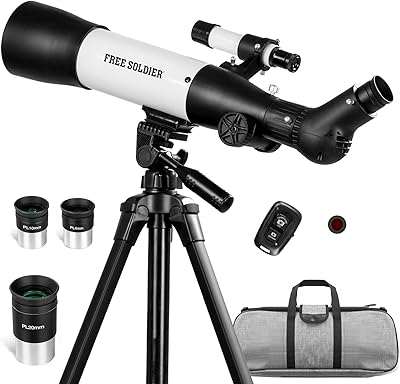
FREE SOLDIER 70mm Refractor Telescope
74%
78%
Optical Clarity
86%
Ease of Setup
58%
Tripod Stability
82%
Value for Money
84%
Moon & Planet Viewing
More
Barska Starwatcher Refractor Telescope 60mm
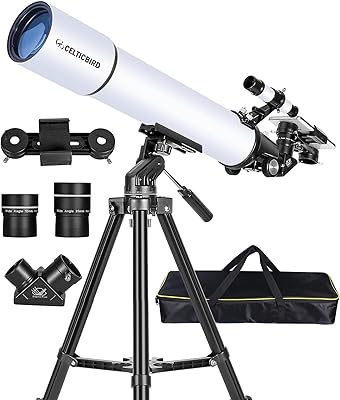
80%
91%
Value for Money
88%
Ease of Setup
93%
Portability
85%
Performance (Planetary Viewing)
62%
Performance (Deep-Sky Viewing)
More
Celticbird 80mm 800mm Refractor Telescope
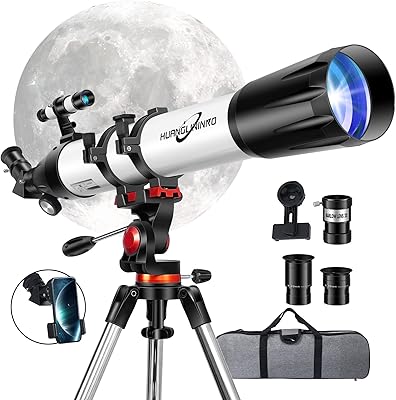
75%
83%
Optical Clarity
91%
Ease of Assembly
78%
Mount Usability
61%
Tripod Stability
58%
Included Eyepiece Quality
More
HUGERSTAR 80600 Refractor Telescope
70%
78%
Optical Clarity
88%
Ease of Setup
61%
Tripod Stability
83%
Value for Money
84%
Portability
More
PISEZ 90800 90mm Refractor Telescope
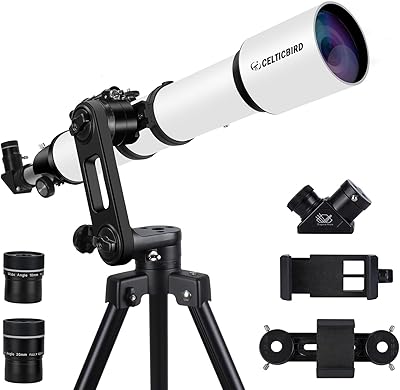
68%
83%
Optical Clarity
81%
Value for Money
72%
Ease of Setup
68%
Magnification Range
61%
Tripod Stability
More
CELTICBIRD 90700 90mm Refractor Telescope
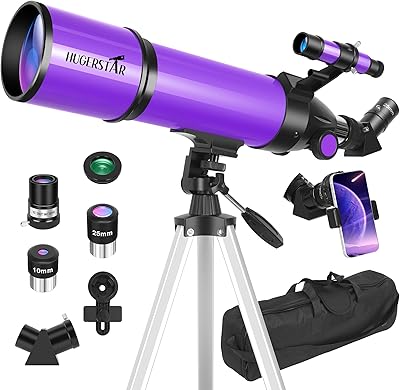
70%
83%
Optical Clarity
76%
Mount Precision
88%
Tripod Stability
81%
Ease of Assembly
62%
Finderscope Usability
More
CELTICBIRD 70mm Kids Refractor Telescope
75%
88%
Ease of Assembly
76%
Optical Clarity
61%
Tripod Stability
84%
Value for Money
71%
Magnification Range
More

FAQ

Mostly yes, with a little initial guidance. The first assembly takes most kids around 20 to 30 minutes, especially if they follow the included video instructions alongside the printed manual. After the first session together, the majority of children in that age range can set it up and start observing independently.

The moon is the standout target — crater detail, mountain ridges, and shadow contrast are all clearly visible and genuinely impressive for a first-timer. For planets, you can make out Saturn's rings and Jupiter's main cloud bands and moons on a clear, steady night. Deep-sky objects like galaxies or nebulae are largely out of reach; this beginner refractor is built for our solar system, not the distant universe.

In practice, no — at least not reliably. Image quality softens noticeably before you reach the maximum advertised magnification, and the tripod introduces enough vibration at that zoom level to make steady viewing difficult. The sweet spot for sharp, satisfying views sits at the mid-range settings, which is where most observers end up spending their time anyway.

The adapter clamps onto the eyepiece and holds your phone over it so the camera lens aligns with the eyepiece — a technique called afocal photography. It works with most standard-sized smartphones, but wider or larger-bodied phones can be tricky to seat securely. Getting the alignment right takes a few minutes of fiddling the first time, but once you find the position, lunar shots come out impressively well.

It is actually useful for one specific purpose: triggering your phone camera without physically tapping the screen, which is one of the main causes of blurry astrophotos. Whether it stays reliable over time is a bit inconsistent across units — some buyers use it regularly, others find it loses connectivity after a while. It runs on a CR2032 battery, so replacing that is the first fix to try if it stops responding.

Yes, it works reasonably well as a daytime spotting scope. The image will appear inverted (upside down) without an erecting prism, which is standard for astronomical refractors, so some users find that takes getting used to for terrestrial viewing. For casual birdwatching or landscape spotting at low magnification, it gets the job done.

At lower magnifications — wide moon views, for example — the tripod holds steady enough without much trouble. The issue shows up when you push to higher zoom, where even a gentle touch on the tube causes several seconds of wobble. Waiting for the vibration to settle before looking through the eyepiece is a common workaround, but it can be frustrating during fast-moving observation sessions.

Not really — the scope comes with enough to start observing right away: two eyepieces, a Barlow lens, a finderscope, a phone adapter, and a wireless remote. The one practical addition many buyers eventually make is a better-quality eyepiece, particularly in the mid-range focal length, which noticeably improves the viewing experience without a major expense.

ToyerBee handles support directly and encourages buyers to reach out for any issues with the scope or accessories. Most buyers report satisfactory resolutions for straightforward problems like missing parts or minor defects, with replacement components sent out without excessive hassle. A smaller subset of users report slower or less thorough responses for more complex optical or mechanical complaints, so experiences are not entirely uniform.

Probably not the right fit. This starter telescope is optimized for first-timers and casual observers — someone who has already used a decent intermediate scope will quickly notice the optical limitations, tripod instability, and basic eyepiece quality. If you have moved past the beginner stage and want to pursue more serious planetary or deep-sky observing, it is worth investing in a larger aperture scope with a more robust mount.

Where to Buy