Overview

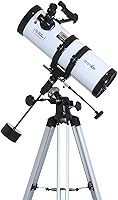
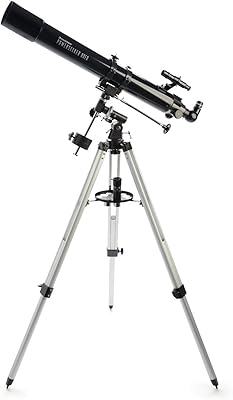
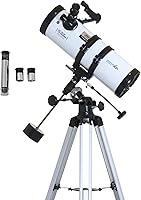
The Zoomion Philae 114/500 EQ Reflector Telescope occupies a genuinely useful spot in the beginner telescope market — not a toy, but not an intimidating piece of professional equipment either. Built around a Newtonian reflector design, it uses a 114mm primary mirror paired with a 500mm focal length to pull in considerably more light than the smaller refractors that tend to dominate this price range. What gives it a real edge over cheaper alternatives is the inclusion of an EQ-1 equatorial mount — a mechanical step up that most rivals at this tier simply skip. If you're comparing starter scopes for a child or yourself, this reflector telescope earns a closer look.
Features & Benefits

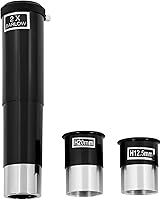
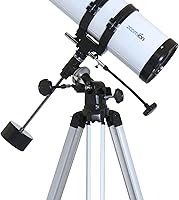
The optical advantage here starts with aperture. A 114mm mirror gathers noticeably more light than the 70mm or 90mm refractors commonly bundled into beginner kits, which translates to crisper views of the Moon's craters and Saturn's rings on a clear night. The EQ-1 mount includes slow-motion control knobs on two axes — once you've aligned it roughly with the celestial pole, you can nudge objects back into the eyepiece view instead of wrestling with the whole tube. The bundled Barlow lens effectively doubles your eyepiece options without extra cost. A red dot finderscope makes locating targets intuitive, and because nothing here runs on batteries, setup is straightforward even for a first-time user.

Best For

This beginner Newtonian scope is most at home in the hands of a curious child between 8 and 14 who has a parent willing to help with the initial setup. It's equally well-suited for adults stepping into astronomy for the first time after being disappointed by a cheap department-store scope. Suburban observers targeting the Moon, Jupiter, and Saturn will get real satisfaction from this instrument; those deep in a city with heavy light pollution may find its deep-sky performance limited. As a gift, the complete accessory bundle is a genuine plus — no scrambling to buy additional eyepieces. Compact enough to store in a closet, it won't collect dust simply because it's too bulky to move.

User Feedback

Many buyers describe their first views of the Moon through this reflector telescope as genuinely surprising — the level of crater detail visible on a clear night routinely draws praise from users who expected far less. That said, a common theme in reviews is the EQ-1 mount's wobble at higher magnifications; even minor vibrations can take a few seconds to settle, which tests patience during planetary sessions. Collimation is another recurring topic — a handful of buyers received a scope that needed mirror alignment out of the box, which is normal for Newtonians but can feel alarming if you're unprepared. Assembly instructions get mixed marks, and a few long-term owners note that some plastic components show wear after a year or two of regular use.

Pros

  • The 114mm mirror gathers noticeably more light than the smaller refractors common at this price point, delivering genuinely satisfying lunar and planetary views.
  • An EQ-1 equatorial mount is a meaningful upgrade over the alt-azimuth designs found on most beginner bundles.
  • Slow-motion control knobs on both axes let you nudge objects back into view without disturbing the whole setup.
  • The included Barlow lens effectively doubles your magnification range without any additional purchase.
  • A red dot finderscope makes pointing at targets intuitive, even for complete beginners.
  • No batteries or power source required — the entire scope runs manually, keeping things simple and reliable.
  • Compact full-tube design stores cleanly in a closet and does not demand dedicated shelf space.
  • Everything arrives in one package, so there is no scrambling to source compatible eyepieces or accessories.
  • Many buyers report that their first view of the Moon through this scope genuinely exceeded their expectations.
  • Well-suited as a shared family instrument that grows with a child's interest over several years.

Cons

  • The EQ-1 mount wobbles noticeably at higher magnifications — vibrations from even a light touch can take several seconds to settle.
  • Some units arrive needing mirror collimation straight out of the box, which can be alarming and confusing for first-time owners.
  • Assembly instructions have received consistent criticism for being unclear, especially for buyers with no prior telescope experience.
  • Several long-term owners have noted that plastic components — particularly on the focuser and mount — show wear after a year or two of regular use.
  • Deep-sky performance is very limited under suburban or urban light pollution; do not expect much beyond bright showpiece objects.
  • At over 25 pounds for the full package, this is not a scope you will casually carry to a remote dark-sky site on a whim.
  • The manual tracking system requires continuous attention during extended observing sessions, which can frustrate younger users.
  • The Zoomion Philae 114/500 EQ Reflector Telescope is entirely unsuitable for astrophotography beyond simple smartphone Moon shots.
  • Finderscope alignment can drift and may need re-zeroing more often than expected during regular use.

Ratings

Our AI rating engine analyzed thousands of verified global reviews for the Zoomion Philae 114/500 EQ Reflector Telescope, actively filtering out incentivized, duplicate, and bot-generated submissions to surface what genuine buyers actually experienced. The scores below reflect a balanced picture — celebrating where this beginner Newtonian scope genuinely delivers and being transparent about the friction points that real users encountered. Both the highs and the frustrations are represented here without bias.

Optical Performance
78%
22%
For a first-night session pointed at the Moon, most owners describe the detail as genuinely jaw-dropping at this tier — crater rims, mountain ranges, and terminator shadows all come through with clarity that surprises new astronomers. Jupiter's equatorial bands and Saturn's rings are reliably visible under steady skies, which is exactly what this reflector telescope promises.
At higher magnifications the image can soften, partly due to the fast f/4.4 focal ratio which is less forgiving of eyepiece quality. Deep-sky performance drops off sharply under suburban skies, and some users noted that uncollimated mirrors on arrival further degraded their early viewing experiences.
Mount Stability
54%
46%
The EQ-1 equatorial mount is a genuine step up from the wobbly alt-azimuth tripods bundled with cheaper beginner scopes, and the slow-motion control knobs on both axes give users a real sense of mechanical control while tracking the Moon across the eyepiece field.
At magnifications above roughly 100x, vibrations from focusing or even brushing the tube can take several uncomfortable seconds to settle — a recurring complaint among buyers. A handful of users also reported that the mount head felt slightly loose out of the box, requiring tightening before it would hold a position reliably.
Collimation Out of Box
61%
39%
When the mirrors arrive properly aligned, the views are noticeably sharp and rewarding from the first session. Many buyers who checked collimation on arrival found it close enough to use immediately without adjustment, which is a reasonable result for a shipped Newtonian.
A significant minority of reviewers received units where the primary or secondary mirror was visibly misaligned, producing soft or distorted images that baffled them until they discovered the collimation issue. For complete beginners who have never heard the term, this can be a discouraging and confusing first experience with the scope.
Assembly Experience
57%
43%
The physical components are logically organized in the packaging, and the overall build process is manageable for adults with basic mechanical confidence. Most buyers report completing first assembly within an hour, which is reasonable for a scope with an equatorial mount.
The included instruction manual draws consistent criticism for being vague, poorly translated, or missing key steps — particularly around polar alignment and finderscope calibration. Many reviewers ended up relying on third-party YouTube videos to fill in the gaps, which works but should not be necessary for a product at this price point.
Value for Money
74%
26%
Buyers consistently appreciate that the package includes an eyepiece set, Barlow lens, and finderscope — accessories that would add meaningful cost if purchased separately. Getting a 114mm Newtonian on an equatorial mount with a full accessory bundle represents solid overall value compared to similarly priced competitors.
A few buyers felt the mount quality in particular did not quite justify the price relative to some competing brands, and the plastic components in the focuser and mount head have led some to question long-term durability. Those who experienced collimation or assembly issues right out of the box found the value proposition harder to defend.
Build Quality
63%
37%
The optical tube itself feels solid and the full-tube design protects the mirrors reasonably well during transport and storage. The main structural components — the tube rings and dovetail bar — are adequate for the intended use and do not feel fragile during normal handling.
Plastic is used extensively in the focuser drawtube, mount clutches, and several adjustment knobs, and long-term owners note these components show the most wear over time. The focuser in particular has received criticism for developing slop or wobble after a year or two of regular use, which impacts focus precision.
Ease of Use
66%
34%
Once the initial setup hurdle is cleared, the day-to-day experience of this beginner Newtonian scope is straightforward — no apps, no batteries, no firmware. Children who have had an adult walk them through the basics are typically able to find and observe the Moon independently within a few sessions.
The equatorial mount has a steeper conceptual learning curve than a simple alt-azimuth design, and new users frequently struggle with polar alignment on their first few outings. Without clear instructions, features like the slow-motion controls are often underused because buyers simply do not know how to set them up correctly.
Portability
67%
33%
The compact full-tube design means the scope fits into a car boot without much drama, and it stores upright in a standard closet — a practical advantage for households without dedicated observatory space. The lack of any motorized components also means there are fewer fragile parts to worry about during transport.
At 25.2 pounds for the complete kit, this is not something you casually carry far from your car. Users hoping to hike to dark-sky sites or travel by public transport with the scope will find the combined weight and package size a real limitation in practice.
Finderscope Usability
71%
29%
The red dot finderscope is intuitive for beginners — point the dot at a bright object in the sky and you are most of the way there. First-time users generally appreciate it as a far more user-friendly starting point than traditional optical finder scopes with their narrow fields and inverted views.
The finderscope bracket can drift out of alignment with the main tube during transport, requiring recalibration before each session — a minor but recurring annoyance noted by regular users. At very low temperatures the red dot brightness can also appear inconsistent, though this is a common limitation of battery-powered reflex finders in general.
Accessory Quality
68%
32%
The Barlow lens performs reliably at lower multiplications and effectively doubles the eyepiece range without obvious image degradation on bright targets like the Moon. Having a bundled eyepiece set ready to go on day one is consistently praised by buyers who want to start observing without additional shopping.
The supplied eyepieces are functional rather than exceptional — coatings are basic and edge sharpness trails off compared to mid-range aftermarket options. Experienced observers who upgrade to better 1.25-inch eyepieces typically report a noticeable improvement in contrast and sharpness, suggesting the included accessories are adequate but not the final word.
Long-Term Durability
59%
41%
The primary mirror and optical tube show good resilience over time when the scope is stored with the dust cap on and kept in a stable indoor environment. Owners who treat the scope carefully and re-tighten hardware periodically report functional performance well beyond the two-year mark.
Multiple long-term reviewers flagged deterioration in the plastic focuser and mount fittings after 18 to 24 months of regular outdoor use. The EQ-1 mount in particular develops perceptible play in its axes over time, which becomes more noticeable and frustrating as users attempt higher magnification planetary work.
Suitability for Children
73%
27%
Children aged 10 and up who have a genuine interest in space can progress from supervised use to largely independent sessions within a few weeks, which is a realistic and rewarding arc for a budding young astronomer. The manual nature of the scope — no screens, no apps — keeps the focus on the actual sky rather than a device interface.
Younger children or those with limited patience will likely need continuous adult involvement, as polar alignment and target finding through the eyepiece require more spatial thinking than is intuitive for the under-10 age group. The assembly weight and mount complexity also mean unsupervised setup by a child is not realistic.
Tracking Capability
58%
42%
The manual slow-motion drives on both equatorial axes allow for smooth, controlled nudging of targets back into view as the Earth rotates — a noticeably more refined experience than the push-and-chase method required by alt-azimuth designs common at this price level.
Without a motorized drive, keeping a high-magnification planetary view centered requires constant minor corrections, which becomes tiring during extended sessions and is particularly challenging for younger users. The lack of any clock-drive option — even as an optional upgrade — is a limitation that users tend to feel more acutely as their skills grow.

Suitable for:

The Zoomion Philae 114/500 EQ Reflector Telescope is a strong match for families with children aged 8 and up who have shown a genuine interest in the night sky and want something more capable than a toy-store impulse buy. It also makes excellent sense for adults who are stepping into amateur astronomy for the first time and want a complete, ready-to-use setup without having to research and purchase accessories separately. Suburban or semi-rural observers will get the most out of it — on a clear night, the Moon's surface detail, Jupiter's cloud bands, and Saturn's rings are all within comfortable reach of this beginner Newtonian scope. The equatorial mount, while manual, introduces newcomers to how professional tracking works without the complexity of motorized systems, making it a practical learning tool as much as an observing one. Gift buyers will also appreciate that everything needed for a first session arrives in one box.
Not suitable for:

Buyers expecting to observe faint galaxies or nebulae from a light-polluted urban backyard will likely be disappointed — the aperture here is capable, but no telescope overcomes a washed-out sky, and this reflector telescope is no exception. Experienced hobbyists who have already worked with a 5-inch or larger instrument will find the optics and mount a step backward rather than an upgrade. The EQ-1 mount, while a notch above basic alt-azimuth designs, is not rigid enough for serious astrophotography — anyone hoping to attach a camera and shoot long exposures should look at a sturdier platform. At just over 25 pounds fully assembled, it is also not the right pick for someone who wants to hike to a dark site or travel frequently with their equipment. Finally, very young children under 8 or those prone to impatience may find the manual collimation and alignment process more frustrating than rewarding without consistent adult guidance.

Specifications

  • Optical Design: This telescope uses a Newtonian reflector design, which employs a parabolic primary mirror rather than lenses to gather and focus light.
  • Aperture: The primary mirror measures 114mm in diameter, giving it a meaningful light-gathering advantage over smaller 70mm or 90mm beginner refractors.
  • Focal Length: The optical tube has a focal length of 500mm, which suits wide-field views of the Moon and bright planets.
  • Focal Ratio: The telescope operates at f/4.4, a relatively fast focal ratio that keeps the tube compact while delivering bright images at lower magnifications.
  • Mount Type: An EQ-1 equatorial mount is included, allowing the telescope to track celestial objects by rotating on a single axis aligned with Earth's poles.
  • Tracking: Manual slow-motion control knobs on both the right ascension and declination axes allow the user to nudge objects back into the field of view without motorized assistance.
  • Finderscope: A reflex-style red dot finderscope is included to help users quickly locate and centre targets before observing through the main eyepiece.
  • Accessories: The package includes a set of eyepieces and a Barlow lens, which effectively doubles the magnification of each eyepiece without additional cost.
  • Focus Type: Focusing is performed manually via a rack-and-pinion or similar manual focuser integrated into the optical tube.
  • Power Source: The telescope and mount require no batteries or external power — all functions are entirely manual.
  • Item Weight: The fully assembled telescope and mount system weighs approximately 25.2 pounds (roughly 11.4 kg).
  • Package Size: The shipping package measures 31.34 x 15.35 x 10.71 inches, making it manageable for storage in a standard closet.
  • Recommended Age: Zoomion recommends this scope for users aged 8 years and older, with adult supervision advised during initial assembly and alignment.
  • Manufacturer: The telescope is designed and sold by Zoomion, a brand focused on entry-level and mid-range optical instruments for hobbyists.
  • Compatibility: The scope can be paired with a laptop or tablet for optional use with planetarium software or digital camera adapters, though no such adapters are included.
  • ASIN: The Amazon product identifier for this item is B017CMY7J8, which can be used to verify the exact listing before purchasing.

Related Reviews
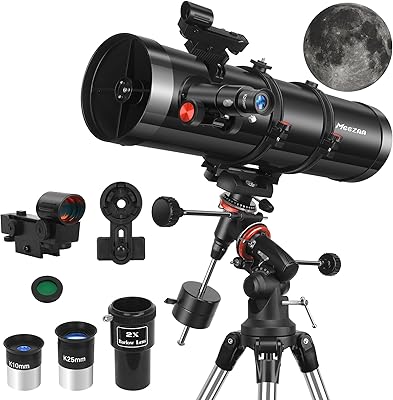
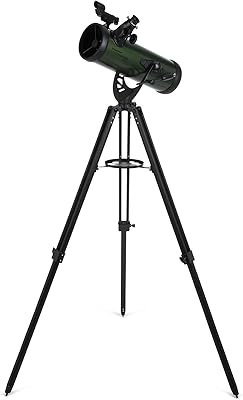
MEEZAA 150EQ Reflector Telescope
70%
83%
Optical Performance
89%
Aperture & Light Gathering
61%
Equatorial Mount Usability
58%
Collimation Out of the Box
67%
Tripod Stability
More
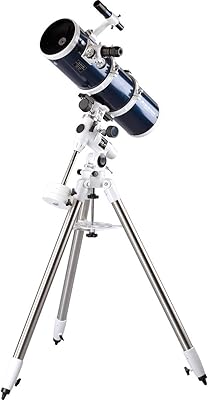
Celestron ExploraScope 114AZ Reflector Telescope
78%
83%
Optical Performance
91%
Ease of Setup
78%
Mount Usability
62%
Included Accessories
57%
Focuser Quality
More
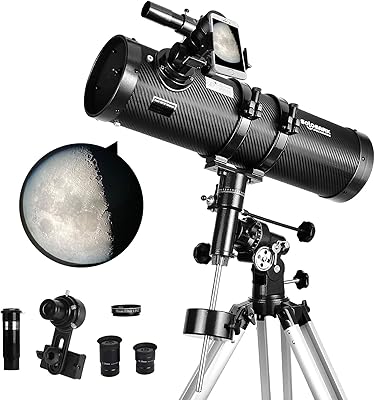
Celestron Omni XLT 150 Reflector Telescope
84%
91%
Optical Clarity
89%
Ease of Setup
85%
Mount Precision
88%
Build Quality
84%
Included Accessories
More
SOLOMARK Polaris 130EQ
69%
88%
Optical Clarity
91%
Aperture & Light Gathering
74%
German Equatorial Mount
82%
Build Quality & Materials
61%
Ease of Assembly
More
JBL Authentics 500
JBL Authentics 500
86%
92%
Sound Quality
89%
Bass Performance
85%
Design & Aesthetics
91%
Ease of Setup
84%
Connectivity & Compatibility
More
HURYSIN 8x42 Monocular
79%
74%
Optical Clarity
83%
Build Quality
88%
Waterproofing
86%
Eye Relief & Comfort
67%
Focus Mechanism
More
URBANCOAST 15x54 Monocular
77%
83%
Optical Clarity
81%
Build Quality
74%
Waterproofing & Weather Resistance
79%
Comfort & Ergonomics
77%
Magnification Performance
More
Celestron NexStar 90SLT Computerized Telescope
73%
78%
Optical Performance
83%
GoTo Accuracy
81%
Ease of Setup
86%
Portability
67%
Build Quality
More
AOMEKIE 40/400 Refractor Telescope
67%
72%
Optical Clarity
67%
Build Quality
88%
Ease of Assembly
54%
Tripod Stability
61%
Magnification Range
More
TruVoice HD-500 Wired Office Headset
80%
88%
Call Audio Clarity
83%
Noise-Canceling Microphone
81%
Comfort During Extended Wear
79%
Quick-Disconnect Functionality
74%
Build Quality & Durability
More

FAQ

Assembly takes most people between 30 and 60 minutes on the first try. The main challenge is attaching the optical tube to the EQ-1 mount and aligning the finderscope. The included instructions have received mixed feedback for clarity, so watching a setup video for the EQ-1 mount on YouTube before you begin is genuinely worth your time.

The Moon is the showstopper — crater detail is sharp and genuinely impressive. Jupiter's main cloud bands and its four Galilean moons are visible, and Saturn's rings are clearly defined. Bright open clusters and some nebulae are within reach if you are away from heavy light pollution, but faint deep-sky objects like distant galaxies will be very difficult from a suburban backyard.

Possibly, yes. Newtonian reflectors can shift out of alignment during shipping, and this beginner Newtonian scope is no exception. Before your first observing session, check whether the mirrors are properly aligned using the focuser as a reference. Collimation tools are inexpensive, and the process is straightforward once you have done it once — but if you skip it, your views will be noticeably softer than they should be.

An equatorial mount tilts and rotates to match the angle of Earth's rotational axis. In practice, this means that once you align it roughly with the north celestial pole, you only need to turn one knob to keep an object in view as the Earth rotates — rather than adjusting two axes separately as you would with a simpler alt-azimuth mount. It adds a small learning curve but makes extended observing sessions much less frustrating.

For children aged 10 and up with some patience, independent use is realistic after an adult handles the initial setup and polar alignment. Younger children or those new to any kind of technical hobby will likely need ongoing help, especially with focusing and locating targets. Think of it less as a solo toy and more as a shared family instrument.

Basic smartphone Moon shots through the eyepiece are absolutely doable and can look great. However, serious astrophotography — long-exposure shots of galaxies or nebulae — is not realistic with this setup. The EQ-1 mount lacks the rigidity and precision tracking that astrophotography demands, and there is no motorized drive included.

This is one of the more common complaints from owners. At moderate magnifications the mount performs acceptably, but push it higher with the Barlow lens and any vibration — even from adjusting the focuser — can take a few seconds to settle. Observing on a calm night and avoiding touching the tube while viewing helps considerably.

It handles suburban skies reasonably well for the Moon and bright planets, which are not significantly harmed by light pollution. If you are deep in a city core with a heavily orange-washed sky, your deep-sky results will be very limited. Getting even 20–30 miles away from the city centre makes a noticeable difference to what this scope can reveal.

Yes. The focuser on this scope accepts standard 1.25-inch eyepieces, which is the most common size on the market. You will have a wide selection of affordable aftermarket eyepieces, filters, and other accessories to choose from as your interest in the hobby grows.

The optics themselves tend to hold up well if the scope is stored properly and the mirrors are kept dust-free. The weakest points noted by long-term owners are the plastic components on the mount and focuser, which can show wear or looseness over time with heavy use. Treating it with reasonable care — keeping it covered when not in use and tightening hardware periodically — goes a long way toward extending its lifespan.