Overview

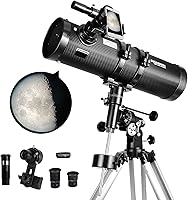
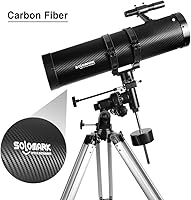
The SOLOMARK Polaris 130EQ is a 130mm Newtonian reflector that sits in an interesting middle ground — capable enough to satisfy curious intermediate stargazers, yet accessible enough for dedicated beginners ready to move beyond entry-level gear. What sets it apart at this price tier is the German equatorial mount, a feature usually reserved for pricier setups. The carbon fiber-wrapped tube gives it a polished, purposeful look that feels a step above the plastic-heavy scopes cluttering the beginner market. Just set expectations accordingly: this isn't something you grab and toss in a car. It's a backyard observatory setup that rewards patience and a consistent observing spot.
Features & Benefits

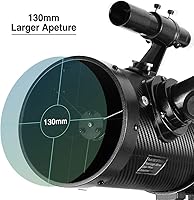
The 130mm aperture is the headline spec here, and it earns its billing. Compared to the 70–90mm refractors that dominate the entry-level shelf, it pulls in noticeably more light — enough to reveal Saturn's rings with satisfying clarity and tease out structure in brighter nebulae. The fully coated objective lens improves contrast, reducing the washed-out look that plagues cheaper optics. Two eyepieces, a 1.5x Barlow, and a 13% moon filter come in the box, so you're not immediately hunting for accessories. The 650mm focal length hits a practical sweet spot, and the aluminum alloy tripod with its accessory tray keeps your kit organized during a session.

Best For

This equatorial telescope makes the most sense for adults who've outgrown a basic scope and want something with real optical muscle — without jumping to a motorized rig. It's built for lunar and planetary observing: the moon, Saturn, Jupiter, and Mars all show well. If you enjoy learning the mechanics of tracking celestial objects by hand rather than pressing a button, the equatorial mount becomes a feature, not a frustration. One honest caveat: at 32.8 lbs assembled, it's not particularly portable. This is a scope that thrives when it has a permanent backyard spot and an owner who returns to it regularly.

User Feedback

With over 1,100 ratings averaging 4.3 stars, the Polaris 130EQ has earned a solid reputation among backyard astronomers. The most consistent praise centers on first-night lunar views — many buyers say the first time they locked onto the moon or Saturn, they were hooked. Assembly takes time, and the equatorial mount has a real learning curve; don't expect to be tracking planets confidently on night one. A handful of users received units needing mirror collimation straight out of the box — normal for reflectors but potentially off-putting for newcomers. The bundled smartphone adapter works acceptably for lunar shots but won't satisfy anyone with deeper astrophotography ambitions.

Pros

  • The 130mm aperture delivers noticeably brighter, sharper views than typical entry-level scopes in the same category.
  • Saturn's rings and Jupiter's cloud bands are clearly visible — genuinely impressive results for a backyard setup.
  • The German equatorial mount enables smooth manual tracking, a meaningful upgrade over basic alt-azimuth designs.
  • Fully coated objective lens improves contrast and reduces glare compared to uncoated optics at this price point.
  • The included moon filter makes extended lunar sessions comfortable and adds real observing value out of the box.
  • Carbon fiber tube wrap and aluminum alloy tripod give this Newtonian reflector a build quality that feels above its class.
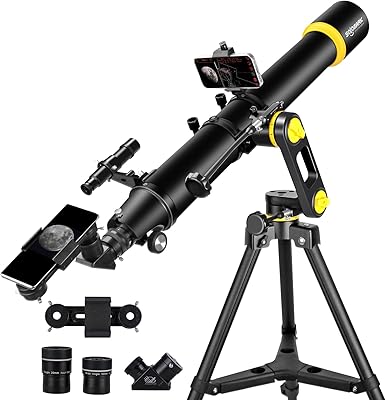
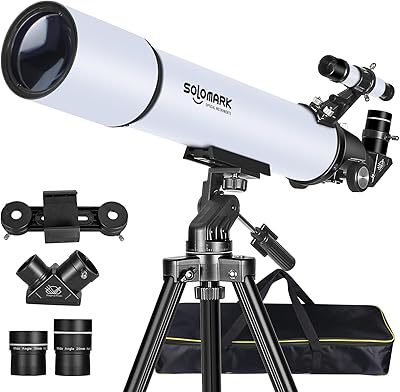
  • The accessory bundle — two eyepieces, Barlow lens, moon filter, and smartphone adapter — means you're observing on night one.
  • The equatorial mount is mechanically compatible with motor drive upgrades, giving the scope a useful long-term upgrade path.
  • At over 1,100 verified ratings averaging 4.3 stars, the Polaris 130EQ has a strong and consistent real-world track record.

Cons

  • Assembly takes significantly longer than expected — first-time setup commonly runs 90 minutes to three hours.
  • The instruction manual is thin on detail for polar alignment and collimation, forcing many users to seek outside resources.
  • Some units arrive with the mirror out of collimation, which is a frustrating first experience for brand-new buyers.
  • The straight-through finderscope becomes awkward and uncomfortable when the tube is aimed near the zenith.
  • The included eyepieces are functional but modest — most serious users replace at least one within a few months.
  • At nearly 33 lbs assembled, spontaneous transport to dark-sky sites is genuinely impractical for most users.
  • The focuser feels noticeably less solid than the rest of the build, occasionally introducing drift during fine adjustments.
  • The smartphone adapter works for moon shots but lacks the precision needed for any consistent astrophotography workflow.
  • No motor drive is included, and finding a confirmed-compatible tracking motor requires extra research beyond the manual.

Ratings

Our AI rating system analyzed thousands of verified global reviews for the SOLOMARK Polaris 130EQ, actively filtering out incentivized, duplicate, and bot-generated submissions to surface what real buyers actually experienced. The scores below reflect a balanced picture — where this Newtonian reflector genuinely impresses and where it falls short of expectations. Both the highlights and the frustrations are represented transparently, so you can make a confident, informed decision.

Optical Clarity
88%
Most buyers are genuinely surprised by how crisp lunar detail appears on the first clear night — crater rims, mountain ridges, and shadow lines all come through with real definition. Saturn's rings and Jupiter's cloud bands are consistently cited as standout views that justify the purchase for planetary observers.
At higher magnifications, some users notice softening toward the field edges, which is typical for fast Newtonian designs but can disappoint those expecting uniform sharpness across the entire eyepiece view. A small number of units arrived with optics that needed recentering before delivering their best performance.
Aperture & Light Gathering
91%
The 130mm aperture is the single biggest advantage this scope holds over typical entry-level alternatives. Users stepping up from a 70mm refractor consistently describe it as a revelation — brighter stars, visible nebula structure, and far more detail on planetary surfaces become accessible in a way smaller scopes simply cannot match.
While 130mm is a genuine upgrade, it still has real limits on deep-sky performance, especially under light-polluted suburban skies. Faint galaxies and diffuse nebulae require dark skies and patient eyes; buyers expecting Hubble-like deep-space views are routinely let down.
German Equatorial Mount
74%
26%
For users willing to learn polar alignment, the equatorial mount transforms the tracking experience compared to basic alt-azimuth designs. Manually following the moon across the sky feels intuitive once you understand the single-axis motion, and the fine-tuned control cables give a satisfying degree of precision during longer viewing sessions.
The learning curve is real and steep for first-timers. Several reviewers spent their first two or three sessions struggling with polar alignment rather than actually observing, and the instructions provided are not always sufficient to bridge that knowledge gap independently.
Build Quality & Materials
82%
18%
The carbon fiber tube wrap gives the Polaris 130EQ a noticeably more premium feel than similarly priced scopes, and the aluminum alloy tripod legs feel solid under real-world backyard conditions. Most users report no flexing or play in the tube rings during normal use, which matters when you're trying to hold a steady view at high magnification.
Some buyers noted that the focuser feels a little loose compared to the rest of the build, occasionally introducing drift during fine focusing. A handful of reviewers also flagged that certain plastic fittings on the mount head felt inconsistent with the otherwise sturdy construction.
Ease of Assembly
61%
39%
The individual components are well-labeled, and buyers with any prior experience assembling equipment generally get through the process without major frustration. Once assembled, the overall structure feels stable and the accessory tray on the tripod is a genuinely useful touch that keeps small parts from getting lost in the dark.
For complete beginners, assembly takes considerably longer than expected — estimates in reviews range from 90 minutes to over three hours on the first attempt. The equatorial mount head in particular requires careful attention to axis orientation, and the included manual does not always provide enough visual guidance to make this intuitive.
Collimation
63%
37%
Experienced amateur astronomers appreciate that the mirror is accessible and adjustable, allowing a proper collimation check to become part of a routine before each session. When collimation is dialed in correctly, the optical improvement is noticeable and the effort feels worthwhile as part of owning a reflector.
A meaningful subset of buyers received units that were noticeably out of collimation straight from the box, which is a disorienting first experience for someone brand new to the hobby. The process is learnable but not trivial, and the telescope's documentation provides minimal guidance on how to approach it correctly.
Included Accessories
77%
23%
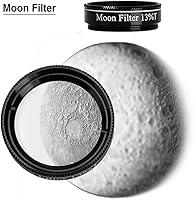
Getting two eyepieces, a Barlow lens, a moon filter, and a smartphone adapter in the box represents solid out-of-the-box value. The 13% moon filter in particular earns consistent praise — it makes extended lunar sessions far more comfortable without any additional spending required.
The eyepieces are functional but not exceptional; serious observers typically replace at least one within a few months. The smartphone adapter works adequately for lunar snapshots but lacks the stability and precision needed for anything beyond casual documentation of bright objects.
Astrophotography Capability
54%
46%
For capturing detailed moon shots on a smartphone — especially with the included adapter — results are genuinely satisfying for a casual hobbyist. Several buyers have shared impressive lunar photos taken through this scope using nothing more than a mid-range phone camera pressed to the eyepiece.
Deep-sky and planetary photography beyond basic moon shots requires motorized tracking and dedicated camera equipment that this scope does not support natively. Users approaching this scope with astrophotography as a primary goal are consistently disappointed by the limitations of the manual equatorial setup.
Tripod Stability
81%
19%
The wide-stance aluminum alloy tripod handles mild wind and accidental nudges without the vibration ringout that plagues cheaper tubular tripods. At high magnification, where even a slight tremor ruins the view, most users find the platform steady enough for comfortable sustained observation.
On uneven ground — a common real-world scenario in backyards — leveling the tripod can be fiddly, and the leg locks require some firmness to stay put under load. A small number of buyers on softer grass surfaces reported the leg tips sinking slightly over a long session.
Portability & Storage
47%
53%
The optical tube can be detached from the mount for storage, which helps manage the bulk somewhat. Users who dedicate a garage shelf or storage closet to the setup find it manageable to bring out for regular evening sessions without excessive inconvenience.
At 32.8 lbs assembled, this is not a telescope you casually transport to a dark-sky site. Buyers who anticipated taking it to star parties or rural locations frequently report that the size and disassembly time make spontaneous trips impractical compared to lighter grab-and-go alternatives.
Value for Money
83%
For the aperture, mount type, and accessory bundle offered, the Polaris 130EQ delivers competitive value within its market tier. Buyers who researched alternatives consistently note that comparable aperture and an equatorial mount together would cost meaningfully more from other established brands.
The value equation shifts if you factor in the likely need to purchase replacement eyepieces and potentially a collimation tool. For buyers who want a truly ready-to-use experience without additional investment, the out-of-box value feels slightly less complete than the spec sheet implies.
Finderscope Usability
66%
34%
The straight-through finderscope does its job for locating bright targets like the moon and major planets, and its alignment is generally consistent out of the box. For observers learning the sky manually, using a finderscope to star-hop is a useful skill the included unit can support.
A straight-through design requires awkward neck and body positions when the telescope is pointed near the zenith, which is a genuine usability issue during extended sessions. Intermediate users often swap it for a red-dot finder relatively quickly, describing the original as serviceable but not ergonomic.
Instruction Manual Quality
44%
56%
The manual covers the basic mechanical assembly clearly enough that most users can get the tube and tripod together without major confusion. Diagrams for the main structural components are reasonably clear and match the physical parts well.
Beyond assembly, the manual falls short — polar alignment, collimation, and optimal eyepiece selection are either skimmed over or absent entirely. Multiple reviewers specifically called out the documentation as a weak point that forced them to rely on YouTube tutorials and astronomy forums to unlock the scope's potential.
Motor & Tracking Upgrade Path
58%
42%
The German equatorial mount is mechanically compatible with standard motor drive attachments, meaning users who want to eventually automate tracking have a viable upgrade path without replacing the entire setup. This gives the scope a degree of future-proofing that alt-azimuth alternatives lack.
The motor drive is not included, and finding confirmed-compatible motors for this specific mount model requires research and some trial and error. Users expecting a simple plug-and-play motor upgrade are often frustrated by the lack of clear guidance from the manufacturer on compatible hardware.

Suitable for:

The SOLOMARK Polaris 130EQ is built for adults who have already caught the astronomy bug and are ready to move beyond the limitations of a starter scope. If you've spent a season squinting through a 70mm refractor and found yourself frustrated by dim, low-detail views, the jump to 130mm aperture on a proper equatorial mount will feel like a significant and rewarding step forward. This scope is particularly well-matched to hobbyists who want to spend serious time on the moon and planets — Saturn's rings, Jupiter's cloud bands, and lunar craters in sharp relief are realistic, repeatable results with this setup. It also suits the kind of person who enjoys learning the mechanical side of astronomy: polar alignment, manual celestial tracking, and occasional mirror collimation are all part of the experience, and buyers who embrace that find it genuinely satisfying. A reasonably dark backyard or low-light suburban patio is the ideal environment, and having a dedicated spot to set it up — rather than lugging it in and out of a car — will make regular use much more practical.
Not suitable for:

The SOLOMARK Polaris 130EQ is not the right choice for someone who wants to walk outside, point a telescope at something interesting, and be done in ten minutes. Complete beginners with no prior experience assembling optical equipment or understanding equatorial mounts may find the initial setup and learning curve genuinely discouraging — this scope rewards patience, not impulse. Travelers and star-party enthusiasts who need a portable setup should look elsewhere; at nearly 33 lbs assembled and with a multi-component disassembly process, frequent transport quickly becomes a chore. Buyers with serious astrophotography ambitions — deep-sky imaging, long-exposure planetary work — will hit the ceiling of what this manual equatorial setup can support relatively fast and will likely need to invest in motorized tracking and dedicated camera equipment before long. And if the appeal of astronomy is mainly casual, low-commitment stargazing on occasional clear nights, a simpler alt-azimuth scope would deliver similar enjoyment with far less setup friction.
Specifications

  • Optical Design: This telescope uses a Newtonian reflector design, which uses a parabolic primary mirror to collect and focus light rather than glass lenses.
  • Aperture: The primary mirror has a diameter of 130mm, enabling significantly greater light collection than typical 70–90mm beginner instruments.
  • Focal Length: The optical tube has a focal length of 650mm, yielding a native focal ratio of approximately f/5.
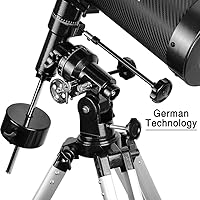
  • Mount Type: The telescope is mounted on a German equatorial mount with fine-tuned dual-axis control cables for manual celestial tracking.
  • Tripod Material: The adjustable tripod legs are constructed from aluminum alloy and include a central accessory tray for storing eyepieces and small attachments.
  • Tube Surface: The exterior of the optical tube is finished with a carbon fiber wrap, contributing to a lightweight yet rigid frame structure.
  • Objective Lens: The objective mirror features fully coated glass optics designed to improve light transmission, contrast, and overall image brightness.
  • Eyepieces: Two eyepieces are included in the box; specific focal lengths allow for both lower-power wide-field and higher-power detailed viewing.
  • Barlow Lens: A 1.5x erecting Barlow lens is included, which increases effective magnification while also correcting image orientation for terrestrial use.
  • Moon Filter: A 1.25″ moon filter with 13% light transmission is included to reduce glare and improve contrast during bright lunar observations.
  • Smartphone Adapter: A 1.25″-compatible smartphone adapter is included for attaching a mobile phone to the eyepiece for casual afocal photography.
  • Finderscope: The included finderscope is a straight-through design, used for locating and centering objects before switching to the main eyepiece.
  • Focus Type: Focusing is achieved manually via a rack-and-pinion or Crayford-style focuser adjusted by hand during observation sessions.
  • Assembled Weight: The fully assembled telescope, mount, and tripod system weighs approximately 32.8 lbs, making it best suited for stationary backyard use.
  • Product Dimensions: Assembled dimensions are approximately 39.37″ deep by 7.87″ wide by 59.06″ tall, reflecting the full tripod-extended height of the system.
  • Power Source: The mount operates entirely manually with no battery or electrical requirement; a power adapter referenced in listings relates to optional accessories only.
  • Tube Length: The optical tube measures 650mm in length, consistent with the focal length of the Newtonian design.
  • Compatibility: The equatorial mount head is mechanically compatible with standard single-axis motor drive attachments for those wishing to add automated tracking later.

Related Reviews
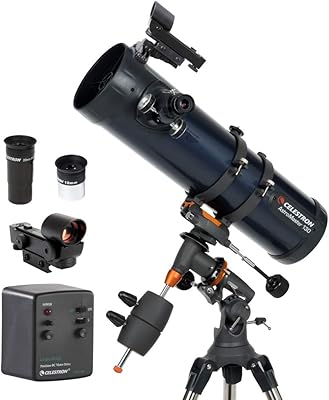
Celestron AstroMaster 130EQ-MD Telescope
82%
88%
Ease of Setup
92%
Motorized Tracking Performance
90%
View Clarity (Planets & Moon)
85%
Portability
70%
Equatorial Mount Setup
More
SOLOMARK 90mm 1000mm Telescope for Adults & Kids
81%
88%
Ease of Use
92%
Setup/Installation
85%
Portability/Size/Weight
78%
Magnification Performance
75%
Stability (Tripod)
More
SOLOMARK 80900 Professional Refractor Telescope 80mm Aperture
84%
92%
Ease of Setup
88%
Image Clarity
94%
Portability
85%
Phone Adapter for Astrophotography
80%
Build Quality
More

FAQ

Expect to spend at least 90 minutes on your first assembly, possibly longer if you're new to equatorial mounts. The optical tube and tripod go together fairly quickly, but getting the equatorial head oriented correctly and polar-aligned takes patience. Watch a few YouTube tutorials before your first night out — it makes a real difference.

Not always, but it's worth checking. Some units arrive perfectly aligned, while others need a minor adjustment after shipping. Collimation sounds intimidating, but for a Newtonian reflector it's a straightforward process once you've done it once — a collimation cap or laser collimator (sold separately) makes it even easier. Most experienced users make it a quick pre-session habit.

Yes, reliably. Saturn's rings are one of the highlights of this equatorial telescope, and they're visible with good definition using the included eyepieces under reasonably dark skies. Jupiter's main cloud bands and the Galilean moons are also easy targets. Expectations should be realistic — these are small, detailed disc views, not wide photographic images — but they're genuinely impressive for a backyard setup.

It can show you brighter deep-sky objects — the Orion Nebula, the Andromeda Galaxy, and various star clusters are all accessible. However, faint galaxies and diffuse nebulae require dark skies and some experience with averted vision to see well. Under typical suburban light pollution, don't expect dramatic detail on most deep-sky targets; lunar and planetary work is where this scope truly shines.

It has a real learning curve, no question. Polar alignment means pointing the mount's right ascension axis toward Polaris (the North Star), which sounds simple but takes a few sessions to do confidently and accurately. Once you get it right, manual celestial tracking becomes smooth and intuitive. Give yourself two or three nights of practice before expecting a polished experience.

You can attach a smartphone using the included adapter, which works well for moon photography and gives satisfying results with a steady hand. For DSLR or mirrorless camera astrophotography, the manual equatorial mount is a significant limitation — long-exposure deep-sky imaging requires motorized tracking that this setup does not include out of the box. Casual lunar snapshots are realistic; serious astrophotography is not.

Technically you can transport it, but at nearly 33 lbs assembled and with several components to disassemble and repack, it's not a quick or enjoyable process for regular trips. Most owners who do take it to dark-sky locations do so infrequently and plan the outing in advance. If portability is a priority, a lighter alt-azimuth Dobsonian or a compact refractor would serve you better.

With the 650mm focal length and the included eyepieces, you can reach useful magnifications for lunar and planetary work. A general rule is that a 130mm aperture can support a maximum practical magnification of around 260x under good seeing conditions, though most observers find 100–150x is the sweet spot for consistent sharp views. The included 1.5x Barlow extends your range without needing to buy additional eyepieces immediately.

The included eyepieces are decent for getting started, but most observers who stick with the hobby end up upgrading at least one within a few months. A quality wide-field eyepiece for low-power scanning and a sharper high-power option will noticeably improve the experience. Think of the included ones as solid starters, not permanent solutions.

Absolutely — it's arguably better suited to a motivated teenager or young adult than it is to a very young child. The assembly, polar alignment, and collimation all involve real learning that engaged young astronomers tend to embrace. The main consideration is that it works best with some adult guidance during the initial setup and first few sessions to avoid frustration.