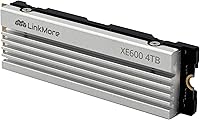





Overview

The LinkMore XE600 4TB NVMe SSD enters a competitive market with a clear pitch: serious storage capacity at a price that undercuts the more established big names. For PS5 owners watching their game library shrink as modern titles push past 100GB each, 4TB is not overkill — it is breathing room. What sets this drive apart right out of the box is the pre-installed aluminum heatsink, which removes one extra purchase from your setup checklist. LinkMore is not Samsung or WD, and it does not try to be. Speeds are genuinely competitive on paper, though real-world results will depend on your system and usage.

Features & Benefits

Running on a PCIe Gen4 x4 interface, this LinkMore drive lists sequential read speeds up to 7200 MB/s and writes up to 6500 MB/s — figures that place it among the faster options in its class, though those numbers come from manufacturer testing and may not fully replicate in every setup. The M.2 2280 form factor drops directly into the PS5 expansion bay without any adapter, and NVMe 1.4 keeps it compatible with current-generation motherboards. The included heatsink manages thermal load during long gaming sessions, and the drive also carries dust and shock resistance, with chips produced in Taiwan. Capacity options span 500GB all the way to 8TB.

Best For

The XE600 SSD is a natural fit for PS5 owners who have exhausted their console's built-in storage and want one large-capacity solution rather than rotating external drives in and out. PC builders on Gen4-capable platforms will find it a solid primary or secondary drive candidate. Content creators working with 4K footage may appreciate the sustained write performance, though serious production workloads deserve real benchmark comparisons first. Anyone who has dreaded sourcing a separate heatsink will genuinely appreciate having one pre-attached. Put simply, this Gen4 NVMe upgrade targets buyers who want substantial headroom and a straightforward installation experience above all else.

User Feedback

Across more than 600 verified ratings, this LinkMore drive holds a strong 4.7-star average — and the reviews behind that number tell a fairly consistent story. Hassle-free PS5 installation and the sheer scale of 4TB storage are the most repeated highlights, with buyers frequently noting the drive was detected and ready without any configuration friction. On the flip side, some reviewers point out a noticeable gap between advertised and actual transfer speeds, which is not unusual for any NVMe drive but is worth factoring into expectations. Brand familiarity concerns surface occasionally, a fair consideration for a newer name. Long-term reliability data remains limited, so reviewing warranty terms beforehand is a smart move.

Pros

  • 4TB capacity handles even the largest modern game libraries without constant drive management.
  • The pre-installed aluminum heatsink saves you the cost and hassle of sourcing one separately.
  • Native M.2 2280 form factor slots into the PS5 expansion bay without any adapter required.
  • Rated sequential read speeds up to 7200 MB/s are competitive with top-tier Gen4 drives on paper.
  • Over 600 verified buyers give this Gen4 NVMe upgrade an impressive 4.7-star average rating.
  • Dust and shock resistance adds a layer of reassurance for drives handled during installation or transport.
  • Chips manufactured in Taiwan suggest reasonable quality control for a value-oriented drive.
  • Available in a wide range of capacities from 500GB to 8TB, suiting different budgets and needs.
  • PS5 installation is consistently described by buyers as smooth and detected without configuration issues.

Cons

  • Real-world transfer speeds often fall short of the advertised 7200 MB/s figures, as with most drives.
  • LinkMore is a relatively unknown brand, which makes long-term reliability harder to assess confidently.
  • Limited independent benchmark data makes it difficult to verify performance claims under sustained workloads.
  • Warranty terms and after-sales support infrastructure are not as clearly established as major competitors.
  • Buyers comparing value against established brands like Samsung or WD may find the gap closer than expected.
  • Random read and write performance details are not prominently disclosed, a concern for mixed workload users.
  • The drive lacks the track record and user longevity data that older brands have accumulated over years.

Ratings

The LinkMore XE600 4TB NVMe SSD scores below are generated by AI after systematically analyzing verified global buyer reviews, actively filtering out incentivized, bot-generated, and low-quality feedback to surface what real users actually experienced. This drive earns strong marks in several areas but also carries honest weaknesses that the data does not hide. Both the highs and the friction points are reflected transparently so you can make a genuinely informed call.

PS5 Compatibility
93%
Buyers installing this LinkMore drive into a PS5 consistently report a smooth, frustration-free experience — the drive seats correctly, the console formats it promptly, and the pre-attached heatsink clears the bay without modification. For a console upgrade, that level of plug-and-play reliability is exactly what most users are hoping for.
A small number of users noted that PS5 firmware updates occasionally require re-confirmation of the expansion drive, which is a console-side behavior rather than a drive fault but still caught some buyers off guard. Nothing that prevents use, but worth knowing.
Sequential Read Speed
78%
22%
Under optimal conditions on a Gen4-capable PC, this Gen4 NVMe upgrade delivers impressively fast large-file transfers — moving game installs or large video exports feels noticeably quicker than older Gen3 drives. Users upgrading from SATA or Gen3 NVMe hardware report a clear, tangible improvement.
The advertised 7200 MB/s figure is a manufacturer peak under controlled conditions, and real-world sustained reads typically land lower depending on thermal state, workload type, and system configuration. A few technically inclined reviewers measured results meaningfully below the marketing spec during prolonged transfers.
Storage Capacity
96%
Four terabytes is a genuinely practical amount of storage for modern gaming — users describe being able to keep their entire active library installed simultaneously without the tedious cycle of deleting and redownloading titles. For PS5 owners in particular, the jump from the console's base storage feels transformative.
A small portion of the 4TB is consumed by formatting overhead and internal drive functions, so the usable figure is slightly less than the headline number — a standard industry reality, but one that surprises some buyers who expected the full 4TB accessible from day one.
Heatsink Design
88%
Having the aluminum heatsink pre-installed removes a genuinely annoying step from the PS5 upgrade process — no need to source a separate one or worry about compatibility with Sony's dimensional requirements. PC users in warmer cases also appreciate having thermal management sorted from the start.
Users in very compact or poorly ventilated PC builds note that the added heatsink height can create clearance conflicts with neighboring components or motherboard-integrated M.2 covers. It is not a widespread issue, but in tight ITX builds it is worth checking clearances before installation.
Write Speed Performance
74%
26%
For large sequential writes — dumping 4K footage from a camera card, copying large game files between drives — the XE600 SSD handles the workload with respectable throughput that outpaces Gen3 alternatives by a clear margin in real use.
Sustained write performance under prolonged heavy workloads shows more variability than the spec sheet implies, with some users reporting speed dips during extended large transfers as thermal limits are approached. Random write performance, which matters more for mixed workloads, is not prominently specified.
Installation Experience
91%
Outside of needing a small screwdriver for the PS5 bay cover, the physical installation process is about as uncomplicated as internal drive upgrades get. Reviewers with no prior PC building experience specifically mention completing the PS5 installation without difficulty using basic online guides.
Documentation included in the packaging is minimal, and buyers who are less comfortable with hardware may feel underserved without clearer printed instructions. LinkMore's online support resources are functional but not as comprehensive as those offered by more established storage brands.
Value for Money
79%
21%
Relative to flagship options from Samsung or WD at comparable capacities, this LinkMore drive lands at a more accessible price point while delivering competitive headline specs. Buyers who prioritize getting the most terabytes per dollar spent tend to view it favorably in post-purchase reviews.
A subset of buyers who compared it directly to established brands questioned whether the savings fully offset the uncertainty around long-term reliability and brand support. The value equation is strongest for buyers who are comfortable with a newer brand and less critical for those who factor in peace of mind as part of the purchase.
Build Quality
82%
18%
The drive feels solid in hand, the heatsink is firmly attached rather than loosely clipped, and the dust and shock resistance ratings give it a bit more reassurance than bare drives in the same price range. Chips manufactured in Taiwan suggest a level of component sourcing that buyers found credible.
There is no independent third-party certification or published endurance rating (TBW figure) readily available for this drive, which makes it harder to objectively assess long-term durability compared to competitors who publish that data prominently.
Brand Reliability
61%
39%
Moment Semiconductor, the manufacturer behind LinkMore, is a real Taiwan-based company with verifiable chip production — this is not a pure white-label reseller situation, and that distinction matters to buyers who dug into the brand before purchasing.
LinkMore simply does not have the years of public reliability data that Samsung, Crucial, or WD have accumulated, and that absence is a legitimate concern for buyers storing irreplaceable files. Several reviewers flagged brand unfamiliarity as their primary hesitation, even after a positive purchase experience.
Thermal Management
81%
19%
During typical gaming sessions on the PS5, users report that the drive runs without any console warnings or thermal-related slowdowns, suggesting the pre-installed heatsink does its job under normal console workloads. That is the primary use case it was designed for, and it holds up well.
In high-ambient-temperature environments or inside PC cases with restricted airflow, some users observed higher-than-expected drive temperatures during sustained workloads. The heatsink helps, but it is not a substitute for good overall system airflow, particularly in warmer climates.
Warranty & Support
57%
43%
LinkMore does provide a warranty and lists a support contact on their website, which is more than some ultra-budget alternatives offer. Buyers who reached out for firmware or compatibility questions reported receiving responses, indicating the support channel is functional.
The warranty terms are not clearly surfaced at point of purchase, and the claims process is not as streamlined or well-documented as those from major brands. A few buyers expressed frustration navigating support for questions that Samsung or WD would typically resolve through robust self-service portals.
Broad PC Compatibility
86%
The M.2 2280 form factor and NVMe 1.4 protocol cover virtually every modern desktop and laptop with an M.2 slot, and the drive also works in Gen3 slots at reduced speeds — useful for buyers upgrading mixed-generation systems or older motherboards.
Users with older Gen3 motherboards who expected Gen4 performance were disappointed to find the drive caps at Gen3 speeds in those systems, which is expected behavior but not prominently flagged in the product listing. Backward compatibility is present but not a performance guarantee.
Noise & Vibration
94%
As a solid-state drive with no moving parts, the XE600 SSD operates in complete silence — not a single buyer comment mentions acoustic issues, which is exactly what you expect and want from NVMe storage in a gaming or workstation environment.
There is genuinely nothing negative to flag here for this product category; silence is a baseline expectation of NVMe drives, and this one meets it without exception. This score reflects category default performance rather than a standout differentiator.

Suitable for:

The LinkMore XE600 4TB NVMe SSD was built with a very specific buyer in mind, and for that buyer it makes a lot of sense. PS5 owners who have watched their internal storage disappear under the weight of modern open-world titles and large game installs will find 4TB a genuinely comfortable upgrade — enough to store a full library without the constant chore of deleting and re-downloading. The drive drops into the PS5 expansion slot natively and ships with an aluminum heatsink already attached, so the installation process is about as straightforward as it gets for a console upgrade. PC builders working on Gen4-capable platforms will also find it a capable primary or secondary drive, particularly those prioritizing capacity over chasing the absolute top benchmark scores. Content creators handling large video assets who want fast sequential throughput without paying flagship brand premiums are another good fit. If your priority is getting a large, fast, and thermally managed drive into your system without a complicated setup, this LinkMore drive checks those boxes effectively.

Not suitable for:

The LinkMore XE600 4TB NVMe SSD is a harder sell for buyers who place brand legacy and long-term reliability data above all else. LinkMore is a newer name in the storage space, and if you are someone who will lose sleep over a drive from a less-established manufacturer holding years of irreplaceable data, you would be more comfortable with a Samsung 990 Pro or WD Black SN850X despite their higher cost. Workstation users and professionals running demanding read-write workloads continuously — video editors working in real time, database operators, or anyone doing sustained random I/O at scale — should scrutinize independent benchmark data carefully before committing, since manufacturer-listed speeds do not always reflect mixed workload performance. Those seeking the absolute peak in random access speeds for competitive PC gaming may find more headroom with drives from brands that have deeper public performance records. Buyers who prioritize comprehensive, well-documented warranty support should verify the terms directly before purchasing, as after-sales infrastructure for newer brands can vary significantly.

Specifications

  • Capacity: The drive is available in this configuration at 4TB usable storage, with some portion reserved for formatting and internal performance functions.
  • Interface: Connects via a PCIe Gen4 x4 interface, offering the full bandwidth headroom of fourth-generation NVMe on compatible motherboards and the PS5.
  • Protocol: Operates on the NVMe 1.4 protocol, ensuring broad compatibility with modern gaming consoles and current-generation PC platforms.
  • Form Factor: Built in the M.2 2280 form factor, measuring 3.15 x 0.94 x 0.43 inches to fit standard M.2 slots on motherboards and the PS5 expansion bay.
  • Sequential Read: Manufacturer-rated maximum sequential read speed is up to 7200 MB/s under controlled internal testing conditions.
  • Sequential Write: Manufacturer-rated maximum sequential write speed reaches up to 6500 MB/s under controlled internal testing conditions.
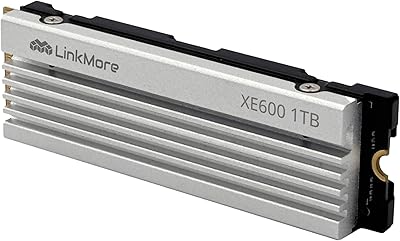
  • Heatsink: Ships with a pre-installed aluminum heatsink designed to dissipate heat during sustained read and write operations.
  • Weight: The drive weighs 1.23 ounces, making it light enough to handle without any special tooling during installation.
  • PS5 Support: Officially compatible with the PlayStation 5 M.2 expansion slot, requiring no adapter for installation.
  • Durability: The drive carries dust resistance and shock resistance ratings, offering basic protection against environmental particulates and physical handling impacts.
  • Chip Origin: Internal NAND chips are manufactured in Taiwan by Moment Semiconductor, Inc., the parent manufacturer behind the LinkMore brand.
  • Capacity Range: The XE600 series spans multiple capacities from 500GB up to 8TB, allowing buyers to select the tier that fits their storage needs and budget.
  • Manufacturer: Produced by Moment Semiconductor, Inc., a Taiwan-based semiconductor company that markets storage products under the LinkMore brand name.
  • Hardware Platform: Compatible with both PC platforms running PCIe Gen4-capable motherboards and the PlayStation 5 gaming console.
  • Release Date: This product first became available on Amazon in July 2023, making it a relatively recent entrant in the Gen4 NVMe market.

Related Reviews
LinkMore XE600 1TB PCIe Gen4 NVMe SSD
89%
95%
Read Speed Performance
93%
Write Speed Performance
90%
PS5 Compatibility
83%
Thermal Management
88%
Build Quality
More
PHIXERO PM7450 4TB NVMe SSD
81%
93%
Sequential Read Performance
87%
Sequential Write Performance
61%
QLC Endurance & Longevity
88%
Thermal Management
84%
Burst Write Speed
More
WD_BLACK SN8100 4TB NVMe SSD
82%
97%
Sequential Throughput
93%
Random I/O Performance
61%
Thermal Management
67%
Value for Money
82%
Installation & Compatibility
More
Ediloca EN870 4TB NVMe M.2 SSD
78%
91%
Sequential Read Speed
58%
Sustained Write Performance
93%
PS5 Compatibility
84%
Value for Money
89%
Installation Experience
More
WD_BLACK SN850X 4TB NVMe SSD
89%
93%
Performance
88%
Thermal Management
87%
Software & Firmware
91%
Ease of Installation
90%
Build Quality
More
PHIXERO P7000PRO 4TB NVMe SSD
80%
88%
Sequential Read Speed
82%
Sequential Write Speed
76%
Thermal Management
84%
Value for Money
91%
Installation Experience
More
Fikwot FX550 4TB NVMe M.2 SSD
79%
93%
Storage Capacity Value
88%
Sequential Read Speed
61%
Sustained Write Performance
91%
Value for Money
89%
Installation & Compatibility
More
WD_BLACK 4TB SN7100 NVMe SSD
87%
94%
Performance (Speed)
92%
Storage Capacity
85%
Power Efficiency
89%
Installation & Setup
91%
Durability & Reliability
More
fanxiang S690Q 4TB NVMe SSD
87%
93%
Performance
95%
Speed (Read/Write)
90%
Ease of Installation
88%
Thermal Management
87%
Build Quality
More
XPG SX8100 4TB NVMe SSD
82%
92%
Performance
89%
Value for Money
75%
Installation Ease
90%
Reliability
94%
Speed (Read/Write)
More

FAQ

Yes, it fits the PS5 M.2 expansion slot directly in the M.2 2280 form factor, and it comes with the heatsink already attached — which is a PS5 installation requirement. You just need a small Phillips screwdriver to open the expansion bay cover. Most buyers report the console recognizes it immediately after a quick format prompt.

Probably not consistently. Those figures are from manufacturer testing under ideal conditions, and real-world speeds depend heavily on your system, workload type, and thermal conditions. On the PS5, the console itself manages storage throughput, so you are unlikely to hit peak sequential numbers regardless of which Gen4 drive you use. For gaming, the practical difference between a 6000 MB/s and 7200 MB/s drive is minimal in day-to-day play.

That is a fair concern and worth taking seriously. LinkMore is the consumer brand for Moment Semiconductor, Inc., a Taiwan-based chip manufacturer — so there is a real company behind it, not just a white-label reseller. That said, they do not have the decades-long track record of Samsung or Western Digital, and independent long-term reliability studies for this specific drive are limited. The LinkMore XE600 4TB NVMe SSD has earned a strong user rating across hundreds of reviews, which is encouraging, but if long-term reliability data matters most to you, the brand gap is a real consideration.

No, the pre-installed heatsink is designed to fit inside the PS5 expansion bay as-is. Sony allows heatsinks up to a certain thickness in that slot, and this one is built within those dimensions. Leave it on — it helps manage heat during gaming sessions.

The PS5 ships with an 825GB internal drive, of which around 667GB is actually usable. A 4TB expansion drive gives you roughly six times more usable space, which is enough to hold a very large library of modern titles simultaneously without deleting and redownloading games constantly.

Yes, as long as your motherboard has an M.2 slot running PCIe Gen4. It will also work in a Gen3 slot, but you will be limited to Gen3 speeds in that case. For most gaming PCs, it works well as either a primary boot drive or a high-speed secondary storage drive.

In most standard PC builds, the heatsink thickness should not cause clearance issues, but it is worth double-checking your motherboard manual if components are tightly packed. Some motherboards also include their own M.2 heatsinks, and you would typically remove the drive's heatsink before using a motherboard-integrated one — though for PS5 use, just leave the factory heatsink on.

Like most NVMe drives under heavy sustained loads, it may throttle speeds to protect itself from overheating if temperatures climb high enough. The aluminum heatsink helps delay that threshold, but in a poorly ventilated PC case or during very long transfer sessions, some thermal throttling is possible. In normal gaming use on a PS5 or a well-ventilated PC, this is unlikely to be a noticeable issue.

Warranty terms should be verified directly with the seller or on LinkMore's official support channels before purchasing, as they can vary by region and retailer. As a newer brand, their support infrastructure is not as widely documented as more established competitors, so confirming the warranty period and the claims process beforehand is a smart step, especially for a drive storing important data.

For most PS5 gamers, 4TB is a sweet spot — large enough to avoid storage headaches for years, without stepping up to the 8TB tier where pricing climbs significantly. If you are on a tighter budget and mostly play a rotating selection of a few games, the 1TB or 2TB options may be more sensible. But if you tend to keep large open-world games, multiple Call of Duty installs, or a growing digital library, 4TB will feel noticeably more comfortable than 1TB or 2TB options.