Overview

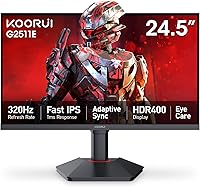
The KOORUI G2511E 24.5-Inch 320Hz Gaming Monitor is KOORUI's push into serious competitive territory at a price that won't drain your build budget. The brand has been quietly building a following among budget-focused PC builders, and this is one of their most spec-forward releases yet. The 320Hz refresh rate is the obvious headline — in fast-paced shooters, that level of fluidity genuinely affects how quickly you can track and react to moving targets. Resolution stays at 1080p, a reasonable trade-off at 24.5 inches for esports-oriented use, though content creators may find it limiting. The glossy IPS panel is a notable differentiator from the matte TN screens common at this price range.
Features & Benefits

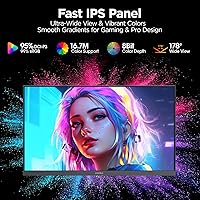
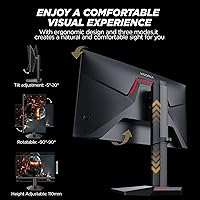
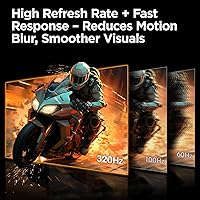
At the heart of the G2511E's appeal is its 320Hz and 1ms response combination — in titles like CS2, Valorant, and Apex Legends, you'll notice how cleanly enemies animate and how little blur trails motion. The IPS panel delivers 95% DCI-P3 color coverage, which is genuinely strong for the category; colors pop without looking oversaturated. HDR400 support is included, but keep expectations realistic — it's entry-level HDR, not the deep contrast you'd see on a premium OLED. The ergonomic stand is a real highlight: tilt, height, and vertical pivot adjustments are features that often cost extra elsewhere. Adaptive Sync works across both AMD and Nvidia setups, and the dual HDMI plus DisplayPort layout handles most multi-device configurations well.

Best For

This 320Hz IPS display is built around one type of buyer: the competitive FPS player who wants smooth, responsive performance above all else. If you're running a mid-range GPU like an RTX 4060 or RX 7600 and regularly pushing 1080p past 200fps in shooters, the G2511E is properly matched to your hardware. It's also a smart pick for first-time builders who want a capable display without paying premium prices. Anyone jumping up from a 144Hz or 165Hz monitor will feel the difference quickly in Valorant or CS2 — the 320Hz step-up is meaningful. The compact 24.5-inch footprint and flexible stand also work well for tighter desk setups where adjustability matters.

User Feedback

Since the G2511E only hit shelves in May 2025, verified buyer reviews are still thin on the ground, so take early impressions with appropriate caution. That said, the questions most buyers will care about — panel uniformity and backlight bleed consistency — are worth watching as more feedback accumulates. On the 320Hz debate: plenty of experienced users argue the jump from 240Hz is harder to perceive than the leap from 144Hz, and that conversation is worth keeping in mind. The split warranty — one year on the display itself, three on accessories — is an unusual structure that buyers should factor in. KOORUI's customer service responsiveness will also matter more given how new this product is.

Pros

  • 320Hz refresh rate delivers genuinely smoother motion in fast-paced shooters compared to 144Hz or 165Hz panels.
  • IPS panel with 95% DCI-P3 coverage produces richer, more accurate colors than typical TN monitors at this price.
  • Full ergonomic stand — tilt, height, and vertical pivot — is rare and practical at this price tier.
  • Adaptive Sync works with both AMD and Nvidia GPUs, so you are not locked into one ecosystem.
  • Dual HDMI 2.0 ports make switching between a PC and a console straightforward without extra adapters.
  • 1ms GTG response time keeps ghosting minimal during high-speed gameplay sequences.
  • DisplayPort 1.4 supports the full 320Hz output without bandwidth bottlenecks.
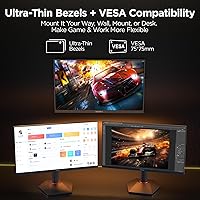
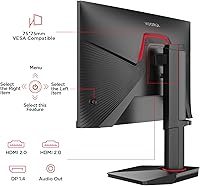
  • VESA 75x75mm compatibility gives flexible mounting options for arm or wall setups.
  • Compact 24.5-inch size keeps the footprint manageable for tight or multi-monitor desk setups.
  • The price-to-refresh-rate ratio is hard to beat for buyers focused on competitive esports performance.

Cons

  • Only one year of warranty coverage on the display panel itself is shorter than many competitors offer.
  • The glossy screen surface causes noticeable glare in rooms with strong ambient or natural lighting.
  • HDR400 support is entry-level at best — do not expect meaningful contrast or brightness improvements over SDR.
  • 1080p resolution can look soft on a 24.5-inch screen for anyone used to 1440p or higher pixel density.
  • As a product launched in mid-2025, long-term durability and quality consistency remain unverified.
  • The jump from 240Hz to 320Hz is subtle — buyers upgrading from 240Hz may not notice a dramatic difference.
  • 350 nits peak brightness is modest and may feel underwhelming in HDR or brighter room conditions.
  • No USB hub functionality limits desk cable management options compared to similarly priced rivals.

Ratings

The scores below reflect our AI-powered analysis of verified global buyer feedback for the KOORUI G2511E 24.5-Inch 320Hz Gaming Monitor, with spam, bot-generated, and incentivized reviews actively filtered out before scoring. Each category captures both what real users praised and where they ran into friction, giving you an honest picture of this display's strengths and limitations. Nothing is glossed over — the numbers reflect the full range of buyer experiences, from first impressions out of the box to longer-term daily use.

Refresh Rate Performance
93%
Competitive FPS players consistently highlight how fluid movement feels in Valorant and CS2 at 320Hz compared to their previous 144Hz or 165Hz panels. Tracking fast-moving targets and reacting to sudden visual cues feels noticeably cleaner, and the difference is especially apparent during sustained high-frame-rate sessions.
Buyers upgrading specifically from a 240Hz display report a less dramatic improvement than they expected — the perceptual jump from 240Hz to 320Hz is genuinely subtle. To fully utilize 320Hz, you also need a DisplayPort 1.4 connection and a GPU capable of pushing consistently high frame counts, which not every buyer has.
Response Time
88%
The 1ms GTG spec translates well to real-world play, with minimal ghosting during fast lateral movement in shooters and battle royale titles. Users who previously dealt with noticeable smearing on slower IPS panels were pleasantly surprised by how clean motion looks during intense gameplay.
Some users note that achieving true 1ms performance depends on enabling the monitor's overdrive setting in the OSD, and getting the right overdrive level dialed in takes a few minutes of adjustment. At higher overdrive settings, a small number of buyers observed inverse ghosting (coronas around moving objects), so some trial and error is involved.
Color Accuracy
84%
The 95% DCI-P3 coverage is a genuine differentiator at this price point — colors in games with rich environments look noticeably more saturated and lifelike compared to standard sRGB IPS panels. Users doing light photo viewing and casual creative work appreciated the warmer, more vibrant palette out of the box.
The factory calibration is not perfect for color-critical work, and buyers who care about accurate color grading will want to run a manual calibration or at least adjust the color temperature in the OSD. The glossy surface also amplifies color saturation in ways that can look slightly overcooked in brightly lit rooms.
HDR Quality
51%
49%
HDR400 certification means the G2511E can accept an HDR signal from your PC or console and display brighter highlights than standard SDR output. In some games with HDR support, users noticed slightly more pop in bright outdoor scenes and lighting effects.
HDR400 is widely considered entry-level, and most experienced users disable it because the contrast improvement is marginal on an IPS panel without local dimming. Buyers expecting meaningful HDR depth — deep blacks, strong tone mapping, or cinematic brightness peaks — will be underwhelmed compared to what higher-tier HDR displays deliver.
Panel Uniformity
67%
33%
The majority of units delivered acceptable uniformity for gaming use, with consistent brightness and color across most of the panel surface during typical gaming sessions. Users primarily using a dark desktop background or playing in dimly lit environments generally did not flag uniformity as an issue.
A portion of early buyers reported mild backlight bleed in the corners, which becomes visible on dark loading screens or in darker game environments. Since the product is new and sample sizes are still small, it is hard to determine whether this reflects a manufacturing consistency issue or isolated unit variance.
Ergonomics & Stand
91%
The stand's range of adjustability — height, tilt, and full 90-degree portrait pivot — is consistently praised as being well above what buyers expected at this price tier. Users with multi-monitor setups or those who switch between landscape and portrait orientations found the pivot functionality especially useful.
The stand base takes up a moderate amount of desk depth, and a small number of buyers found the height range slightly limited for very tall or very low desk configurations. Cable management through the stand is functional but minimal compared to premium monitor stands that include dedicated routing channels.
Build Quality
74%
26%
The overall construction feels solid enough for daily desk use, and the stand does not wobble noticeably during normal typing or gaming sessions. Most buyers describe the plastic chassis as feeling appropriately sturdy for the price rather than cheap or flimsy.
The monitor is built primarily from plastic, and a few buyers noted that the rear panel and bezels feel thinner than monitors at a higher price point. There is currently limited data on long-term durability since the product only launched in May 2025, so build quality over a multi-year lifespan remains unconfirmed.
Connectivity
86%
Having two HDMI 2.0 ports alongside a DisplayPort 1.4 is a practical setup that lets users keep a PC and a console connected simultaneously without unplugging anything. The included audio out jack is a small but appreciated convenience for users who run headphones directly from their monitor.
There is no USB hub built into the monitor, which is a feature some competing displays at similar prices include for cable management convenience. HDMI 2.0 also caps out below 320Hz at 1080p, so buyers expecting to hit the panel's maximum refresh rate via HDMI will be disappointed until they switch to DisplayPort.
Adaptive Sync
89%
The G2511E works reliably with both AMD FreeSync and Nvidia G-Sync Compatible setups, which means it functions well across a wide range of mid-range GPUs without compatibility headaches. Users with RTX 4060 and RX 7600 builds reported smooth, tear-free gameplay across a broad frame-rate range.
G-Sync Compatible certification is not the same as full G-Sync hardware, so Nvidia users may notice occasional micro-stuttering at very low frame rates below 48fps. The effective sync range within the OSD is worth checking and adjusting, as default settings do not always optimize for the smoothest low-framerate experience.
Brightness & Glare
63%
37%
At 350 nits, the display is bright enough for evening and dim-room gaming sessions, and the glossy surface makes colors feel more vivid and punchy than comparable matte panels in those conditions. Users in controlled lighting setups frequently commented on how clean and sharp the image looks.
In rooms with natural daylight or overhead lighting, the glossy coating becomes a real problem — reflections from windows and lamps can wash out the image during daytime hours. The 350 nit ceiling also means the monitor cannot overcome strong ambient lighting the way higher-brightness matte displays can.
Value for Money
92%
For buyers focused on competitive 1080p gaming, the combination of a 320Hz IPS panel, full ergonomic stand adjustability, and Adaptive Sync support at this price is genuinely difficult to match in the current market. Students and first-time builders consistently describe it as the most capable display they could find without exceeding their budget.
The one-year display warranty is a meaningful drawback relative to competitors that cover their panels for two or three years at similar price points, which slightly undermines the overall value proposition. Buyers prioritizing long-term peace of mind may find the warranty gap worth paying extra to close with a competing brand.
OSD & Setup
72%
28%
The on-screen display is logically organized and covers the key settings buyers need — overdrive, refresh rate confirmation, HDR toggle, and color mode selection are all accessible without digging through confusing sub-menus. Initial setup out of the box is straightforward and most buyers reported being gaming within minutes of unboxing.
The OSD button placement on the rear of the monitor is functional but not particularly intuitive, and a few users found themselves accidentally adjusting the wrong setting in the dark during gameplay. The OSD also lacks some advanced calibration options that more experienced users look for, such as precise white point adjustment or per-channel color controls.
Resolution Clarity
69%
31%
At 24.5 inches, 1080p looks acceptably sharp for fast-paced gaming, and the IPS panel renders fine in-game text and UI elements cleanly enough for daily use. Esports titles with simpler visual styles look particularly clean given the high frame rate and responsive pixel response.
Users coming from a 1440p or higher-resolution display will immediately notice the step down in pixel density — desktop icons, text rendering, and detailed game textures all look softer by comparison. For anything beyond gaming — productivity work, web browsing with lots of text, or video editing — 1080p at this screen size feels like a limitation.
Unboxing & Packaging
78%
22%
The packaging is well-padded and the monitor arrived undamaged for the vast majority of buyers, which is an important baseline given how fragile large glossy panels can be in transit. Assembly of the stand requires no tools and most buyers had it fully set up in under five minutes.
The box includes only a basic set of accessories — one cable is included, but buyers wanting to immediately use both HDMI and DisplayPort simultaneously will need to supply their own second cable. The included documentation is minimal, with no printed calibration guide or OSD walkthrough for first-time monitor buyers.

Suitable for:

The KOORUI G2511E 24.5-Inch 320Hz Gaming Monitor is purpose-built for competitive FPS players who want every frame-rate advantage they can get in titles like Valorant, CS2, or Apex Legends. If you're running a mid-range GPU — an RTX 4060, RX 7600, or similar — and regularly hitting high frame counts at 1080p, this display is genuinely well-matched to that hardware. Students and first-time builders will appreciate that it doesn't force a compromise between refresh rate and ergonomics; the adjustable stand with height, tilt, and vertical pivot is a feature set that typically costs noticeably more elsewhere. Gamers stepping up from a 144Hz or 165Hz panel will feel the fluidity difference quickly in fast-paced multiplayer. The compact 24.5-inch footprint and VESA compatibility also make it a strong fit for smaller desks or multi-monitor arrangements where flexibility matters.
Not suitable for:

Buyers expecting a well-rounded creative or productivity display should look elsewhere — the G2511E's 1080p resolution at 24.5 inches is fine for gaming but starts to feel limiting for photo editing, video work, or detailed design tasks where pixel density matters. The glossy panel, while vibrant in dim or controlled environments, can become a glare problem in brightly lit rooms with windows nearby, so if your workspace gets a lot of ambient light, a matte-screen alternative is worth considering. HDR400 support sounds appealing on paper, but it delivers only a modest improvement over standard dynamic range — buyers expecting cinematic HDR contrast will be disappointed. The warranty structure is also worth noting: display coverage lasts just one year, shorter than what several competing brands offer at similar price points. Finally, since this monitor only launched in May 2025, there is limited long-term reliability data available, which may give pause to buyers who prioritize proven track records over early adoption.

Specifications

  • Screen Size: The display measures 24.5 inches diagonally, a common competitive gaming size that balances field-of-view coverage with fast eye tracking.
  • Panel Type: Uses an IPS (In-Plane Switching) panel, which provides wider viewing angles and better color consistency than TN alternatives at this price tier.
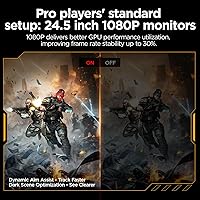
  • Resolution: Native resolution is 1920x1080 (Full HD), delivering sharp visuals for esports at this screen size without requiring a high-end GPU.
  • Refresh Rate: Rated at 320Hz, this is the panel's maximum refresh rate and requires a DisplayPort 1.4 connection to achieve at full resolution.
  • Response Time: Specified at 1ms GTG (gray-to-gray), minimizing motion blur and ghosting during fast-paced gameplay sequences.
  • Color Gamut: Covers 95% of the DCI-P3 color space, offering noticeably richer and more saturated colors than standard sRGB monitors in the same category.
  • HDR Support: Supports HDR400 certification, which provides a baseline level of high dynamic range; this is entry-level HDR and should not be compared to HDR1000 or OLED performance.
  • Brightness: Peak brightness is rated at 350 candelas per square meter (nits), adequate for dim-to-moderate ambient lighting conditions.
  • Screen Surface: The panel uses a glossy surface coating, which enhances color vibrancy but can produce reflections in rooms with strong direct or ambient light sources.
  • Aspect Ratio: Standard 16:9 widescreen aspect ratio, compatible with all modern gaming resolutions and console outputs without stretching or letterboxing.
  • Ports: Connectivity includes two HDMI 2.0 ports, one DisplayPort 1.4, and one 3.5mm audio output jack for headphones or external speakers.
  • Adaptive Sync: Compatible with both AMD FreeSync and Nvidia G-Sync Compatible standards, reducing screen tearing across a wide range of GPU setups.
  • Stand Adjustments: The included stand supports tilt, height, and vertical (pivot) adjustment, allowing the monitor to rotate 90 degrees into portrait orientation.
  • VESA Mount: Supports VESA 75x75mm mounting pattern, compatible with most standard monitor arms and wall-mount brackets.
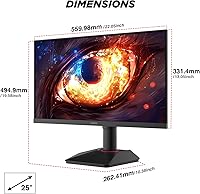
  • Dimensions: Assembled unit with stand measures approximately 22.05 inches wide, 19.58 inches tall, and 10.38 inches deep.
  • Weight: Complete unit including stand weighs 12.92 pounds, which is typical for a monitor of this size and stand construction.
  • Warranty: KOORUI covers the display panel for 1 year and included accessories for 3 years; this split structure differs from standard full-unit warranties offered by some competitors.
  • Availability: The G2511E first became available in May 2025, making it a recently launched product with limited long-term reliability data in the public domain.

Related Reviews

CRUA CR245ZB 24.5″ Gaming Monitor
78%
83%
Gaming Performance
86%
Refresh Rate & Smoothness
74%
Color Accuracy & Vibrancy
91%
Ergonomics & Adjustability
68%
Build Quality & Materials
More
KOORUI E2411K 24-inch Gaming Monitor
76%
91%
Value for Money
83%
Gaming Performance
74%
Image & Color Quality
88%
Refresh Rate & Smoothness
81%
Eye Comfort
More
Dell G2524H Gaming Monitor 24.5-inch
87%
92%
Performance
96%
Refresh Rate
88%
Build Quality
91%
Ergonomics
93%
Display Quality
More
KTC H25X7 24.5-inch 400Hz Gaming Monitor
75%
92%
Refresh Rate Performance
84%
Panel Color Quality
91%
Value for Money
88%
Input Lag & Responsiveness
86%
Connectivity Options
More
GIGABYTE GS25F2 24.5″ FHD Gaming Monitor
80%
93%
Refresh Rate Performance
88%
Response Time & Motion Clarity
84%
Color Accuracy & Vibrancy
91%
Value for Money
87%
Adaptive Sync (FreeSync)
More
Gawfolk GF240A 24.5-inch 200Hz Gaming Monitor
68%
83%
Refresh Rate Performance
79%
Response Time & Motion Clarity
71%
Image & Color Quality
88%
Value for Money
57%
Build Quality & Stand
More
Acer Nitro KG251Q 24.5-inch Gaming Monitor
77%
93%
Refresh Rate Performance
91%
Value for Money
86%
Motion Clarity
82%
Image Contrast & Blacks
61%
Color Accuracy
More
Gawfolk GF245A 24.5-Inch Curved Gaming Monitor
72%
88%
Value for Money
79%
Image Quality
83%
Refresh Rate Performance
81%
Response Time
63%
Build Quality
More
Z-Edge UG25I 24.5-inch 240Hz Gaming Monitor
83%
92%
Value for Money
90%
Gaming Performance
89%
Display Quality
85%
Ergonomics & Design
84%
Connectivity Options
More
EPORMOT 24.5″ 165Hz 2K Portable Monitor
79%
88%
Image Quality
91%
Refresh Rate & Smoothness
62%
Portability
86%
Kickstand & Ergonomics
79%
Build Quality
More

FAQ

Yes — you will need a DisplayPort 1.4 cable to reach 320Hz at 1080p. HDMI 2.0, which is also included on the G2511E, tops out at around 240Hz at this resolution, so if you plug in via HDMI expecting the full 320Hz, you will be capped short. Make sure your GPU also has a DisplayPort 1.4 output available.

Honestly, the jump from 240Hz to 320Hz is subtle and harder to perceive than moving from 144Hz to 240Hz. Most players will feel a slight smoothness improvement in very fast tracking scenarios in games like Valorant or CS2, but it is not a night-and-day difference. If you are coming from 144Hz or 165Hz, the improvement will feel much more significant.

That depends on your hardware and the game. A mid-range GPU like an RTX 4060 or RX 7600 can comfortably exceed 200fps in esports titles like CS2 or Valorant at 1080p on medium-to-high settings, which gives you a real benefit from this display. In more demanding games like AAA titles, you will likely be well below 320fps, so the high refresh rate becomes less relevant there.

It depends a lot on your setup. If you have a window directly behind you or strong overhead lighting, the glossy surface will reflect noticeably and can be distracting. In a room with controlled lighting or where you game in the evenings, the glossy coating actually makes colors look more vivid and punchy compared to a matte panel. If glare is a concern for your space, a matte-screen alternative may suit you better.

Not dramatically. HDR400 is the lowest tier of HDR certification and primarily means the monitor can accept an HDR signal and hit 400 nits peak brightness. You will see some improvement in bright highlights compared to standard SDR, but do not expect the deep black levels or vivid HDR contrast you would get from a high-end OLED or Mini LED display. For competitive gaming, most players leave HDR disabled anyway since it can affect color accuracy in some titles.

Yes, the dual HDMI 2.0 ports make it straightforward to connect a console. Keep in mind that HDMI 2.0 limits you to 1080p at up to 240Hz, and most current-gen consoles output at either 1080p or 4K — so the 320Hz panel spec is not something you will fully utilize from a console. It will still work well as a console display with clean image quality and fast response.

The stand on this KOORUI monitor is actually a strong point for its price tier — it offers height, tilt, and pivot adjustments that cheaper monitors skip entirely. For most users it will be perfectly stable and functional without needing an arm. If you already own a VESA arm or prefer a cleaner cable setup, the 75x75mm VESA compatibility means swapping to an arm is straightforward.

The KOORUI G2511E 24.5-Inch 320Hz Gaming Monitor comes with a one-year warranty on the panel and three years on accessories like the stand and cables. One year of display coverage is on the shorter end compared to competitors that offer two or three years on the full unit, so it is worth factoring that into your decision. KOORUI does have customer support available, but as a newer brand, their service track record is still being established.

Yes, the stand supports a full 90-degree pivot into portrait orientation, which is useful for reading, coding, or using the display as a secondary vertical screen. Just make sure to rotate the image in your GPU driver settings to match — on both Nvidia and AMD, this is a quick adjustment in the display settings panel.

It is a reasonable all-rounder for light creative work thanks to the 95% DCI-P3 color coverage, which is genuinely good for this price range. However, the 1080p resolution does limit fine detail work, and the glossy surface can make color-critical editing trickier under certain lighting. If photo editing is a significant part of your workflow alongside gaming, you may want to consider a 1440p IPS panel that offers higher pixel density for detail work.