Overview

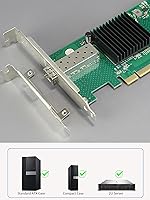
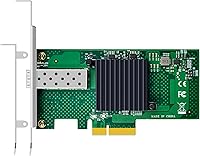
The GLOTRENDS ST7315 1-Port 10GbE SFP+ Network Card is one of the more compelling budget-tier options if you need to push 10-gigabit traffic without spending a fortune. What gives this card real credibility is the Intel 82599EN controller — a chipset that earned its stripes in enterprise hardware long before it started appearing in affordable retail cards. Before you order, be clear on one thing: no SFP+ module, DAC cable, or AOC cable is included in the box, and you will need to source those separately. Mac OS users should also look elsewhere; there is no macOS support here. On the physical side, both a standard 12cm bracket and an 8cm low-profile bracket are included, which gives you genuine flexibility across different chassis types.
Features & Benefits

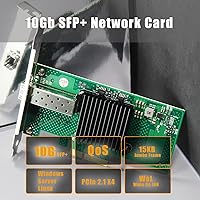
The Intel 82599EN chipset is the backbone of what makes this card worth considering. It is a mature, well-documented controller with stable drivers maintained directly by Intel, meaning you are not relying on third-party software of questionable quality. The PCIe 2.0 x4 interface is common enough to work across a wide range of older and current motherboards. The card auto-negotiates between 10Gbps and 1Gbps, so it fits cleanly into mixed-speed environments without manual tinkering. For virtualization users, SR-IOV support allows the physical port to be partitioned and passed directly to individual virtual machines — a practical capability in ESXi or Proxmox setups. MACsec encryption and IEEE 1588 time synchronization round out the feature set for anyone with more specialized deployment requirements.

Best For

This 10GbE SFP+ card is a natural fit for home lab builders who want to stop bottlenecking their NAS or VM host at 1Gbps without committing to expensive enterprise hardware. Small business IT teams looking to add fast connectivity to a tower server or rack unit will also find the value proposition hard to ignore. The included low-profile bracket makes it viable for compact builds where a full-height card simply will not fit. On the software side, broad compatibility with Windows Server editions, multiple Linux distributions, and VMware ESXi means it covers the most common deployment scenarios without friction. If you run Proxmox or ESXi and want SR-IOV passthrough without paying a significant premium, this Intel-powered network adapter is worth serious consideration.

User Feedback

With a 4.1 out of 5 rating from just over 100 buyers, the ST7315 sits in a reasonable position for a niche networking product. That score is not exceptional, but it is solid given the technical nature of the audience. The most consistent praise centers on driver reliability on Linux and Windows Server — users report getting it running without hunting down obscure packages. The recurring frustration, predictably, is the absence of any included SFP+ module or cable; some buyers clearly overlooked that detail before purchasing. A handful of users also flag compatibility questions with specific PCIe slot configurations on certain boards. Despite those friction points, holding the #144 rank in Internal Networking Cards signals real, sustained purchase activity — not a product that simply launched and quietly faded.

Pros

  • The Intel 82599EN controller brings enterprise-level driver stability to an affordable card.
  • Drivers are maintained by Intel directly, reducing dependency on third-party software.
  • Auto-negotiation between 10Gbps and 1Gbps means it fits into mixed-speed networks without reconfiguration.
  • SR-IOV support makes the ST7315 genuinely useful for ESXi and Proxmox virtualization environments.
  • Both a standard and low-profile bracket are included, covering a wide range of chassis types.
  • OS compatibility spans Windows 7 through 11, multiple Windows Server versions, RHEL, Ubuntu, Debian, and FreeBSD.
  • MACsec encryption support adds a layer of link-level security most budget cards skip entirely.
  • IEEE 1588 PTP support makes this 10GbE SFP+ card viable for time-sensitive or precision networking applications.
  • Jumbo frame support up to 15.5 KB helps reduce CPU overhead in high-throughput transfer scenarios.
  • Holding a top-150 rank in its category suggests consistent real-world buyer demand, not just a launch spike.

Cons

  • No SFP+ module, DAC cable, or AOC cable is included — total deployment cost is higher than the card price alone.
  • Mac OS is completely unsupported, with no indication that will change.
  • Only a single SFP+ port is available, limiting use cases that require redundancy or multi-link aggregation.
  • Some users report uncertainty around PCIe slot compatibility with certain non-standard or older motherboards.
  • Driver setup on less common Linux distributions may require manual steps or contacting the manufacturer for links.
  • With just over 100 ratings, the review pool is still relatively small, making it harder to spot long-term reliability trends.
  • No formal enterprise support contract or vendor certification is available for regulated or compliance-driven environments.
  • The card depends on a separate transceiver ecosystem, so buyers unfamiliar with SFP+ purchasing may find the setup process unexpectedly complex.

Ratings

The scores below for the GLOTRENDS ST7315 1-Port 10GbE SFP+ Network Card were generated by our AI system after analyzing verified global user reviews, with automated filtering applied to remove incentivized, bot-generated, and spam submissions. Each category reflects both the genuine strengths buyers praise and the real friction points they report, without glossing over either side. The result is a transparent, balanced snapshot of how this Intel-powered network adapter actually performs across a range of real-world deployments.
Driver Reliability
88%
Users running Ubuntu, RHEL, and Windows Server consistently report that the card is recognized immediately after installation with no manual driver hunting required. The Intel 82599EN controller benefits from years of kernel-level support, which makes the out-of-the-box experience noticeably cleaner than cards using lesser-known chipsets.
A small subset of users on less mainstream Linux distributions or older Windows Server builds report needing to download drivers manually from Intel's site, which adds friction for less experienced users. ESXi compatibility can also be version-sensitive, requiring users to verify driver support against their specific hypervisor build.
Virtualization Support
86%
SR-IOV support is the headline capability here, and for home lab users running Proxmox or ESXi, it genuinely delivers — allowing the single physical port to be partitioned into virtual functions that pass directly to VMs with lower latency than a standard software bridge. Users building dedicated virtualization hosts specifically call this out as a deciding factor in their purchase.
SR-IOV configuration is not plug-and-play; it requires BIOS-level IOMMU enablement and some platform-specific setup steps that can catch newer virtualization users off guard. VMDq, while supported, is rarely discussed in user feedback, suggesting it sees limited real-world use at this product tier.
Value for Money
91%
For buyers who understand what they are getting, the price-to-chipset ratio here is genuinely difficult to argue with — an Intel 82599EN controller at this price point is a strong proposition for home lab and small business use cases. Users who already own compatible SFP+ modules or DAC cables from prior builds report feeling like they got a bargain.
The value calculation shifts for buyers who factor in the mandatory additional purchase of an SFP+ module or DAC cable, which can meaningfully increase the real entry cost. Users who were not expecting that requirement at checkout tend to rate the value lower in their reviews.
Compatibility Range
84%
The breadth of supported operating systems is genuinely impressive for a card at this price — covering Windows 7 through 11, multiple Windows Server generations, four major Linux distributions, FreeBSD, and VMware ESXi. Users migrating existing servers or building multi-OS environments appreciate not having to cross-check every platform individually.
macOS is a hard exclusion with no workaround, which has caught some buyers off guard despite it being clearly stated. A small number of users have also flagged unexpected PCIe slot compatibility issues on certain non-standard or older consumer motherboards.
Throughput Performance
83%
Users transferring large files between NAS units and servers report hitting near-line-rate 10Gbps speeds once the link is properly established, with the Intel controller handling sustained workloads without thermal throttling or unexplained packet drops. Jumbo frame support up to 15.5 KB also contributes to noticeably reduced CPU utilization during bulk transfers.
Actual throughput is naturally limited by the rest of the user's infrastructure — switch quality, cable type, and transceiver selection all play a role that the card itself cannot compensate for. A handful of users noted lower-than-expected speeds that were ultimately traced back to incompatible or low-quality DAC cables rather than the card itself.
Installation Experience
79%
21%
Physical installation is straightforward for anyone comfortable working inside a desktop or server chassis — the card is compact, the bracket swap between full-height and low-profile is simple, and PCIe seating is unremarkable. Most Linux and Windows Server users report a clean first-boot recognition experience.
The installation experience diverges sharply once users realize that no transceiver or cable is included and they cannot test the link immediately out of the box. Users unfamiliar with SFP+ ecosystems sometimes spend considerable time sourcing a compatible module before they can validate the card is even working.
Build Quality
76%
24%
The card feels solidly constructed for its price bracket — the PCIe fingers are clean, the port housing is firm, and the included brackets are metal rather than the flimsy plastic found on some budget alternatives. Users inserting and reseating the card during builds report no flex or creaking in the PCB.
It is a budget card, and the component aesthetics reflect that — there is no heatsink, minimal labeling, and the overall finish is utilitarian rather than polished. Users placing it in visible or showcase builds have noted it looks noticeably cheaper than branded alternatives sitting nearby.
Bracket Flexibility
87%
Including both a standard 12cm bracket and an 8cm low-profile bracket in the same box is a practical touch that removes a common installation headache. Users building in compact rack-mount chassis or small form factor servers specifically mention this as something they appreciated without having to think about.
The bracket swap itself requires a small screwdriver and a bit of care, which is minor but worth noting for users who expected the low-profile option to be pre-installed. No additional mounting hardware beyond the two brackets is provided.
Hypervisor Compatibility
81%
19%
VMware ESXi recognizes the Intel 82599EN chipset natively in most common version ranges, and Proxmox users report equally clean experiences through the built-in ixgbe kernel module. For home lab operators consolidating workloads onto a single host, reliable hypervisor support without custom VIB installations is a meaningful time-saver.
Specific ESXi versions, particularly newer 8.x builds, have periodically required additional steps or community-packaged drivers due to Intel driver deprecation decisions at the VMware level. Users should verify ESXi version compatibility before assuming native support applies to their exact build.
Link Auto-Negotiation
78%
22%
The ability to auto-negotiate between 10Gbps and 1Gbps is genuinely useful for users running mixed-speed infrastructure, allowing the card to function as a 1G fallback when connected to older switches without manual reconfiguration. Home lab users who are gradually upgrading their network in stages find this flexibility particularly useful during the transition period.
Auto-negotiation behavior can occasionally be inconsistent when using third-party SFP+ modules that do not cleanly signal their speed tier, leading to link establishment delays or manual speed-forcing at the switch level. This is not unique to this card but is worth flagging for users with mixed or unbranded transceiver inventories.
Documentation & Support
63%
37%
GLOTRENDS offers to provide driver download links directly on request, which at least provides a fallback for users who cannot locate the correct Intel package independently. The product page covers the OS compatibility list in reasonable detail, which reduces ambiguity during the pre-purchase research phase.
There is no printed manual or setup guide in the box, and the manufacturer's own documentation beyond the product listing is thin. Users who run into edge-case compatibility issues or ESXi-specific configuration questions are largely left to community forums and Intel's own support resources rather than any direct manufacturer guidance.
Security Features
74%
26%
MACsec support per IEEE 802.1AE is a capability most cards at this price point simply do not offer, making the ST7315 a reasonable option for users who need link-level encryption between directly connected devices in small business or lab environments. Having it available as an option — even if most home lab users never enable it — adds real depth to the feature set.
MACsec configuration is not exposed through any simplified interface and requires platform-specific tooling and kernel support to actually implement, placing it out of reach for less technical buyers. Real-world user feedback on this feature specifically is sparse, suggesting most buyers are not actively using it.
Packaging & Unboxing
69%
31%
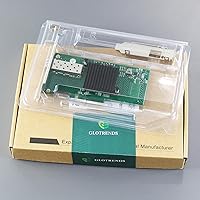
The card arrives in a compact retail box with adequate protective packaging that keeps it safe in transit. Both bracket options are included and clearly separated, and the card itself is protected by an anti-static bag as expected for a PCIe component.
Beyond the card and brackets, the box is essentially empty — no SFP+ module, no cable, no driver disc, and no quick-start guide. For experienced buyers this is normal, but for users newer to SFP+ hardware, the sparse contents can leave them momentarily uncertain about what they still need to purchase to get the link running.

Suitable for:

The GLOTRENDS ST7315 1-Port 10GbE SFP+ Network Card is a strong pick for home lab enthusiasts who want to break through the 1Gbps ceiling between their NAS, switches, and servers without spending heavily on enterprise-grade hardware. IT administrators at small businesses will find it a practical way to add fast connectivity to an existing tower or rack server, especially when the budget does not justify a full infrastructure overhaul. Virtualization users running ESXi or Proxmox will particularly appreciate the SR-IOV support, which allows the physical port to be shared efficiently across multiple virtual machines. The included low-profile bracket makes this Intel-powered network adapter a viable option even in compact or small form factor chassis where full-height cards simply do not fit. Anyone working within Windows Server, mainstream Linux distributions, or FreeBSD environments should have no trouble getting reliable driver support without much manual effort.
Not suitable for:

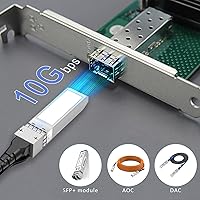
Mac OS users should stop here — the GLOTRENDS ST7315 1-Port 10GbE SFP+ Network Card has no macOS support, and there is no workaround for that. Buyers who expect a complete, plug-and-play kit will also be disappointed, since no SFP+ transceiver, DAC cable, or AOC cable is included in the box; those need to be purchased separately, and depending on your setup, that added cost is real. If you need more than one 10GbE port from a single card, this single-port design will not cover you. Users who rely on Intel 10G cards in stricter enterprise environments where vendor certification and formal support contracts matter should look toward branded, enterprise-warranted alternatives. Finally, anyone with a very tight PCIe slot situation on an older or proprietary motherboard should verify lane availability and physical clearance before ordering, as a small number of users have reported fit or compatibility questions in atypical board configurations.
Specifications

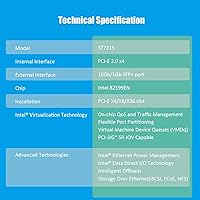
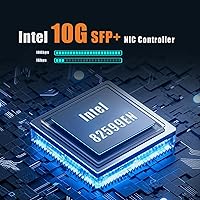
  • Controller: Powered by the Intel 82599EN chipset, a well-established enterprise-grade controller known for stable drivers and broad platform support.
  • Port: Features a single SFP+ port capable of accepting standard SFP+ transceivers, DAC cables, or AOC cables (none of which are included in the box).
  • Data Rate: Automatically negotiates between 10Gbps and 1Gbps depending on the connected switch or device, with no manual configuration required.
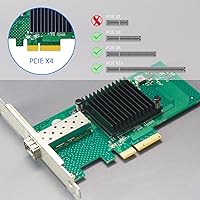
  • Bus Interface: Uses a PCIe 2.0 x4 interface, which is compatible with a wide range of modern and legacy motherboards that offer x4, x8, or x16 slots.
  • Jumbo Frames: Supports jumbo frames up to 15.5 KB, which can meaningfully reduce CPU overhead during large, sustained data transfers.
  • Virtualization: SR-IOV (Single Root I/O Virtualization) and VMDq are supported, enabling direct port partitioning and assignment to individual virtual machines in ESXi and Proxmox.
  • Security: Implements MACsec encryption per the IEEE 802.1AE standard, providing link-level security between directly connected devices.
  • Time Sync: IEEE 1588 Precision Time Protocol (PTP) is supported for hardware-level time synchronization in latency-sensitive or precision networking deployments.
  • Wake on LAN: Wake on LAN functionality is supported, allowing a compatible system to be powered on remotely over the network.
  • Brackets: Ships with both a 12cm full-height bracket pre-installed and an 8cm low-profile bracket in the box, covering standard towers and compact chassis alike.
  • Windows Support: Compatible with Windows 7 through 11 in 32-bit and 64-bit editions, as well as Windows Server 2008 R2 through Windows Server 2022.
  • Linux Support: Officially tested with RHEL 8.0 through 9.4, Ubuntu 20.04 and 22.04, Debian 11, and FreeBSD versions 12.0 through 14.0.
  • Hypervisor: VMware ESXi is explicitly supported, making this card a viable option for dedicated virtualization host builds.
  • Mac OS: macOS is not supported in any version; there are no available drivers for Apple operating systems.
  • Item Weight: The card weighs 7 oz, making it lightweight enough to seat and secure without stressing PCIe slot retention mechanisms.
  • Package Size: The retail package measures 8.74 x 6.18 x 1.26 inches, a compact footprint that reflects the card's single-port, half-length design.

Related Reviews
StarTech ST1000SPEX2L 1-Port PCIe Network Card
82%
91%
Ease of Installation
88%
Connection Stability
93%
Low-Profile Compatibility
82%
OS & Driver Compatibility
94%
Value for Money
More
GLOTRENDS LE8202 2-Port Gigabit PCIe Network Card
82%
88%
Driver Compatibility
91%
Ease of Installation
94%
Value for Money
86%
OS & Platform Coverage
79%
Build Quality
More
StarTech ST1000SPEXI PCIe Gigabit Network Card
82%
94%
Driver Stability & OS Compatibility
92%
Connection Reliability & Uptime
91%
Installation Ease
67%
Value for Money
96%
Chipset Quality
More
Euqvos PCIe Ethernet Network Card X710-DA4 10Gb 4 Port SFP+
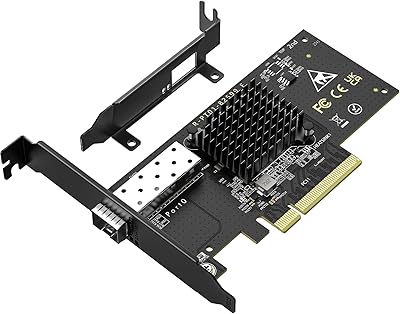
85%
92%
Performance
89%
Value for Money
80%
Compatibility with Operating Systems
87%
Heat Dissipation
85%
Ease of Installation
More
VIMIN X520-DA1 10GbE SFP+ PCIe Network Card
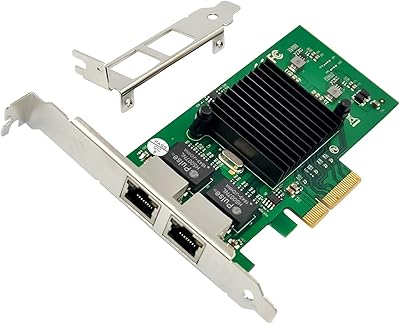
83%
93%
Value for Money
91%
Driver Compatibility — Linux & VMware
67%
Driver Compatibility — Windows & Windows Server
63%
SFP+ Transceiver Compatibility
82%
Build Quality
More
ULANSeN Intel 82576 Dual-Port Gigabit Network Card
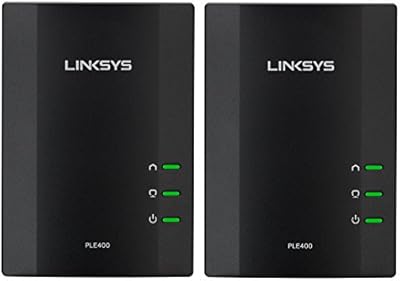
81%
91%
Driver Compatibility
84%
Virtualization Support
88%
Value for Money
79%
Throughput Performance
63%
Build Quality
More
Linksys PLEK400 Powerline Network Adapter Kit
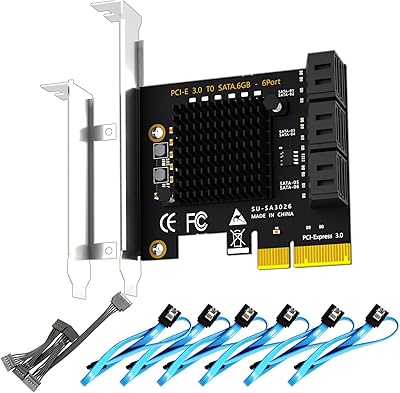
70%
89%
Ease of Setup
58%
Speed Performance
76%
Connection Stability
67%
Value for Money
54%
Interference Resistance
More
GLOTRENDS SA3026-C 6-Port PCIe SATA Card
84%
92%
Ease of Installation
89%
OS & Platform Compatibility
74%
Throughput & Bandwidth
91%
Value for Money
83%
Build & Component Quality
More
QNAP QSW-M2116P-2T2S 20-Port Managed Network Switch
78%
91%
Port Density & Speed Mix
88%
PoE Power Delivery
83%
Web Management Interface
79%
Value for Money
51%
Fan Noise & Acoustics
More
IO CREST AQC113 10Gbps PCIe Network Card
79%
83%
Real-World Transfer Speed
89%
Chipset Reliability
78%
Installation & Driver Setup
86%
Multi-Gig Auto-Negotiation
91%
Case & Bracket Compatibility
More

FAQ

No, nothing is included for the actual fiber or copper connection. The box contains the card and two brackets, and that is it. You will need to source an SFP+ transceiver, DAC cable, or AOC cable separately depending on your setup. This surprises more buyers than it should, so factor that extra purchase into your planning upfront.

Yes, it will. PCIe slots are physically and electrically backward compatible in terms of slot width, meaning you can seat an x4 card in an x8 or x16 slot without any issue. The card will still operate at x4 bandwidth, which is more than sufficient for 10GbE throughput.

Yes, and it works well there. The Intel 82599EN controller is natively supported by the ixgbe kernel module that ships with most Linux-based hypervisors including Proxmox VE. SR-IOV is also supported, which means you can pass virtual functions directly to individual VMs rather than sharing a single software-bridged interface.

There is no driver disc included. For Windows, the most reliable approach is downloading the ixgbe driver package directly from Intel's support site using the controller model number. On modern Linux distributions like Ubuntu 22.04 or RHEL 9, the driver is typically already present in the kernel and loads automatically on boot. GLOTRENDS also offers to send a download link if you contact them directly.

Yes, that is specifically accounted for. The box includes both a standard 12cm bracket and an 8cm low-profile bracket, so you can swap to whichever fits your chassis before installation. Just make sure your SFF machine actually has a free PCIe x4 or wider slot available.

Broadly yes, but with a small caveat. ESXi does include a native driver for the Intel 82599 chipset family, so in many cases the card is recognized without extra steps. However, ESXi driver support can be version-specific, so it is worth checking Intel's VMware compatibility matrix against your exact ESXi build before committing.

It will, as long as you are using a compatible SFP module on both ends that supports 1GbE. The card itself handles auto-negotiation between 10G and 1G speeds without manual configuration. That said, if your switch only supports 1Gbps SFP rather than SFP+, you will want to confirm module compatibility before assuming it will link up cleanly.

SR-IOV stands for Single Root I/O Virtualization. In practical terms, it lets you split the physical network port into multiple virtual functions that can each be assigned directly to a separate virtual machine, bypassing the hypervisor software network stack entirely. The result is lower latency and less CPU overhead compared to a standard virtual switch setup. If you are not running a hypervisor, you do not need it — but if you are, it is a meaningful capability to have available.

Not directly. This card has an SFP+ port, not an RJ45 copper port, so it connects via fiber transceivers, DAC cables, or AOC cables — not standard ethernet patch cables. If your switch only has RJ45 10G ports, you would need a media converter or a switch that includes SFP+ uplink ports to make the two sides talk.

It is one of the more sensible options at this price point for exactly that scenario. The Intel 82599EN controller has years of proven driver support across the NAS operating systems most home users rely on, including FreeNAS-derived platforms and Linux-based systems. Just remember you will need a compatible SFP+ DAC cable or transceiver to complete the link, and both ends of your network need to support 10GbE to actually benefit from the speed upgrade.