Overview

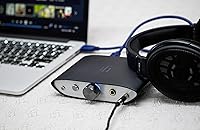
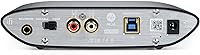
The iFi Zen DAC V2 Desktop DAC is iFi's entry-level answer to a real problem: the audio chip built into your computer is almost certainly holding your headphones back. A dedicated DAC converts digital signals into analogue with far greater precision, cutting out the electrical noise that plagues motherboard audio. The V2 refines the original with a lower-jitter clock — an upgrade that meaningfully tightens the sound — and sits in a sturdy aluminium enclosure small enough to live comfortably on any desk. Be clear-eyed about what this is, though: a gateway into serious listening, not a statement piece for seasoned audiophiles chasing diminishing returns.
Features & Benefits

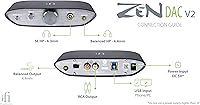
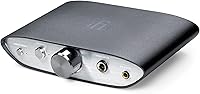
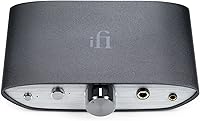
At the core of this desktop DAC sits a Burr-Brown True Native chip capable of handling PCM up to 384kHz/24-bit, DSD256, and full MQA decoding — so if you stream Tidal Masters tracks, the hardware does the unfolding itself rather than leaning on software. Two headphone outputs cover most scenarios: a standard 6.3mm jack and a 4.4mm balanced output that noticeably lowers the noise floor with compatible headphones. The PowerMatch toggle lets you optimise output impedance for sensitive IEMs without touching any settings on your computer. TrueBass adds a touch of warmth for IEMs that can otherwise sound thin, and RCA outputs let you feed powered speakers or an external amplifier directly.

Best For

This desktop DAC makes the most sense for anyone stepping up from stock laptop or PC audio for the first time. If you use IEMs or mid-tier over-ear headphones — Sennheiser HD 6XX, Beyerdynamic DT 770, that kind of range — iFi's compact DAC-amp has the power and finesse to make them perform properly. Tidal subscribers who want to actually use MQA rather than rely on software decoding will appreciate the hardware-level unfolding. It also works well as a clean source feeding active studio monitors on a tight desk setup. For a first serious upgrade away from onboard audio, it is genuinely hard to argue against.

User Feedback

Across a large pool of verified buyers, the most consistent praise centres on the warm, musical character the Zen DAC V2 delivers compared to flat, harsh onboard audio. The balanced output earns frequent specific mentions — people clearly notice the difference when their headphones support 4.4mm. On the critical side, a notable number of users feel the volume knob does not quite match the solid aluminium chassis in build quality. The channel imbalance at very low volumes is real and worth knowing upfront; iFi acknowledges it and recommends keeping the dial between 11 and 1 o'clock. Windows driver setup is occasionally flagged as fiddly, so budget a few extra minutes on first use.

Pros

  • The Burr-Brown True Native chip delivers a warm, musical sound that is a clear step up from any motherboard audio.
  • A 4.4mm balanced headphone output at this price tier is genuinely rare and audibly beneficial with compatible headphones.
  • Full hardware MQA decoding means Tidal Masters tracks play as intended without relying on a software workaround.
  • The PowerMatch toggle makes the Zen DAC V2 genuinely versatile across IEMs and full-size headphones without needing separate gear.
  • RCA outputs let you use this desktop DAC as a clean source for powered speakers or an external amplifier.
  • The compact aluminium chassis is sturdy, professional-looking, and takes up minimal desk space.
  • TrueBass gives IEM users a practical way to add low-end weight without EQ software.
  • USB 3.0 input with USB 2.0 compatibility means it works reliably with virtually any modern computer or DAP.
  • Support for PCM 384kHz, DSD256, and DXD 384kHz means the hardware will not become a bottleneck as your library grows.
  • Buyers using it purely as a DAC into a separate amp consistently report clean, transparent output with no unwanted colouration.

Cons

  • The analogue volume pot exhibits a channel imbalance at very low listening levels, which iFi acknowledges but some buyers still find annoying.
  • The volume knob feels noticeably cheaper than the solid aluminium enclosure surrounding it, which is a mismatch at this price.
  • Windows driver installation can be fiddly on first setup and occasionally requires troubleshooting before audio is recognised correctly.
  • The onboard amplifier does not have enough output power to drive demanding planar magnetic headphones to their full potential.
  • There is no optical or coaxial digital input, so connectivity is limited strictly to USB sources.
  • MQA support is less compelling than it once was as the format loses streaming platform backing over time.
  • No remote control or digital volume adjustment means you must physically reach for the unit to change listening levels.
  • The single USB input offers no flexibility if you want to switch between a desktop computer and another source device quickly.

Ratings

The iFi Zen DAC V2 Desktop DAC earns strong marks across most categories based on AI analysis of thousands of verified global user reviews, with spam, bot-generated, and incentivized submissions actively filtered out before scoring. The results reflect a product that consistently over-delivers for first-time DAC buyers while carrying a small number of recurring complaints that are worth knowing before you commit. Both the genuine strengths and the honest frustrations are represented in the scores below.
Sound Quality
88%
The warm, musical character of the Burr-Brown chip is the single most praised aspect across buyer reviews, with users consistently describing their familiar music as noticeably more detailed and natural compared to motherboard audio. Headphone listeners pairing it with dynamic driver cans like the Sennheiser HD 650 or similar report an immediate, tangible improvement in clarity and tonal richness.
A smaller contingent of listeners who prefer a leaner, more analytical sound find the Burr-Brown warmth a bit coloured for critical monitoring work. It is a character choice rather than a flaw, but buyers expecting a ruler-flat reference signature may find the tuning slightly too euphonic for their taste.
Balanced Output Quality
91%
The 4.4mm Pentaconn balanced output is consistently singled out as a highlight — buyers who own headphones with balanced cables report a noticeably blacker background and improved channel separation compared to the unbalanced jack. At this price tier, having a proper balanced output at all is uncommon, which amplifies its perceived value among the enthusiast community.
The benefit is entirely contingent on owning headphones with a 4.4mm terminated cable, which many buyers do not have out of the box. Purchasing a balanced recable adds cost and effort, meaning a portion of buyers never actually use this feature despite it being a key selling point.
Value for Money
89%
Across review platforms, the consensus is that iFi's compact DAC-amp punches well above its price bracket in terms of feature density — dual headphone outputs, full MQA decoding, PowerMatch, and TrueBass are not features typically found bundled together at this spend level. First-time upgraders from onboard audio frequently describe the improvement as far larger than the outlay suggests.
Buyers comparing it specifically against newer competing units at similar prices occasionally note that some rivals have closed the gap in raw output power. The value case is strongest for headphone listeners; those primarily wanting to drive demanding planars may feel the amplification stage limits the overall return.
Build Quality
74%
26%
The aluminium chassis feels solid and looks purposeful on a desk — it is clearly not a plasticky budget product, and the overall density and finish give a reassuring sense of durability. Most buyers report no issues with the chassis itself after extended daily use.
The volume knob is the one component that consistently draws criticism for feeling loose or slightly hollow relative to the quality of everything around it, and it is the first thing you touch every listening session. For a unit positioned as a step into serious audio, a premium pot would have meaningfully strengthened the overall impression.
Ease of Setup
77%
23%
On macOS and Linux the Zen DAC V2 is genuinely plug-and-play — connect the USB cable and it is immediately recognised as an audio output with no intervention required. Most Windows users also get up and running quickly once the ASIO driver is installed.
A recurring thread among Windows users involves driver installation being unexpectedly fiddly, with some reporting that the device is not recognised until after a full restart or a manual driver re-install. For less technically confident buyers, this initial friction can be a frustrating first impression that undermines an otherwise simple product.
IEM Compatibility
86%
The PowerMatch toggle combined with the low output impedance in IEM mode gives sensitive in-ear monitors a quiet, clean signal that many competing units at this tier fail to deliver. Buyers using IEMs like the Shure SE series or custom in-ears specifically praise the low noise floor and the optional TrueBass switch for adding body without reaching for EQ software.
TrueBass, while useful for thin-sounding IEMs, applies a fixed bass curve with no adjustment, which can feel heavy-handed with earphones that already have a warm low end. It is a binary on/off toggle rather than a variable control, which limits how precisely you can tailor the effect.
MQA Decoding
79%
21%
For Tidal Masters subscribers, hardware MQA unfolding works reliably and removes the need for software-side decoding entirely, which simplifies the playback chain considerably. Buyers who use MQA regularly appreciate not having to configure anything — it just works.
MQA's relevance as a feature has diminished as the format has faced commercial uncertainty and lost streaming platform support in some regions. Buyers who are sceptical of MQA or who primarily stream non-MQA sources will find this feature largely invisible in day-to-day use, which reduces its contribution to overall value for a meaningful subset of buyers.
Volume Control
61%
39%
The analogue potentiometer provides a smooth, continuous volume sweep across most of its range, and the tactile feel of a physical knob is genuinely preferred by most listeners over software-based volume management. In the recommended listening zone between 11 and 1 o'clock, channel balance is consistent and reliable.
The channel imbalance below the 9 o'clock position is a well-documented and frequently cited frustration — iFi discloses it, but buyers who listen quietly in a shared space or at night find themselves pushed into an uncomfortable compromise between volume and stereo accuracy. A higher-quality potentiometer would have been a meaningful investment at this price point.
Connectivity Options
72%
28%
Having both headphone outputs and RCA line outputs on a single compact unit means this desktop DAC can serve double duty — headphones at a desk during the day and powered monitors in the evening — without any recabling between sources. That flexibility is appreciated by buyers with evolving setups.
The single USB Type-B input is the only digital source option, which means there is no optical, coaxial, or Bluetooth input for buyers who want to connect a television, CD transport, or wireless source. If your use case extends beyond a single USB computer source, the connectivity becomes a genuine limitation.
Headphone Amplifier Power
67%
33%
For the majority of popular headphones in the 32 to 300 ohm range — including the Beyerdynamic DT 770, AKG K701, or Sennheiser HD 6XX — the onboard amplifier provides adequate drive with comfortable headroom. The PowerMatch toggle helps the unit adapt to different impedance loads without requiring a separate device.
Power-hungry planar magnetic headphones from brands like HiFiMAN or Audeze do not reach their performance ceiling on this unit alone, and experienced listeners will hear the limitation as a loss of control and dynamics at higher volumes. For that class of headphone, a dedicated amplifier downstream is effectively required.
Desktop Footprint
87%
At 6.3″ by 4.6″ and under two pounds, the unit occupies minimal desk real estate and sits neatly alongside a keyboard or monitor stand without demanding attention. The compact footprint is consistently praised by buyers in small home office setups or apartment listening spaces where every inch counts.
The relatively small chassis means the front panel is fairly dense with controls — volume knob, PowerMatch toggle, and TrueBass switch all in close proximity — which can make accidental adjustments slightly more likely during casual use. It is a minor ergonomic trade-off rather than a serious flaw.
Driver & Software Experience
68%
32%
Once drivers are correctly installed on Windows, the unit operates stably across long listening sessions with no reported dropout or disconnection issues under normal desktop use. macOS users in particular report a completely frictionless experience with zero configuration required.
The Windows driver situation introduces more friction than it should for a product aimed partly at non-technical buyers — the documentation included in the box is minimal, and first-time setup relies on users finding and downloading the correct driver version from iFi's website independently. A more guided out-of-box experience would have helped.
High-Resolution Audio Support
92%
Supporting PCM up to 384kHz/24-bit, DSD256, and DXD 384kHz natively means the Zen DAC V2 handles every meaningful high-resolution format currently in circulation without any conversion penalty. Buyers building a library of hi-res downloads or using services that offer full-resolution streaming consistently report the hardware never becomes the bottleneck.
The practical benefit of the upper resolution tiers depends entirely on the quality of your source material — standard 16-bit/44.1kHz streaming content accounts for the majority of most people's listening and will not exercise the hardware's ceiling. For buyers primarily using Spotify or similar lossy services, this specification is largely academic.
Long-Term Reliability
81%
19%
With a rating dating back to March 2021 and a strong seller rank sustained over several years, the Zen DAC V2 has accumulated enough long-term owner feedback to establish a consistent reliability track record. The aluminium chassis shows no signs of degradation issues, and the unit remains in active production with ongoing manufacturer support.
The volume pot is the component most frequently mentioned in longer-term reviews as showing wear — some users note it feels slightly looser after a year or more of daily use compared to its initial condition. It is not a failure point, but it reinforces the sense that the potentiometer was not specified to match the longevity of the rest of the hardware.

Suitable for:

The iFi Zen DAC V2 Desktop DAC is a strong fit for anyone who has decent headphones or IEMs but suspects their computer is the weakest link in the chain — because it almost certainly is. Listeners who own mid-tier cans like the Sennheiser HD 650, Beyerdynamic DT 770, or a good pair of IEMs will hear a clear and immediate improvement over onboard audio, particularly in background noise reduction and dynamic range. Tidal subscribers who pay for the Masters tier will also get tangible value here, since the hardware handles MQA unfolding directly rather than delegating it to software. The 4.4mm balanced output is a genuine differentiator at this price point, making it a smart pick for anyone whose headphones support balanced termination. It also suits compact home studio setups where space is limited but clean RCA output to powered monitors is a priority.
Not suitable for:

If you are already running a dedicated DAC and amplifier stack, the iFi Zen DAC V2 Desktop DAC is unlikely to justify a sideways move — it is built for first-time upgraders, not experienced listeners looking to trade up within a serious system. Audiophiles who prefer a neutral, analytical sound signature may find the warmer Burr-Brown character a matter of taste rather than a clear win. The built-in amplification stage has limits too; power-hungry planar magnetic headphones like the HiFiMAN Arya or Audeze LCD series will not reach their potential here and will benefit from a dedicated headphone amplifier instead. Anyone deeply sceptical of MQA as a format — and there are principled reasons to be — should treat that feature as incidental rather than a reason to buy. Finally, buyers who tend to listen at very low volumes late at night should know about the analogue volume pot behaviour below the 9 o'clock position, which can produce a mild channel imbalance that some find frustrating.
Specifications

  • DAC Chip: Uses a Burr-Brown True Native digital-to-analogue converter, known for its warm and musical character across the frequency range.
  • PCM Resolution: Supports PCM audio up to 384kHz at 24-bit depth, covering all standard high-resolution audio formats without additional conversion.
  • DSD Support: Handles native DSD playback up to DSD256, allowing high-rate single-bit audio files to be processed without PCM conversion.
  • DXD Support: Compatible with DXD audio at up to 384kHz, a format commonly used in professional mastering and high-end digital recordings.
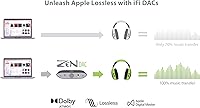
  • MQA Decoding: Functions as a full hardware MQA decoder, capable of unfolding MQA-encoded streams such as Tidal Masters directly without software assistance.
  • Headphone Outputs: Provides two headphone outputs: a 6.3mm unbalanced jack and a 4.4mm Pentaconn balanced jack for use with balanced-terminated headphone cables.
  • Line Output: Includes a stereo RCA output pair for connecting to active powered speakers, a stereo amplifier, or other analogue audio equipment.
  • Digital Input: Accepts audio via a single USB 3.0 Type-B input that is fully backward compatible with USB 2.0 sources including computers and digital audio players.
  • PowerMatch: Features a two-position PowerMatch toggle that adjusts output impedance to suit either sensitive in-ear monitors or standard full-size headphones.
  • TrueBass: Includes a switchable TrueBass circuit that applies an analogue bass boost specifically designed to add low-frequency body when using IEMs.
  • Volume Control: Uses an analogue potentiometer for volume adjustment; a minor channel imbalance may occur at very low dial positions below the 9 o'clock mark.
  • Chassis Material: The enclosure is constructed from machined aluminium, providing a rigid and relatively interference-resistant housing for the internal circuitry.
  • Dimensions: The unit measures 6.3″ in length by 4.6″ in width, making it compact enough to sit on a standard desk without occupying excessive space.
  • Weight: Weighs 1.76 pounds, light enough to remain stable on a desk without requiring mounting hardware or additional support.
  • Manufacturer: Designed and produced by Abbingdon Music Research, trading as iFi Audio, a British brand specialising in affordable high-fidelity audio equipment.
  • Model Version: This is the V2 iteration, which introduced a refined low-jitter clock with over 20dB of improved jitter performance compared to the original Zen DAC.
  • Placement Type: Designed for tabletop or plug-mount use on a desk, shelf, or similar flat surface in a home listening or office environment.
  • Number of Channels: Outputs stereo two-channel audio across all output types, with no surround sound or multi-channel functionality included.
  • Availability Status: As of the latest listing data, this product has not been discontinued by the manufacturer and remains in active production.
  • Release Date: The Zen DAC V2 was first made available for purchase in March 2021, succeeding the original Zen DAC released the previous year.

Related Reviews
FiiO K7
FiiO K7
84%
93%
Sound Transparency
91%
Amplifier Power
89%
Connectivity & Inputs
92%
Value for Money
78%
Build Quality
More
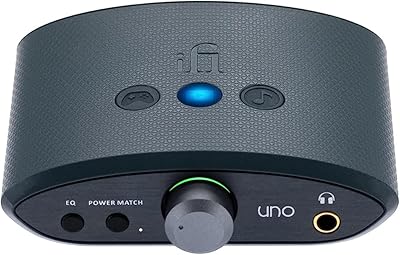
iFi uno DAC & Headphone AMP
85%
91%
Sound Quality
89%
Value for Money
87%
Portability
82%
Setup & Installation
88%
Build Quality
More
iFi Zen Air Phono Preamplifier
82%
91%
Noise Floor & Signal Clarity
88%
MM & MC Cartridge Compatibility
86%
Subsonic Filter Performance
93%
Value for Money
89%
Ease of Setup
More
FiiO K9 Pro ESS
FiiO K9 Pro ESS
77%
91%
Sound Quality
93%
Driving Power & Headphone Compatibility
89%
Connectivity & Input Options
86%
Bluetooth Performance
88%
Build Quality & Materials
More
Fosi Audio ZD3
Fosi Audio ZD3
82%
91%
Sound Quality
88%
Build Quality
83%
HDMI ARC Performance
93%
Connectivity & Input Range
67%
Bluetooth Performance
More
FiiO K11
FiiO K11
80%
91%
Value for Money
88%
Output Power & Headphone Driving
82%
Sound Quality
79%
Build Quality
71%
Balanced Output Implementation
More
iFi Zen Air Blue
iFi Zen Air Blue
80%
88%
Audio Quality
93%
Codec Support
67%
Connectivity & Pairing
79%
Build Quality
63%
Compatibility
More
iFi GO blu
iFi GO blu
77%
93%
Sound Quality
89%
Codec Performance
91%
Balanced Output (4.4mm)
78%
Portability & Form Factor
84%
Build Quality
More
Khadas Tone2 Pro
Khadas Tone2 Pro
79%
91%
Sound Quality
88%
Build Quality
89%
Value for Money
83%
Amplifier Performance
79%
MQA Decoding
More
Audioengine D1
Audioengine D1
84%
93%
Audio Quality
88%
Headphone Amplifier Performance
84%
Build Quality
96%
Ease of Setup
79%
Value for Money
More

FAQ

On macOS and Linux it works plug-and-play, but Windows users will need to install iFi's ASIO driver for the best performance and full resolution support. The process is straightforward but it is worth downloading the driver from iFi's website before you plug the unit in for the first time. A handful of users report needing to restart after installation before Windows recognises the device correctly.

At very low volume positions — roughly below the 9 o'clock mark on the dial — the analogue potentiometer can favour one channel slightly over the other. iFi acknowledges this openly and recommends listening between 11 and 1 o'clock for balanced stereo. In practice, most people listen at levels well above the affected range, so it rarely becomes a real problem during normal use.

Yes, this is actually one of the stronger points of the Zen DAC V2. The PowerMatch toggle lets you drop the output impedance to a level suitable for sensitive in-ear monitors, which significantly reduces the noise floor. Most IEM users report a very clean, quiet background at typical listening volumes.

If your headphones support a balanced connection — either natively or via a cable upgrade — yes, it is genuinely audible rather than a paper specification. Balanced output typically lowers crosstalk and background noise, and at this price point having a 4.4mm Pentaconn jack is uncommon, which is why so many buyers specifically mention it in their reviews.

Absolutely. The RCA outputs let you send a line-level analogue signal to any external amplifier or pair of powered speakers. A number of buyers use iFi's compact DAC-amp purely in this mode, bypassing the headphone stage entirely, and report clean and transparent output with no unwanted colouration added to the signal.

It can drive them to audible levels, but demanding planars — think HiFiMAN Arya or Audeze LCD-2 — will not reach their full potential from the onboard amplifier alone. For that kind of headphone, you would be better served pairing this unit as a DAC with a dedicated headphone amplifier downstream. For mid-impedance dynamic driver headphones in the 80 to 300 ohm range, it performs well.

That depends on where you stand on the format. If you subscribe to Tidal and regularly stream Masters-tier content, having hardware unfolding here means your tracks are decoded as the format intends. That said, MQA has become controversial in audio communities and some platforms have moved away from it, so treat it as a useful bonus rather than a primary reason to choose this desktop DAC.

The headline change is the clock circuit: the V2 has a lower-jitter oscillator that iFi claims delivers more than 20dB of improvement over the original. The practical result is a slightly tighter, better-defined sound, particularly noticeable with fast transients. The overall feature set and form factor remain very similar, so if you own the original and are happy with it, an upgrade is not urgent.

The USB Type-B input is designed for connection to a computer or a digital audio player with a USB output. Connecting directly to a smartphone is generally not straightforward without an OTG adapter and even then compatibility is not guaranteed. For mobile use, iFi makes other products in their range designed specifically for that purpose.

It is a genuine analogue circuit boost rather than a digital effect, and for IEM listeners who find their earphones lacking in low-end weight it can be a useful option. That said, most people with full-size headphones leave it off — it is not something you would engage with closed-back or open-back cans unless you specifically want added bass. Think of it as an optional tool rather than a feature you need to justify the purchase.

Where to Buy

Audio Advisor
In stock $199.00
SKY by Gramophone
In stock $199.00