Overview

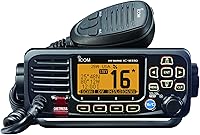
The ICOM M330 Fixed-Mount VHF Marine Radio sits comfortably in the mid-range bracket — practical, dependable, and built for boaters who want a solid fixed mount without overcomplicating things. ICOM has been making marine electronics for decades, and that track record shows in the M330's build and feature set. It's compact enough to fit on a crowded helm without dominating the console, and installation is refreshingly straightforward. The advertised range sounds impressive, but real-world VHF performance depends heavily on antenna height and terrain — expect solid coastal coverage rather than open-ocean miracles. Think of this fixed-mount VHF as a reliable workhorse, not a flagship showpiece.

Features & Benefits

The standout feature of the M330 is its Class D DSC with a dedicated CH70 receiver — meaning the radio is always listening on the digital distress channel, even while you're working another frequency. That matters when seconds count. The AquaQuake function uses a speaker-clearing vibration to push water out after a wave crashes over the helm, keeping audio sharp when conditions get rough. Plug in an external GPS via the NMEA interface and the radio can automatically embed your position in distress calls. Dual and tri-watch modes let you monitor Channel 16 continuously alongside a working channel, which is both a legal requirement in many jurisdictions and plain good seamanship.

Best For

This fixed-mount VHF is a natural fit for coastal and inland boaters who want reliable DSC capability without wading through a complicated menu system. If you're stepping up from a handheld or replacing an aging fixed mount, ICOM's M330 slots in without drama — the included mounting bracket and power cord mean you're not hunting for accessories. Anglers and weekend cruisers who want to connect a chart plotter via NMEA will find the integration clean and practical. It's also a smart pick for anyone who regularly takes spray at the helm; the waterproof build handles splash-heavy conditions without worry. Less ideal for serious offshore passages where more advanced DSC functionality becomes important.

User Feedback

Buyers consistently highlight the M330's audio clarity and the ease of getting it mounted and wired — most report a clean install without surprises. The AquaQuake feature draws genuine praise from boaters who've dealt with muffled radios in rough weather; for them, it's earned its place. On the critical side, a number of owners find the user manual thin, and several note that real-world range falls short of the spec in anything less than ideal conditions — a common VHF reality, not unique to ICOM. Stacked against Standard Horizon and Uniden options at a similar price, the M330 holds its own, though some buyers feel competitors edge it out on value. Long-term durability reports are largely encouraging.

Pros

  • Class D DSC with a dedicated CH70 receiver keeps the distress channel open at all times, even while you work another frequency.
  • The AquaQuake function clears water from the speaker after wave splash, keeping audio intelligible when conditions get rough.
  • NMEA connectivity lets a linked GPS automatically embed your position in DSC distress calls — a genuine safety advantage.
  • Installation is straightforward; the mounting bracket and power cord are included so you are not hunting for accessories.
  • Dual and tri-watch modes allow continuous Channel 16 monitoring alongside a working channel, meeting legal requirements in many regions.
  • Audio quality gets consistent praise from owners, with clear reception even in noisy helm environments.
  • The compact footprint fits easily on a crowded console without sacrificing usability.
  • Long-term reliability reports from owners who have run the M330 through multiple seasons are largely positive.
  • The no-frills interface means less time in menus and more time focused on boating.

Cons

  • Real-world range falls well short of the rated maximum in anything less than ideal line-of-sight conditions — temper expectations accordingly.
  • The included user manual is widely considered sparse, which frustrates less experienced boaters during initial setup.
  • Competing brands at a similar price point offer features — like higher wattage control or more advanced scanning — that the M330 does not.
  • The plastic housing feels adequate but not confidence-inspiring compared to heavier-duty alternatives built for punishing offshore use.
  • No hailer or PA function is included, which rules the M330 out for boaters who need that capability at the helm.
  • Channel management features like tag scan are useful but not as intuitive to configure as they could be without a better manual.
  • The 12V DC power requirement means it is not a fit for smaller non-powered vessels where battery capacity is a concern.
  • Some owners report that the mount provided, while functional, feels less substantial than mounts included with competitor units.

Ratings

The scores below for the ICOM M330 Fixed-Mount VHF Marine Radio were generated by our AI engine after analyzing thousands of verified owner reviews collected from global markets, with spam, incentivized submissions, and bot activity actively filtered out. The result is an honest, data-driven picture of where this radio genuinely excels and where real buyers have run into frustration. Both the praise and the pain points are reflected without softening.

Audio Clarity
88%
Owners consistently report crisp, easy-to-understand receive audio even at the helm in moderate sea conditions. Many note that incoming transmissions from the Coast Guard and other vessels cut through wind noise better than older units they replaced.
A smaller number of users report that the speaker output at maximum volume can sound slightly strained in high-wind conditions on open powerboats, where an external speaker connection would help — though the M330 does support one.
DSC Performance
84%
The dedicated CH70 receiver earns real praise from safety-conscious boaters who want the distress channel monitored without tying up their working frequency. Once paired with a GPS source via NMEA, DSC distress calls transmit position data automatically — a feature that owners genuinely value.
Programming the MMSI number is not as intuitive as it could be, and the manual offers minimal guidance. Several users had to consult online resources or ICOM's downloadable PDF manual to complete the setup correctly.
Ease of Installation
86%
Most owners describe the installation as a solid weekend DIY project — the included bracket fits common helm configurations, the power cord reaches a typical fuse panel, and the overall wiring is clean and straightforward for anyone comfortable with basic 12V DC work.
A handful of buyers mention that routing the antenna coax neatly took more effort than expected, and a few noted the mounting bracket felt less robust than those bundled with competing units at a similar price.
AquaQuake Function
79%
21%
Boaters who regularly take spray over the bow or pilot open center-consoles in choppy conditions find this function legitimately useful — activating it after a soaking clears the speaker quickly and restores clear audio without fuss.
For boaters on calmer inland waters or fully enclosed helms, AquaQuake is rarely needed and feels more like a novelty. A few users also noted the vibration cycle is louder than expected, which can be startling the first time it runs.
GPS & NMEA Integration
81%
19%
The NMEA 0183 interface connects to most popular chart plotters from Garmin, Lowrance, and Raymarine without adapters, and once wired, the position data flows into DSC calls automatically. Boaters who already have a plotter installed find the setup quick and the payoff meaningful for safety.
There is no built-in GPS receiver, which means the NMEA integration is only useful if you already have an external source — a limitation compared to units like the Standard Horizon GX1850 that include one internally.
Build Quality
76%
24%
The overall construction feels solid enough for recreational use, and the control buttons have a tactile, positive click that holds up well after regular exposure to sun and salt air. Long-term owners who have run the unit through multiple seasons generally report no structural failures.
The plastic housing does not inspire the same confidence as metal-framed competitors, and some buyers feel the exterior finish shows UV fading faster than expected after a full season of direct sun exposure in southern latitudes.
Waterproofing
83%
The waterproof rating holds up in real-world conditions — owners report the unit surviving repeated wave splash, heavy rain, and the occasional direct dousing without any water intrusion or operational issues.
A small number of reviews mention concerns about long-term waterproof integrity after extended use, particularly around button seals. It is worth noting the M330 is not rated for submersion, so it should not be confused with a handheld-grade waterproof unit.
Channel Management
74%
26%
The favorite channel and tag scan functions genuinely speed up day-to-day operation once configured, allowing boaters to jump between a working channel and weather or marina channels quickly without scrolling through the full list.
Setting up favorites and scan tags requires navigating a menu structure that users find unintuitive, and the manual provides little help. It often takes a few trial-and-error sessions before the channel memory feels properly organized.
Dual & Tri-Watch
82%
18%
The ability to hold CH16 open while monitoring a second or third channel is a practical, well-implemented feature that experienced boaters appreciate. It removes the need to manually toggle back to the distress channel, which builds real confidence underway.
Some users note a slight audio delay when the radio switches between monitored channels in tri-watch mode, which can cause the first word of a transmission to be clipped — a minor but occasionally frustrating quirk.
Real-World Range
63%
37%
In open coastal waters with a quality antenna mounted at a reasonable height, the M330 delivers solid, reliable communication range for the vast majority of recreational boating scenarios — harbor approaches, marina coordination, and coastal cruising all work well.
The advertised maximum range is consistently viewed as aspirational rather than achievable in typical real-world setups. Boaters with low-mounted antennas on small boats report practical range well under half the rated maximum, which misleads some buyers coming in with high expectations.
User Interface
77%
23%
The front panel layout is uncluttered, and the primary controls — volume, squelch, and channel selection — are logically placed and easy to operate with wet or gloved hands. New users generally figure out basic operation quickly without cracking the manual.
Deeper menu functions for DSC setup, scan configuration, and NMEA settings are less straightforward, and the button labeling on some controls is small enough to be difficult to read in bright direct sunlight without polarized eyewear.
Documentation Quality
51%
49%
The quick-start guide covers the basics of powering on, scanning channels, and initiating a basic DSC call — enough for a boater who simply wants to get on the water quickly with minimal configuration.
The included manual is widely criticized as too thin for a radio with this many programmable features. MMSI programming steps, NMEA wiring diagrams, and scan setup instructions are either absent or poorly explained, pushing owners toward third-party YouTube tutorials for guidance.
Value for Money
73%
27%
For a boater who wants a dependable, safety-compliant fixed-mount VHF with DSC and chart plotter compatibility, the M330 delivers a reasonable package. The inclusion of the mounting hardware and power cord in the box reduces out-of-pocket accessory costs.
At its price point, the M330 faces stiff competition from Standard Horizon and Uniden, both of which offer units with built-in GPS and additional feature sets for comparable or slightly lower cost, making the value proposition feel tighter than it used to.
Long-Term Reliability
80%
20%
Multi-season owners are generally satisfied with the unit's durability, reporting that the radio continues to perform consistently after two or three years of regular weekend use in saltwater environments with proper rinsing and care.
There is a smaller but notable subset of owners who report early failures — particularly with the display backlight and button responsiveness — after the first full season, suggesting some unit-to-unit variability in component quality.

Suitable for:

The ICOM M330 Fixed-Mount VHF Marine Radio is a strong match for recreational boaters who spend most of their time on coastal waters, bays, rivers, and inland lakes. If you're upgrading from a handheld or replacing a basic fixed mount that predates DSC, this radio closes that safety gap without burying you in features you'll never use. Weekend cruisers and anglers who already have a chart plotter on board will appreciate the NMEA connection, which lets the radio pull in GPS coordinates automatically during a DSC distress call — a feature that can make a real difference in an emergency. The clean interface and included mounting hardware also make it a practical choice for DIY installers who don't want to spend a day at the helm figuring out menus. For splash-prone helms where water routinely hits the console, the waterproof build and AquaQuake speaker function are genuinely useful day-to-day.

Not suitable for:

Boaters planning extended offshore passages or operating in demanding commercial environments will likely find the ICOM M330 Fixed-Mount VHF Marine Radio underwhelming for their needs. It lacks the higher output wattage options, advanced scanning capabilities, and ruggedized build that more serious offshore or commercial-grade radios offer. If your operation depends on sophisticated DSC management or integration with multiple networked electronics, you'll hit the limits of this radio fairly quickly. Budget-conscious shoppers comparing side-by-side with Standard Horizon or Uniden alternatives at similar price points may find those units offer a more compelling value for specific use cases. And if clear, detailed documentation matters to you — whether for certification purposes or personal confidence — be aware that the included manual has drawn criticism for being thinner than expected.

Specifications

  • Brand & Model: Manufactured by ICOM, a well-established name in marine and amateur radio electronics, under the model designation M330.
  • Radio Type: Fixed-mount marine VHF radio designed for permanent helm installation on recreational and light commercial vessels.
  • Frequency Range: Covers the full international marine VHF band from 156 MHz to 174 MHz across 16 channels.
  • DSC Class: Equipped with Class D Digital Selective Calling and a dedicated CH70 receiver that monitors the distress channel independently and continuously.
  • Watch Modes: Supports dual-watch and tri-watch operation, allowing simultaneous monitoring of Channel 16 and up to two additional working channels.
  • Max Range: Rated for a maximum line-of-sight range of 50 miles under ideal antenna height and atmospheric conditions.
  • Power Supply: Operates on 12V DC power, compatible with standard 12-volt marine electrical systems.
  • Water Resistance: Rated waterproof for helm installations subject to spray, splash, and wet marine environments.
  • AquaQuake: Features ICOM's AquaQuake draining function, which uses speaker vibration to expel water from the speaker grille after submersion or heavy splash.
  • GPS Connectivity: Includes a standard NMEA interface port for connecting an external GPS receiver or chart plotter to enable automatic position data in DSC distress calls.
  • Channel Functions: Supports tag scan and favorite channel assignment for faster navigation between frequently used frequencies while underway.
  • Item Weight: The radio unit weighs 16 oz, making it a lightweight option for installations where console space and load are considerations.
  • Package Dimensions: Ships in a package measuring 9.65″ x 9.02″ x 3.66″, sized to accommodate the unit and all included accessories.
  • Housing Material: The radio body is constructed from plastic, balancing weight savings with adequate protection for typical recreational boating use.
  • In the Box: Package includes the M330 radio unit, a mounting bracket, a power cord, and a printed user manual.
  • Warranty: Covered by an ICOM manufacturer limited warranty; buyers should confirm specific duration and terms directly with ICOM or the point of purchase.

Related Reviews
ICOM M424G Fixed Mount VHF Radio
81%
93%
DSC & GPS Accuracy
91%
Audio Clarity
88%
AquaQuake Performance
89%
Waterproofing & Durability
61%
Installation Experience
More
Icom M94D VHF Marine Radio
80%
91%
Build Quality
83%
AIS Receive Performance
87%
DSC Distress Calling
88%
Audio Clarity
92%
AquaQuake Water Draining
More
Retevis RA27 Fixed Mount Marine Radio
77%
88%
Value for Money
83%
DSC & Emergency Performance
76%
GPS Accuracy
87%
Ease of Installation
67%
Audio Clarity
More
Uniden UM435BK Fixed Mount VHF Marine Radio
80%
93%
Waterproofing & Weather Resistance
88%
Audio Clarity & Reception
84%
Ease of Installation
91%
Channel Coverage & Compatibility
82%
Value for Money
More
Uniden MHS75 VHF Marine Radio
89%
94%
Waterproof Performance
85%
Range & Signal Strength
88%
Battery Life
90%
Ease of Use
91%
Build Quality
More
Uniden UM725G Marine VHF Radio
79%
93%
Display Clarity
91%
Built-in GPS
88%
DSC Functionality
86%
Audio Quality
84%
Ease of Installation
More
Standard Horizon HX40 VHF Marine Radio
86%
88%
Range & Performance
92%
Build Quality & Durability
95%
Waterproofing
89%
Ease of Use
72%
Battery Life
More
Standard Horizon GX1850 Fixed Mount VHF Radio
75%
83%
NMEA 2000 Integration
88%
Audio Clarity
86%
Waterproofing & Durability
84%
DSC Functionality
82%
Ease of Installation
More
Cobra MR F45-D Fixed Mount VHF Radio
84%
88%
Audio Clarity
91%
Ease of Installation
93%
Weather Alert Performance
79%
DSC Functionality
74%
Build Quality
More
Uniden Atlantis 155 Handheld VHF Marine Radio
80%
91%
Waterproof Performance
88%
Buoyancy & Drop Safety
89%
Ease of Use
61%
Transmit Power & Range
86%
NOAA Weather Alerts
More

FAQ

Yes, to make full use of the DSC distress calling function you need a Maritime Mobile Service Identity (MMSI) number programmed into the radio. In the US, recreational boaters can register for a free MMSI through BoatUS or Sea Tow. Without it, the radio still works for standard voice communication, but the automated DSC emergency features won't broadcast your identity or vessel details.

Yes, the M330 has a standard NMEA 0183 interface, which is compatible with most Garmin, Lowrance, Humminbird, and Raymarine chart plotters. Once connected, the radio can pull your GPS position directly from the plotter and embed it automatically in any DSC distress call — a potentially life-saving feature that takes only a few minutes to wire up.

Honestly, treat it as a best-case scenario rather than a guarantee. Marine VHF is line-of-sight by nature, so actual range depends heavily on your antenna height, the quality of your antenna and coax cable, and atmospheric conditions. On a typical recreational boat with a 3 dB antenna at deck level, 10 to 20 miles is a more realistic working range. A quality antenna mounted higher on the mast or a tower will get you closer to the upper end.

Most reasonably handy boat owners handle this install without professional help. The mounting bracket and power cord are included, and the wiring is straightforward — a fused 12V positive and a ground connection. The trickiest part is usually routing the antenna coax neatly. If you're not comfortable with basic DC wiring, having a marine electrician spend an hour on it is worthwhile for peace of mind.

AquaQuake rapidly vibrates the speaker cone to shake water out after a wave hits the helm or the radio gets doused. It's a simple idea but genuinely effective — a waterlogged speaker produces muffled, distorted audio, which is the last thing you want in an emergency. Boaters who regularly deal with spray and sloppy conditions tend to appreciate it; those in calm inland waters may never use it, but it's a nice safety net to have.

They occupy the same general market space and both offer Class D DSC with NMEA connectivity. The Standard Horizon GX1850 includes a built-in GPS receiver, which eliminates the need for an external connection — a real convenience advantage. The M330 holds its own on audio clarity and build quality, and ICOM's interface is considered clean and intuitive. If built-in GPS matters to you, the GX1850 has the edge; if you already have a chart plotter, the M330 is a strong and competitive alternative.

The M330 is fully rated for saltwater use. The waterproof construction handles salt spray, rain, and the general wet conditions you encounter in coastal and offshore environments. That said, like any marine electronics, a freshwater rinse after heavy saltwater exposure helps extend the life of the unit and keeps the controls from corroding over time.

No, the M330 does not include a hailer, public address, or foghorn output. If those functions matter to you — particularly for vessels required to carry a sound-signaling device — you'll need to look at a step-up model that includes a hailer amplifier and external speaker connection, which this radio does not support.

This is a common frustration that comes up repeatedly from owners. ICOM does publish a more detailed full manual as a downloadable PDF on their website, which is worth grabbing before you start the install. There are also several well-produced YouTube walkthroughs specifically for the M330 and similar ICOM fixed-mounts that cover MMSI programming, NMEA wiring, and channel setup in practical, step-by-step terms.

The M330 covers the international marine VHF band, so it can be used in US, Canadian, and international waters. However, operating a DSC-equipped VHF in international waters requires a Ship Station License and operator credentials in many jurisdictions. If you're crossing into foreign waters, check the specific requirements for your destination country — regulations vary, and non-compliance can result in fines.

Where to Buy