Overview

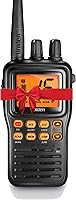
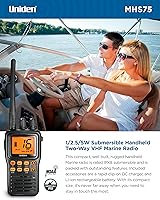
The Uniden MHS75 Handheld VHF Marine Radio has been earning its place on boats since 2008, and that kind of track record means something. This is a mid-range marine handheld that doesn’t try to be everything — it just handles the core job reliably. The JIS8 waterproof rating means it can go overboard and come back working, and the floating body design is a genuine safety net, not a marketing footnote. With selectable transmit power and full coverage of US, Canadian, and international channels, the MHS75 is built for real-world use across different waters and conditions.

Features & Benefits

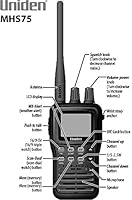
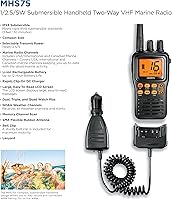
Drop this VHF radio into 5 feet of water for half an hour, pull it out, and it should still work — that’s what the JIS8 submersion rating is designed to guarantee. The three-level power output (1, 2.5, and 5 watts) is genuinely useful: running at 1 watt in a busy marina saves battery and reduces interference, while bumping up to 5 watts gives you reach when you need it offshore. NOAA weather alerts fire automatically if the service issues a warning while the feature is active, and Triple Watch mode quietly monitors channels 16 and 9 in the background so you won’t miss a distress call.

Best For

This marine handheld is a natural fit for recreational boaters and anglers who want a dependable primary or backup radio without spending top dollar. Kayakers and paddleboarders will appreciate that the floating body and waterproofing aren’t compromises here. If you frequently cross between US and Canadian waters, the multi-region channel support means you’re not fumbling with workarounds. It also makes sense as a secondary unit on larger vessels where crew members need their own communication line. Anyone who treats weather monitoring seriously will find the built-in NOAA alert system a practical, not optional, feature.

User Feedback

Across its substantial review base, buyers consistently highlight build quality and durability as standout strengths — the waterproofing inspires real confidence rather than just sounding good on a spec sheet. Audio performance at higher power levels gets positive marks for open-water clarity. That said, some users point out that the menu navigation feels dated, which is a fair observation for a design with roots going back well over a decade. A handful of owners have flagged the charging port as a long-term durability concern. On balance, the consensus leans positive: a reliable everyday radio that earns its place on the water.

Pros

  • JIS8 waterproof rating provides genuine confidence that the radio will survive wet and rough conditions on the water.
  • The floating body design means dropping it overboard isn’t necessarily a loss — it stays retrievable.
  • Selectable transmit power at 1, 2.5, and 5 watts gives real flexibility between battery conservation and communication range.
  • NOAA weather alerts trigger automatically, so you get severe weather warnings without having to monitor a channel manually.
  • Triple Watch mode keeps channels 16 and 9 under passive surveillance while you use another channel — a practical safety feature.
  • Full US, Canadian, and international channel coverage makes it ready for cross-border boating with zero reconfiguration.
  • Up to 12 hours of battery life holds up well across a full day on the water.
  • A long-standing product with over 1,400 reviews gives buyers a well-documented real-world performance picture before purchasing.
  • At its price point, the build quality and feature set represent solid value for recreational use.
  • Compact and light enough at 1.35 pounds to carry comfortably without adding meaningful bulk to your gear.

Cons

  • No DSC (Digital Selective Calling) support limits its usefulness for automated distress signaling in emergencies.
  • No GPS integration means you cannot transmit your position automatically, which is a meaningful gap for offshore use.
  • The menu interface feels dated and less intuitive compared to newer competing models in the same category.
  • No Bluetooth connectivity rules out integration with apps or wireless accessories that modern boaters increasingly expect.
  • Some long-term owners have reported durability concerns with the charging port in humid, marine environments.
  • The overall design has changed little since 2008, which can be a drawback for buyers who want current UX standards.
  • No built-in emergency strobe light, an omission that matters in low-visibility or overboard situations.
  • Limited to 15 km maximum talk range, which may not be sufficient in open-ocean or challenging terrain scenarios.

Ratings

Our AI rating system analyzed thousands of verified global reviews for the Uniden MHS75 Handheld VHF Marine Radio, actively filtering out incentivized, bot-generated, and duplicate feedback to surface what real buyers actually experience on the water. The scores below reflect both the genuine strengths that keep this marine handheld ranked among the top sellers in its category and the honest pain points that prospective buyers deserve to know before committing.

Waterproof Performance
91%
The JIS8 submersion rating is not just a sticker — buyers who have actually dropped the MHS75 overboard or gotten caught in heavy rain report that it holds up as advertised. The floating body adds meaningful real-world reassurance, especially for kayakers and paddlers who know a drop is eventually inevitable.
A small number of users report that after extended saltwater exposure over multiple seasons, the waterproof integrity around the port cover can degrade if not carefully maintained. Rinsing after every saltwater outing is essentially required to preserve the rating long-term.
Build Quality
87%
For a radio at this price tier, the chassis feels solid and purposeful in hand. Buyers who take this VHF radio out regularly in rough conditions — offshore fishing, coastal cruising — consistently report that it survives the physical abuse of life on a working boat without showing alarming wear.
The overall design language is aging visibly, and some buyers note that the plastic feels less premium compared to newer competing models. Button feedback and panel rigidity are functional but not confidence-inspiring in the way that a higher-end unit might feel.
Audio Clarity
83%
At 5 watts in open water, the audio from this marine handheld is consistently described as clear and loud enough to cut through wind and engine noise. Users on smaller vessels and kayaks particularly appreciate that incoming transmissions are intelligible even in moderately rough conditions.
In congested harbor environments with significant RF interference, a few users note that audio can become slightly muddy on weaker incoming signals. The speaker, while adequate, lacks the crispness that some newer models with updated speaker drivers deliver.
Transmit Range
78%
22%
Under good open-water conditions, the 5-watt output reaches the rated range reliably enough for coastal recreational use. Anglers and day sailors report satisfactory contact with marinas and other vessels at distances that comfortably cover typical day-trip scenarios.
Range degrades noticeably in areas with terrain obstruction or heavy marine traffic, which is expected for any handheld VHF but worth flagging here. Users expecting performance comparable to a fixed-mount radio will be disappointed, as the physics of a handheld antenna impose real limits.
Battery Life
76%
24%
Most users get comfortably through a full day on the water without reaching for a charger, which aligns with the rated 12-hour claim under mixed use. Anglers who leave the radio on standby for hours between transmissions find battery performance particularly solid.
Heavy transmit use — especially sustained operation at 5 watts — reduces runtime noticeably below the rated figure. A few users also flag that battery capacity diminishes after extended ownership, a common issue with rechargeable units that lack user-replaceable cells.
Charging Port Durability
58%
42%
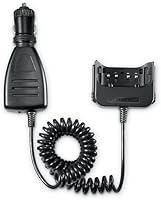
The charging system works reliably when new, and most users have no issues during the first year or two of regular use. The rechargeable setup is convenient and reduces the need for disposable batteries on shorter outings.
This is the most consistently flagged long-term concern among owners. Salt air and humidity accelerate wear on the port cover and connector, and several users report charging failures after a couple of seasons of marine use without careful maintenance. It is a genuine weak point for a device designed to live in a harsh environment.
NOAA Weather Alerts
89%
The automatic weather alert feature is one of the most practically valued aspects of this VHF radio among buyers who actually use it in conditions where weather changes fast. Day sailors and coastal anglers report real peace of mind from knowing the radio will sound an alert without them having to actively monitor a weather channel.
The alert tone itself is functional but not particularly distinctive from other radio sounds, which a handful of users mention as a minor annoyance in noisy cockpit environments. The feature also requires the alert mode to be actively enabled, which new users occasionally forget to toggle on.
Channel Coverage
92%
Having all US, Canadian, and international channels pre-loaded genuinely matters for boaters who cross between jurisdictions, and buyers who regularly move between American and Canadian waters highlight this as a meaningful practical advantage. No reconfiguration, no workarounds.
The channel scanning interface is where the older design age shows most clearly — navigating between channel groups is less fluid than on newer models with more logically organized menus. For users who primarily stick to a small set of channels it’s a non-issue, but those who actively scan may find it tedious.
Ease of Use
63%
37%
Core functions — adjusting power, switching channels, activating weather alerts — are accessible once you spend time with the manual. Users who keep this radio as a dedicated piece of safety gear and use it regularly report building intuition for the interface relatively quickly.
The menu system reflects a UI philosophy from an earlier era of consumer electronics, and first-time VHF radio users in particular often find the learning curve steeper than expected. Compared to competitors with more modern interface design, the MHS75 requires noticeably more patience to navigate confidently.
Triple Watch Function
81%
19%
Boaters who treat channel 16 monitoring as a genuine safety habit — rather than an optional feature — appreciate that Triple Watch runs continuously in the background without requiring any active attention. It functions reliably and does exactly what the specification describes.
The 2-second scan interval is functional but not instantaneous, meaning there is a small theoretical window where a short burst of traffic could be missed. Most users consider this an acceptable engineering trade-off, but it is worth understanding before relying on it as a primary safety monitor.
Value for Money
84%
At its price point in the mid-range marine handheld segment, the MHS75 delivers a feature set — JIS8 waterproofing, multi-region channels, NOAA alerts, floating design — that would cost significantly more from comparable brands. Buyers consistently describe it as a fair deal for what you get.
The value equation weakens somewhat when factoring in the aging interface and the charging port durability concerns, which can result in a shorter effective lifespan than the hardware otherwise suggests. Buyers who need a radio for many consecutive seasons may find that total cost of ownership nudges closer to a premium model.
Portability
88%
At 1.35 pounds and with a form factor that fits comfortably in a life vest pocket or dry bag side pocket, this marine handheld is easy to keep on your person rather than mounted and out of reach. Kayakers especially appreciate the compact carry profile during active paddling.
The dimensions, while not bulky by category standards, make the radio slightly thick for smaller hand sizes, and extended handheld monitoring during a long passage can become mildly fatiguing. A belt clip or harness attachment improves this significantly but adds to what you need to carry.
Instant Channel 16 Access
86%
The dedicated channel 16 button is one of those features that sounds minor until the moment you actually need it in a hurry. Users who have needed to reach the distress channel quickly report that the direct access works exactly as intended without fumbling through menus.
The button placement, while functional, is not ideally positioned for single-handed operation with gloved hands, which is a realistic scenario in cold or wet conditions. A slightly more prominent or recessed button design would improve confidence in emergency use.

Suitable for:

The Uniden MHS75 Handheld VHF Marine Radio is a strong match for recreational boaters, anglers, and paddlers who want a dependable, waterproof communication tool without moving into professional-grade territory. If you spend weekends on a bass boat, take a kayak out in open coastal water, or sail between US and Canadian waters, this radio covers your practical needs well. The automatic NOAA weather alerting is particularly valuable for anyone who heads out without a dedicated weather radio, since it monitors conditions in the background without any manual effort. Crew members on larger vessels who need a personal handheld radio to stay in contact with the helm will also find the MHS75 a sensible, cost-effective choice. Its multi-region channel support means boaters crossing international boundaries don’t need to reconfigure anything — it simply works across jurisdictions out of the box.

Not suitable for:

Buyers who want advanced features like Digital Selective Calling (DSC), GPS integration, or Bluetooth connectivity should look elsewhere — the Uniden MHS75 Handheld VHF Marine Radio does not offer any of those capabilities. Commercial mariners or serious offshore sailors who rely on DSC for automated distress signaling will find this radio falls short of regulatory and practical requirements for extended blue-water use. The interface, while functional, reflects a design that hasn’t changed dramatically since the radio’s original release, so users who expect modern menu logic or a backlit display with contemporary UX will likely feel the age of the platform. Anyone who has experienced issues with marine radio charging ports in high-humidity environments should also be aware that a subset of long-term users have flagged this as a weak point over time. If cutting-edge technology or future-proofed connectivity is a priority, a newer model with a fresher feature set is worth the additional investment.

Specifications

  • Waterproof Rating: Rated JIS8 and IPX8, meaning the radio is fully submersible in up to 5 feet of water for up to 30 minutes.
  • Floating Design: The radio body is buoyant and will float face-up if dropped overboard, making it retrievable in most water conditions.
  • Transmit Power: Output power is user-selectable between 1, 2.5, and 5 watts to balance communication range against battery consumption.
  • Frequency Range: Operates across the 156–174 MHz VHF marine band, covering the full range of internationally recognized marine channels.
  • Channel Coverage: Comes pre-loaded with all USA, International, and Canadian marine channels, including weather and emergency channels.
  • NOAA Weather: All NOAA weather channels are pre-programmed, and the radio automatically sounds an alert tone when a severe weather warning is issued.
  • Triple Watch: Triple Watch mode scans channels 16 and 9 for activity every 2 seconds while the user monitors any other selected channel.
  • Talk Range: Maximum rated communication range is approximately 15 km under optimal open-water conditions.
  • Battery Life: The rechargeable battery provides up to 12 hours of use per charge under typical mixed transmit and standby conditions.
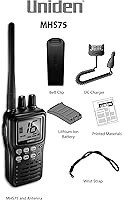
  • Battery Type: Powered by 1 AA battery (included); the unit supports rechargeable operation to reduce ongoing battery replacement costs.
  • Dimensions: The radio measures 6.4 x 6.2 x 3.4 inches, making it a compact handheld suitable for storage in a boat compartment or life vest pocket.
  • Weight: The unit weighs 1.35 pounds, light enough for extended handheld use without causing fatigue.
  • Voltage: Operates at 12.0V, consistent with standard marine-grade handheld radio power requirements.
  • Instant Channel 16: Dedicated Instant Channel 16 access allows the user to jump to the international distress and calling channel with a single button press.
  • Brand & Model: Manufactured by Uniden under model number MHS75; the product has been commercially available since October 2008.

Related Reviews
Uniden Atlantis 155 Handheld VHF Marine Radio
80%
91%
Waterproof Performance
88%
Buoyancy & Drop Safety
89%
Ease of Use
61%
Transmit Power & Range
86%
NOAA Weather Alerts
More
Uniden Atlantis 275 Handheld VHF Marine Radio
81%
93%
Waterproof Performance
88%
Display Quality
79%
Transmit Power & Range
82%
Battery Life
76%
Build Quality
More
Uniden UM725G Marine VHF Radio
79%
93%
Display Clarity
91%
Built-in GPS
88%
DSC Functionality
86%
Audio Quality
84%
Ease of Installation
More
Uniden UM435BK Fixed Mount VHF Marine Radio
80%
93%
Waterproofing & Weather Resistance
88%
Audio Clarity & Reception
84%
Ease of Installation
91%
Channel Coverage & Compatibility
82%
Value for Money
More
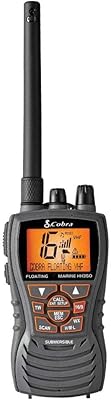
Cobra MR HH600FLTBTGPS Handheld Floating VHF Marine Radio
85%
93%
Waterproof & Durability
88%
Ease of Use
83%
Battery Life
91%
Bluetooth Connectivity
87%
GPS Accuracy & Safety Features
More
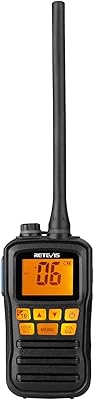
Cobra MR HH350 FLT Floating Marine Radio
82%
93%
Water Resistance & Floatability
88%
Audio Clarity & Microphone Performance
79%
Range & Signal Performance
61%
Battery Life
82%
Ease of Use & Interface
More
Retevis RT55 Handheld Marine Radio
79%
88%
Waterproof Performance
91%
Float Functionality
83%
Audio Clarity
62%
Battery Life
84%
Build Quality
More
Uniden PRO401HH 40-Channel Handheld CB Radio
77%
86%
Audio Clarity
67%
Range Performance
61%
Battery Life & System
79%
Build Quality
91%
Ease of Use
More
Retevis RM21 Handheld Marine VHF Radio
81%
86%
Audio Clarity
83%
Waterproofing & Durability
91%
Floating & Overboard Detection
88%
Battery Life
82%
Noise Cancellation
More
Uniden PRO501HH 40-Channel Handheld CB Radio
74%
78%
Build Quality
82%
Transmission Clarity
74%
Reception Quality
61%
Battery Performance
59%
Range (Real-World)
More

FAQ

Yes, and it’s one of the more credible waterproofing claims in this category. The JIS8 / IPX8 rating means it’s been tested for submersion at 5 feet for up to 30 minutes — not just splash resistance. For kayaking, paddleboarding, or getting caught in a wave, that level of protection is genuinely reassuring.

It does. The body is designed to be buoyant, so if it goes over the side it should float face-up rather than sink. That said, it’s still worth attaching a lanyard as a backup, especially in current or chop where retrieval might not be immediate.

Yes, the MHS75 comes pre-loaded with all US, International, and Canadian marine channels, including the Canadian ‘B’ channels. There’s no manual reprogramming needed — you just switch to the appropriate channel for your location.

Triple Watch lets you monitor channels 16 and 9 for incoming traffic in the background while you’re tuned to a different working channel. The radio checks those two channels every couple of seconds automatically, so you won’t miss a distress call or marina hail even if you’re on another frequency.

No, it does not. DSC is a feature that allows automated distress signaling with GPS coordinates, and it’s found on higher-end models. If DSC capability is important for your boating plans — particularly for offshore or coastal passages — you’ll need to look at a more advanced unit.

No, that’s the convenient part. When the weather alert feature is turned on, the radio monitors NOAA broadcasts in the background and sounds an audible alert tone automatically if a warning is issued. You don’t need to actively tune to a weather channel to stay informed.

Functionally, no — VHF marine radio hasn’t changed dramatically at the core level, and this radio still covers everything a recreational boater needs. Where the age shows is in the menu navigation and interface, which some users find less intuitive compared to newer designs. It’s worth being aware of that if you’re used to modern device UX, but it doesn’t affect core performance.

Realistically, most users report getting through a full day without needing a recharge. The rated 12-hour battery life holds up reasonably well under mixed use — meaning a combination of standby monitoring and occasional transmitting. If you’re transmitting heavily at 5 watts for extended periods, expect that to come down somewhat.

This is one area where a small number of owners have reported concerns over time. Marine environments are tough on any electrical connector due to salt air and humidity, and a subset of long-term users have flagged the charging port as a potential weak point. Rinsing the radio with fresh water after saltwater exposure and keeping the port covered when not charging is a sensible precaution.

At 1 watt, you’re fine for short-range communication in busy areas like marinas or anchorages, and it draws significantly less power. Bumping up to 2.5 or 5 watts extends your range and improves your ability to reach other stations when conditions are challenging or distances are greater. In practice, most boaters start at 1 watt and only step up when they’re not getting a response.