Overview

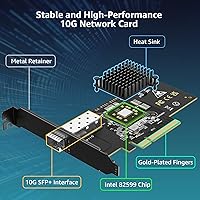
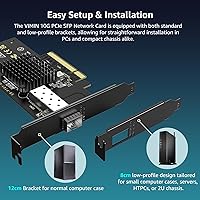
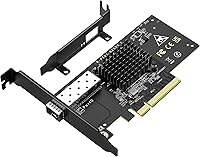
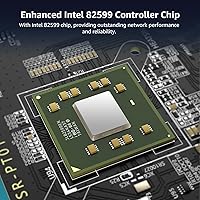
The VIMIN X520-DA1 10GbE SFP+ PCIe Network Card brings 10-gigabit networking within reach of home lab builders and prosumer server operators who'd rather not spend enterprise money on a genuine Intel OEM card. Built around the Intel 82599 chipset, it delivers the same core controller that powers many well-regarded NICs, just without the brand premium. The single SFP+ port keeps things simple, and the inclusion of both standard and low-profile brackets means it fits a wider range of chassis than most budget alternatives. A passive heatsink comes included, which matters when you're pushing sustained 10G traffic through a small server box.
Features & Benefits

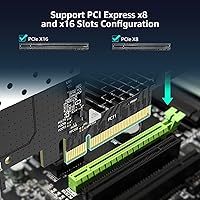
What makes this Intel 82599-based NIC particularly practical is its broad OS compatibility — it works natively with Linux, VMware, and Windows without hunting for third-party driver packages. That's a real time-saver for anyone standing up a Proxmox node or spinning up a fresh ESXi host. The card fits both PCIe x8 and x16 slots, which removes one of the more common compatibility headaches when sourcing hardware for mixed server builds. It handles speeds from 100Mbps up to 10Gbps, so swapping transceivers for slower links won't cause issues. The gold-finger edge connector adds a small but meaningful layer of connection reliability over time.

Best For

This SFP+ network card hits a sweet spot for home lab enthusiasts running Proxmox, TrueNAS, or ESXi who want genuine 10G without the cost of branded enterprise NICs. It's equally well-suited to small business server environments where traffic demands are real but mission-critical redundancy isn't a strict requirement. If you're upgrading a NAS-to-workstation link and already have SFP+ DAC cables or compatible transceivers on hand, this card slots right into that workflow. The low-profile bracket also makes it a solid pick for 1U rackmount builds where full-height cards simply won't fit. Budget-conscious IT admins testing network configs will find it a sensible, low-risk option.

User Feedback

Across nearly 500 ratings, this 10GbE adapter holds a strong 4.4 out of 5, and the feedback breakdown is telling. Linux and VMware users consistently report plug-and-play detection with no manual driver work needed — that alone earns goodwill in the home lab community. Windows Server installs are a bit less smooth for some; a handful of buyers had to source drivers manually, so it's worth keeping that in mind before deploying in a Windows-heavy environment. Transceiver compatibility is the other caveat: DAC cables work reliably, but certain optical transceivers have caused issues for a minority of users. For non-critical workloads, many buyers see little practical difference between this and far costlier OEM alternatives.

Pros

  • Intel 82599 chipset delivers near-universal plug-and-play detection on Linux and VMware out of the box.
  • Both standard and low-profile brackets are included, covering a wide range of chassis types without extra purchases.
  • Passive heatsink keeps temperatures stable under sustained 10G loads without adding fan noise.
  • PCIe x8 and x16 slot compatibility works across a broad mix of desktop and server motherboards.
  • DAC cable connections are consistently stable and reliable at full 10Gbps speeds.
  • Strong value for home lab and prosumer builds — Intel 82599 performance at a fraction of OEM pricing.
  • The card holds a 4.4 out of 5 rating across nearly 500 verified reviews, signaling broad buyer satisfaction.
  • Low-profile form factor support makes it a practical choice for compact 1U rackmount server builds.
  • Multi-speed support from 100Mbps to 10Gbps allows flexible pairing with different SFP+ transceivers.

Cons

  • Windows Server driver installation is not always automatic and may require manual sourcing for some configurations.
  • Optical transceiver compatibility is inconsistent — certain third-party modules have caused link detection issues.
  • VIMIN offers no meaningful official technical support if you hit a problem outside common use cases.
  • No PCIe x4 slot support, which rules out some mini-ITX and embedded boards.
  • Brand is relatively new with limited long-term reliability data beyond early 2024 launch feedback.
  • Some units have shown minor bracket fitment inconsistencies that require adjustment during installation.
  • Not suitable for latency-sensitive or RDMA-dependent workloads that demand more than commodity NIC performance.

Ratings

The scores below for the VIMIN X520-DA1 10GbE SFP+ PCIe Network Card were generated by AI after analyzing verified buyer reviews from multiple global markets, with spam, bot-submitted, and incentivized feedback actively filtered out. Each category reflects real-world usage patterns from home lab builders, small business server operators, and prosumer NAS users. Both the genuine strengths and the friction points are represented honestly — nothing is glossed over.

Value for Money
93%
For buyers coming from enterprise NIC pricing, this SFP+ network card lands like a genuine surprise. Most users acknowledge that getting the Intel 82599 chipset at this tier — with heatsink and dual brackets included — represents exceptional bang for the investment, especially for non-critical lab and prosumer workloads.
A handful of buyers who encountered Windows Server driver friction felt the savings came with a hidden time cost. If your time has real value and you're not comfortable troubleshooting drivers, the apparent savings can feel less clear-cut.
Driver Compatibility — Linux & VMware
91%
This is where the Intel 82599-based NIC earns its strongest marks. Linux and VMware users overwhelmingly report the card being detected automatically with no manual driver work, making it close to plug-and-play for Proxmox nodes, TrueNAS setups, and ESXi hosts straight out of the box.
The experience isn't perfectly universal — a small percentage of Linux users on less common distributions reported needing to confirm kernel module loading. Not a dealbreaker, but worth noting if you're running anything outside mainstream distros.
Driver Compatibility — Windows & Windows Server
67%
33%
Most consumer Windows installs handle the card without issues, and buyers deploying it on standard Windows 10 or 11 machines generally report smooth detection. For straightforward desktop use cases, the experience is solid.
Windows Server is a different story for a notable minority. Some administrators had to manually locate and install drivers, which adds friction in time-sensitive deployments. It's not a widespread failure, but it's consistent enough across reviews to flag before committing to a Windows Server environment.
SFP+ Transceiver Compatibility
63%
37%
DAC cables are the clear winner here — buyers using direct-attach copper cables between servers or to switches report consistently stable, full-speed connections with no negotiation issues. For home lab point-to-point links, DAC is a reliable and affordable pairing.
Optical transceivers are a mixed bag. Several users experienced detection issues or link instability with third-party optical modules, and compatibility appears to vary by vendor and module type. If your setup relies on specific optical transceivers, verify compatibility before purchasing.
Build Quality
82%
18%
The card feels appropriately solid for its market position. The heatsink is well-attached and not an afterthought, and the PCB finish is clean. Buyers upgrading from bargain no-name NICs note a visible step up in physical construction quality.
It doesn't match the tactile confidence of a genuine OEM Intel card — the bracket finish and component tolerances are adequate but not exceptional. For most users this is irrelevant, but it's worth setting expectations if you're used to handling enterprise hardware.
Thermal Management
84%
The included passive heatsink does its job quietly and effectively. Users running sustained 10G transfers in home server environments report stable temperatures without the card throttling or causing system instability, even in compact chassis with limited airflow.
In very tight 1U cases with poor ambient airflow, passive cooling has its limits. A minority of users in thermally dense rack environments suggested the heatsink could run warm under truly continuous heavy loads, though no reported failures were linked to this.
Installation & Physical Fit
88%
Including both standard and low-profile brackets is a practical touch that removes a real frustration for builders. Switching between them takes seconds, and the card slots cleanly into PCIe x8 and x16 slots across a wide range of desktop and server motherboards.
A few users noted the bracket screws felt slightly loose out of the box, requiring minor adjustment during installation. Nothing serious, but the kind of small quality-control inconsistency that crops up occasionally with budget-tier hardware.
10G Throughput Performance
86%
Real-world throughput consistently meets expectations for users pushing NAS-to-workstation file transfers or inter-VM traffic on Proxmox and ESXi. Buyers moving large media libraries or backup jobs over 10G links report the card sustains bandwidth well without unexpected drops.
This isn't a card for ultra-low-latency or jitter-sensitive applications at scale. Users with enterprise traffic shaping needs or RDMA requirements will find it falls short — but that audience isn't really who this card is built for.
Packaging & Included Accessories
74%
26%
The dual-bracket inclusion is genuinely useful and not always guaranteed at this price. The card arrives protected adequately and the heatsink is pre-applied, so there's no assembly fiddling before installation.
Documentation is minimal — essentially non-existent for buyers expecting a setup guide. Self-taught hobbyists will be fine relying on community forums, but less experienced users may feel under-supported straight out of the box.
PCIe Slot Flexibility
89%
Supporting both x8 and x16 PCIe slots is quietly one of the card's most practical attributes. It opens up compatibility across a wide range of server and desktop motherboards, including older hardware that home lab builders frequently repurpose.
There is no x4 slot support, which rules out a subset of budget mini-ITX and embedded boards that only offer x4 slots. Not a common constraint, but worth confirming your slot availability before ordering.
Long-Term Stability
78%
22%
Most buyers running this Intel 82599-based NIC in always-on server environments for several months report no degradation in link stability or throughput. The gold-finger connector design appears to hold up well under repeated reseating.
Long-term data is inherently limited given the product launched in early 2024. A smaller number of users reported intermittent link drops after extended uptime, though it's unclear whether this is card-specific or environmental.
Community & Ecosystem Support
87%
The Intel 82599 chipset has been in the market long enough that community documentation, forum threads, and driver repositories are extensive. For anyone troubleshooting edge cases on Proxmox or TrueNAS, answers are rarely more than a search away.
VIMIN as a brand has limited official support infrastructure. If something goes wrong outside the standard use case, you're largely on your own or dependent on community knowledge rather than any formal technical support channel.
Noise Level
94%
Fully passive cooling means zero added fan noise — a genuine plus in quiet home office server builds where every decibel matters. Buyers who prioritize acoustic comfort in their setups consistently appreciate this design choice.
There is nothing meaningful to flag here for typical use cases. The only theoretical downside is the passive approach in thermally stressed environments, already addressed under thermal management.

Suitable for:

The VIMIN X520-DA1 10GbE SFP+ PCIe Network Card is a strong fit for home lab builders who want genuine 10-gigabit networking without paying enterprise prices. If you're running Proxmox, TrueNAS, or ESXi and need a reliable NIC that just works on Linux or VMware without hunting for drivers, this card checks the box without drama. It's equally well-matched for small business operators connecting a NAS to a workstation or server over 10G — particularly if you already have SFP+ DAC cables in your setup, since those pair with this card most reliably. IT admins who need a low-risk sandbox NIC for testing VMware or Linux network configurations will find it a practical, low-investment choice. The included low-profile bracket also makes it genuinely useful for builders working with 1U rackmount or small-form-factor cases where full-height cards simply don't fit.
Not suitable for:

If your environment demands mission-critical reliability, formal vendor support, or guaranteed transceiver interoperability, this SFP+ network card isn't the right tool. Businesses running production workloads where NIC failure or driver friction has real operational consequences should look at validated enterprise hardware with proper warranty and support channels — VIMIN is a third-party brand with limited official support infrastructure, and that gap shows when edge cases arise. Windows Server deployments deserve extra caution, as a notable subset of buyers had to manually source and install drivers, which is a real burden in managed IT environments. If your 10G setup relies on specific optical transceivers rather than DAC cables, compatibility is genuinely uncertain and worth verifying before committing. Users who want a card they can deploy, forget about, and have someone else support if things break will be better served elsewhere.

Specifications

  • Brand: Manufactured and sold by VIMIN, a third-party hardware brand producing Intel chipset-based networking adapters.
  • Model Number: The card carries the model designation X520-DA1, referencing its Intel X520-series chipset lineage.
  • Chipset: Built on the Intel 82599 controller, a widely supported and mature 10GbE chipset used across enterprise and prosumer networking hardware.
  • Network Port: Features a single SFP+ port supporting direct-attach copper cables and compatible optical transceivers.
  • Max Speed: Capable of network speeds up to 10Gbps, with backward-compatible operation at 100Mbps, 1Gbps, and 2.5Gbps.
  • PCIe Interface: Compatible with PCIe x8 and x16 slots; the card will not fit or function in PCIe x4 or narrower slots.
  • OS Support: Officially compatible with Windows, Windows Server, Linux, and VMware ESXi without requiring third-party driver patches on most distributions.
  • Brackets: Ships with both a standard full-height bracket and a low-profile bracket to accommodate different server and desktop chassis sizes.
  • Cooling: Uses a passive aluminum heatsink mounted directly on the controller to dissipate heat during sustained high-throughput operation.
  • Dimensions: The card measures approximately 8.2 x 5.5 x 1.1 inches, consistent with a standard half-length PCIe adapter form factor.
  • Weight: Weighs approximately 5.6 ounces (around 160g), including the pre-installed heatsink.
  • Connector Quality: The PCIe edge connector uses a gold-finger finish intended to reduce oxidation and maintain a stable slot connection over time.
  • Package Contents: Includes the network card, standard bracket, low-profile bracket, and basic installation hardware; no SFP+ transceivers or DAC cables are included.
  • First Available: This product became available on Amazon in March 2024, making long-term reliability data limited at time of review.
  • BSR Ranking: Holds a Best Sellers Rank of #35 in the Internal Computer Networking Cards category on Amazon at time of writing.
  • Review Score: Carries a 4.4 out of 5 star rating based on approximately 470 verified customer reviews across global Amazon markets.

Related Reviews
Euqvos PCIe Ethernet Network Card X710-DA4 10Gb 4 Port SFP+
85%
92%
Performance
89%
Value for Money
80%
Compatibility with Operating Systems
87%
Heat Dissipation
85%
Ease of Installation
More
WAVLINK 5GB PCIe Network Card
87%
89%
Installation Ease
91%
Performance (Speed)
90%
Value for Money
88%
Compatibility with OS
85%
Build Quality
More
BrosTrend 5Gbps PCIe Network Card
79%
91%
Installation Ease
83%
Real-World Speed Gains
58%
OS & Platform Compatibility
84%
Build & Component Quality
88%
Value for Money
More
WAVLINK WL-WN675X3 WiFi 6E PCIe Network Card
78%
83%
WiFi Performance
67%
6GHz Band Usability
74%
Installation Ease
78%
Bluetooth 5.3 Performance
86%
Antenna Design & Placement
More
GLOTRENDS LE8202 2-Port Gigabit PCIe Network Card
82%
88%
Driver Compatibility
91%
Ease of Installation
94%
Value for Money
86%
OS & Platform Coverage
79%
Build Quality
More
StarTech ST1000SPEX2L 1-Port PCIe Network Card
82%
91%
Ease of Installation
88%
Connection Stability
93%
Low-Profile Compatibility
82%
OS & Driver Compatibility
94%
Value for Money
More
TP-Link TX401 10GbE PCIe Network Card
80%
91%
Installation Ease
88%
Data Transfer Performance
63%
Linux Compatibility
86%
Value for Money
82%
Build Quality
More
TEROW ROW076 WiFi 6 PCIe Network Card
85%
87%
Performance
90%
Installation Ease
89%
WiFi Speed & Reliability
85%
Bluetooth Connectivity
91%
Gaming Experience
More
BrosTrend 2.5G Linux PCIe Network Card
80%
94%
Linux Compatibility
91%
Plug-and-Play Experience
82%
Network Throughput
78%
Build Quality
88%
Value for Money
More
ULANSeN Intel 82576 Dual-Port Gigabit Network Card
81%
91%
Driver Compatibility
84%
Virtualization Support
88%
Value for Money
79%
Throughput Performance
63%
Build Quality
More

FAQ

Yes, in most cases it does. The Intel 82599 chipset is well-supported by the ixgbe kernel module that ships with standard Linux distributions, including those Proxmox is built on. Most users report the card is detected automatically at boot without any manual driver work.

Absolutely. PCIe slots are backward and forward compatible in terms of physical size — an x8 card runs just fine in an x16 slot. You won't lose any meaningful performance in a networking context, since 10GbE traffic doesn't come close to saturating an x8 lane's bandwidth.

DAC cables — direct-attach copper — are your safest and most reliable option with this card, and the majority of buyers use them for NAS-to-server or server-to-switch links. If you want to use optical transceivers, compatibility isn't guaranteed across all brands and module types, so it's worth checking community forums or contacting the seller before buying specific optics.

For most standard Windows 10 and 11 desktop installs, the card is detected without manual driver intervention. Windows Server is a different story — a meaningful number of buyers there had to locate and install drivers manually. If you're deploying on Windows Server, budget some time for that step just in case.

No, it isn't. This card uses the same Intel 82599 chipset that powers the Intel X520 line, but it's a third-party product made by VIMIN, not Intel. In practice the chipset compatibility is broadly the same, but it doesn't carry Intel's warranty, official support, or OEM validation for enterprise platforms.

Yes, and that's actually one of the more useful things about it. The package includes a low-profile bracket specifically for this scenario. Just swap the full-height bracket for the low-profile one before installation and it fits standard 1U chassis without any issues.

No — it's a fully passive heatsink with no fan, so it adds zero noise to your system. For home lab or quiet office server builds, that's a real plus. In very restricted airflow environments it can run warm under continuous heavy load, but no reported failures have been tied to this.

It's a popular choice for exactly that use case. Pairing this SFP+ network card with a matching NIC in your workstation via a DAC cable gives you a clean, fast 10G link for large file transfers. Just make sure your workstation also has a free PCIe x8 or x16 slot for a compatible NIC on the other end.

Generally very well. VMware has native support for the Intel 82599 chipset, and most buyers deploying this Intel 82599-based NIC on ESXi hosts report it being recognized immediately with no extra configuration. It's a common pick for budget home lab virtualization setups.

For non-critical small business workloads — file serving, backups, internal data transfers — yes, it holds up well based on user feedback. That said, it's not validated enterprise hardware with formal support, so if your server role is business-critical and downtime is costly, you'd want a fully supported NIC with a warranty to match.

Where to Buy