Overview

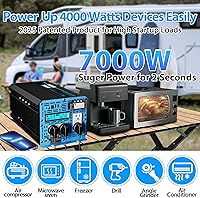
The Giandel 4000W 24V Pure Sine Wave Inverter entered the market in early 2025 as a serious contender in the mid-to-upper tier of high-capacity inverters, backed by UL458 and FCC certifications that budget alternatives rarely bother to obtain. Before anything else, note the 24V DC input requirement — this is not a universal-voltage unit, and buyers running 12V battery banks will need to look elsewhere. Physically, it's a solid, no-flex aluminum alloy build measuring roughly 14.6 by 8.1 by 6.7 inches and weighing just over 16 pounds — dense but manageable for a permanent RV or solar install. The 7000W surge rating is useful for starting motors or compressors, though it's a 2-second peak, not a sustained figure.
Features & Benefits

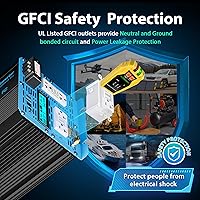
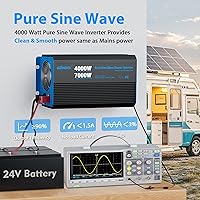
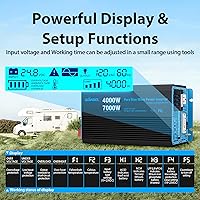
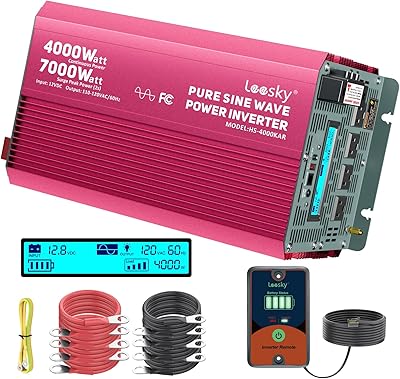
What sets pure sine wave output apart from cheaper modified sine wave units is the quality of power delivered — it's essentially grid-equivalent AC, which matters if you're running CPAP machines, variable-speed motors, or anything with a microprocessor inside. The two 20-amp GFCI outlets add a meaningful safety layer, cutting power instantly if a ground fault is detected, which is especially relevant in damp RV environments or outdoor setups. A 30-foot wired remote handles day-to-day on/off control when the inverter is tucked away, and a wireless remote ships as backup. The LCD readout shows live wattage draw, battery voltage, and fault codes — genuinely useful for troubleshooting rather than guessing. Included ring terminal cables are fully insulated, a step up from the plastic-tipped alligator clips common on lower-cost competitors.

Best For

This 24V inverter makes the most sense for RV and camper owners who have already committed to a 24V house battery system and need reliable power for microwaves, air conditioning, or a full entertainment setup on the road. Off-grid solar users will appreciate the clean output, which won't interfere with sensitive charge controllers or inverter-chargers. Contractors running high-draw tools from a 24V auxiliary truck setup are another solid fit. It also works well as an emergency home backup unit when paired with a battery bank, particularly for households with medical equipment that can't tolerate dirty power. If safety certifications matter to you — and they should — the UL and FCC approvals distinguish this from the many uncertified imports flooding the market.

User Feedback

Across 724 ratings averaging 4.5 stars, the most consistent praise for the Giandel 4000W unit centers on build quality and output cleanliness — buyers report running CPAP devices, laptops, and small AC units without any of the buzzing or interference associated with modified sine wave inverters. The dual remote setup also gets frequent mentions as a practical convenience. On the downside, some owners note that the cooling fans run audibly under heavy load, which can be a nuisance in quiet sleeping quarters. A handful of reviewers also mention a learning curve with the LCD fault codes. Worth flagging: a few negative reviews stem from buyers who ordered the wrong voltage — this unit is strictly 24V, not compatible with 12V systems. Warranty support through U.S.-based service centers has drawn generally positive feedback.

Pros

  • Pure sine wave output protects sensitive electronics, medical devices, and variable-speed motors from power quality issues.
  • UL458 listing and FCC approval provide third-party safety validation that most similarly priced competitors simply skip.
  • GFCI-protected 20-amp outlets add a meaningful fault-protection layer in wet, outdoor, or RV environments.
  • The 30-foot wired remote makes day-to-day control practical when the inverter is mounted in a hard-to-reach compartment.
  • Aluminum alloy housing dissipates heat better than plastic-shell rivals and holds up to the bumps of mobile use.
  • The LCD display shows real-time load wattage, battery voltage, and fault codes, cutting down on guesswork during troubleshooting.
  • All-insulated ring terminal cables come included — a safer and more durable starting point than the alligator-clip bundles on budget units.
  • The 7000W momentary surge capacity handles the high start-up draw of compressors, motors, and air conditioners without tripping.
  • Three U.S.-based service centers back an 18-month warranty, which is a concrete reassurance at this price point.
  • Buyers across hundreds of reviews consistently report appliances running quietly with no buzzing or interference from the output.

Cons

  • Strictly requires a 24V DC input — buyers with 12V systems must look elsewhere, and this detail trips up many shoppers.
  • Cooling fans run audibly under moderate-to-heavy load, which can be disruptive in quiet sleeping quarters or small camper cabins.
  • Decoding LCD fault codes requires referencing the manual; the system is not intuitive enough to self-explain in the moment.
  • At over 16 pounds and nearly 15 inches long, this pure sine wave inverter demands a dedicated, ventilated mounting spot.
  • No built-in USB charging ports, which is a noticeable omission for van-lifers or campers managing several USB-powered devices.
  • The wireless remote is a basic backup rather than a primary feature; range and consistency in metal-walled RVs may disappoint.
  • Sustained full-load operation draws heavy current from your battery bank — cable sizing requirements can catch first-time installers off guard.
  • Some users report the unit running noticeably warm during extended high-draw sessions, making adequate airflow around it non-negotiable.

Ratings

Based on AI analysis of verified purchase reviews for the Giandel 4000W 24V Pure Sine Wave Inverter — with spam, incentivized, and bot-generated feedback actively filtered out — the scores below reflect a balanced picture of what real owners across the globe have experienced. Standout strengths in output cleanliness and build credibility coexist with honest signals around fan noise and installation complexity. Every category, whether positive or critical, is scored as transparently as the underlying data supports.
Pure Sine Wave Quality
91%
Owners running CPAP machines, laptop setups, and high-end audio equipment consistently report zero interference, humming, or equipment damage — a direct contrast to the distorted output many experienced with modified sine wave units before switching. For off-grid solar users and RV full-timers, clean power output is the core requirement, and this 24V inverter delivers it reliably.
A small number of technically inclined users noted minor harmonic distortion under very heavy sustained loads when measured with an oscilloscope, though this rarely affects real-world appliances in practice. The advantage over modified sine wave is also largely irrelevant for buyers whose loads are entirely resistive, such as basic power tools or simple lighting setups.
Build Quality
88%
The aluminum alloy housing earns consistent praise from owners who have used cheaper plastic-shell inverters before — it feels dense and purposeful, and holds up well to the vibration and temperature swings inherent in RV travel or work truck installs. Several reviewers noted that after months of continuous use, there are no signs of warping, cracking, or finish degradation.
At over 16 pounds, the unit demands more thoughtful permanent mounting than lighter alternatives, and a handful of users found the included hardware insufficient for their specific mounting surfaces. A few buyers also noted that the fan grilles feel less refined than the rest of the housing, a minor aesthetic point that matters in clean, purpose-built installations.
Safety Features
86%
The UL458-certified GFCI outlets are a meaningfully practical safety addition — they cut power instantly on a ground fault, which is a real risk in marine docks, wet campsite hookups, and RV kitchens. Under-voltage, over-voltage, over-temperature, and short-circuit protections all activate reliably per user reports, with fault codes providing actionable diagnostic output.
Some users found the GFCI reset button awkward to access in tight mounting configurations, requiring partial removal of surrounding panels in certain RV builds. A minority also felt the fault code reference section in the manual was too brief, making self-diagnosis of protection events harder than it should be without placing a support call.
Output Power Accuracy
83%
Most buyers confirm the Giandel 4000W unit performs close to its stated continuous rating in real-world conditions, handling simultaneous loads like a microwave and an air conditioner without unexpected shutdowns. Owners measuring with a clamp meter report wattage figures that track closely with the LCD display, which adds useful confidence to day-to-day load management.
A handful of owners note the inverter occasionally trips overload protection at sustained draws approaching — but still under — the 4,000W ceiling, particularly in high-ambient-temperature environments. This thermal derating behavior is standard for inverters of this class, but buyers planning to run near full capacity continuously should expect a practical ceiling closer to 3,200 to 3,600 watts.
Value for Money
81%
19%
For a UL458-listed, FCC-approved pure sine wave inverter with GFCI outlets and a dual remote system, the pricing sits at a fair premium over uncertified competitors — buyers who have compared certified alternatives tend to agree it holds its own in the mid-to-upper tier. Off-grid solar installers and experienced RV owners in particular report feeling the cost is justified once the unit is running reliably.
Budget-focused buyers may find a less expensive modified sine wave option sufficient if power quality is not a priority for their load types, making the premium harder to justify on a tight budget. A few reviewers also noted they expected longer included cable runs given the overall price point, adding an unexpected additional cost at installation.
Ease of Installation
72%
28%
The all-insulated ring terminal cables give buyers a cleaner, safer starting connection than alligator-clip bundles, and the LCD fault codes help identify issues during commissioning without requiring a support call. Owners with prior inverter experience consistently describe the physical installation as intuitive, with the wired remote cable being particularly easy to route through cabinetry.
First-time inverter buyers frequently report confusion around DC cable sizing — at 4,000W and 24V, current draw can exceed 160 amps, and the included cables are rarely sufficient for battery banks located more than a short distance away. Several users also noted that the manual's wiring diagrams lack the clarity needed to guide a non-electrician through a safe installation.
Remote Control
79%
21%
The 30-foot wired remote is the standout convenience feature for buyers who mount the inverter in a locked bay or under-bed compartment — routing the cable to a dashboard or galley panel takes minutes and eliminates the need to physically access the unit to toggle power. This setup earns consistent and genuine appreciation in RV and camper owner reviews.
The wireless remote draws mixed reviews for range and reliability inside metal-walled vehicles — some RV owners report it barely reaches from the front cab to the rear storage compartment. A few users also noted the wireless remote feels lightweight and insubstantial relative to the overall build quality of the inverter itself.
LCD Display
77%
23%
Real-time wattage, input voltage, and battery level readouts are practical tools that experienced users genuinely rely on — glancing at current load draw while adding appliances helps prevent overload trips during busy cooking or work sessions in the field. Several reviewers specifically praised the battery voltage display for helping them manage charge cycles on their 24V battery bank.
The fault code system has a learning curve that frustrates less technically experienced owners — the codes are not self-explanatory on the display, and the manual's explanation section is brief enough that some users ended up contacting support for basic error interpretation. Screen visibility in direct sunlight is also reported as a mild issue in some dash-mounted or outdoor configurations.
Fan Noise Level
58%
42%
Under light to moderate loads, the variable-speed fans run quietly enough that most owners in workshop, garage, or outdoor storage environments barely register them. Buyers using this pure sine wave inverter in truck beds or utility bays — where ambient background noise already exists — report no meaningful interference from fan operation.
Under heavy sustained loads, the fans spin up to a clearly audible level that multiple RV reviewers describe as intrusive in sleeping quarters or small camper cabins. This is one of the most consistently mentioned complaints across the user feedback pool, and buyers who prioritize quiet nighttime operation should plan to mount the inverter as far from sleeping areas as their wiring run allows.
Thermal Management
74%
26%
The aluminum alloy housing actively assists heat dissipation in a way ABS plastic bodies cannot, and the variable-speed fans respond proportionally to load demand rather than running at full blast constantly. Under typical mixed loads in a well-ventilated compartment, owners report the unit staying comfortably within safe operating temperatures across extended sessions.
Several users in hot climates — particularly those with the inverter in unventilated RV storage bays during summer months — report thermal protection shutdowns under sustained heavy loads. Adequate airflow around the unit is non-negotiable, and more than a few buyers discovered this constraint only after installing it inside a tightly enclosed cabinet.
Surge Performance
84%
The 7,000W momentary surge capacity — active for up to 2 seconds — is consistently praised by buyers starting air conditioners, refrigerators, and compressors, all of which draw substantially more power at start-up than during continuous operation. Owners report clean motor starts without the stumble, flicker, or shutdown that underpowered inverters produce under the same conditions.
The 2-second surge window is shorter than some competing inverters offer, and users attempting to start particularly large or older motor loads — commercial compressors or larger HVAC units — occasionally report the inverter tripping before the motor fully spins up. For typical RV or residential backup loads, this is rarely a practical issue.
Voltage Stability
87%
Output voltage consistency is one of the technical strengths buyers running sensitive audio-visual equipment, CPAP therapy devices, and variable-speed kitchen appliances point to most often. The pure sine wave architecture maintains stable output as load conditions change, exactly the behavior required by electronics with tight voltage tolerances.
A small number of users with measurement equipment report minor voltage fluctuations at very low load levels — typically when the inverter is running a single small load well below its operating capacity. This is a common characteristic of high-wattage inverters at low utilization and rarely causes practical issues, but it is worth flagging for precision-critical applications.
Cable & Accessories
76%
24%
Shipping with all-insulated ring terminal cables rather than plastic-tipped alligator clips is a genuine step up over most budget inverter packages — the connections are more secure, safer under high-current loads, and more appropriate for permanent installs. Buyers upgrading from cheaper units consistently call out the cable quality as an immediate positive first impression.
The included cables are frequently not long enough for installations where the inverter is mounted more than a foot or two from the battery bank, requiring buyers to source additional appropriately gauged cable separately. A DC-side fuse block is also notably absent from the package, which is a meaningful gap for inexperienced installers who may not know to add one independently.
Warranty & Support
83%
The 18-month coverage backed by three U.S.-based service centers in Illinois, Tennessee, and Texas is a tangible differentiator in a market segment dominated by brands routing all support through overseas channels with long turnaround times. Multiple reviewers report reaching a real human support contact without excessive hold times, which stands out positively against typical electronics support experiences.
A minority of users report slower-than-expected response times during peak periods, and at least a few noted that securing a replacement unit required more back-and-forth than they anticipated. The 18-month warranty period also falls short of the 2-year or even 3-year coverage offered by select premium competitors at similar price points.
Long-term Reliability
78%
22%
Buyers who purchased near the January 2025 launch report encouraging results across several months of consistent use, with no reported component failures or measurable performance degradation across RV travel, solar, and contractor worksite applications. The aluminum housing and quality internal components provide a reasonable structural basis for durability beyond the warranty window.
The product's relative newness means multi-year reliability data simply does not exist yet, introducing uncertainty that more established inverter models with longer track records do not carry. Buyers who place strong weight on proven long-term durability may prefer models with two or more years of documented field history, even where the specifications appear comparable.

Suitable for:

The Giandel 4000W 24V Pure Sine Wave Inverter is purpose-built for buyers who have already committed to a 24V battery system and need a substantial, certification-backed power source they can rely on daily. RV and full-time camper owners are the most natural fit — if you're running a microwave, a rooftop air conditioner, or an entertainment system off a 24V lithium or AGM bank, this inverter has the capacity and output quality to handle it without stressing your appliances. Off-grid solar installers will find it equally well-matched, since the pure sine wave output works cleanly alongside sensitive charge controllers and inverter-chargers that modified sine wave units can degrade over time. Contractors who depend on a 24V auxiliary system in a work truck — powering compressors, saws, or laptop-heavy job sites — get a rugged, field-ready option with enough surge headroom for motor-start demands. Anyone in a scenario where a ground fault poses a real danger, such as a wet marina dock or an outdoor campsite hookup, will genuinely appreciate the GFCI-protected outlets. Buyers who have been burned by uncertified imports and want UL and FCC credentials on the box will find this a meaningful step up in accountability.
Not suitable for:

The Giandel 4000W 24V Pure Sine Wave Inverter is a firm mismatch if your battery bank runs on 12V — this is the single most important thing to verify before ordering, and a surprising number of negative reviews trace back to exactly this voltage confusion. If your real-world power needs cap out around 1,000 to 1,500 watts, this unit is also significant overkill; a smaller, lighter inverter will cost less, run more efficiently, and take up less space. Buyers who prioritize whisper-quiet operation should be aware that the cooling fans kick in audibly under load — it is not overwhelming, but it is noticeable enough to disrupt sleep in a camper bedroom. At over 16 pounds and nearly 15 inches in length, this is not a compact or portable unit; it requires a dedicated, well-ventilated mounting location, which rules it out for quick or improvised setups. Those expecting plug-and-play simplicity may also find the LCD fault code system requires a manual consultation or two before it feels second nature.

Specifications

  • Continuous Power: This inverter sustains a continuous 4,000W output, sufficient to run full-size kitchen appliances, air conditioning units, or power tools within that combined wattage limit.
  • Surge Power: A peak surge capacity of 7,000W is available for up to 2 seconds, covering the high start-up draw of motor-driven appliances such as compressors, refrigerators, and air conditioners.
  • Input Voltage: Requires a 24V DC input from a battery bank or compatible off-grid solar system; it is not interchangeable with 12V systems and will not operate correctly if connected to one.
  • Output Voltage: Delivers 120V AC output, matching standard U.S. household current and making it compatible with the vast majority of North American appliances and electronics.
  • Waveform: Output is pure sine wave, which is electrically equivalent to grid power and safe for sensitive electronics, medical devices, and variable-speed motor applications.
  • AC Outlets: Equipped with two 20-amp GFCI outlets that carry UL458 listing, providing ground fault circuit interrupter protection suited for outdoor, marine, and RV environments.
  • Certifications: Holds UL458 inverter certification and FCC approval, with key internal components including the PCB, fuses, and transformers independently UL-listed as well.
  • Display: A backlit LCD panel shows real-time input voltage, output voltage, load wattage, battery level, and alphanumeric fault codes for on-the-spot diagnostics.
  • Remote Control: Includes a 30-foot wired remote for on/off switching and battery voltage monitoring, plus a wireless remote as a backup for installs where running a cable is impractical.
  • Housing: The outer shell is aluminum alloy, which improves heat dissipation compared to ABS plastic housings and provides greater resistance to impact and warping in mobile installs.
  • Dimensions: The unit measures 14.6 x 8.1 x 6.7 inches (length x width x height), requiring a dedicated and well-ventilated mounting location for any permanent installation.
  • Weight: At 16.06 pounds, the inverter is substantial enough to require secure mounting hardware and is not practical as a portable or frequently relocated unit.
  • Cooling System: High-speed internal ventilation fans activate automatically under load to maintain safe operating temperatures during extended or high-demand use sessions.
  • Cables: Ships with all-insulated ring terminal cables for connecting to the battery bank, a safer and more durable alternative to the alligator-clip cables commonly bundled with budget inverters.
  • Warranty: Backed by an 18-month limited warranty supported by three U.S.-based service centers located in Illinois, Tennessee, and Texas.
  • Model Number: The model designation is GS-4000KAR-24V, which also distinguishes this 24V variant from Giandel's separate 12V inverter product line.

Related Reviews

Yinleader 4000W 24V Pure Sine Wave Inverter
72%
83%
Power Output Accuracy
86%
Pure Sine Wave Quality
67%
Build Quality
79%
Value for Money
84%
Ease of Installation
More
OLTEANP 48V 4000W Pure Sine Wave Inverter
83%
90%
Performance Under Load
65%
Ease of Setup
88%
Battery Compatibility & Longevity
91%
Noise & Operation Smoothness
83%
Build Quality
More
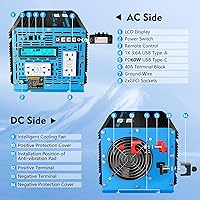
Novopal 2000W 24V Pure Sine Wave Inverter
79%
88%
Power Output Quality
83%
Build Quality
79%
Value for Money
74%
Ease of Installation
81%
Remote Control Functionality
More
OLTEANP TK-3 3000W Pure Sine Wave Inverter
78%
92%
Power Output Quality
88%
Lithium Battery Compatibility
74%
Build Quality
61%
Fan Noise
86%
LCD Display & Usability
More
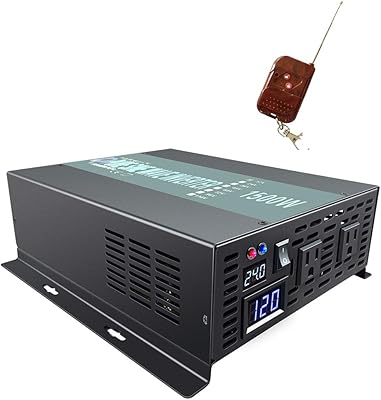
SUNWHEEL 3000W 24V Pure Sine Wave Inverter
78%
88%
Output Power Quality
83%
Value for Money
86%
Ease of Installation
81%
Surge Handling
79%
Noise Level
More
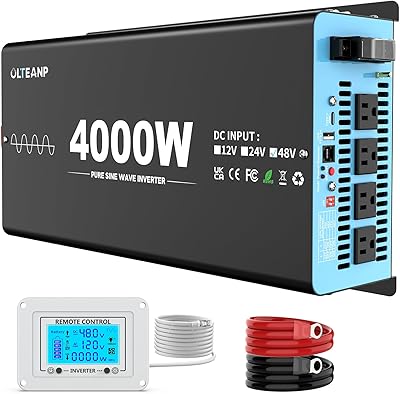
WZRELB 1500W 24V Pure Sine Wave Inverter
73%
88%
Output Power Quality
61%
Reliability & Longevity
84%
Cooling & Noise
82%
Ease of Installation
71%
Remote Control Function
More
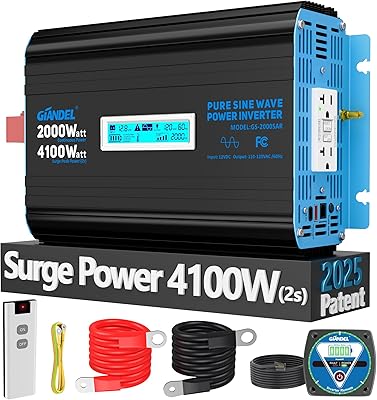
VOLTWORKS HS-4000KBR 4000W Pure Sine Wave Inverter
78%
88%
Power Output Reliability
91%
Pure Sine Wave Quality
86%
Lithium Battery Compatibility
61%
Installation Experience
74%
Thermal Management
More
LEESKY HS-4000KAR 4000W Pure Sine Wave Inverter
80%
88%
Power Output Reliability
93%
Waveform Quality
86%
Lithium Battery Compatibility
84%
Build Quality
81%
LCD Display Accuracy
More
Ampinvt 5000W 24V Split Phase Power Inverter
72%
83%
Power Output Reliability
78%
Build Quality
86%
Pure Sine Wave Quality
81%
Battery Charger Performance
54%
Installation Experience
More
Giandel 2000W Pure Sine Wave Power Inverter
81%
88%
Power Output Reliability
91%
Pure Sine Wave Quality
86%
Build Quality
74%
Noise Level
79%
LCD Display & Monitoring
More

FAQ

No — this is strictly a 24V input unit, and confirming your battery bank voltage before ordering is the single most important step. Connecting it to a 12V system will trigger under-voltage protection and the inverter simply won't run. A surprising number of negative reviews trace back to buyers who missed this detail, so double-check your system voltage before purchasing.

Pure sine wave output is essentially the same quality of electricity you get from a standard wall outlet at home. Modified sine wave is a rougher approximation that works fine for basic resistive loads like incandescent bulbs or simple heating elements, but it causes problems with CPAP machines, laser printers, variable-speed motors, and anything with a microprocessor. If you're powering sensitive electronics or medical equipment, pure sine wave is the right choice — not a luxury.

Yes, a 2,000W microwave is well within the 4,000W continuous rating, so the inverter handles it comfortably on its own. The more relevant detail is the surge: microwaves draw significantly more than their rated wattage for a fraction of a second at start-up, and the 7,000W surge headroom — active for up to 2 seconds — covers that spike cleanly. Just keep an eye on your total combined load if you're running other appliances at the same time.

This comes up regularly in user reviews. The fans are load-dependent and stay relatively quiet at lower power draws, but they spin up noticeably once you're pushing the inverter harder — somewhere between a laptop fan and a desktop PC under load. In a quiet bunk area, some owners do find it disruptive. Mounting the inverter in a storage compartment away from sleeping areas is the most practical workaround if noise sensitivity is a concern.

The wireless remote is best thought of as a backup rather than the primary control method. Metal RV walls can interfere with the signal, limiting range and reliability. For everyday use in a permanent RV install, the 30-foot wired remote is the more dependable option — run it from the inverter compartment to a convenient spot in your living space and you'll likely never need the wireless remote at all.

No — solar panels alone won't work because their output fluctuates constantly with sunlight conditions, which would cause the inverter to repeatedly trip its voltage protection circuits. You need a 24V battery bank in the system, charged by your panels through a charge controller, with the inverter drawing from the battery bank. That combination is exactly what this 24V inverter is designed for in off-grid solar setups.

The included all-insulated ring terminal cables give you a better starting point than the alligator-clip bundles common on cheaper inverters, but they may not cover every installation. At 4,000W and 24V, you can see over 160 amps of DC current draw at full load, which demands properly gauged cable runs to avoid dangerous heat buildup and voltage drop. If your battery bank is more than a foot or two away, plan to source appropriately rated inverter cable and install proper DC-side fusing — this is non-negotiable for safe operation.

In most cases, yes. A standard 13,500 BTU rooftop RV AC unit typically draws 1,200 to 1,500 watts running, but can surge to 2,500 to 3,000 watts at start-up. The 4,000W continuous rating and 7,000W surge capacity should handle that on its own without issue. Where you need to be careful is if you plan to run the AC simultaneously with other heavy loads like a microwave or refrigerator — add up the combined draw and stay within the continuous output limit.

The coverage runs for 18 months and is backed by three U.S.-based service centers in Illinois, Tennessee, and Texas, which is a practical advantage over brands that route all support overseas. General user feedback on warranty interactions is fairly positive, with most owners noting that reaching a real support contact is straightforward. Keep your purchase confirmation on hand and note your order date so the warranty process is hassle-free if you ever need it.

The gap comes down to verified safety and actual output quality. Uncertified inverters frequently overstate wattage ratings, use components that degrade faster, and lack the protective circuitry that prevents dangerous fault conditions. The UL458 and FCC certifications on this unit mean an independent testing lab has evaluated it against defined safety benchmarks — that carries real weight when the inverter is living inside an RV, camper, or home backup setup where a fault event could cause serious harm.