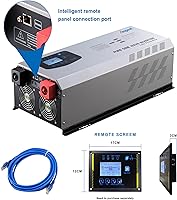
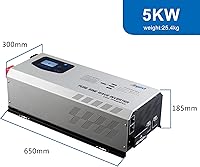
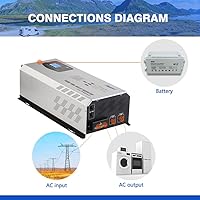
Overview

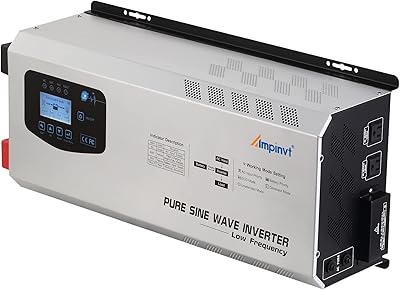
The Ampinvt 5000W 24V Split Phase Power Inverter is a low-frequency, pure sine wave inverter-charger built for people serious about off-grid living or whole-home backup power. It takes 24V DC from a battery bank and delivers split-phase 120V/240V AC output — the kind of setup required to run a well pump, central air conditioner, or workshop compressor without compromise. The 5000W continuous rating is what matters day-to-day; the 15000W peak handles motor startup surges, not sustained operation. At this price tier, buyers reasonably expect solid build quality and reliable output, and Ampinvt has been manufacturing solar inverters since 2013, with US-based customer service established in 2019.
Features & Benefits

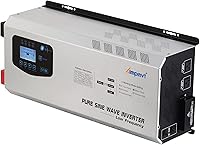
What sets this inverter-charger apart from basic modified sine wave units is the depth of its feature set. The built-in charger supports multiple battery chemistries — LiFePO4, AGM, Gel, and flooded lead-acid — with charge current adjustable from 0 to 35A. Five operating modes, including ECO and unattended, let you fine-tune behavior depending on whether grid power, a generator, or batteries serve as your primary source. Pure sine wave output protects sensitive electronics and motors that modified sine wave inverters would degrade over time. Transfer time under 4ms covers most household loads, though it falls short of medical-grade UPS standards. RS485 connectivity and a built-in AVR stabilizer round out a genuinely practical feature set.

Best For

This split-phase inverter is a natural fit for off-grid homeowners who need to run standard 240V appliances — dryers, well pumps, or HVAC equipment — from a 24V battery bank without building a complex multi-component system. Solar energy builders will appreciate the all-in-one design that eliminates a separate charger. Cabin or rural property owners relying on a generator as a fallback will find the generator and auto-transfer modes particularly useful. Multi-chemistry charging support means you can adapt to battery upgrades over time. That said, this is not a plug-and-play device. Proper electrical installation is required, and buyers without hands-on experience should budget for professional help.

User Feedback

With a 3.9-star average across over 130 reviews, the Ampinvt unit earns a reasonably positive but honest reception. Build quality and output reliability come up often in positive reviews, with buyers reporting solid performance under sustained loads. The most consistent criticism targets the manual — multiple users describe it as thin on practical installation detail, which is a real obstacle when wiring into a home system for the first time. Fan noise under heavy load is another recurring mention. A few buyers also flagged that the unit runs noticeably warm during extended operation, making adequate ventilation clearance a genuine requirement. Customer support feedback is mixed — some report prompt resolution, others have not.

Pros

  • Delivers clean pure sine wave output that runs sensitive electronics, variable-speed motors, and HVAC systems without damage or interference.
  • The all-in-one inverter-charger design eliminates the need for a separate battery charger, simplifying wiring and reducing overall system cost.
  • Supports LiFePO4, AGM, Gel, and flooded lead-acid batteries with adjustable charge current — future-proofing your system as battery technology evolves.
  • Five operating modes including ECO and unattended give experienced installers precise control over how the system prioritizes power sources.
  • Split-phase 120V and 240V output means you can run full-size American household appliances directly, not just small loads.
  • Built-in AVR stabilizer and multiple protection circuits provide a meaningful safety layer for both the unit and connected equipment.
  • Sub-4ms transfer time keeps most household loads running without visible interruption during source switchover.
  • At its price tier, the power capacity and feature depth offer genuine value compared to commercial low-frequency inverters.
  • The LCD display provides real-time system feedback without requiring an additional monitoring accessory right away.
  • US-based customer service means warranty claims do not require navigating international shipping or overseas support queues.

Cons

  • The installation manual is widely criticized as too thin — experienced self-installers often rely on third-party tutorials to fill the gaps.
  • Customer support quality is inconsistent, with a meaningful share of buyers reporting slow or unhelpful post-purchase responses.
  • The unit runs noticeably warm under sustained heavy loads, making ventilation clearance a hard requirement, not an optional consideration.
  • Fan noise ramps up significantly at high draw levels, making it a poor fit for any installation near a bedroom or living area.
  • WiFi monitoring and external control screen capabilities require purchasing separate accessories that are not included at any price tier.
  • Charge profile configuration for LiFePO4 batteries requires manual research — the documentation does not guide you through it adequately.
  • The one-year warranty is shorter than competing brands at a similar price point, with no extended coverage option available.
  • Some buyers report the overload protection triggers below the advertised threshold, leaving less real-world headroom than the specs suggest.
  • The mode-switching interface is non-intuitive without a well-written manual to reference during initial setup.
  • At nearly 68 pounds, installation requires at least two people or proper lifting equipment — solo mounting is impractical and risky.

Ratings

Based on verified buyer reviews analyzed across global marketplaces — with spam, incentivized, and bot-generated feedback actively filtered out — our AI rating system scores the Ampinvt 5000W 24V Split Phase Power Inverter across the dimensions that matter most to real installers and off-grid homeowners. The scores below reflect the full spectrum of user experience, including where this inverter-charger genuinely delivers and where it falls short of expectations.
Power Output Reliability
83%
Users running well pumps, air compressors, and workshop tools consistently report that the continuous output holds steady without unexpected shutdowns during sustained loads. The low-frequency transformer design handles motor startup surges noticeably better than high-frequency alternatives at a similar price point.
A handful of buyers noted the unit tripped under loads they calculated should be within spec, suggesting some variance in real-world headroom versus rated capacity. Those pushing the unit close to its ceiling report the protection circuits can activate before the advertised threshold.
Build Quality
78%
22%
The overall construction feels substantial for the price tier — the metal enclosure is solid, internal components appear well-organized based on buyer teardown photos, and the unit does not rattle or flex under handling. Several users upgrading from cheaper inverters specifically called out the noticeably heavier, more professional feel.
A few buyers flagged cosmetic inconsistencies like uneven panel finishing and slightly misaligned terminal covers, which raises minor doubts about long-term durability in harsh environments. It does not match the fit-and-finish of commercial-grade inverters costing significantly more.
Pure Sine Wave Quality
86%
Sensitive electronics including variable-speed motors, medical-grade CPAP machines, and audio equipment have been run off this inverter-charger without reported interference or damage, which is the core promise of pure sine wave output. Users replacing modified sine wave units noticed an immediate improvement in motor efficiency and appliance behavior.
Independent waveform measurements from a small number of technically inclined buyers suggest minor harmonic distortion under heavy load, though it remains within acceptable tolerance for most household applications. It would not be the first choice for precision lab equipment or professional audio recording setups.
Battery Charger Performance
81%
19%
The ability to adjust charge current across a wide range is a genuine practical advantage, especially for users pairing this unit with lithium LiFePO4 banks that have strict charge parameters. Buyers building hybrid solar systems appreciated eliminating a separate charger from their component list entirely.
Some users reported the default charging profile was not ideal out of the box for their specific battery chemistry, requiring manual tuning that the documentation does not guide well. LiFePO4 owners in particular noted they had to research charge voltage settings independently before feeling confident running the charger.
Installation Experience
54%
46%
For buyers with hands-on electrical experience, the physical installation process is straightforward — terminals are clearly labeled, the unit is logically laid out, and the LCD display provides immediate feedback during commissioning. Experienced installers report getting the unit operational within a few hours.
First-time installers consistently flag the manual as the biggest obstacle — it lacks step-by-step wiring diagrams, configuration walkthroughs, and troubleshooting guidance that a unit at this complexity level genuinely needs. Multiple buyers resorted to third-party YouTube tutorials and forum threads to complete what should be a documented process.
Operating Modes Flexibility
82%
18%
Having five distinct operating modes — including a battery priority and unattended mode with low-voltage protection thresholds — gives this split-phase inverter real versatility across cabin, RV, and home installation scenarios. Users running overnight solar storage systems particularly valued the ECO mode for reducing idle power draw.
Switching between modes requires navigating a menu system that several users described as non-intuitive, especially without a well-written manual to reference. The unattended mode settings in particular took multiple configuration attempts before users felt confident leaving the system running autonomously.
Thermal Management
62%
38%
The unit handles moderate continuous loads without alarming temperature readings, and the thermal protection circuitry does appear to activate correctly before any damage occurs. Buyers running the inverter in well-ventilated spaces or with supplemental airflow report stable long-term operation.
Under sustained high loads, the unit runs noticeably warm, and several buyers flagged this as a concern for enclosed installations like tight battery cabinets or poorly ventilated utility rooms. Fan noise at higher temperatures is consistent enough that it becomes a consideration for any installation near living spaces.
Transfer Time
79%
21%
The sub-4ms transfer time between AC input and battery output is fast enough to keep most household loads — including desktop computers, routers, and LED lighting — running without visible interruption during grid or generator switchover. For typical home backup applications, it performs exactly as needed.
It does not meet the stricter switchover requirements of medical UPS applications or certain industrial equipment that demands near-zero transfer gaps. Buyers who misread this as a UPS replacement for critical medical devices need to understand this distinction clearly before purchasing.
LCD Display & Monitoring
71%
29%
The onboard LCD shows the essential real-time data — input voltage, output load, battery state, and operating mode — that allows users to monitor system health without additional equipment. Most buyers found the display readable and appreciated having that visibility without needing to buy a separate monitor immediately.
The display lacks granularity for users who want detailed battery analytics or historical data logging, and the RS485 port-based WiFi monitoring accessory that provides more depth is sold separately at additional cost. A few users found the LCD contrast and viewing angle less than ideal in bright outdoor installations.
Multi-Chemistry Battery Support
84%
Supporting Gel, SLA, AGM, flooded lead-acid, and LiFePO4 in a single unit is a meaningful advantage for buyers with existing battery banks of varying types, or those planning to upgrade to lithium chemistry down the line without replacing the inverter. This flexibility directly reduces long-term system upgrade costs.
The configuration process for selecting battery type and adjusting charge parameters is not well-documented, leading some users to run non-optimal settings unknowingly. Without clear guidance, there is a real risk of incorrect charge profiles being applied to sensitive lithium batteries.
Fan Noise
58%
42%
Under light to moderate loads, the cooling fan operates at a tolerable noise level that most buyers in utility or garage installations would not find disruptive. The temperature-based speed control means the fan is often quieter during low-demand periods.
At sustained high loads, the fan ramps up to a level that multiple users described as loud enough to be annoying in any shared or living space. For cabin or indoor installations where quiet operation matters, this is a genuine drawback rather than a minor inconvenience.
Value for Money
76%
24%
Relative to commercial low-frequency inverter-chargers with comparable split-phase output, this unit sits at a fraction of the cost while delivering a feature set that covers the needs of most serious off-grid home setups. Buyers coming from high-frequency budget inverters consistently rate the performance improvement as worth the step-up in price.
At its price point, buyers reasonably expect more complete documentation, better customer support, and tighter quality control — areas where the unit does not fully deliver. The value proposition is strong on paper but slightly undermined by the ownership experience gaps that add hidden time and effort costs.
Customer Support
51%
49%
Some buyers report positive direct interactions with the US-based support team for warranty claims, with a few replacement units dispatched without significant friction. The existence of a domestic support center is a step above many competing brands operating purely from overseas.
The feedback on support responsiveness is genuinely inconsistent — a meaningful portion of buyers describe slow response times, templated replies, and difficulty escalating unresolved technical issues. For a unit requiring confident troubleshooting support, this inconsistency is a real purchasing risk.
Warranty & After-Sales
63%
37%
A one-year warranty covering free repair or full product replacement provides a reasonable safety net for a power electronics purchase at this tier. Buyers who did successfully use the warranty report the process was handled without excessive bureaucracy in most cases.
One year is shorter than the two-year coverage offered by several competing brands, and the warranty terms do not clearly address damage from installation errors — a relevant concern given the documentation gaps. Extended coverage is not offered, which matters for buyers planning decade-long off-grid installations.

Suitable for:

The Ampinvt 5000W 24V Split Phase Power Inverter is genuinely well-matched to off-grid homeowners, solar system builders, and rural property owners who need to power standard 240V household appliances — well pumps, central air units, chest freezers, or workshop equipment — from a 24V battery bank. If you are building or expanding a solar energy system and want to consolidate your inverter and battery charger into one unit rather than wiring separate components together, this inverter-charger directly addresses that need. Cabin owners who rely on a generator as a backup power source will appreciate the auto-transfer functionality and configurable operating modes that let the system handle source switching without manual intervention. It is also a strong fit for buyers who are upgrading from a basic modified sine wave inverter and want clean, stable output that will not degrade sensitive electronics or cause motor-driven appliances to run inefficiently. Buyers who are comfortable doing their own electrical work — or who have an electrician on call — will get the most out of what this split-phase inverter offers at its price point.
Not suitable for:

The Ampinvt 5000W 24V Split Phase Power Inverter is not the right choice for anyone expecting a simple, plug-and-play installation experience. The documentation is genuinely lacking — without external resources like community forums or video tutorials, first-time installers will likely find themselves guessing at configuration steps that should be clearly explained in the manual. Buyers who need medical-grade power reliability, such as those running home oxygen concentrators or other life-critical devices that require true UPS-level transfer speeds and certification, should look elsewhere. If your installation environment is enclosed, cramped, or poorly ventilated — a tight utility closet, for example — the unit's thermal behavior under sustained load and its fan noise at high draw levels make it a poor fit. Anyone expecting commercial-grade after-sales support with guaranteed response times will also be disappointed, given the inconsistent customer service feedback from existing buyers. Finally, if you need a 48V input system rather than 24V, or require a three-phase output, this is not architected for that.
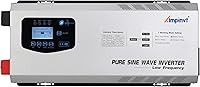
Specifications

  • Continuous Output: The inverter delivers a sustained 5000W of continuous AC power, suitable for running multiple household loads simultaneously without throttling.
  • Peak Output: A 15000W peak rating handles the high startup surge currents drawn by motor-driven appliances like well pumps and air compressors, but only for brief milliseconds — it is not a sustained figure.
  • Input Voltage: Designed for a 24V DC battery bank input, with an operating range of 20–32V DC before over- or under-voltage protection engages.
  • AC Output: Delivers split-phase 120V and 240V AC simultaneously at 60Hz, matching the standard North American residential power format required for full-size appliances.
  • Waveform: Outputs a true pure sine wave, making it compatible with sensitive electronics, variable-speed motors, and any appliance that would be damaged or degraded by modified sine wave power.
  • AC Input: Accepts a wide AC input range of 240VAC plus or minus 25% at 60Hz plus or minus 5Hz, providing tolerance for generator voltage fluctuations.
  • Battery Charger: The integrated AC battery charger supports a maximum charge current of 35A, fully adjustable from 0A to 35A to match the requirements of different battery banks and chemistries.
  • Battery Compatibility: Supports Gel, SLA, AGM, flooded lead-acid, and LiFePO4 lithium battery chemistries, with selectable charge profiles for each type.
  • Transfer Time: Switches between AC input and battery output in under 4 milliseconds, fast enough for most household and small office loads.
  • Overcharge Protection: Automatically triggers overcharge protection when battery voltage reaches or exceeds 32V DC, preventing damage to the connected battery bank.
  • Communication Port: Equipped with an RS485 communication port that supports optional WiFi monitoring modules and external control screens, both sold separately.
  • Display: Includes a built-in LCD panel showing real-time input voltage, output load percentage, battery state, and current operating mode.
  • Operating Temperature: Rated for use in ambient temperatures between 0°C and 60°C, though sustained operation near the upper limit requires adequate ventilation clearance.
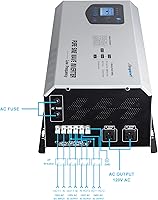
  • Dimensions: The unit measures 23.8 x 6.7 x 10.2 inches, requiring dedicated wall or rack mounting space with clearance on all sides for airflow.
  • Weight: At 67.6 pounds, this is a heavy-duty low-frequency unit that requires two people or mechanical assistance for safe mounting and installation.
  • Operating Modes: Offers five selectable modes — AC priority, battery priority, generator, ECO, and unattended — each designed for a different power source management scenario.
  • Protection Systems: Built-in protections include low and high battery voltage alarms, over-temperature shutdown, overload cutoff, and short-circuit protection.
  • AVR Stabilizer: An integrated automatic voltage regulator stabilizes output voltage, reducing the impact of input fluctuations on connected loads.
  • Model Identifier: Sold under model number FT-5000W24V, manufactured by Top One Power under the Ampinvt brand.
  • Warranty: Covered by a one-year manufacturer warranty that includes free repair or full product replacement for qualifying defects.

Related Reviews

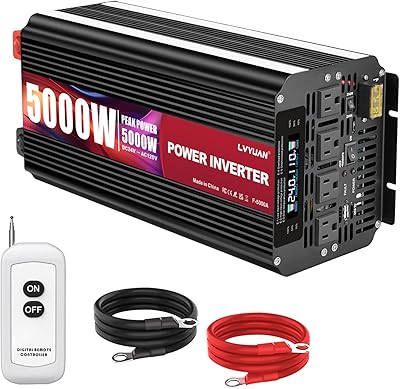
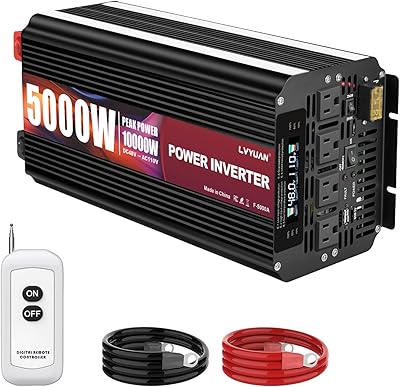
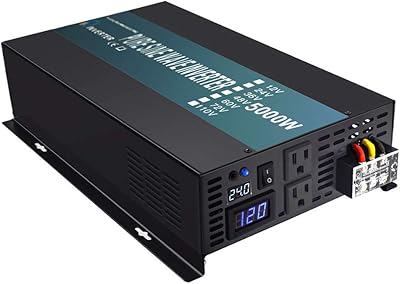
LVYUAN 5000W Power Inverter 24V to 110V/120V
84%
88%
Power Performance
84%
Ease of Use
92%
Safety Features
67%
Portability/Size
90%
Reliability in Off-Grid Use
More
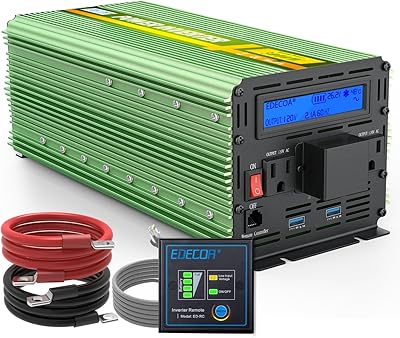
EDECOA 3000W 24V Power Inverter
86%
91%
Value for Money
87%
Performance under Load
95%
Ease of Setup
62%
Noise Level at High Loads
88%
Reliability
More
LVYUAN 5000W Power Inverter 48V to 120V
84%
92%
Power Output
88%
Build Quality
85%
Ease of Setup
90%
Safety Features
65%
Noise Level Under Load
More
Ampinvt 5000W 48V Pure Sine Wave Inverter
81%
91%
Power Efficiency
78%
Ease of Setup
88%
Battery Compatibility
84%
Build Quality
65%
Weight & Size
More
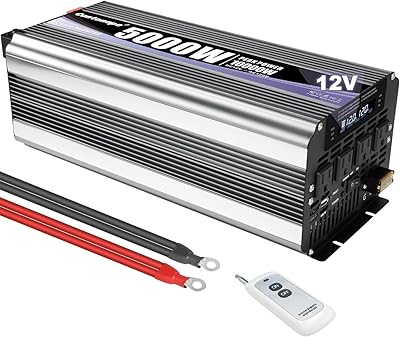
Cantonape MSW1500W-LED-US 5000W Power Inverter
86%
88%
Performance under Load
92%
Build Quality & Durability
85%
Ease of Setup
90%
Safety Features
89%
LCD Display Functionality
More
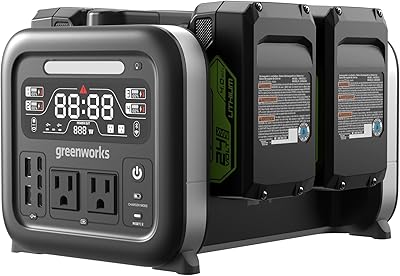
Greenworks 500W 24V Portable Power Inverter with 4 Batteries
84%
88%
App Control Experience
91%
Ease of Setup
64%
Portability/Weight
85%
Battery Life/Power
90%
AC Outlet Performance
More
WZRELB RBP-500024S 5000W 24V Pure Sine Wave Inverter
84%
91%
Power Performance
73%
Ease of Setup
85%
Safety Features
88%
Cooling Efficiency
90%
Build Quality
More
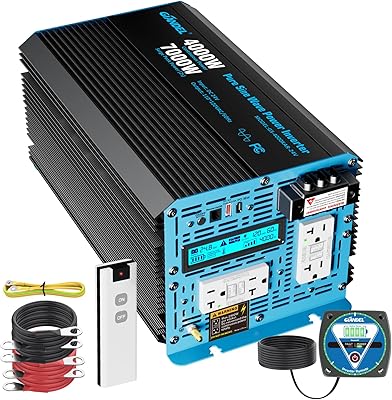
GIANDEL GS-4000KAR-24V 4000W Pure Sine Wave Power Inverter
87%
89%
Performance
90%
Build Quality
94%
Surge Power Handling
80%
Ease of Setup
85%
Remote Control Usability
More
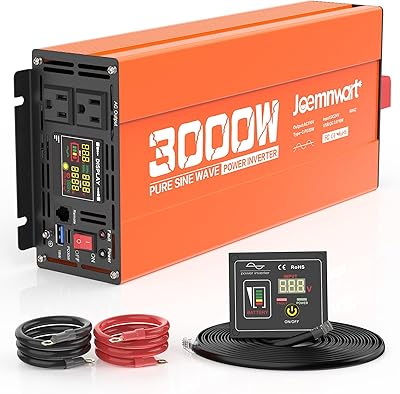
Joemnwart 3000W Pure Sine Wave Power Inverter 24V DC to 110V AC
85%
91%
Power Output
89%
Efficiency
88%
Ease of Use
74%
Noise Levels
85%
Build Quality
More
Kzreect Inverter-MK 220W Portable Power Inverter
85%
94%
Portability and Size
89%
Charging Speed (USB-C & USB-A)
82%
Battery Compatibility
88%
Ease of Use
90%
Safety Features (Overload, Overcurrent)
More

FAQ

Yes, for most residential-sized units. The key is understanding that the 5000W figure is the continuous capacity — what it can sustain indefinitely. Motor-driven loads like well pumps and AC compressors draw a much higher current at startup, and that is where the peak rating provides the headroom. As long as your appliance's running wattage stays comfortably under 5000W and its startup surge does not exceed the peak rating, you should be fine. Always check your appliance nameplate for both running and locked-rotor amperage before assuming compatibility.

It does support LiFePO4, but you need to manually configure the charge voltage and current settings to match your specific battery bank's requirements. The unit does not auto-detect battery chemistry, so if you connect lithium batteries and leave it on a default lead-acid profile, you risk improper charging. Check your battery manufacturer's recommended charge parameters and program them in before running the charger — the documentation is thin on this, so budget some time for research.

The 5000W is the continuous output — how much power the Ampinvt 5000W 24V Split Phase Power Inverter can deliver reliably over an extended period. The 15000W peak is a very short-duration burst capacity that allows motor-driven appliances to start up without tripping the inverter. Think of it like the difference between cruising speed and a sprint. You should size your system around the 5000W figure, not the peak number.
In principle, yes — the split-phase 120V/240V output is designed for exactly that kind of installation. In practice, connecting any inverter to a home electrical panel requires proper transfer switch wiring to prevent backfeed onto the utility grid, which is both a safety hazard and a code violation. This is not a DIY job unless you have solid electrical experience. Have a licensed electrician handle the panel integration even if you do the battery and inverter wiring yourself.

Under light loads, the fan is relatively quiet and not much of an issue. Under sustained heavy loads, it ramps up noticeably — several buyers describe it as loud enough to be distracting in an adjacent room. If your installation is in a detached garage, shed, or utility building, fan noise is unlikely to be a problem. For a basement, closet, or indoor utility room near living areas, it is worth factoring in, especially if the system runs frequently under high demand.

Yes, generator mode is one of the five selectable operating modes specifically for this scenario. It is designed to tolerate the voltage and frequency fluctuations that generators typically produce, within the accepted input tolerance range. If you are running a generator as your primary AC source rather than grid power, make sure the generator's output voltage and frequency stay within the unit's specified AC input range for reliable operation.

WiFi monitoring is not included — the RS485 communication port is present on the unit, but the WiFi adapter module and any external control screen are sold separately. If remote monitoring matters to your setup, factor that additional cost into your budget before purchasing. Some users find the onboard LCD sufficient for day-to-day monitoring; others find the lack of remote visibility frustrating for unattended off-grid systems.

It is a genuinely complex installation. Labeling and terminal layout are reasonably clear, but the included manual does not provide the step-by-step wiring diagrams or configuration walkthroughs that a first-time installer needs. Most buyers who successfully self-installed report spending significant time on community forums and watching third-party installation videos. If you are not already comfortable working with high-current DC wiring and AC panel connections, hiring an electrician for at least the commissioning phase is a smart investment.

No — this specific unit is designed exclusively for 24V DC input. If your battery bank is configured at 48V, you would need a different model; Ampinvt does offer a 48V variant of this inverter for that purpose. Running a 48V bank into a 24V inverter is not possible without reconfiguring the battery bank itself, which involves rewiring your batteries into a different series/parallel arrangement.

It triggers protection and shuts down the output rather than failing permanently, which is the intended safe behavior. Overtemperature protection activates when internal temperatures exceed safe thresholds, and overload protection cuts in when output demand exceeds rated capacity for longer than the allowed brief duration. Once the fault condition clears — the unit cools down, or the overloaded appliance is disconnected — you can restart it. However, consistently running near the thermal limit in a poorly ventilated space will shorten the unit's lifespan even if each individual shutdown event is safe.

Where to Buy