Overview

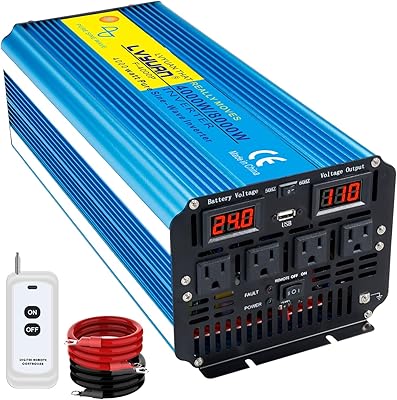
The VOLTWORKS HS-4000KBR 4000W Pure Sine Wave Inverter sits in a practical middle ground — capable enough to run demanding appliances, yet not priced like commercial-grade hardware. One thing worth clarifying upfront: this unit requires a 24V DC input, so if your battery bank is wired at 12V, this is not your inverter. For those already running 24V systems, the pure sine wave output is the real draw. Unlike modified sine wave alternatives, it produces clean AC power that won't damage motor-driven appliances, audio equipment, or sensitive electronics. The FCC certification adds a layer of reassurance for anyone powering radios or communication gear.
Features & Benefits

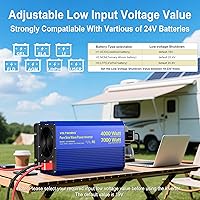
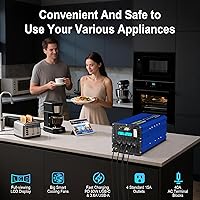
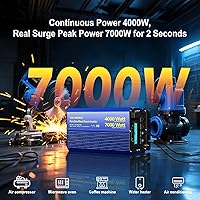
At 4000W continuous, this 4000W inverter can handle a mid-size air conditioner, a full-size refrigerator, or a microwave without issue. The 7000W surge rating helps start motor-heavy loads, though that surge lasts only two seconds — just enough to get a compressor spinning, not a sustained boost. The adjustable low-voltage cutoff, configurable from 19V to 23V, is genuinely useful for lithium battery users who need tighter control over discharge thresholds. Dual USB ports — a QC 3.0 and a PD 60W USB-C — let you charge phones and laptops directly without hunting for an adapter. The LCD and wireless remote round things out practically.

Best For

This pure sine wave inverter is well-matched for RV and van life builds running a 24V battery bank — particularly setups where you want to operate a window AC unit, full-size fridge, or microwave off-grid. It also works well in solar installations where lithium battery compatibility and adjustable voltage thresholds genuinely matter. Contractors running circular saws or power tools from a truck-mounted 24V system will appreciate the headroom. During a home power outage, it can keep critical appliances running without the noise or fuel costs of a generator. Anyone powering FCC-sensitive equipment like ham radios or audio gear will find the clean output a real advantage.

User Feedback

With over 800 ratings and a 4.4-star average, the VOLTWORKS unit has earned generally strong marks. Buyers consistently praise real-world load handling — most report it manages the appliances advertised without trouble. The wireless remote gets positive mentions, though a handful of users note the LCD can be hard to read in bright sunlight. The most cited complaint involves installation: the included battery cables are only 2 feet long and 4AWG, which may be undersized for some setups, so plan on sourcing heavier gauge wire separately. Customer support experiences appear mixed, but the 18-month warranty backed by AIG insurance is a meaningful assurance for buyers investing at this level.

Pros

  • Handles real household appliances — air conditioners, refrigerators, and microwaves — without struggling.
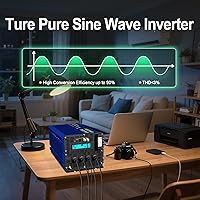
  • Pure sine wave output with THD under 3% protects sensitive electronics and motor-driven equipment.
  • Adjustable low-voltage cutoff is a genuine advantage for lithium battery users managing discharge carefully.
  • Low no-load draw keeps battery drain minimal when the inverter is on but idle.
  • Wireless remote with 50-foot range makes it easy to switch on or off from outside the vehicle or across a room.
  • Both QC 3.0 and PD 60W USB ports mean fast charging for phones and laptops without adapters.
  • FCC certification makes it appropriate for powering radios and audio gear without signal interference concerns.
  • LCD readout gives real-time visibility into input voltage, output load, and fault codes during operation.
  • 18-month warranty backed by AIG insurance adds meaningful protection at this price tier.
  • Four AC outlets provide enough simultaneous connections for a practical off-grid or backup power setup.

Cons

  • Strictly requires a 24V DC input — buyers with 12V systems cannot use this unit at all.
  • The 7000W surge only lasts two seconds, which may not be enough for some hard-starting motors.
  • Included battery cables are only 2 feet long and 4AWG — most real installations will need longer, heavier wire.
  • The LCD screen can be difficult to read in direct sunlight, limiting its usefulness during outdoor daytime use.
  • At 16 pounds and roughly 14.5 inches long, permanent mounting requires planning and adequate physical space.
  • Customer support experiences reported by buyers are inconsistent, which matters when warranty claims arise.
  • No built-in Bluetooth or app monitoring — remote visibility is limited to the physical LCD and wired battery monitor.
  • The cooling fan activates under moderate load, and some users find the noise noticeable in quiet environments.

Ratings

The VOLTWORKS HS-4000KBR 4000W Pure Sine Wave Inverter has been evaluated by our AI system after analyzing verified global buyer reviews, with spam, bot-submitted, and incentivized feedback actively filtered out. Scores reflect the genuine consensus of real-world users across RV builds, off-grid solar installations, and emergency backup scenarios. Both the standout strengths and the friction points buyers actually encounter are transparently represented below.
Power Output Reliability
88%
Buyers running demanding appliances — window AC units, double-door refrigerators, and microwave ovens — consistently report that this 4000W inverter delivers on its continuous wattage rating without nuisance tripping. RV users in particular praise its ability to hold steady under the sustained draw of a compressor-based appliance.
A minority of users note that operating close to the 4000W ceiling in high-ambient temperatures can trigger thermal protection sooner than expected. The 2-second surge window, while technically accurate, has caught a few buyers off guard when dealing with particularly stubborn motor startups.
Pure Sine Wave Quality
91%
The clean AC output — with THD held below 3% — earns consistent praise from users running sensitive gear like audio mixers, ham radios, and variable-speed tools. Several buyers specifically switched from modified sine wave inverters after noticing buzzing in speakers or erratic behavior in electronics, and report those issues completely resolved with the VOLTWORKS unit.
A small number of users with extremely high-fidelity audio setups or laboratory-grade equipment note that even sub-3% THD introduces a barely perceptible noise floor compared to shore power. This is a niche concern and unlikely to matter for the vast majority of use cases.
Lithium Battery Compatibility
86%
The adjustable low-voltage cutoff is one of the most appreciated features among off-grid solar builders, particularly those using LiFePO4 packs with specific discharge thresholds. Being able to dial in the cutoff rather than accepting a fixed default gives lithium users meaningful control over battery longevity.
Some users report that the adjustment interface, while functional, is not intuitive — a few had to consult the manual multiple times to set the threshold correctly. There have also been isolated reports of the cutoff not behaving precisely at the edges of the adjustment range.
Installation Experience
61%
39%
The physical unit is well-labeled and the terminal layout is logical, which experienced installers appreciate. Users who came prepared with proper cable sizing and mounting hardware report a straightforward process overall.
The included 2-foot, 4AWG battery cables are the single most criticized aspect of the installation experience — they are too short and too light for most real-world permanent installs, forcing buyers to source 2/0 or 4/0 AWG cable separately. First-time inverter buyers frequently flag the manual as lacking clear guidance on appropriate wire sizing and fuse placement.
Thermal Management
74%
26%
The intelligent fan control — activating only above 100°F or when load exceeds 2000W — keeps the unit quiet during light-duty use, which RV and van life users appreciate in a sleeping environment. Buyers report the fan does a reasonable job of keeping temperatures in check during sustained mid-range loads.
In confined mounting spaces with restricted airflow, some users report the unit running hot during extended high-load sessions. A handful of buyers in hot climate regions note the fan cycling on more frequently than expected even at moderate wattage, suggesting the thermal headroom tightens quickly in warm environments.
LCD Display Usefulness
77%
23%
The real-time readout of input voltage, output voltage, load wattage, and fault codes is genuinely useful for diagnosing issues and monitoring battery state during a power outage or off-grid session. Users who've experienced a protection event praise the fault codes for pointing them toward the root cause quickly.
In direct sunlight — common in RV and outdoor use cases — the display is frequently described as hard to read, with contrast washing out significantly. The automatic screen shutoff after one minute of inactivity is a minor annoyance for users who want continuous monitoring without touching the unit.
Wireless Remote
79%
21%
The 50-foot wireless range is practical for installations where the inverter is tucked away under a bed, inside a cargo bay, or in a basement utility room. Most buyers find the remote reliable and appreciate not having to physically access the unit every time they want to toggle power.
The remote lacks any status feedback — you press the button and assume the unit responded. In noisy RF environments or through certain materials, a small number of users report intermittent missed commands. The remote also has no range indicator, so users sometimes discover its limits only by accident.
USB Charging Performance
83%
Having both a QC 3.0 USB-A and a 60W USB-C PD port on a power inverter at this capacity is a thoughtful addition. Van lifers and RV users report being able to charge laptops, tablets, and phones simultaneously at full speed without needing a separate charging hub.
With only one USB-A and one USB-C port, users with multiple devices find the ports fill up quickly. A couple of buyers noted the USB-C port did not deliver the full 60W to all laptop models, suggesting partial PD protocol compatibility depending on the device.
Protection Systems
85%
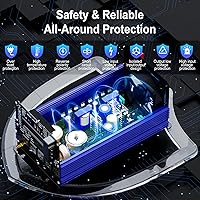
The breadth of built-in protections — covering short circuit, overload, reverse polarity, over and under voltage, and output low-voltage — gives buyers genuine confidence in leaving the unit running unattended. Several users specifically credit the reverse polarity protection for saving the unit after a wiring mistake during initial setup.
A few users report that overload protection triggers slightly conservatively, shutting down under loads that are nominally within spec. Recovery from a protection event requires manual intervention, which can be inconvenient when the inverter is mounted in an awkward location.
Build Quality & Durability
76%
24%
The enclosure feels solid and the terminal blocks are robust enough for permanent installations. Buyers using the inverter in a truck or RV — where vibration and movement are constant — generally report no issues with the housing or connections loosening over time.
At 16 pounds, the unit demands proper mounting hardware, and the case finish shows wear relatively quickly in dusty or outdoor environments. A small number of longer-term owners report minor cosmetic degradation on the housing, though structural integrity complaints are uncommon.
Value for Money
81%
19%
For a 4000W pure sine wave inverter with lithium battery support, FCC certification, dual fast-charge USB, wireless remote, and AIG-backed warranty, most buyers feel the pricing hits a reasonable mid-market sweet spot. Users who previously owned budget modified-sine inverters frequently comment that the upgrade justified the cost difference.
The value proposition takes a small hit when buyers factor in the cost of purchasing proper battery cables separately — a near-universal additional expense. Those who compared it against premium inverter brands note the VOLTWORKS unit trades some build refinement and software polish for a lower entry price.
Noise Level
72%
28%
Under light loads — charging devices, running a laptop, powering LED lighting — the inverter is effectively silent since the fan does not activate. For overnight use in an RV or van, this behavior is specifically called out as a positive by buyers sensitive to background noise.
Once the fan kicks in above 2000W or in warmer conditions, it produces a clearly audible hum that some users find intrusive in quiet settings. A handful of buyers report the fan noise is louder than expected at moderate loads compared to inverters they have previously owned.
Customer Support
58%
42%
The AIG insurance backing and 18-month warranty provide a structural safety net that some buyers have successfully used. A portion of users report positive resolution experiences, particularly for units that arrived with manufacturing defects.
Support response times and resolution quality appear inconsistent based on buyer feedback, with a meaningful cluster of reviews citing slow replies or difficulty getting warranty claims processed. The gap between the warranty promise and the actual support experience is the most recurring disappointment among dissatisfied buyers.
Ease of Monitoring
78%
22%
The combination of the onboard LCD and the 30-foot wired battery monitor remote gives users two ways to keep tabs on system status from different vantage points. Off-grid solar users appreciate being able to check battery voltage from inside a cabin or vehicle without walking to the inverter.
There is no wireless or app-based monitoring option, which feels like a gap for a unit at this price point. Users accustomed to Bluetooth-enabled inverters or solar charge controllers with smartphone dashboards find the monitoring setup noticeably dated.

Suitable for:

The VOLTWORKS HS-4000KBR 4000W Pure Sine Wave Inverter is a strong match for anyone running a 24V battery bank who needs to power real household appliances — not just charge phones. RV owners and van lifers who want to run a window AC unit, a full-size refrigerator, or a microwave without a generator will find the continuous 4000W output gives them enough headroom to do that comfortably. Off-grid solar builders, particularly those using lithium battery packs, will appreciate the adjustable low-voltage cutoff, which lets you fine-tune discharge protection rather than accepting a fixed threshold. Contractors who've wired their work truck to a 24V system and need to run power tools on a job site are another natural fit. Anyone operating FCC-sensitive gear — ham radios, PA systems, audio mixers — will benefit from the clean sine wave output that modified inverters simply can't deliver reliably.
Not suitable for:

If your battery bank runs at 12V, stop here — this 4000W inverter is strictly a 24V input device, and no workaround changes that. Buyers expecting to run heavy loads continuously near the 4000W ceiling for extended periods should also temper expectations; the 7000W surge is real, but it lasts only two seconds, which means sustained near-peak draws will push the thermal protection system harder than light-duty use. Anyone who wants a true plug-and-play installation may be frustrated: the included battery cables are short and on the lighter side for a unit this size, so a proper install likely means sourcing heavier gauge wire and planning your mounting location carefully. This pure sine wave inverter is also probably overkill — and overpriced — if your actual needs top out at charging laptops and running a small fan; a 1000W or 2000W unit would serve that use case at a fraction of the cost. Finally, buyers who need confirmed compatibility with medical-grade equipment should consult the device manufacturer before relying on any consumer inverter, regardless of its output quality.

Specifications

  • Continuous Output: This inverter delivers a steady 4000W of continuous AC power, sufficient to run appliances like a mid-size air conditioner, full-size refrigerator, or microwave without tripping protection.
  • Surge Capacity: A 7000W surge rating handles the brief high-draw startup of motor-driven loads, though this surge window is limited to approximately 2 seconds.
  • Input Voltage: Requires a 24V DC battery source; the low-voltage cutoff is user-adjustable between 19V and 23V, which is particularly useful for calibrating lithium battery discharge limits.
  • Output Voltage: Produces 110V–120V AC output with a tolerance of ±10%, compatible with standard North American household appliances and equipment.
  • Output Waveform: Generates a true pure sine wave with total harmonic distortion (THD) at or below 3%, making it safe for sensitive electronics, variable-speed motors, and audio equipment.
  • Efficiency: Rated at up to 90% conversion efficiency under typical load conditions, reducing unnecessary battery drain during normal operation.
  • Idle Consumption: No-load current draw stays under 35W, meaning the inverter consumes relatively little power when switched on but not actively driving a load.
  • AC Outlets: Equipped with 4 standard AC outlets, allowing multiple appliances to be connected simultaneously within the total wattage limit.
  • USB Charging: Includes one USB-A port with Qualcomm Quick Charge 3.0 and one USB-C port with Power Delivery up to 60W for fast charging of phones, tablets, and laptops.
  • Wireless Remote: A wireless remote control operates the inverter from distances up to 50 feet, allowing power on/off without direct access to the unit.
  • Battery Monitor: A wired battery level monitor remote extends up to 30 feet from the unit, giving remote visibility into battery state without requiring line-of-sight to the LCD.
  • LCD Display: The onboard LCD screen displays real-time input DC voltage, output AC voltage, current load in watts, and fault codes for diagnosing protection events.
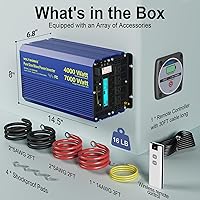
  • Dimensions: The unit measures 14.5″ x 7.98″ x 6.8″, requiring a reasonably dedicated mounting footprint in an RV bay, truck bed, or utility cabinet.
  • Weight: At 16 pounds, this inverter is substantial enough to warrant secure mounting rather than casual placement, especially in mobile applications.
  • Certifications: Carries FCC certification and includes UL458-rated fuses, confirming it meets baseline safety and interference standards for use with radio and communication equipment.
  • Protection Systems: Built-in protections cover short circuit, overload, over-voltage, under-voltage, reverse polarity, overheating, and an output low-voltage shutdown threshold at or below 95V AC.
  • Cooling System: An intelligent cooling fan activates automatically when internal temperature exceeds approximately 100°F or when load surpasses 2000W, staying quiet during light-duty use.
  • Included Cables: Ships with four 4AWG battery cables at 2 feet in length plus a 3-foot ground cable; these are adequate for bench testing but many installations will require longer, heavier gauge wiring.
  • Battery Compatibility: Works with lithium, AGM, flooded lead-acid, and GEL battery types, with the adjustable input threshold providing the most benefit to lithium users.
  • Warranty: Covered by an 18-month manufacturer warranty with AIG insurance backing, offering meaningful protection against defects or premature failure at this investment level.

Related Reviews
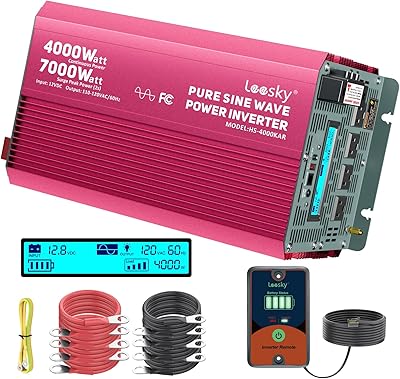
LEESKY HS-4000KAR 4000W Pure Sine Wave Inverter
80%
88%
Power Output Reliability
93%
Waveform Quality
86%
Lithium Battery Compatibility
84%
Build Quality
81%
LCD Display Accuracy
More
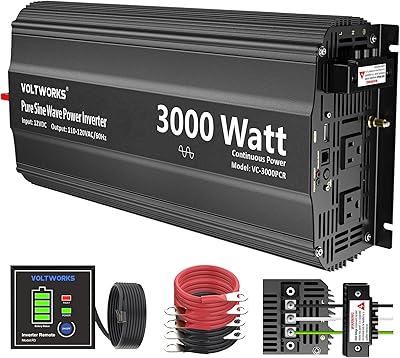
VOLTWORKS VS-3000PCR 3000W Pure Sine Wave Inverter
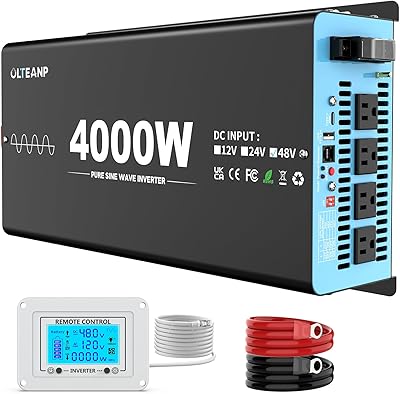
79%
83%
Output Power Accuracy
91%
Output Signal Quality
88%
Cooling & Noise Level
79%
Build Quality & Housing
86%
Installation Ease
More
OLTEANP 48V 4000W Pure Sine Wave Inverter
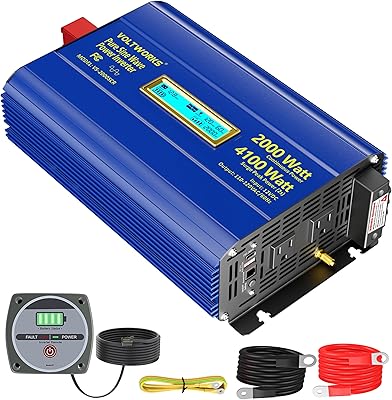
83%
90%
Performance Under Load
65%
Ease of Setup
88%
Battery Compatibility & Longevity
91%
Noise & Operation Smoothness
83%
Build Quality
More
VOLTWORKS VS-1500SCR 1500W Pure Sine Wave Inverter
84%
87%
Performance
82%
Build Quality
91%
Ease of Use
88%
Reliability
79%
Portability
More
VOLTWORKS VS-2000SCR 2000W Pure Sine Wave Inverter
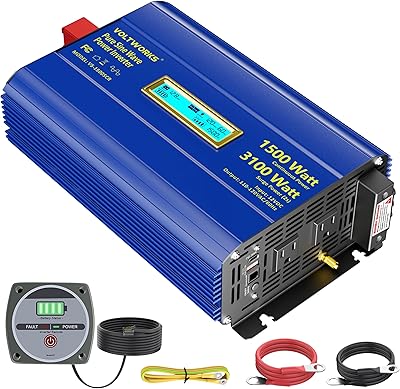
81%
88%
Output Power & Reliability
91%
Sine Wave Quality
83%
Surge Performance
86%
Lithium Battery Compatibility
79%
Build Quality & Housing
More
Giandel 4000W 24V Pure Sine Wave Inverter
80%
91%
Pure Sine Wave Quality
88%
Build Quality
86%
Safety Features
83%
Output Power Accuracy
81%
Value for Money
More
Yinleader 4000W 24V Pure Sine Wave Inverter
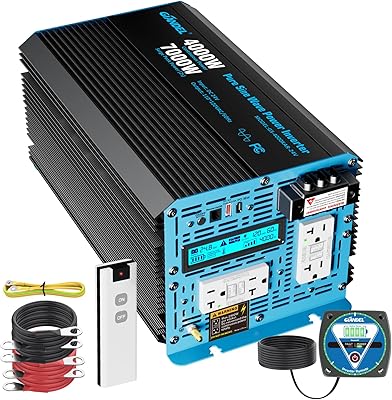
72%
83%
Power Output Accuracy
86%
Pure Sine Wave Quality
67%
Build Quality
79%
Value for Money
84%
Ease of Installation
More
XWJNE 4000W Pure Sine Wave Power Inverter 12V DC to 120V AC
83%
88%
Performance
92%
Efficiency
84%
Build Quality
90%
Safety Features
85%
Noise Level
More
KORKIE 1000W Pure Sine Wave Inverter
76%
88%
Output Signal Quality
82%
Port Variety & Charging
91%
Ease of Setup
79%
Fan Noise
63%
Build Quality
More
ZETAWALE 2500W Pure Sine Wave Inverter
78%
91%
Pure Sine Wave Quality
87%
Auto Transfer Switch
84%
Value for Money
61%
Long-term Reliability
68%
Cooling & Noise
More

FAQ

No — this is strictly a 24V DC input device. There is no adapter or workaround that makes it compatible with a 12V system. If your batteries are wired at 12V, you will need to look at a different unit built for that voltage.

In most cases, yes. A typical 8,000–10,000 BTU window AC unit draws roughly 900–1,200W running and may spike to 2,000–3,000W on startup. This 4000W inverter has the continuous headroom and the surge capacity to handle that startup spike, provided your battery bank can supply the current. Just make sure your battery cables and connections are up to the amperage demands.

It sets the voltage threshold at which the inverter shuts down to protect your batteries from over-discharge. For lithium batteries specifically, the ideal cutoff point varies by battery chemistry and brand — some should not go below 20V per pair, for example. Being able to dial this in between 19V and 23V means you are not stuck with a generic default that may cut off too early or drain your pack too deep.

Almost certainly yes for a permanent install. The included cables are 4AWG and only 2 feet long, which is fine for a quick test but inadequate for most real mounting scenarios where the inverter sits a few feet from the battery bank. For a 4000W unit drawing over 160 amps at full load, you should use 2/0 AWG or 4/0 AWG cables depending on run length, and consult an ampacity chart to size them correctly.

Pure sine wave output is the right starting point for any device with a sensitive power supply, and this inverter does produce clean AC with THD under 3%. That said, for medical equipment specifically, we would always recommend checking with the device manufacturer before relying on any third-party inverter. Some medical devices have explicit requirements around power source type, and the manufacturer is the authoritative source on that.

The fan does not run constantly — it activates when the internal temperature climbs above roughly 100°F or when the load exceeds 2000W. Under light loads in a cool environment, the unit runs silently. Under heavier loads or in warm conditions, the fan is audible but most users describe it as moderate rather than disruptive. In a running vehicle or outdoors, you would barely notice it.

Yes, but the inverter connects to your battery bank, not directly to solar panels. In a solar setup, the panels charge the batteries through a charge controller, and the inverter draws from those batteries to produce AC power. As long as your battery bank is 24V, this inverter integrates into a solar system the same way it would in any other off-grid application.

The wireless remote is a simple RF on/off toggle that works up to 50 feet from the unit, which is useful when the inverter is mounted in a hard-to-reach spot like under a bed or in a rear cargo bay. Most users report it works reliably within range. The separate 30-foot wired battery monitor remote is a different accessory — it lets you check battery voltage without walking to the inverter.

The VOLTWORKS unit includes reverse polarity protection, so connecting the cables backwards should trigger a protection response rather than immediately damaging the inverter. That said, reverse polarity is still bad practice and can stress internal components over time. Always double-check polarity — red to positive, black to negative — before powering on for the first time.

The unit comes with an 18-month manufacturer warranty backed by AIG insurance, which is a more substantive coverage arrangement than you get from many budget inverter brands. User experiences with the support process appear mixed based on buyer feedback, so documenting your purchase and keeping records of any issues from the start is a smart precaution. If your unit arrives with defects or fails prematurely within the warranty window, having your order information readily available will make the claims process smoother.