Overview

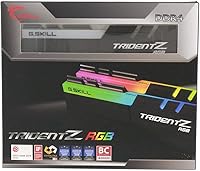
The G.SKILL Trident Z RGB 64GB DDR4 RAM is a high-capacity kit built for power users who have outgrown 32GB and aren't ready to jump platforms for DDR5. It ships as a matched 2x32GB pair, which matters more than it sounds — running two well-tested modules in dual-channel is generally more stable than cobbling together mismatched sticks. G.SKILL has spent years earning credibility in the enthusiast memory space, and this kit reflects that. If you're on an AM4 board like the X570 or B550, or an Intel LGA1200 platform, DDR4 is still very much relevant, and this kit hits a sweet spot for anyone who needs real headroom without rebuilding from scratch.
Features & Benefits

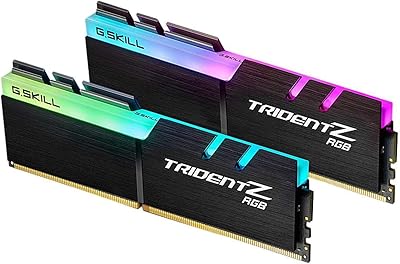
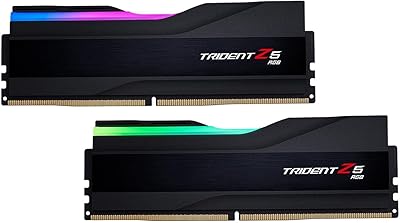
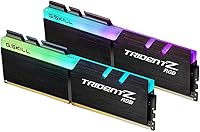
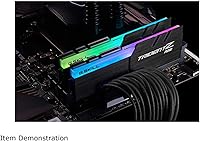
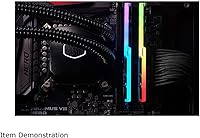
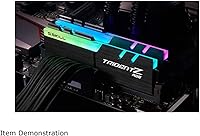
The kit runs at 3200MHz with CL16 primary timings, which in plain terms means it strikes a solid balance between raw bandwidth and access latency — not the tightest timings money can buy, but very capable for the vast majority of workloads. Enabling the XMP 2.0 profile in your BIOS takes about thirty seconds and unlocks those rated speeds automatically on Intel platforms. AMD users aren't left out, but you'll likely need DOCP or a manual timing entry rather than a native XMP toggle. The 1.35V operating voltage keeps thermals in check, and the aluminum heatspreader with its per-module RGB strip looks sharp without adding bulk that might crowd adjacent slots.

Best For

This memory kit makes the most sense for heavy multitaskers — people who game and stream simultaneously, run virtual machines, or keep dozens of browser tabs open alongside creative applications. Video editors and 3D artists working on Intel 10th or 11th gen, or Ryzen 3000 and 5000 series systems, will find 64GB gives them room to breathe without upgrading the entire platform. The RGB aesthetic is a real draw for builders who want a cohesive, lit interior. That said, this kit is not the right choice for anyone building around a DDR5 motherboard, needing ECC error correction, or chasing the absolute lowest latency for competitive esports.

User Feedback

Across a very large pool of verified buyers, the Trident Z RGB DDR4 kit has earned consistently strong marks — the kind of satisfaction level that doesn't appear by accident. Users frequently highlight how painless the initial setup is, particularly on Intel boards where XMP loads without drama. Long-term stability comes up repeatedly, with many owners reporting months of trouble-free use. On the other side, a subset of AMD users ran into XMP instability on certain B550 motherboards until they pushed through a BIOS update — not a dealbreaker, but worth knowing. Checking G.SKILL's QVL compatibility list before you order is genuinely useful advice, not fine print.

Pros

  • 64GB of capacity gives heavy multitaskers and creative professionals genuine breathing room.
  • The matched 2x32GB dual-channel configuration installs cleanly and avoids stability issues from mixing kits.
  • XMP 2.0 support means Intel platform users can hit rated speeds with a single BIOS toggle.
  • 1.35V operation runs cool and plays nicely with builds that have tighter power or thermal constraints.
  • Per-module RGB lighting syncs with major software ecosystems and looks polished inside a windowed case.
  • Long-term reliability feedback from a large owner base is broadly positive, with very few reports of module failure.
  • G.SKILL offers strong QVL documentation, making compatibility research straightforward before you buy.
  • Works on both Intel and AMD desktop platforms, giving this kit broad applicability across common DDR4 builds.

Cons

  • No native AMD EXPO support; Ryzen users must rely on DOCP or manual BIOS configuration to reach rated speeds.
  • Some B-series AMD motherboards require a BIOS update before XMP or DOCP loads stably at 3200MHz.
  • CL16 timings are competitive but not the tightest available if ultra-low latency is a priority.
  • DDR4 platform only — entirely incompatible with any DDR5 motherboard, which limits future upgrade paths.
  • Non-ECC design rules this kit out completely for workstation or error-sensitive computing environments.
  • The heatspreader adds height that can conflict with large tower CPU coolers in tighter builds.
  • Sold strictly as a matched pair; adding a second kit later risks instability if batch numbers differ.
  • No DDR5 migration path means buyers planning a platform upgrade within a year may find limited long-term value.

Ratings

The scores below were generated by our AI after analyzing thousands of verified buyer reviews for the G.SKILL Trident Z RGB 64GB DDR4 RAM from global sources, with active filtering applied to remove incentivized, bot-generated, and outlier feedback. Each category reflects both the genuine enthusiasm and the real frustrations that surfaced consistently across a broad owner base. Nothing has been smoothed over — where pain points exist, they are scored and explained transparently.
Real-World Performance
88%
Users running demanding creative workloads — video timelines, multi-application streaming setups, large 3D scene files — consistently report that 64GB at 3200MHz gives them the headroom to stop managing RAM usage and just work. The CL16 timings hold up well in sustained use without throttling or unexpected slowdowns.
For pure gaming without additional workloads running in parallel, the performance uplift over a well-tuned 32GB kit is hard to feel in practice. A handful of users noted that tighter-timed DDR4 alternatives at similar speeds can edge this kit out in memory-latency-sensitive benchmarks.
Platform Compatibility
74%
26%
On validated Intel LGA1200 platforms and most high-end AMD X570 boards, installation is straightforward and the kit reaches rated speeds without incident. The broad DDR4 support across AM4 and LGA1200 generations makes this a viable upgrade for a large installed base of existing builds.
Compatibility is not universal — several B550 and B450 AMD users reported the kit defaulting to JEDEC speeds or refusing to post at 3200MHz until a BIOS update was applied. Checking G.SKILL's QVL before purchasing is genuinely important here, not just a formality.
Setup & Installation
86%
On Intel platforms especially, the XMP 2.0 profile loads with a single BIOS toggle and the system boots at full speed immediately — most users describe the process taking under two minutes. The physical installation is clean, with no unusual fitment issues on standard ATX or mid-tower builds.
AMD users face a slightly more involved process, needing to locate and enable DOCP rather than a native XMP setting, which trips up less experienced builders. A subset of users had to hunt for a BIOS update before the kit would even post stably at rated speeds on their motherboard.
Value for Money
83%
For buyers who genuinely need 64GB on a DDR4 platform, this kit offers a compelling price-per-gigabyte ratio when benchmarked against comparable capacity kits from other established brands. The combination of rated performance, a quality heatspreader, and RGB lighting at this price tier is hard to match without compromise.
Users who only need 32GB today may find the jump to this kit harder to justify on value grounds alone. A few owners also noted that tighter-timed 64GB kits are available at a modest premium, making the value case slightly less clear-cut for enthusiasts who prioritize raw latency.
Long-Term Reliability
92%
Across the broader reviewer base, reports of module failure are genuinely rare — owners running this memory kit for one, two, or even three years tend to describe continued stable operation without degradation. G.SKILL's track record in the enthusiast space carries real weight here, and buyers clearly notice it.
The small number of reliability complaints that do surface tend to involve edge cases: early instability on specific boards that was later resolved with a BIOS update, or one module arriving DOA. G.SKILL's warranty and RMA process receives mixed reviews, with some users reporting smooth replacements and others experiencing delays.
AMD Platform Experience
67%
33%
Ryzen 3000 and 5000 users who took the time to update their BIOS and enable DOCP generally landed at stable 3200MHz operation after some initial configuration work. Once dialed in, the kit performs consistently on AM4, and many AMD builders report no further issues after that first setup session.
The absence of native AMD EXPO support is a genuine friction point — it means AMD users can't just flip one toggle and walk away the way Intel users can. The extra configuration steps, combined with occasional instability on B-series boards, make this a less plug-and-play experience on the AMD side.
Build Quality & Design
91%
The aluminum heatspreader feels solid and well-fitted to the PCB, with no flex or rattling reported during installation. The black finish with the RGB strip running along the top edge looks purposeful rather than garish, and the overall construction inspires confidence in a way that cheaper kits simply do not.
The heatspreader adds meaningful height to each module, which can be a genuine issue in builds with large tower coolers that overhang the first DIMM slot. A few users had to re-evaluate their cooler choice or reseat the CPU cooler after installing this kit.
RGB Lighting Quality
89%
The per-module RGB strip delivers smooth, even illumination that looks noticeably more polished than budget alternatives, and it integrates cleanly with Asus Aura Sync, MSI Mystic Light, and Gigabyte RGB Fusion without needing third-party workarounds. Builders consistently highlight the lighting as one of the nicer touches in a fully lit system.
Corsair iCUE users will find no native integration, which is a real inconvenience if the rest of your peripherals and components are already in that ecosystem. Occasionally, RGB synchronization can fall out of step after a system restart and requires a software re-sync to correct.
Thermal Management
87%
The 1.35V operating voltage means the modules run noticeably cooler than older, higher-voltage DDR4 kits, and users in cases with moderate airflow report no thermal throttling even during extended rendering or compilation sessions. The aluminum heatspreader contributes meaningfully rather than serving as purely decorative.
In very compact cases with poor airflow, a few users noted the modules running warm enough to be notable during prolonged heavy workloads. This is not a widespread issue, but builders in small form factor cases should ensure they have at least basic airflow passing over the DIMM area.
XMP & Overclocking
82%
18%
The XMP 2.0 profile is well-programmed and loads cleanly on compatible Intel boards, reliably hitting the rated 3200MHz CL16 specification without needing manual tuning. Users who wanted to push further and tighten sub-timings manually found the modules had reasonable headroom beyond their rated profile.
There is no XMP 3.0 or AMD EXPO profile, which means the out-of-box overclock experience is limited to a single preset. Enthusiasts hoping to push past 3600MHz on Ryzen will likely need to invest significant time in manual tuning, with results varying by motherboard and chip sample.
Capacity for Workload
93%
For users whose daily workflows genuinely stress memory — running Premiere Pro alongside After Effects, managing large virtual machine environments, or keeping dozens of browser tabs open during a live stream — 64GB provides a quality-of-life improvement that is immediately tangible rather than theoretical.
For the majority of users whose workload consists primarily of gaming with occasional light browsing, 64GB represents more capacity than current software can meaningfully consume. Buyers who stretch to this capacity speculatively rather than out of a demonstrated need may find the upgrade underwhelming in day-to-day use.
Software & Ecosystem Support
77%
23%
Compatibility with the three dominant motherboard RGB ecosystems — Aura, Mystic Light, and RGB Fusion — covers the vast majority of builders without extra configuration. G.SKILL's own lighting utility provides an alternative path for those who prefer to manage the modules independently of their motherboard software.
The software experience is entirely dependent on third-party motherboard utilities, and when those applications update or break, the lighting can misbehave without any recourse directly from G.SKILL. Users on niche or lesser-known motherboard brands may find partial or no RGB software support for these modules.
Documentation & Support
72%
28%
G.SKILL's online QVL database is genuinely thorough and regularly updated, making pre-purchase compatibility research a realistic and reliable process. The model number system is consistent and searchable, which helps buyers cross-reference their specific motherboard quickly.
The physical documentation included with the kit is minimal, which catches some less-experienced builders off guard when they encounter AMD BIOS configuration steps for the first time. Customer support response times have drawn mixed feedback, with some users reporting efficient RMA handling and others describing frustratingly slow turnarounds.

Suitable for:

The G.SKILL Trident Z RGB 64GB DDR4 RAM is a strong pick for anyone still running a capable DDR4 platform who has genuinely hit the ceiling of 32GB. That includes streamers who game and encode simultaneously, video editors cutting 4K or multi-track timelines, and 3D artists whose scene files routinely balloon in size. If your build is centered around an AMD Ryzen 3000 or 5000 series processor, or an Intel 10th or 11th gen chip, this kit drops in cleanly and delivers real-world headroom without forcing a platform change. Builders who care about aesthetics will also appreciate the per-module RGB lighting, which syncs well with most major software ecosystems for a tidy, cohesive look inside the case. Anyone upgrading from a 32GB setup will find the matched-pair configuration far more reliable than mixing old and new sticks together.
Not suitable for:

If you are building a new system from scratch around a DDR5-native platform — Intel 12th gen and later or AMD Ryzen 7000 series — the G.SKILL Trident Z RGB 64GB DDR4 RAM simply does not apply; those boards require DDR5 and the two are not interchangeable. Workstation users who need ECC memory for error-sensitive computing tasks like financial modeling, scientific simulation, or server workloads should also look elsewhere, as this is a standard non-ECC consumer kit. Competitive gamers laser-focused on achieving the absolute tightest possible memory latency may find tighter-timed alternatives more appealing, since CL16 at 3200MHz is solid but not class-leading on that front. Buyers with older B450 or X370 boards should carefully verify QVL support before purchasing, as rated speeds are not guaranteed on every AMD motherboard without a BIOS update. And if your case has very limited clearance above the DIMM slots, the heatspreader height is worth measuring against your CPU cooler beforehand.
Specifications

  • Total Capacity: The kit provides 64GB of total memory, delivered as two matched 32GB modules designed to run together in a dual-channel configuration.
  • Memory Type: Uses DDR4 U-DIMM (Unbuffered DIMM) technology, which is the standard consumer desktop memory format and is not compatible with laptop or server sockets.
  • Rated Speed: Operates at 3200MT/s (DDR4-3200) when the XMP 2.0 profile or equivalent DOCP setting is enabled in the system BIOS.
  • Latency Timings: Primary timings are rated at CL16-18-18-38, representing a well-balanced profile between bandwidth and access latency for everyday computing and creative workloads.
  • Operating Voltage: Runs at 1.35V, which is below the standard 1.5V DDR3 reference point and helps keep the modules running cooler under sustained workloads.
  • Pin Configuration: Uses the 288-pin U-DIMM form factor standard for all modern Intel and AMD consumer desktop motherboards.
  • BIOS Profiles: Ships with two profiles: a JEDEC default for out-of-the-box compatibility at lower speeds, and an Intel XMP 2.0 profile to unlock the full 3200MHz rated speed.
  • ECC Support: This is a non-ECC kit, meaning it does not include error-correcting code functionality and is not suited for workstation or server environments that require ECC memory.
  • Platform Support: Compatible with Intel and AMD consumer desktop platforms that support DDR4; not compatible with DDR5-native motherboards.
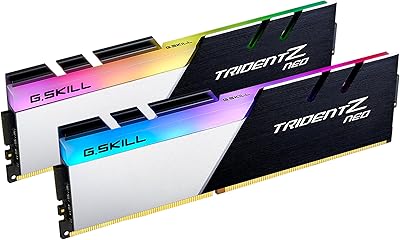
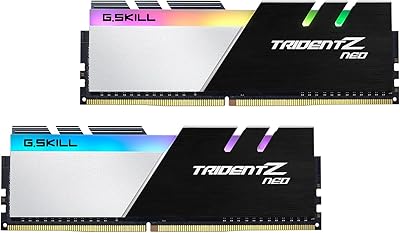
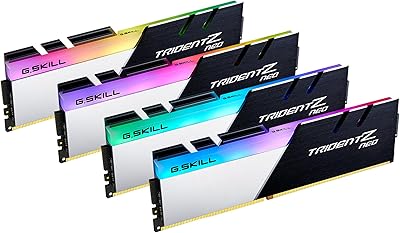
  • Heatspreader: Each module features an aluminum Trident Z RGB heatspreader in a black finish, designed to aid heat dissipation while contributing to the visual aesthetic of the build.
  • RGB Lighting: Each module has a dedicated multi-zone RGB light strip along the top edge, controllable per module through compatible RGB software ecosystems.
  • Module Count: Sold as a matched pair of two sticks; the kit is validated and binned to run together and should not be separated or mixed with modules from a different kit.
  • Module Dimensions: Each module measures approximately 6.4 x 5.4 x 0.6 inches (L x W x H), with the heatspreader adding height that may affect CPU cooler clearance in tight builds.
  • Kit Weight: The complete two-module kit weighs approximately 6.6 ounces in total.
  • Model Number: The official G.SKILL model number for this kit is F4-3200C16D-64GTZR, which can be used to look up motherboard compatibility on G.SKILL's QVL database.

Related Reviews

G.SKILL Trident Z Neo 64GB DDR4 RAM
83%
93%
XMP Reliability
91%
Stability & Reliability
82%
Platform Compatibility
89%
Performance at Rated Speed
78%
Value for Capacity
More
G.SKILL Trident Z RGB 16GB DDR4 RAM
83%
91%
Performance at Rated Speed
88%
Installation & Setup
93%
Stability & Reliability
74%
AMD Platform Compatibility
86%
RGB Lighting Quality
More
G.SKILL Trident Z Neo 16GB DDR4 RAM
88%
93%
XMP Compatibility
91%
Platform Performance
94%
Stability & Reliability
89%
Thermal Performance
86%
Build & Heatspreader Quality
More
G.SKILL Trident Z Neo DDR4 128GB (4x32GB) 3200MT/s RAM
87%
91%
Performance in Gaming
93%
Multitasking & Workload Handling
88%
Overclocking Ease
90%
Build Quality & Durability
84%
Value for Money
More
G.SKILL Trident Z Royal 64GB DDR4 RAM
84%
93%
Overall Stability
89%
XMP Setup Experience
91%
Build Quality
88%
Aesthetic Design
84%
Performance at Rated Speed
More
G.SKILL Trident Z Neo 32GB DDR4 RAM Kit
84%
93%
Performance at Rated Speed
91%
XMP Setup Experience
89%
System Stability
84%
Compatibility Range
88%
RGB Aesthetics
More
G.SKILL Trident Z Neo 32GB DDR4 RAM
80%
83%
Platform Compatibility
91%
Out-of-Box Performance
88%
Build Quality
79%
Thermal Management
84%
RGB Aesthetics
More
G.SKILL Trident Z5 RGB 64GB DDR5 Kit
84%
93%
XMP & EXPO Activation
91%
System Stability
89%
Performance at Rated Speed
86%
RGB Lighting Quality
88%
Build & Heatspreader Quality
More
G.SKILL Trident Z5 RGB DDR5-6400 64GB (2x32GB)
83%
94%
Rated Speed Accuracy
91%
Stability & Reliability
78%
Compatibility Range
71%
Physical Fitment & Clearance
83%
RGB Lighting Quality
More
G.SKILL AEGIS 16GB DDR4 3200MHz Desktop RAM
78%
91%
Value for Money
88%
Installation Ease
83%
Gaming Performance
86%
System Stability
79%
Motherboard Compatibility
More

FAQ

Yes, the G.SKILL Trident Z RGB 64GB DDR4 RAM is compatible with Ryzen 5000 series processors on AM4 motherboards. That said, AMD platforms do not use Intel XMP natively, so you will need to enable DOCP or EXPO in your BIOS to reach the rated 3200MHz speeds. It is also worth checking that your specific motherboard model appears on G.SKILL's QVL list, particularly if you have a B550 board, as some require a BIOS update first.
By default, most systems will boot at a lower JEDEC speed until you manually enable the XMP 2.0 profile in BIOS. On Intel boards, look for an XMP toggle in the memory or overclocking section. On AMD, the equivalent setting is usually labeled DOCP or EXPO. Once enabled, your system will run at the full 3200MHz with the correct CL16 timings automatically.

G.SKILL strongly advises against mixing kits, even from the same product line. Memory kits are validated and binned as matched sets, and combining two separate kits — even with identical specs on paper — can introduce instability or prevent the system from posting. If you think you might need more than 64GB in the future, it is worth planning for that now rather than assuming a second kit will pair cleanly later.

Yes, the Trident Z RGB DDR4 kit is compatible with the major motherboard RGB software ecosystems, including Asus Aura Sync, MSI Mystic Light, Gigabyte RGB Fusion, and ASRock Polychrome. Corsair iCUE is a separate ecosystem and is not directly supported. G.SKILL also offers its own lighting control software if you prefer managing the RGB independently of your motherboard software.

For gaming alone, 64GB is more than most titles will ever use — 16GB to 32GB covers the vast majority of games comfortably. Where this kit makes real sense is if you are gaming and streaming at the same time, running a browser with many tabs open alongside a game, or switching between gaming and memory-heavy creative work like video editing or 3D rendering. If your workload is purely gaming, you might not need this much capacity just yet.

Possibly, but it is worth checking. The heatspreader adds meaningful height to each module, and some large tower coolers with wide bases can overhang the first DIMM slot and physically block tall memory. Before purchasing, compare the module height with the clearance spec listed in your CPU cooler's documentation. Low-profile memory exists specifically for tight builds, though the Trident Z RGB is not one of them.

No. Intel 12th gen (Alder Lake) and later platforms use LGA1700 motherboards that are designed for DDR5 or DDR4 depending on the specific board variant. If your LGA1700 motherboard supports DDR4, this kit may work, but you would need to verify that explicitly. For anyone building new with a current-generation Intel platform, DDR5 is the more natural choice going forward.

G.SKILL maintains a publicly accessible QVL (Qualified Vendor List) on their website. You can search by the model number F4-3200C16D-64GTZR alongside your motherboard model to see whether the combination has been tested and validated. This is genuinely useful research to do before buying, not just formality — especially on B-series boards where compatibility at rated speeds is less universally guaranteed.

This is one of the trickier aspects of matched-pair memory kits. G.SKILL sells this as a set, and finding a single 32GB module from an identical production batch later on is not straightforward. If a module fails under warranty, your best path is to contact G.SKILL directly for an RMA on the full kit. Trying to replace just one stick with a separately purchased module risks reintroducing the instability that matched kits are designed to avoid.

Across a large pool of long-term owners, reliability feedback is quite positive. Reports of actual module failure are uncommon, and most users who encountered early issues traced them back to BIOS settings or motherboard compatibility rather than defective hardware. The most consistent advice from experienced owners is to check the QVL, update your BIOS before installing, and enable XMP or DOCP before drawing conclusions about performance.