Overview

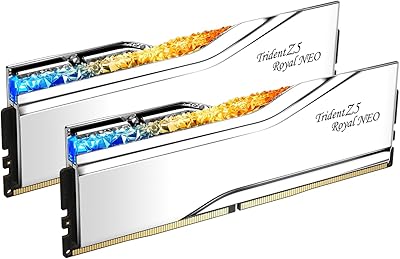
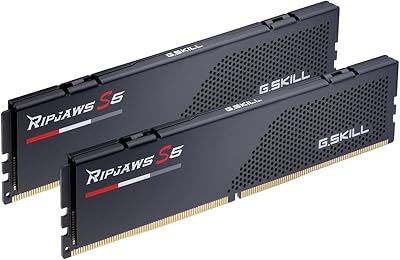
The G.SKILL Trident Z5 RGB 64GB DDR5 Kit is built for desktop builders who aren’t willing to compromise on capacity or speed when moving to a modern platform. Two 32GB modules running in dual-channel configuration give you enough headroom for serious multitasking, content creation workflows, and the kind of future-proofing that makes a build feel relevant three or four years down the line. It covers a wide range of current Intel and AMD platforms, so compatibility isn’t usually a guessing game. The Matte Black finish and RGB lighting set it apart visually in a category where most kits look identical. This is a premium-tier purchase aimed squarely at enthusiasts who want both performance and aesthetics without settling.
Features & Benefits

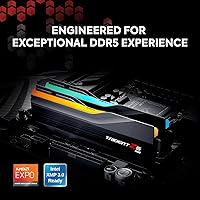
Running at DDR5-6000 with CL36 latency timings, this DDR5 kit sits in a sweet spot that most enthusiast builders actively target — fast enough to push memory-sensitive workloads noticeably forward without the instability that comes with forcing tighter timings at high speeds. Enabling the performance profile is straightforward: both Intel XMP 3.0 and AMD EXPO are supported, so a single BIOS toggle gets you to rated speeds with no manual tuning needed. The 1.35V operating voltage keeps things efficient relative to kits that push harder on the voltage rail. RGB sync works with major motherboard ecosystems. Because this is a matched dual-channel pair, both modules are tested and binned together — don’t mix in a spare stick from another kit, or stability becomes unpredictable fast.

Best For

The Trident Z5 RGB is an obvious fit for anyone building around an Intel 700 or 800-series board, or an AMD 600-series platform, who wants to max out dual-channel memory without stepping up to a more complex quad-channel setup. Content creators — especially those juggling 4K video timelines, large Photoshop files, or simultaneous render and browser sessions — will feel the difference 64GB makes compared to a 32GB kit. Gamers who think ahead will appreciate the capacity buffer as modern titles keep creeping up on memory requirements. It also suits anyone who cares about the visual side of their build. Plug-and-play overclocking via XMP or EXPO makes it approachable for builders who don’t want to dig into memory sub-timings.

User Feedback

With over 1,500 ratings averaging 4.7 stars, this 64GB memory upgrade has earned a strong reception overall. Buyers frequently praise XMP activation reliability and RGB build quality — many note it just works once XMP is toggled on in the BIOS. That said, a recurring thread in critical reviews involves compatibility hiccups on certain boards that required a BIOS update before the kit would post at rated speeds, which isn’t unusual for high-speed DDR5 but is worth knowing ahead of time. A handful of users mention RGB software conflicts depending on motherboard brand. Physical clearance with tall air coolers hasn’t been a widespread concern. Long-term reliability feedback is broadly positive, with very few reports of issues after extended use.

Pros

  • DDR5-6000 speed with CL36 timings hits a well-regarded sweet spot for both gaming and productivity workloads.
  • Intel XMP 3.0 and AMD EXPO support means one BIOS toggle gets you to full rated speed instantly.
  • 64GB of capacity future-proofs your build against increasingly memory-hungry software and games.
  • The 1.35V operating voltage runs efficiently without putting unnecessary strain on your power delivery.
  • Matched dual-channel configuration is tested and binned together, so out-of-box stability is consistently strong.
  • RGB lighting syncs reliably with major motherboard ecosystems and looks polished in a windowed case.
  • Broad platform compatibility spans most current Intel and AMD consumer chipsets without compatibility anxiety.
  • Long-term reliability feedback from verified buyers is notably positive, with very few failure reports after extended use.
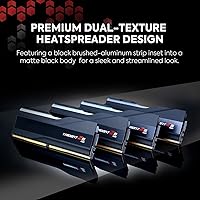
  • The Matte Black finish looks premium without being flashy, pairing well with most high-end build aesthetics.

Cons

  • Some motherboards require a BIOS update before the kit will post at DDR5-6000, which can catch first-time DDR5 builders off guard.
  • RGB software experience can be inconsistent depending on your motherboard brand and which lighting control app you use.
  • The premium price makes this hard to justify for users who genuinely don’t need more than 32GB of RAM.
  • At 64GB capacity, this DDR5 kit is overkill for everyday gaming rigs where the extra memory will sit idle.
  • Running only two slots means no easy path to expand capacity later without replacing the entire kit.
  • Occasional reports of compatibility friction on specific board and CPU combinations, requiring extra troubleshooting steps.
  • No ECC support limits usefulness for professional workstation users where data integrity is a hard requirement.

Ratings

The scores below reflect AI-driven analysis of verified global buyer reviews for the G.SKILL Trident Z5 RGB 64GB DDR5 Kit, with spam, incentivized, and bot-flagged submissions actively filtered out before scoring. Each category is evaluated on real-world usage patterns reported by confirmed purchasers, not marketing claims. Both the strengths that make this DDR5 kit a top-seller and the friction points that occasionally frustrate buyers are represented transparently.

XMP & EXPO Activation
93%
The vast majority of buyers report that enabling rated performance is as simple as flipping a single switch in BIOS — no manual timing adjustments, no voltage fiddling. On Intel Z790 and AMD X670 boards in particular, the profile loads cleanly and the system boots to 6000MT/s on the first try in most reported cases.
A subset of users on certain B-series boards encountered situations where the EXPO or XMP profile caused initial boot failures, requiring a BIOS update before things stabilized. This is not unique to this kit, but it can unsettle less experienced builders who expect a completely friction-free first boot.
System Stability
91%
Long-term reliability feedback is notably strong — buyers who have been running this 64GB memory upgrade for a year or more rarely report crashes, blue screens, or memory errors under sustained workloads. Creative professionals doing overnight renders and gamers running extended sessions both describe the kit as rock-solid once properly configured.
A small number of users noted occasional instability when running the kit in systems with aggressive power-saving features or non-standard memory slot configurations. These issues are edge cases, but they do appear in the feedback pool often enough to be worth flagging for builders with unconventional setups.
Performance at Rated Speed
89%
At DDR5-6000 with CL36 timings, the Trident Z5 RGB delivers measurably fast throughput for memory-sensitive workloads like video encoding, large dataset processing, and games that actively benefit from high bandwidth. Buyers upgrading from DDR4 or slower DDR5 kits consistently describe a noticeable improvement in application responsiveness.
Hardcore overclockers looking to push beyond 6000MT/s or tighten timings further report that this kit has limited headroom, which is common at this speed bin. Users chasing maximum benchmark numbers may find the ceiling frustrating compared to hand-picked ‘OC-grade’ modules sold specifically for that purpose.
RGB Lighting Quality
86%
The per-module RGB diffusion is widely praised for looking clean and even, without the blotchy or segmented appearance that plagues cheaper kits. Buyers building windowed cases with coordinated color themes describe the lighting as a genuine visual asset that holds up well next to premium GPU and motherboard RGB implementations.
RGB software synchronization is the one area where feedback gets messy — some users report conflicts between G.SKILL’s own lighting app and Gigabyte or MSI motherboard software, leading to modules occasionally defaulting to a static rainbow pattern after a restart. It is manageable but requires some setup patience.
Build & Heatspreader Quality
88%
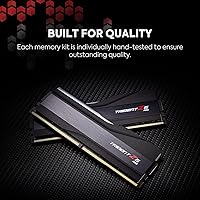
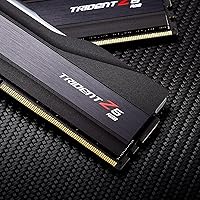
The aluminum Matte Black heatspreader feels solid and well-machined compared to the flimsy plastic found on budget DDR5 kits. Buyers who handle a lot of memory note that the finish holds up without scratching during installation, and the overall fit and feel communicates a level of quality consistent with a premium product tier.
The heatspreader height creates measurable clearance issues for a minority of users pairing this kit with large tower air coolers, particularly those that overhang the first DIMM slot. It is not a dealbreaker for most builds, but it is a real consideration that a handful of buyers wish they had checked before purchasing.
Compatibility Range
84%
Support for both Intel XMP 3.0 and AMD EXPO across a wide range of current-gen chipsets means most builders on modern platforms will find this kit listed on their motherboard’s QVL without issue. Buyers consistently appreciate not having to hunt for obscure compatibility workarounds just to get their memory running as advertised.
Compatibility is not universal — users on some specific board and firmware combinations have reported needing to manually update BIOS before the kit would train properly, and a few older revisions of supported chipset boards have shown inconsistent behavior. Always checking the specific motherboard’s memory QVL before purchasing is strongly recommended.
Value for Money
72%
28%
For buyers who genuinely need 64GB of fast DDR5 in a matched dual-channel configuration with strong brand backing, the pricing reflects the capacity and performance tier accurately. Content creators and power users who have maxed out 32GB report that the jump to this kit felt justified given how it eliminated workflow bottlenecks.
For anyone whose use case doesn’t actually demand 64GB, this kit is straightforwardly expensive relative to 32GB alternatives running similar speeds. The premium is real, and buyers who purchased primarily for the RGB aesthetics without needing the capacity sometimes express post-purchase regret in their reviews.
Installation Experience
87%
Physical installation is described as clean and uncomplicated — the modules seat firmly, the heatspreader design gives a solid grip without being awkward to handle, and the 288-pin connector slides in without excessive force. First-time builders and experienced veterans alike describe the hardware side of setup as a non-issue.
The post-installation BIOS configuration step trips up a meaningful number of less experienced buyers who assume the memory will automatically run at its rated speed without any intervention. The gap between expectation and reality on this front drives a portion of the lower-star reviews despite the kit itself performing correctly.
Thermal Performance
83%
Under sustained memory-intensive workloads, buyers report that the aluminum heatspreader does its job without requiring active cooling or special airflow considerations. The 1.35V operating voltage keeps heat output modest enough that the kit runs comfortably even in cases with average airflow configurations.
A small number of buyers in high-ambient-temperature environments or very restricted airflow cases mention that the heatspreaders get noticeably warm under prolonged load, though no thermal throttling or instability issues have been widely reported as a result. This is a minor concern rather than a real reliability risk.
Dual-Channel Consistency
91%
As a factory-matched pair, both modules are binned and tested together, which translates to reliable dual-channel operation without the frequency mismatches or timing conflicts that can emerge when mixing sticks from different production batches. Buyers building from scratch with this kit report clean memory detection and consistent benchmark results across runs.
The matched-pair design also means there is no practical upgrade path without replacing the entire kit — adding a third or fourth stick from any other source typically degrades performance or causes instability. Buyers who did not read the fine print on this have expressed frustration when their expansion plans hit a wall.
Software Ecosystem
68%
32%
G.SKILL’s lighting control software provides granular RGB customization for buyers who want precise control over effects and colors outside of motherboard-native apps. Users who set up their build once and leave the configuration alone tend to have a perfectly satisfactory experience with minimal software intervention required.
The software experience is the most consistently mixed aspect of user feedback — update conflicts, app crashes, and lighting resets after driver updates are recurring complaints. Buyers who actively tweak their RGB setup frequently find G.SKILL’s app less polished than what major motherboard manufacturers offer natively.
Long-Term Reliability
90%
Across reviews from buyers who purchased early in the kit’s availability window, reports of module failure or degradation over time are rare. The lifetime warranty backing and G.SKILL’s established reputation in the enthusiast segment give buyers measurable confidence that this is a purchase built to last the life of their current platform.
Because this specific configuration launched in mid-2023, the long-term dataset is still relatively limited compared to more established DDR4 products. Most reliability reports beyond 18 months are positive, but the sample size for truly extended use is smaller than it would be for a product with several years of field history.
Packaging & Unboxing
81%
19%
Buyers consistently note that the modules arrive well-protected in rigid clamshell packaging that prevents physical damage during shipping. The presentation feels appropriate for a premium-tier product, and the included documentation makes it easy to confirm the model number and profile details before installation.
There is no standout unboxing experience here beyond adequate protection and basic documentation — no extras, accessories, or installation aids included. Buyers expecting anything beyond the modules themselves in the box may find the packaging functional but unremarkable relative to the price paid.
Capacity Justification
77%
23%
For the right user, 64GB represents genuine future-proofing rather than wasted spend — video editors, 3D artists, and heavy multitaskers who have previously hit the ceiling on 32GB describe the additional headroom as immediately impactful in their daily workflows. The capacity argument is real for this audience.
Honest buyer feedback reveals a noticeable segment of purchasers who retrospectively acknowledge that 32GB would have been sufficient for their actual usage. The capacity premium is only defensible if your workload genuinely demands it, and some buyers did not fully assess that before purchasing.

Suitable for:

The G.SKILL Trident Z5 RGB 64GB DDR5 Kit is built for a specific kind of builder: someone on a current-gen Intel or AMD platform who wants to load up on memory capacity now rather than upgrade again in two years. Content creators are an obvious fit — if you regularly work with large video projects, run multiple virtual machines, or keep dozens of browser tabs open alongside a DAW or design suite, 64GB gives you the breathing room that 32GB increasingly cannot. Gamers who think long-term will also find real value here, since memory requirements for modern titles are creeping upward and having headroom matters. The XMP 3.0 and AMD EXPO support mean you get rated performance without needing to touch a single timing manually, which makes this approachable for builders who are confident enough to pick high-end components but don’t necessarily want to spend hours in BIOS. Anyone who cares about the visual side of a build will appreciate that the RGB implementation and Matte Black finish hold up well next to premium cases and motherboards.
Not suitable for:

The G.SKILL Trident Z5 RGB 64GB DDR5 Kit is not the right call for every buyer, and being honest about that matters. If you’re still running an older Intel or AMD platform that predates DDR5 support, this kit simply won’t work in your system — DDR5 and DDR4 are not interchangeable. Budget-conscious builders who need capable RAM but can’t justify a premium price for a 64GB configuration should look at 32GB DDR5 kits running at similar speeds, which cost considerably less and are still more than enough for most gaming and productivity use cases. If your workflow doesn’t actually demand more than 32GB — and for a large portion of users it genuinely doesn’t — you’d be paying for capacity you’ll never use. Workstation users who need error-correcting memory for data integrity reasons should also look elsewhere, since this is a non-ECC consumer kit by design. Anyone hoping to add a third or fourth module from a different kit later will likely run into stability problems, as matched kits need to stay together.
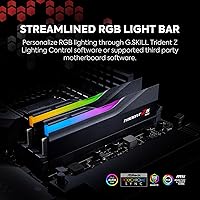
Specifications

  • Total Capacity: This kit provides 64GB of total memory across two matched 32GB DDR5 U-DIMM modules running in dual-channel configuration.
  • Memory Type: DDR5 U-DIMM Non-ECC, designed for consumer desktop systems rather than workstation or server environments requiring error correction.
  • Rated Speed: Modules are rated for DDR5-6000, equivalent to 6000MT/s, when the XMP 3.0 or AMD EXPO profile is enabled in BIOS.
  • Latency Timings: Primary timings are set at CL36-36-36-96, representing a well-balanced profile for high-frequency DDR5 operation.
  • Operating Voltage: The kit runs at 1.35V under its rated XMP or EXPO profile, which is efficient relative to many competing high-speed DDR5 kits.
  • Profile Support: Both Intel XMP 3.0 and AMD EXPO overclock profiles are embedded, enabling one-click activation of rated speeds on supported platforms.
  • Form Factor: Standard 288-pin U-DIMM form factor, compatible with full-size desktop motherboards on supported Intel and AMD chipsets.
  • Module Count: This is a two-module kit; both sticks are matched, binned, and intended to be used together as a complete set.
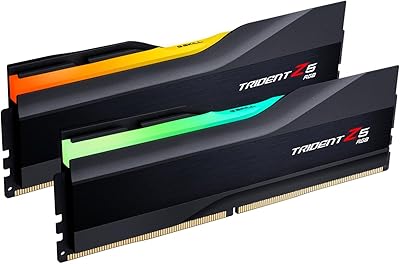
  • RGB Lighting: Each module features addressable RGB lighting under the Trident Z5 RGB series heatspreader, compatible with major motherboard lighting ecosystems.
  • Heatspreader Color: The aluminum heatspreader is finished in Matte Black, offering a clean, understated look suited to most premium build color schemes.
  • Compatible Platforms: Validated for use on Intel Z890, Z790, Z690, B860, B760, and B660 chipsets, as well as AMD X870, X670, B850, B840, and B650 platforms.
  • JEDEC Profile: A standard JEDEC default profile is also included, allowing the kit to boot at baseline DDR5 speeds on any compatible board before XMP or EXPO is enabled.
  • Physical Dimensions: Each module measures approximately 9.69 x 1.1 inches in profile, which may affect clearance with tall tower CPU coolers in compact cases.
  • Kit Weight: The full two-module kit weighs approximately 5.6 ounces combined, consistent with standard heatspreader-equipped DDR5 modules.
  • Market Ranking: This kit holds a Best Sellers Rank of #63 in the Computer Memory category on Amazon, indicating strong and sustained buyer demand.
  • Buyer Rating: Rated 4.7 out of 5 stars across more than 1,500 verified ratings, reflecting consistently high satisfaction among purchasers.
  • First Available: This specific model configuration was first made available in May 2023, coinciding with broader DDR5 platform adoption on Intel 700-series and AMD 600-series boards.

Related Reviews
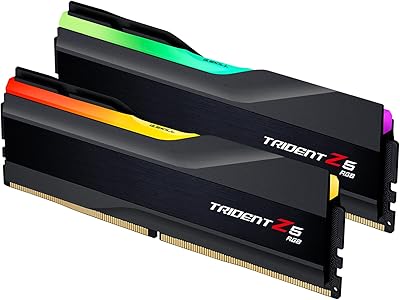
G.SKILL Trident Z5 RGB DDR5-6400 64GB (2x32GB)
83%
94%
Rated Speed Accuracy
91%
Stability & Reliability
78%
Compatibility Range
71%
Physical Fitment & Clearance
83%
RGB Lighting Quality
More
G.SKILL Trident Z5 RGB DDR5 48GB (2x24GB) 8000MT/s Memory Kit
87%
92%
Performance
90%
Ease of Overclocking
87%
Build Quality
88%
Aesthetics/Design
93%
Compatibility with Intel XMP
More
G.SKILL Trident Z5 RGB 96GB DDR5 RAM
80%
91%
Raw Performance
93%
XMP Setup Experience
88%
System Stability
84%
Capacity Value
67%
Platform Compatibility
More
G.SKILL Trident Z5 RGB 32GB DDR5-7200 RAM Kit
80%
91%
Rated Speed Stability
74%
XMP Setup Experience
83%
Real-World Performance
93%
Build Quality
86%
RGB Lighting Quality
More
G.SKILL Trident Z5 Neo RGB DDR5 32GB (2x16GB) 6000MT/s
86%
91%
Performance in Gaming
88%
Overclocking Ease
84%
RGB Aesthetics
93%
Compatibility with Intel & AMD
89%
Multitasking Performance
More
G.SKILL Trident Z5 Neo RGB 32GB RAM
84%
94%
Raw Memory Performance
89%
AMD EXPO Compatibility
86%
Stability Under Load
91%
Installation & Setup Experience
63%
Motherboard Compatibility Breadth
More
G.SKILL Trident Z Royal 64GB DDR4 RAM
84%
93%
Overall Stability
89%
XMP Setup Experience
91%
Build Quality
88%
Aesthetic Design
84%
Performance at Rated Speed
More
G.SKILL Trident Z5 Royal Neo DDR5 6000MHz 32GB (2x16GB)
80%
88%
Out-of-Box Compatibility
91%
Performance at Rated Speed
93%
AMD EXPO Ease of Use
89%
Stability & Reliability
87%
Build Quality & Heatspreader
More
G.SKILL Trident Z RGB 64GB DDR4 RAM
83%
88%
Real-World Performance
74%
Platform Compatibility
86%
Setup & Installation
83%
Value for Money
92%
Long-Term Reliability
More
G.SKILL Ripjaws S5 64GB 6000MT/s DDR5 RAM
80%
91%
Stability & Reliability
88%
XMP & EXPO Setup
89%
Performance at Rated Speed
83%
Platform Compatibility
67%
Value for Money
More

FAQ

Yes, but it is straightforward. The modules will boot at a default JEDEC speed the first time you install them, which is normal for DDR5. To hit the rated 6000MT/s, go into your BIOS and enable the XMP 3.0 profile if you’re on Intel, or the AMD EXPO profile if you’re on a Ryzen system. It’s usually a single toggle, and the BIOS will handle the rest automatically.

Yes, as long as your motherboard uses a supported AMD chipset such as X670, X870, B650, B840, or B850. The AMD EXPO profile is specifically included to ensure clean compatibility with these platforms. That said, it is always worth cross-referencing your exact motherboard model against G.SKILL’s online QVL tool, since memory compatibility can vary even within the same chipset family.

Technically the slots may be there, but you should not mix this kit with modules from a different kit or purchase. G.SKILL ships these as matched pairs that are tested together, and adding unmatched sticks often causes instability or forces the system to run at lower speeds. If you know you will eventually want 128GB, buying two identical kits of 32GB each upfront is a more reliable approach than expanding later.

Generally yes. The Trident Z5 RGB series is designed to sync with the major motherboard lighting ecosystems including ASUS Aura Sync, MSI Mystic Light, and Gigabyte RGB Fusion. Some buyers have reported occasional software conflicts depending on software versions, so keeping your motherboard’s RGB control app updated helps avoid most friction.

Possibly, depending on your specific cooler and case layout. At roughly 1.1 inches wide, the heatspreader sits taller than a bare module would. Most modern tower coolers overhang the first DIMM slot to some degree, so it is worth checking your cooler manufacturer’s clearance specs against your motherboard’s DIMM slot positioning before purchasing. Compact or low-profile coolers generally have no issue.

No. This is a Non-ECC consumer kit, which means it does not support error-correcting memory features. For professional workstations where data integrity is critical — think scientific computing, financial modeling, or medical imaging — you would need a dedicated ECC-registered memory platform. For gaming, content creation, and general desktop use, Non-ECC is perfectly appropriate and is the standard across consumer DDR5 platforms.

Yes, Z790 is explicitly listed as a supported platform. Intel 13th Gen (Raptor Lake) and 14th Gen (Raptor Lake Refresh) processors paired with Z790 motherboards are among the most common configurations this kit is used with. Just make sure your specific board has been updated to a recent BIOS version, as some early Z790 BIOSes had issues training high-speed DDR5 reliably.

For pure gaming on current titles, the honest answer is that 32GB is usually sufficient right now. Where 64GB makes a real difference is in memory-intensive creative work — editing high-resolution video, working with large Photoshop or Lightroom catalogs, running virtual machines, or keeping a heavy multitasking workload running without slowdowns. It also gives your system room to handle future software demands without needing a memory upgrade in a year or two.

Start by checking whether your motherboard BIOS is on the latest available version, since many boards required updates specifically to improve high-speed DDR5 training. If it still won’t post, try reseating the modules firmly and ensuring they are in the correct slots for dual-channel operation, which is typically slots 2 and 4 on most boards. If problems persist, G.SKILL’s support team is generally responsive and can help diagnose whether it is a board-specific issue.

G.SKILL backs their Trident Z5 series with a limited lifetime warranty, which is standard for their enthusiast memory lines. This covers manufacturing defects under normal operating conditions. Keep your proof of purchase handy if you ever need to make a claim, and note that running the kit outside of its rated specifications or mixing it with incompatible modules would void warranty coverage.

Where to Buy