Overview

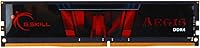
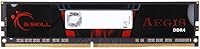
The G.SKILL AEGIS 16GB DDR4 Desktop RAM is a straightforward, dependable memory stick built for everyday PC builders who don't need to overspend to get something solid. Coming as a single 16GB module, it leaves your second DIMM slot open for a future upgrade — a practical advantage if you're building on a budget now and planning to expand later. DDR4-2666 is not the fastest speed on the market anymore, but it handles web browsing, office tasks, and casual gaming without complaint. G.SKILL has spent years earning credibility in the memory space, and the AEGIS line reflects that — reliable without the premium price tag.

Features & Benefits

At its core, this G.SKILL AEGIS stick runs at DDR4-2666 with CL19 latency timings, which simply means the memory responds to requests with a slight delay compared to tighter-timed kits — imperceptible in day-to-day use, and a fair trade-off at this tier. It operates at a standard 1.20V, so it runs cool without stressing your system over long sessions. The 288-pin U-DIMM format slots into virtually any modern Intel or AMD desktop board without fuss. There is no XMP profile to configure — it boots at its rated speed right out of the box, which is exactly what a first-time builder wants to hear.

Best For

This DDR4 memory module is a natural fit for budget desktop builds — think home office PCs, school computers, or a casual gaming rig where you're not chasing high frame rates. It's also a smart choice if you're refreshing an older DDR4 platform that caps out at 2666 anyway; there's no point paying for speed your motherboard can't use. The single-module design is particularly handy if you want to leave one slot free for expansion down the road. That said, if you're editing video, rendering 3D scenes, or building a high-performance gaming rig, you'll want faster memory with tighter timings — this is not that.

User Feedback

Buyers are largely satisfied with the AEGIS 16GB kit, pointing to trouble-free installation and consistent stability as the main reasons they'd recommend it. Value-for-money sentiment is strong — most feel it delivers appropriately for what it costs compared to pricier name-brand alternatives. A small number of users ran into issues, though nearly all traced back to mixing this module with a different memory kit; G.SKILL explicitly advises against this, since mismatched kits can cause boot failures or instability, so always pair like with like. Thermal complaints are essentially absent, and long-term reliability comes up positively across extended-use feedback.

Pros

  • Installs without any BIOS configuration — it simply boots at rated speed out of the box.
  • A single-module design keeps one DIMM slot free for a straightforward capacity upgrade later.
  • Broad compatibility across Intel and AMD desktop motherboards reduces the risk of fitment headaches.
  • Runs at a conservative 1.20V, which keeps thermals low and is easy on your system over long sessions.
  • Low-profile build fits comfortably in compact cases and avoids clearance conflicts with large CPU coolers.
  • G.SKILL is a well-established memory brand with a reliable track record in both mainstream and enthusiast markets.
  • Strong real-world stability scores from buyers using it in everyday workloads over extended periods.
  • Represents a competitive price-per-gigabyte option among trusted brands at this memory tier.

Cons

  • DDR4-2666 is on the slower end of the DDR4 spectrum, and platforms like AMD Ryzen genuinely benefit from faster speeds.
  • CL19 latency is loose by today's standards — tighter-timed kits at similar prices do exist.
  • No XMP profile means there is no headroom to push performance beyond the rated spec.
  • Sold as a single-channel kit, which leaves dual-channel bandwidth on the table unless a matching module is added.
  • Mixing this DDR4 memory module with a different brand or kit is unsupported and can cause serious instability.
  • The minimalist heatspreader offers no aesthetic appeal for windowed builds where RAM visibility matters.
  • DDR4 as a platform is aging — buyers with newer motherboards supporting DDR5 may find this a short-term investment.
  • No confirmation of XMP or EXPO overclocking support limits flexibility for users who want to push speeds later.

Ratings

The scores below reflect an AI-driven analysis of verified global buyer reviews for the G.SKILL AEGIS 16GB DDR4 Desktop RAM, with spam, bot-submitted, and incentivized feedback actively filtered out to protect accuracy. We examined feedback from first-time builders, system upgraders, and everyday desktop users across multiple regions to surface patterns in both satisfaction and frustration. The result is a transparent, balanced scorecard that captures what this DDR4 memory module genuinely does well — and where it falls short for certain buyers.

Value for Money
89%
Buyers repeatedly describe this DDR4 memory module as one of the more honest deals in the budget memory segment, particularly for office and school PC builds where overspending on RAM simply isn't justified. The combination of a trusted brand name and a competitive price point lands well with cost-conscious upgraders who've been burned by no-name sticks before.
A handful of buyers feel the value proposition softens when faster DDR4 kits with tighter timings occasionally appear at comparable prices during sales events. For users who do their homework, the price-per-performance gap between this and a CL16 alternative can feel narrower than expected.
Installation Ease
94%
The plug-and-play nature of this G.SKILL AEGIS stick is consistently one of the most praised aspects across buyer feedback — it boots at rated speed without touching the BIOS, which genuinely matters to first-time builders who find memory configuration intimidating. Multiple reviewers specifically mention that the module seated firmly on the first try with no fussing.
A very small number of users building on less common or older AMD platforms reported needing a BIOS update before the system recognized the module correctly, which added an unexpected extra step to what should be a simple install.
System Stability
91%
Long-term stability is where this DDR4 memory module earns real credibility — buyers running it continuously in home office and productivity setups report months of uptime without a single memory-related crash or blue screen. The conservative voltage and JEDEC-standard timings appear to contribute to rock-solid day-to-day behavior.
The stability picture changes sharply when users attempt to mix this kit with modules from a different brand or series, which is an unsupported configuration that has caused boot failures and memory errors for a notable subset of reviewers who ignored G.SKILL's explicit guidance.
Performance for Everyday Use
78%
22%
For the core tasks this memory is actually sold for — web browsing, document editing, video calls, and light multitasking — the AEGIS 16GB kit delivers a comfortable and responsive experience on both Intel and AMD platforms running at stock speeds. Users upgrading from 8GB or from slower DDR3 systems report a clearly noticeable improvement in system snappiness.
DDR4-2666 with CL19 timings shows its limits under heavier workloads; users who later moved to video editing or opened large spreadsheets alongside multiple browser tabs noticed the system feeling more strained than they expected from a 16GB configuration. The memory speed itself, not the capacity, is the culprit.
Gaming Performance
63%
37%
For casual gaming at 1080p on integrated graphics or a mid-range GPU, this memory handles itself adequately — titles like Minecraft, older MOBAs, and light indie games run without memory-related hitching. Buyers using this in a budget gaming build report satisfactory results as long as expectations are set appropriately.
Enthusiast-level gaming reveals the ceiling quickly; reviewers targeting high refresh rates on AMD Ryzen systems found meaningful frame-rate improvements after switching to DDR4-3200 or faster, which is a well-documented characteristic of Ryzen's memory-sensitive architecture. This is not the stick to pair with a high-end GPU.
Thermal Performance
87%
Running at 1.20V keeps heat output genuinely low, and buyers in poorly ventilated cases or compact small-form-factor builds specifically appreciate that this memory never becomes a thermal concern. Even during long gaming or productivity sessions, the module remains cool to the touch.
The minimal heatspreader offers limited passive cooling surface compared to thicker, finned alternatives — though in practice this has not translated into real-world heat complaints given the low operating voltage.
Compatibility
82%
18%
The 288-pin U-DIMM standard covers an enormous range of Intel Core and AMD Ryzen desktop motherboards, and the vast majority of buyers report seamless recognition across popular boards from ASUS, MSI, Gigabyte, and ASRock. G.SKILL's QVL database provides added reassurance for builders who want to verify support before ordering.
A small share of buyers with niche or older motherboard models encountered compatibility gaps not reflected in initial product listings, and a few noted that cross-referencing the QVL list — while useful — felt like an extra homework step compared to kits that ship with broader out-of-box compatibility guarantees.
Build & Physical Quality
76%
24%
The module feels solid in hand with no flex or cheap plastic feel, and the heatspreader is cleanly applied with consistent finish quality across units. Buyers handling multiple G.SKILL sticks for comparison generally describe the AEGIS as feeling appropriately made for its price tier.
The aesthetic is functional at best — the black-and-red color scheme is dated by current standards, and the low-profile heatspreader looks noticeably plain inside a windowed case. Buyers who care about the interior appearance of their build tend to find this stick visually underwhelming.
Upgrade Flexibility
83%
Buying a single 16GB module rather than a dual-module kit is a deliberate and practical strategy for builders who want to keep one DIMM slot free — and buyers who planned ahead describe it as a smart way to start with adequate memory and double capacity later without replacing what they already own.
The upgrade path only works cleanly if an identical matching module is available at the time of expansion, which is not guaranteed given how quickly specific SKUs cycle out of production — a concern raised by a few buyers who returned to find the exact model no longer stocked.
Latency & Responsiveness
61%
39%
For non-latency-sensitive workloads, CL19 timings are invisible in practice — users running standard productivity software, streaming, or casual gaming will not perceive any sluggishness attributable to the memory's response time. The timings are consistent and stable under sustained load.
In benchmarks and latency-sensitive workloads, CL19 sits noticeably behind CL16 or CL14 alternatives, and more technically experienced buyers who ran memory diagnostics flagged the high latency as a meaningful trade-off. Competitive gamers running frame-timing analysis are likely to find this the weakest aspect of the kit.
Brand Reliability
88%
G.SKILL's established reputation reassures buyers who have dealt with failed no-name RAM before — reviewers who have used multiple G.SKILL products over the years describe the brand as consistently delivering on basic promises of stability and longevity. The lifetime warranty adds an extra layer of confidence for long-term ownership.
A small number of users who needed to invoke G.SKILL's warranty reported a slower-than-expected response process, with some waiting longer than they felt reasonable for a replacement module. Customer support responsiveness appears to vary by region.
Kit Mixing Risk
44%
56%
G.SKILL is transparent about the requirement to use matched kits, and buyers who followed this guidance consistently reported no mixing-related problems. The documentation makes the limitation clear enough that informed purchasers can plan accordingly.
This is one of the more frustrating real-world pain points in user reviews — a meaningful number of buyers who attempted to combine this module with existing RAM from a different kit experienced boot failures, POST errors, or forced downgrades in speed. The restriction is by design, but it catches enough buyers off guard to warrant serious attention before purchase.
Aesthetics
57%
43%
The understated black-and-red finish works fine in closed cases where RAM is never seen, and buyers building a functional workhorse PC with no window panel have no complaints about the appearance. The low profile keeps things tidy in compact builds.
Buyers building display-worthy systems with RGB lighting and tempered glass side panels consistently describe the AEGIS heatspreader as looking budget and out of place. There is no RGB option in this series, and the flat stamped heatspreader design has not been refreshed in years.

Suitable for:

The G.SKILL AEGIS 16GB DDR4 Desktop RAM is a solid pick for anyone building or upgrading a practical desktop without a performance-enthusiast budget. It fits naturally into home office machines, school computers, and light-use family PCs where the priority is reliability and compatibility rather than raw speed. Builders who want a single 16GB stick now and plan to add a second module later will appreciate that it keeps one DIMM slot free, giving the system room to grow. It also makes good sense for anyone refreshing an older Intel or AMD DDR4 platform that already caps out at 2666 speeds — there is genuinely no benefit in paying for faster memory if your motherboard cannot use it. First-time builders in particular will find the plug-and-play nature of this module reassuring, since it boots at its rated speed without any BIOS adjustments.

Not suitable for:

The G.SKILL AEGIS 16GB DDR4 Desktop RAM is not the right choice for buyers who need their memory to pull serious weight. If you are editing video, working in 3D rendering software, or running memory-hungry creative applications, the DDR4-2666 speed and CL19 latency will become a noticeable bottleneck compared to faster kits with tighter timings. Competitive gamers targeting high refresh rates will also want to look elsewhere, since modern AMD Ryzen platforms in particular respond well to faster memory speeds, and the performance gap at the top end is measurable. Anyone already owning a different DDR4 kit should not attempt to mix modules — G.SKILL explicitly warns against this, and doing so risks system instability or outright boot failures. Finally, builders on a platform that supports DDR5 should skip DDR4 entirely at this stage rather than investing in previous-generation memory.

Specifications

  • Capacity: This kit provides 16GB of total memory delivered as a single U-DIMM module.
  • Memory Type: Uses DDR4 SDRAM technology, the standard for desktop platforms released from 2014 onward.
  • Speed: Rated at 2666 MT/s, suitable for everyday desktop workloads on compatible Intel and AMD platforms.
  • Latency Timings: Operates at CL19-19-19-43, reflecting standard relaxed timings typical of value-tier DDR4 modules.
  • Voltage: Runs at 1.20V, within the JEDEC-standard range for DDR4, keeping power draw and heat output low.
  • Form Factor: 288-pin U-DIMM design, compatible with full-size and mid-tower desktop motherboards from major manufacturers.
  • ECC Support: Non-ECC memory, meaning it does not include hardware error-correction — standard for consumer desktop use.
  • XMP Profile: Ships with a JEDEC default SPD profile only; no XMP overclocking profile is included.
  • Platform Support: Validated for use on Intel and AMD desktop platforms; consult the G.SKILL QVL tool for specific motherboard compatibility.
  • Module Count: Sold as a single-module kit (1x16GB), leaving additional DIMM slots available for future expansion.
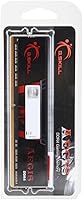
  • Heatspreader: Features a low-profile heatspreader finished in black with red accents, adding minimal height above the PCB.
  • Dimensions: Package measures 5.87 x 2.44 x 0.47 inches, with the module itself fitting standard full-length DIMM slots.
  • Weight: The packaged unit weighs 1.13 oz, reflecting the module's compact and lightweight construction.
  • Series: Part of G.SKILL's AEGIS lineup, positioned as an accessible, no-frills memory series for mainstream desktop builds.
  • Model Number: Identified by the official model code F4-2666C19S-16GIS, useful when cross-referencing motherboard QVL lists.
  • Manufacturer: Made by G.SKILL International, a Taiwan-based memory specialist with decades of experience in consumer and enthusiast DRAM.
  • Warranty: G.SKILL backs its AEGIS modules with a limited lifetime warranty covering manufacturing defects under normal usage conditions.
  • Channel Config: Shipped as a single module, which runs in single-channel mode unless paired with a matching second stick.

Related Reviews
G.SKILL AEGIS 16GB DDR4 3200MHz Desktop RAM
78%
91%
Value for Money
88%
Installation Ease
83%
Gaming Performance
86%
System Stability
79%
Motherboard Compatibility
More
G.SKILL AEGIS 32GB DDR4-3000 Desktop RAM Kit
81%
88%
Value for Money
91%
Installation Ease
87%
Stability & Reliability
83%
XMP Performance
84%
Dual-Channel Bandwidth
More
G.SKILL Ripjaws DDR4 SO-DIMM 16GB Laptop RAM
82%
92%
Installation Ease
89%
Stability & Reliability
86%
Value for Money
77%
Compatibility
74%
Real-World Performance
More
G.SKILL Trident Z Neo 16GB DDR4 RAM
88%
93%
XMP Compatibility
91%
Platform Performance
94%
Stability & Reliability
89%
Thermal Performance
86%
Build & Heatspreader Quality
More
Crucial 16GB DDR4 3200MHz Desktop RAM
78%
93%
Ease of Installation
88%
Compatibility Range
79%
Real-World Performance
91%
Long-Term Reliability
74%
Value for Money
More
Timetec 16GB KIT DDR4 3200MHz Desktop RAM
81%
88%
Value for Money
93%
Installation Ease
82%
Compatibility
86%
Stability & Reliability
62%
Latency Performance
More
G.SKILL Ripjaws 16GB DDR4 SO-DIMM RAM
81%
83%
Compatibility
93%
Installation Ease
78%
Performance Gain
88%
Value for Money
91%
Reliability & Stability
More
G.SKILL Ripjaws DDR4 SO-DIMM 16GB Laptop RAM
83%
93%
Ease of Installation
91%
System Stability
84%
Real-World Performance
78%
Compatibility Range
88%
Value for Money
More
A-Tech 16GB (2x8GB) DDR4 2133 MHz Desktop RAM
85%
94%
Ease of Installation
87%
System Responsiveness
90%
Energy Efficiency
85%
Performance for General Use
92%
Price to Performance Ratio
More
G.SKILL Ripjaws DDR5 SO-DIMM 16GB 5600MT/s RAM
88%
94%
Performance Boost
88%
Energy Efficiency
91%
Installation Ease
93%
Speed (5600MT/s)
86%
Build Quality
More

FAQ

Yes, this DDR4 memory module is compatible with AMD Ryzen platforms that support DDR4. That said, memory compatibility can vary by specific motherboard model, so it is worth checking G.SKILL's online QVL tool or your motherboard manufacturer's memory support list before purchasing to confirm your exact board is validated.

No, you do not. This G.SKILL AEGIS stick uses a standard JEDEC SPD profile, which means your system will automatically recognize and run it at its rated 2666 MT/s speed with default BIOS settings. There is no XMP profile to enable and no manual configuration needed — just install and boot.

You can, but there is an important caveat: G.SKILL strongly advises against mixing this module with a stick from a different kit or brand. For dual-channel operation, you should buy a second identical module from the same product line, or better yet, purchase a matched 2x16GB kit from the start to ensure stable performance.

For everyday tasks like browsing, office work, media playback, and light gaming, DDR4-2666 is still perfectly functional. Where it falls short is on platforms like AMD Ryzen that extract a noticeable performance gain from faster memory, or in workloads that are heavily memory-bandwidth dependent. If your build fits a modest-use profile and your motherboard maxes out at 2666 anyway, it is a sensible and cost-effective choice.

CL19 refers to the number of clock cycles the memory takes before responding to a data request. In plain terms, it is a measure of latency — and CL19 is on the looser end of the DDR4 range. For typical desktop tasks you will not notice any difference, but in latency-sensitive scenarios like high-framerate gaming or certain professional applications, tighter-timed kits can have a small edge.

No, the AEGIS 16GB kit has no RGB lighting. It features a plain low-profile heatspreader in black with red accents. If aesthetics inside a windowed case matter to you, you would need to look at G.SKILL's Trident Z RGB or similar lines.

Most likely yes. The AEGIS series uses a minimal heatspreader that sits close to the PCB height, so clearance conflicts with even large tower coolers are uncommon. If you are using an especially wide or low-hanging cooler, it is worth checking the cooler manufacturer's RAM clearance specification to be sure.

This is one area to be careful about. Mixing the G.SKILL AEGIS 16GB DDR4 Desktop RAM with a module from a different kit — even one that looks identical on the surface — is not supported by G.SKILL and can lead to boot failures, system instability, or the memory running at a reduced speed. If you already have RAM installed and want to expand, the safest path is to replace both sticks with a matched dual-module kit.

Desktop only. This module uses the 288-pin U-DIMM form factor, which is designed for full-size desktop motherboards. Laptops use a different, smaller form factor called SO-DIMM, so this stick will not physically fit in a laptop memory slot.

G.SKILL covers the AEGIS series with a limited lifetime warranty against manufacturing defects under normal usage conditions. In practice, buyers generally report positive experiences when contacting G.SKILL support with legitimate defect claims. Keep your purchase receipt or order confirmation handy, as it may be requested during any warranty process.