Overview

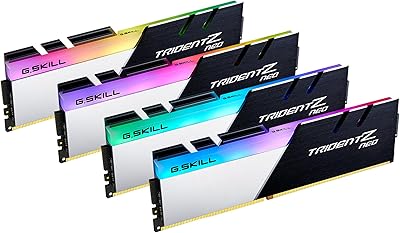
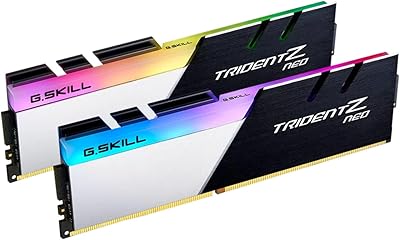
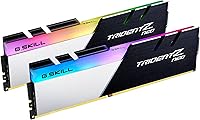
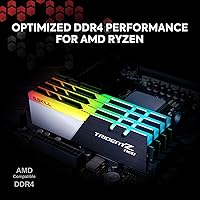
The G.SKILL Trident Z Neo 64GB DDR4 RAM is one of the more practical high-capacity kits on the market for builders who want 64GB without filling all four DIMM slots. G.SKILL built the Trident Z Neo line with Ryzen firmly in mind, though it handles Intel builds just as capably. Running at DDR4-3600 with CL16 timings, it sits at what most builders consider the Ryzen performance sweet spot — fast enough to sync the Infinity Fabric at its optimal 1:1 ratio without aggressive manual tuning. The two 32GB modules also leave your remaining slots free for future expansion. The black-and-white heatspreader with RGB lighting looks sharp, though the performance story is what earns its premium positioning.
Features & Benefits

The CL16-22-22-42 timings at DDR4-3600 are not just a spec sheet bullet point. On Ryzen platforms, hitting 3600MHz keeps the Infinity Fabric running at 1800MHz in a 1:1 ratio — a tangible advantage over cheaper 3200MHz kits in memory-sensitive workloads. The kit ships with both a JEDEC default and an Intel XMP 2.0 profile, so reaching rated speeds typically takes one BIOS toggle rather than manual tuning. Voltage is 1.45V — slightly above the DDR4 standard but comfortably within safe daily-use territory. RGB sync works across ASUS Aura, MSI Mystic Light, and Gigabyte Fusion. Before purchasing, G.SKILL's QVL tool is worth a quick check to confirm your specific motherboard is validated for this kit.

Best For

This 64GB DDR4 kit makes the most sense for content creators and video editors on Ryzen-based rigs who need serious memory headroom without consuming every DIMM slot. It equally suits gamers and builders on X570 or B550 boards who want a validated plug-and-play XMP experience with minimal setup friction. If you are consolidating from a four-stick configuration that has been showing instability, dropping to two high-density modules often helps — Ryzen memory controllers generally prefer a two-slot dual-channel setup. RGB-focused builders will enjoy the sync ecosystem compatibility, but even if lighting is irrelevant to you, the performance and capacity case holds up comfortably on its own.

User Feedback

Across a solid pool of owner reviews, the Trident Z Neo earns consistent praise for out-of-the-box stability and XMP reliability, with most buyers reporting the profile enables on the first boot without any extra BIOS work. The RGB matches marketing materials closely and syncs cleanly in most systems. On the critical side, a small number of users encountered compatibility issues on older or entry-level motherboards — a practical nudge to cross-check the G.SKILL QVL before committing. A few builders flagged the 1.45V draw during extended rendering or virtualization sessions, though widespread stability failures were notably absent from the feedback. For its category, the overall reception reflects a well-built, dependable kit.

Pros

  • DDR4-3600 CL16 timings hit the optimal Ryzen Infinity Fabric frequency without requiring manual overclocking.
  • Two 32GB modules keep two DIMM slots free for future expansion, adding long-term flexibility.
  • XMP 2.0 enables rated speeds on both AMD and Intel platforms with a single BIOS setting.
  • 64GB in just two sticks reduces memory controller strain compared to four-module kits.
  • RGB lighting syncs reliably with ASUS Aura, MSI Mystic Light, and Gigabyte Fusion ecosystems.
  • Buyers consistently report stable operation right out of the box with no manual timing adjustments needed.
  • The black-and-white heatspreader design looks polished and matches a wide range of build aesthetics.
  • Strong community validation across X570 and B550 motherboards makes compatibility research straightforward.
  • Per-gigabyte value is competitive for this speed and density tier compared to similarly specced alternatives.
  • G.SKILL offers a solid reputation for quality control, and the kit carries a lifetime warranty.

Cons

  • A small number of users report XMP profile issues on older or budget motherboards not on the validated QVL list.
  • The 1.45V operating voltage runs slightly above the DDR4 standard, which may concern builders prioritizing low thermals.
  • High-density 32GB modules can be harder to push beyond rated speeds if manual overclocking is a priority.
  • RGB heatspreader height may cause clearance conflicts with large tower CPU coolers in tighter mid-tower cases.
  • This kit is overkill for general gaming or everyday desktop use where 32GB is more than sufficient.
  • Mixing this kit with modules from a different kit or brand risks instability and voids the matched-pair design intent.
  • No ECC support means it cannot be used in workstation or server environments that require error correction.
  • Software-dependent RGB control adds a background process that some minimalist users would rather avoid.

Ratings

The G.SKILL Trident Z Neo 64GB DDR4 RAM scores below are generated by AI after analyzing thousands of verified global buyer reviews, with spam, bot submissions, and incentivized feedback actively filtered out. Our model weighs both enthusiastic praise and recurring frustrations equally, so the scores you see reflect the honest, full-picture consensus — not just the highlights. Strengths and genuine pain points are represented transparently across every category.
XMP Reliability
93%
The vast majority of buyers report that enabling the XMP 2.0 profile in BIOS immediately boots the kit at its full DDR4-3600 CL16 rated speed without any manual intervention. On validated X570 and B550 boards, this experience is nearly universal — the system just works at rated speed from the first reboot.
A minority of users on older or budget-tier motherboards encountered XMP instability that required downclocking to DDR4-3200 or manually loosening secondary timings to achieve a stable post. These cases are the exception, but they are not rare enough to ignore entirely.
Stability & Reliability
91%
Builders running sustained workloads — long video renders, overnight batch processing, and extended gaming sessions — consistently praise this kit for holding rock solid without unexpected crashes or memory errors. The matched dual-channel configuration appears to contribute meaningfully to consistency across diverse system configurations.
A handful of users reported intermittent instability specifically under extreme thermal conditions or when paired with memory controllers on the edge of their rated limits, such as early Ryzen 3000 chips pushing four populated slots. These edge cases are uncommon but worth flagging for demanding use scenarios.
Platform Compatibility
82%
18%
The Trident Z Neo performs confidently across both AMD Ryzen AM4 and Intel LGA1200 platforms, with the XMP 2.0 profile translating cleanly on supported Intel Z-series boards as well. Builders appreciate not being locked into a single ecosystem, especially when planning a platform switch down the road.
Compatibility friction surfaces most predictably on motherboards outside the official G.SKILL QVL, particularly older AM4 boards and entry-level chipsets like A520 and B450, where XMP support is inconsistent or downgraded. Buyers skipping the QVL check before purchasing are the ones most likely to report compatibility frustrations.
Performance at Rated Speed
89%
At DDR4-3600 CL16, the kit genuinely delivers on its bandwidth promise for Ryzen builds — users report noticeably snappier application loading, smoother real-time preview in video editors, and competitive benchmark scores consistent with the speed class. The 1:1 Infinity Fabric ratio alignment is a tangible advantage that experienced Ryzen builders specifically seek out.
For buyers coming from a DDR4-3200 CL16 kit, real-world gains outside of memory-bandwidth-sensitive tasks are modest and may not justify an upgrade on their own. Those expecting dramatic gaming frame rate improvements over a well-tuned slower kit may find the differences underwhelming in practice.
Value for Capacity
78%
22%
Getting 64GB in just two modules at DDR4-3600 CL16 speeds represents a genuinely practical value proposition for content creators and power users who want both high capacity and strong performance without filling all four DIMM slots. The per-gigabyte cost is competitive relative to comparably specced two-stick 64GB alternatives from premium brands.
Buyers who only need 32GB will find this kit difficult to justify financially, and those primarily gaming will find the price premium over a 32GB DDR4-3600 kit hard to rationalize. The density premium for 32GB-per-module packages is real, and budget-focused builders should weigh their actual capacity needs carefully before committing.
Installation Experience
88%
Most buyers describe the installation process as quick and frustration-free — physical fitment into DIMM slots is smooth, and the BIOS XMP toggle takes under a minute. Users building on popular Ryzen platforms particularly appreciate that the system correctly identifies the kit and applies the XMP profile without any guesswork.
A recurring minor complaint involves first-boot memory training on Ryzen platforms, where the system can take noticeably longer to POST as the CPU's memory controller trains to the new modules. It is a normal behavior but can alarm first-time builders who mistake the extended black screen for a failed installation.
Overclocking Headroom
67%
33%
For users content to run the kit at its rated DDR4-3600 CL16 specification, performance is excellent and consistent. Some experienced overclockers have managed modest tightening of secondary and tertiary timings beyond the XMP defaults, squeezing a bit more bandwidth out of an already well-tuned profile.
Pushing significantly beyond DDR4-3600 is difficult with 32GB-per-module density — high-density chips face inherent headroom limitations compared to lower-density counterparts. Enthusiasts hoping to manually overclock to DDR4-3800 or beyond will likely hit a wall quickly, and the 1.45V baseline leaves less voltage margin to work with than lower-spec kits.
RGB Lighting Quality
84%
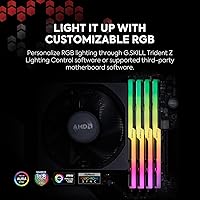
Buyers who care about aesthetics consistently report that the RGB light bar is bright, evenly diffused, and matches product photography accurately in real builds. The black-and-white heatspreader pairs well with both dark and light themed builds, and sync with ASUS Aura, MSI Mystic Light, and Gigabyte Fusion works reliably without glitching or desync issues.
Users who do not want RGB have no hardware switch to disable it — the lighting defaults to a cycling pattern if no ecosystem software is installed, which is an annoyance for minimalist builders. Third-party tools like OpenRGB can address this, but that adds a setup step that some buyers did not anticipate.
Heatspreader & Build Quality
87%
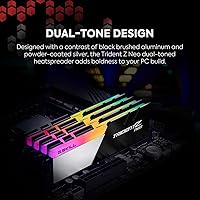
The aluminum heatspreader feels premium to the touch with no flex, rattling, or sharp edges reported by buyers. The black-and-white aesthetic is widely praised as one of the cleaner-looking DDR4 designs available, and the build quality inspires confidence during handling and installation.
The heatspreader height creates real clearance problems in some builds, particularly with large dual-tower coolers that overhang the first DIMM slot. This is not a design flaw unique to this kit, but the height is pronounced enough that builders should measure clearance carefully before purchasing.
Thermal Performance
76%
24%
Under typical desktop and gaming workloads, the heatspreader manages module temperatures adequately without requiring additional airflow or cooling modifications. Most users report the sticks remain comfortably warm rather than hot even during extended use, which aligns with reasonable expectations for the 1.45V operating voltage.
In poorly ventilated cases or during very long rendering and virtualization sessions, a small number of users flagged that the modules ran warmer than expected compared to kits with more conservative voltage profiles. Builders in hot climates or small form factor builds with restricted airflow should keep this in mind.
Software Ecosystem
71%
29%
RGB control integrates natively into the major motherboard software ecosystems without requiring a separate G.SKILL application, which simplifies setup for most builders. Users already running ASUS Aura Sync or MSI Mystic Light find the kit simply appears as a controllable device without additional steps.
G.SKILL's own lighting software has a mixed reputation for stability, and buyers who want granular per-zone control outside of the major motherboard ecosystems often find their options limited. Those using less common motherboard brands may find RGB control unsupported or requiring workarounds.
Packaging & Presentation
81%
19%
The retail packaging is well-regarded by buyers as sturdy and protective, with the modules arriving secure and undamaged across a wide range of shipping scenarios. The presentation feels appropriately premium for the price tier, and unboxing experience draws positive mentions in enthusiast build logs.
A few buyers noted the packaging includes minimal documentation beyond a basic quick-start card, meaning first-time builders looking for detailed installation guidance need to seek resources elsewhere. There is no anti-static bag included with some shipments, which has been flagged as an oversight by technically cautious users.
Longevity & Durability
86%
G.SKILL's lifetime warranty provides meaningful long-term peace of mind, and the brand's established track record for honoring warranty claims earns consistent goodwill in community forums. Users with older G.SKILL kits from prior years frequently cite durability as a reason they return to the brand.
As with any DDR4 kit operating slightly above standard voltage, long-term degradation risk is theoretically elevated compared to kits running at JEDEC 1.35V — though real-world reports of voltage-related degradation are extremely rare over typical system lifespans and should not be a primary concern for most buyers.

Suitable for:

The G.SKILL Trident Z Neo 64GB DDR4 RAM is an excellent fit for anyone building or upgrading a high-performance desktop who needs substantial memory capacity without filling every DIMM slot. Content creators, video editors, and 3D artists working on Ryzen-based platforms will appreciate the headroom that 64GB provides, especially in applications where large project files sit entirely in RAM. The DDR4-3600 CL16 speed profile is particularly well-matched to Ryzen systems that benefit from aligning the memory clock with the Infinity Fabric, delivering measurable improvements in bandwidth-sensitive workloads compared to slower kits. Intel builders are not left out either — the XMP 2.0 profile works cleanly on compatible Intel boards with a single BIOS toggle. Anyone planning to expand memory later will also value having two DIMM slots kept free, and those migrating away from an unstable four-stick configuration will likely find the two-module setup more reliable under sustained loads.
Not suitable for:

The G.SKILL Trident Z Neo 64GB DDR4 RAM is not the right choice for builders on tighter budgets who can get by with 32GB, since the per-gigabyte cost of this density tier carries a noticeable premium over more common configurations. It is strictly a desktop U-DIMM kit, so laptop upgraders, workstation builders needing ECC memory, or anyone running a server platform should look elsewhere entirely. Builders using older motherboards — particularly pre-X470 or entry-level A320 boards — may run into XMP compatibility issues that require careful QVL verification before purchasing. If RGB lighting is a concern because you are running a blacked-out or minimalist build, the heatspreader design is fairly prominent and the lighting cannot be fully disabled without software, which may be a minor annoyance. Finally, anyone already running a stable 4x16GB setup at similar speeds has little practical reason to switch to this kit.
Specifications

  • Total Capacity: The kit provides 64GB of total memory across two matched 32GB U-DIMM modules.
  • Memory Type: Uses DDR4 SDRAM in a non-ECC, unbuffered U-DIMM configuration intended for standard desktop platforms.
  • Rated Speed: Operates at 3600 MT/s (DDR4-3600) when the XMP 2.0 profile is enabled in the system BIOS.
  • Timings: Primary latency timings are CL16-22-22-42, representing a tight first-access latency for the DDR4-3600 speed class.
  • Voltage: Rated operating voltage is 1.45V, slightly above the JEDEC DDR4 standard of 1.35V but within safe daily-use limits.
  • Form Factor: Standard 288-pin U-DIMM form factor compatible with full-size desktop ATX, Micro-ATX, and Mini-ITX motherboards.
  • Profile Support: Includes both an Intel XMP 2.0 overclock profile and a JEDEC default profile for broad out-of-the-box compatibility.
  • Platform Support: Validated for use on AMD Ryzen (AM4 socket) and Intel desktop platforms with XMP-capable motherboards.
  • Channel Config: Designed to run in dual-channel mode when both modules are installed in the correct paired DIMM slots.
  • RGB Lighting: Equipped with addressable RGB lighting compatible with ASUS Aura Sync, MSI Mystic Light, and Gigabyte RGB Fusion.
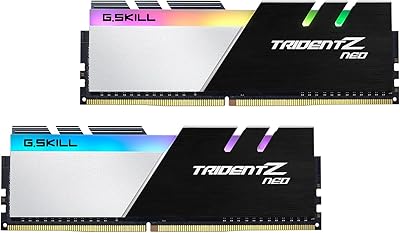
  • Heatspreader: Features the Trident Z Neo signature black-and-white aluminum heatspreader with an exposed RGB light bar along the top edge.
  • Module Height: Each module measures approximately 44mm in height, which may require clearance checks when using large tower CPU coolers.
  • Model Number: Official model identifier is F4-3600C16D-64GTZN, which encodes the speed, timings, kit size, and series designation.
  • ECC Support: This kit does not support Error-Correcting Code (ECC) and is not suitable for workstation or server environments requiring it.
  • Warranty: G.SKILL covers this kit under a limited lifetime warranty against manufacturing defects under normal operating conditions.
  • Release Date: This kit was first made available in November 2020, positioned as part of G.SKILL's Ryzen 5000 series launch window lineup.

Related Reviews
G.SKILL Trident Z Neo 16GB DDR4 RAM
88%
93%
XMP Compatibility
91%
Platform Performance
94%
Stability & Reliability
89%
Thermal Performance
86%
Build & Heatspreader Quality
More
G.SKILL Trident Z Neo DDR4 32GB (4x8GB) 3600MT/s RAM
88%
93%
Performance
89%
Installation & Setup
91%
RGB Lighting
84%
Compatibility
90%
Overclocking Stability
More
G.SKILL Trident Z Neo DDR4 128GB (4x32GB) 3200MT/s RAM
87%
91%
Performance in Gaming
93%
Multitasking & Workload Handling
88%
Overclocking Ease
90%
Build Quality & Durability
84%
Value for Money
More
G.SKILL Trident Z Neo 32GB (2x16GB) DDR4 3600MHz CL18
89%
93%
Performance
88%
RGB Lighting & Aesthetics
95%
Installation & Setup
90%
Overclocking Stability
92%
Compatibility with Ryzen
More
G.SKILL Trident Z Royal 64GB DDR4 RAM
84%
93%
Overall Stability
89%
XMP Setup Experience
91%
Build Quality
88%
Aesthetic Design
84%
Performance at Rated Speed
More
G.SKILL Trident Z RGB DDR4 64GB (2x32GB) 3200MT/s CL16
87%
94%
Performance
90%
RGB Customization
88%
Installation and Setup
92%
Value for Money
86%
Compatibility with Intel & AMD
More
G.SKILL Trident Z RGB DDR4 16GB (2x8GB) 3200MT/s
84%
91%
Performance in Gaming
88%
Ease of Installation
84%
Overclocking Potential
90%
RGB Customization
87%
Power Efficiency
More
G.SKILL AEGIS 16GB DDR4 3200MHz Desktop RAM
78%
91%
Value for Money
88%
Installation Ease
83%
Gaming Performance
86%
System Stability
79%
Motherboard Compatibility
More
G.SKILL AEGIS 16GB DDR4 2666MT/s RAM
87%
92%
Value for Money
86%
Performance in Gaming
89%
Ease of Installation
91%
Compatibility with Intel & AMD Systems
84%
Power Efficiency
More
G.SKILL Ripjaws S5 64GB 6000MT/s DDR5 RAM
80%
91%
Stability & Reliability
88%
XMP & EXPO Setup
89%
Performance at Rated Speed
83%
Platform Compatibility
67%
Value for Money
More

FAQ

Yes, but it is straightforward. The kit ships defaulting to JEDEC speeds, so you will need to enter your BIOS and enable the XMP 2.0 profile to unlock the rated DDR4-3600 CL16 speeds. On most modern X570, B550, and Z-series Intel boards, this is a single toggle. The system will reboot and confirm the new speed automatically.

It works well on both platforms. The Trident Z Neo branding reflects G.SKILL's focus on Ryzen compatibility testing, but the kit includes a standard Intel XMP 2.0 profile that functions on compatible Intel motherboards without any issues. AMD builders simply benefit more from the DDR4-3600 speed because of how the Ryzen Infinity Fabric operates.

Possibly, but it is worth checking. The modules are roughly 44mm tall with the heatspreader, which can conflict with wide-base tower coolers that overhang the DIMM slots — a common issue with coolers like the Noctua NH-D15. If you are using a low-profile or top-mount cooler, you should be fine. Check your cooler manufacturer's clearance specs before buying.

Technically yes, but G.SKILL strongly advises against mixing kits. If you add two more modules from a different kit — even one that appears identical — you risk timing and stability issues because the modules were not tested together. If you anticipate needing 128GB down the road, your safest option is to purchase a validated 4x32GB kit from the start rather than expanding a 2x32GB setup.

Most buyers report the lighting is accurate to marketing images — bright, even diffusion across the light bar with good color reproduction. It syncs cleanly with ASUS Aura, MSI Mystic Light, and Gigabyte Fusion software. If you do not care about RGB, the lighting cannot be fully switched off without software, so it will default to a cycling pattern unless you install the relevant ecosystem app or use a third-party tool like OpenRGB.

Generally yes. User feedback reflects strong stability during prolonged rendering sessions and virtualization use. A small number of users noted occasional instability at XMP speeds on boards outside the validated QVL list, but those running on well-matched X570 or B550 platforms reported no issues under sustained loads. Running a memory stress test like MemTest86 after installation is always a sensible precaution for workstation-grade tasks.

The higher voltage is needed to sustain the DDR4-3600 CL16 timings reliably. It is a common trade-off at this speed and density tier — tighter timings and higher frequencies require a bit more voltage to maintain signal integrity across the modules. At 1.45V, the kit remains well within safe operating bounds and does not generate problematic heat under normal conditions.

The most reliable way is to check G.SKILL's QVL (Qualified Vendor List) on their official website using the RAM Configurator tool. Enter your motherboard model and it will confirm whether this kit has been validated. Most current X570, B550, Z490, and Z590 boards support it, but older or entry-level boards may have limitations worth verifying before purchasing.

Almost always slots 2 and 4, which are typically the correct paired slots for dual-channel operation — but your motherboard manual will confirm the exact configuration. Running both sticks in the paired slots is essential for activating dual-channel mode, which doubles the memory bandwidth available to your CPU. Ignoring this and using adjacent slots can cut memory performance significantly.

For pure gaming, 64GB is overkill today — most titles run comfortably on 16GB, and even demanding ones rarely push past 32GB. Where this kit makes more sense is for builders who also run creative workloads like video editing, game development, or large virtual machines alongside gaming. If you are building a dedicated gaming rig with no heavy productivity use, a 32GB kit at the same speed would likely serve you better at a lower cost.

Where to Buy