
Overview

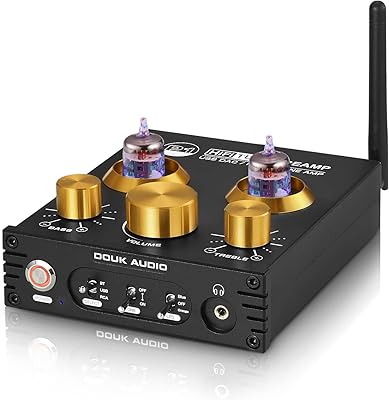
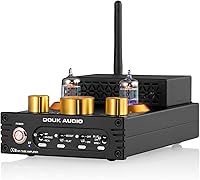
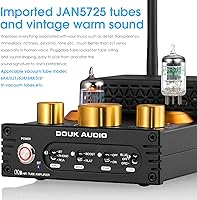
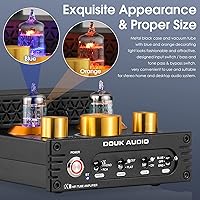
The Douk Audio X1 is a compact desktop amplifier that manages to pack a tube stage, a phono preamp, and Bluetooth connectivity into an aluminum chassis small enough to sit comfortably on a crowded desk. The glowing JAN5725 vacuum tubes give it genuine visual appeal, and they also contribute a mild warmth to the sound that separates it from purely solid-state boxes at a similar price. It won't replace a dedicated valve amp — the tube effect here is real but subtle. Still, for someone wanting a versatile audio hub that handles vinyl and wireless streaming without juggling multiple boxes, this tube amp makes a strong case.

Features & Benefits

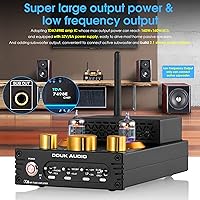
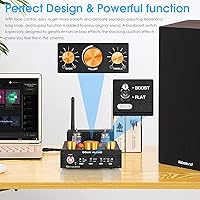
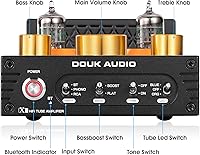
The TDA7498E amplifier chip at the heart of this desktop phono amplifier delivers enough power to drive most passive bookshelf speakers with ease — 160 watts per channel into a 4-ohm load is genuinely capable output for a box this size. The built-in MM phono stage means turntable owners can connect directly without buying a separate preamp, saving both money and desk space. Bluetooth 5.0 with aptX-HD handles wireless streaming from phones and tablets at a quality level most casual listeners will find satisfying. Tone controls cover treble and bass adjustment, plus a bypass switch for a flat signal. The tube sockets are solderless and swappable, so experimenting with different tubes is a low-risk exercise.

Best For

This desktop phono amplifier is an especially good fit for vinyl hobbyists who want to simplify their setup. If you run a turntable with a moving magnet cartridge and passive speakers, the Douk X1 eliminates the need for a separate phono preamp and power amp — two boxes become one. It also works well for anyone splitting listening time between records and Bluetooth streaming who doesn't want to manage multiple devices. That said, critical vinyl listeners with high-resolution turntables may find the phono stage adequate but not exceptional. This is a box for people who value convenience and a pleasant sound signature over absolute transparency.

User Feedback

Buyers generally respond well to the Douk X1, with the warm sound character and glowing tube aesthetic drawing the most consistent praise. Many note that build quality surprises positively at this price tier, and Bluetooth performance — particularly the aptX-HD codec — earns strong marks for reliability and clarity. On the critical side, some audiophile reviewers describe the phono stage as functional rather than exceptional, cautioning that serious vinyl listeners may eventually want something more capable. A handful of buyers have also raised questions about long-term durability and getting timely responses from the manufacturer — worth factoring in if after-sales support matters to you.

Pros

  • Combines phono preamp, tube amp, and Bluetooth receiver in one compact box — a genuine space saver.
  • AptX-HD Bluetooth delivers noticeably cleaner wireless audio than standard SBC devices at this price.
  • Tube sockets are solderless and swappable, making tube rolling accessible even for complete beginners.
  • The aluminum chassis feels more solid and premium than most budget-tier competitors.
  • Built-in subwoofer output makes 2.1 system expansion straightforward without extra hardware.
  • Tone controls and a flat-signal bypass switch give practical day-to-day tuning flexibility.
  • Enough amplifier headroom to drive most passive bookshelf speakers cleanly at real-room volumes.
  • The glowing tube aesthetic adds a warm, tactile character to any desk or listening space.
  • Included power supply means no hunting for compatible third-party adapters out of the box.

Cons

  • The phono stage falls short for critical vinyl listening — detail and dynamics feel constrained with better cartridges.
  • Tube coloration is subtle enough that listeners expecting dramatic warmth may feel underwhelmed.
  • No optical, USB, or digital input limits compatibility with TVs and modern source components.
  • Background hiss is audible through high-sensitivity speakers at low volumes, especially from the phono input.
  • Bass boost is a fixed on/off switch with no adjustable intensity, reducing its practical usefulness.
  • Subwoofer output level cannot be set independently, making sub-to-satellite balance fiddly to dial in.
  • Long-term durability reports from owners beyond the first year are inconsistent and raise some concern.
  • Customer support responsiveness has drawn repeated criticism from buyers dealing with post-warranty issues.
  • Input switching is fully manual with no auto-detection, which gets tedious during multi-source listening sessions.

Ratings

The Douk Audio X1 has been evaluated by our AI rating system after analyzing hundreds of verified buyer reviews sourced globally, with spam, bot-generated, and incentivized feedback actively filtered out. The scores below reflect a balanced picture of where this tube amp genuinely delivers and where real-world users have run into friction. Both the strengths and the limitations are represented transparently so you can make an informed decision.

Sound Quality
78%
22%
Most buyers describe the overall sound as warm and engaging, with a pleasant mid-range character that makes long listening sessions comfortable. The tube stage adds a subtle but noticeable softness that solid-state amps at this price rarely replicate, particularly appreciated during relaxed vinyl evenings.
Experienced listeners point out the tube coloration is mild rather than transformative — don't expect the richness of a dedicated valve amplifier. Some users also note the high-frequency detail can feel slightly rolled off compared to purer solid-state alternatives.
Phono Stage Performance
71%
29%
For casual vinyl listeners, the built-in MM phono stage is genuinely convenient and competent, handling everyday turntables cleanly without extra boxes or cables cluttering the desk. Many buyers with entry-level to mid-range turntables report satisfying results right out of the box.
Critical vinyl enthusiasts with better cartridges tend to find the phono stage adequate but not particularly resolving — fine details and dynamics can feel compressed during careful A/B listening. It is not a replacement for a dedicated standalone phono preamp if vinyl is your primary source.
Bluetooth Performance
84%
The QCC3034 chipset with aptX-HD support is a genuine highlight at this price tier. Buyers consistently report stable pairing, minimal dropouts, and noticeably cleaner wireless audio compared to devices relying on standard SBC Bluetooth transmission.
A small number of users mention occasional initial pairing quirks with certain Android devices, requiring a reconnect. The wireless range, while adequate for a desk setup, can become inconsistent through walls, limiting flexibility for room-wide streaming use.
Power Output & Speaker Driving
83%
The TDA7498E chip pushes enough headroom to drive most passive bookshelf speakers to satisfying volumes without strain. Buyers with moderately efficient 6-ohm and 8-ohm speakers routinely report clean, controlled sound even at higher listening levels in small to medium rooms.
Users pairing this desktop phono amplifier with lower-sensitivity or large floor-standing speakers sometimes find the power ceiling tighter than the headline wattage implies. Real-world output at 8 ohms is noticeably lower than the peak 4-ohm figure, which is worth accounting for when matching speakers.
Build Quality
76%
24%
The aluminum alloy chassis feels noticeably more solid than plastic-bodied competitors at this price, and most buyers are pleasantly surprised by the weight and rigidity when it first arrives. The front panel controls have a tactile quality that gives the unit a more premium feel in daily use.
Some users note that the knobs and selector switches feel slightly loose over time with regular use. A few reviewers have flagged minor cosmetic inconsistencies in the finish, suggesting quality control is not perfectly uniform across production batches.
Tube Aesthetics & Glow
88%
The glowing JAN5725 tubes are a consistent crowd-pleaser, particularly for buyers setting up a visible desktop audio station. Owners frequently mention that the warm amber glow adds a tactile, analogue atmosphere to a listening space that purely digital gear simply cannot replicate.
The tubes do generate mild heat, which a handful of users find concerning in enclosed or poorly ventilated desk setups. A small number of buyers also report that one tube appeared dimmer than the other out of the box, suggesting minor variance in tube matching.
Tube Rolling Flexibility
81%
19%
Solderless, pluggable tube sockets make swapping tubes genuinely accessible for beginners who want to experiment without any technical risk. Several buyers report noticeable tonal shifts when rolling in compatible substitutes, adding a layer of personalization uncommon at this price point.
The range of compatible tube types is narrower than full-size amplifiers, limiting rolling options for more enthusiastic experimenters. Finding well-matched pairs for the dual sockets can also require some research and trial-and-error before landing on a preferred combination.
Tone Controls & Tuning
74%
26%
Having physical treble, bass, and bass-boost controls on the front panel is practical for desktop listeners who switch between different music genres throughout the day. The bypass switch is a thoughtful addition, letting purists run a flat signal without pulling out cables.
The ±6dB adjustment range is functional but limited compared to a dedicated equalizer, and some buyers wish the bass boost had adjustable intensity rather than being a fixed on/off switch. The controls can also introduce a faint channel imbalance at extreme positions according to some users.
Connectivity & Input Options
82%
18%
Having Bluetooth, stereo RCA line-in, and a dedicated phono input in one compact box covers the most common desktop audio sources cleanly. Buyers appreciate not needing a separate switch box or input selector when moving between a turntable, a computer sound card, and a phone.
There is no optical or USB digital input, which frustrates buyers wanting to connect a TV or computer directly via digital signal. Source switching between inputs is manual rather than automatic, which some users find slightly inconvenient during casual multi-source listening.
Subwoofer Output
77%
23%
The dedicated subwoofer RCA output is a practical bonus that lets users build a 2.1 system without adding a crossover or active preamp. Buyers who have paired it with an affordable active sub consistently describe the low-frequency integration as natural and easy to dial in.
The subwoofer output level is not independently adjustable from the main volume, which makes fine-tuning the sub-to-satellite balance slightly fiddly depending on the active sub being used. A handful of users also note a faint hum from the sub output when the unit is idle.
Setup & Ease of Use
86%
The learning curve is minimal — most buyers report being up and running with a turntable or Bluetooth source within minutes of unboxing. The labeled front panel and included power supply remove the guesswork that often accompanies budget audio gear from smaller brands.
The manual is brief and lacks detail for less confident users, particularly around grounding turntable setups and configuring a subwoofer output. A few reviewers mention that the lack of any gain adjustment can make matching with higher-output sources slightly awkward.
Value for Money
83%
Combining a phono preamp, tube stage, Bluetooth receiver, and power amplifier into a single affordable package represents strong value for casual listeners and HiFi beginners. Buyers frequently note that replicating this feature set with separate components would cost considerably more.
Audiophiles who compare component-by-component rather than all-in-one convenience often conclude that each individual function is outperformed by dedicated units at a similar combined cost. The value proposition depends heavily on whether integration and desk space matter more than peak performance.
Long-Term Durability
62%
38%
Most users report trouble-free operation over the first year of ownership, with no reported catastrophic failures among the majority of reviewers. The aluminum chassis appears to age reasonably well without cosmetic degradation under normal indoor use conditions.
A recurring theme in longer-term reviews is uncertainty about component longevity, particularly the capacitors and internal solder joints under sustained use. Customer support responsiveness from the manufacturer has drawn criticism from several buyers who experienced issues after the initial return window closed.
Noise Floor & Background Hiss
69%
31%
At normal listening volumes with typical bookshelf speakers, the background noise level is low enough that most buyers do not notice it during music playback. The low-noise ICs in the phono stage contribute meaningfully to keeping vinyl playback clean in everyday conditions.
Users with higher-sensitivity speakers or those listening in quiet rooms at low volumes report an audible hiss from the tube stage, which becomes distracting during quiet passages. The phono input in particular can pick up interference if the turntable ground wire is not properly connected.

Suitable for:

The Douk Audio X1 is a natural fit for vinyl hobbyists who want to simplify their desktop setup without sacrificing the basics of good sound. If you run a turntable with a moving magnet cartridge and a pair of passive bookshelf speakers, this tube amp handles the phono preamp and amplification duties in a single compact box — no extra gear, no extra cables. It also works well for listeners who split their time between spinning records and streaming from a phone or tablet, since the aptX-HD Bluetooth input is genuinely capable rather than an afterthought. Beginners who are curious about tube sound but reluctant to invest in separates will find this desktop phono amplifier an accessible and low-risk entry point. The built-in subwoofer output is a practical bonus for anyone planning to grow into a 2.1 setup down the line.

Not suitable for:

The Douk Audio X1 is unlikely to satisfy listeners who take vinyl seriously as a primary, high-resolution source. The phono stage is competent for casual use but lacks the resolution and dynamic range that a dedicated standalone preamp delivers, and experienced ears will notice the difference. Anyone expecting dramatic, old-school valve amplifier warmth should also temper their expectations — the JAN5725 tubes add a gentle character, not a bold transformation. This tube amp also lacks optical or USB digital inputs, so if you want to connect a TV, a DAC, or a modern desktop PC directly via digital signal, you will need additional hardware. Buyers who prioritize manufacturer support and long-term service reliability may also want to look at more established brands, as after-sales responsiveness from Douk Audio has drawn criticism from a portion of users who ran into issues outside the return window.

Specifications

  • Brand & Model: Manufactured by Douk Audio under the model designation X1, a compact all-in-one desktop amplifier.
  • Amplifier IC: Uses the TDA7498E Class-D amplifier chip, known for high efficiency and reliable power delivery in compact chassis designs.
  • Output Power: Rated at 160W per channel into a 4-ohm load, with usable output into 4–8 ohm speaker impedances.
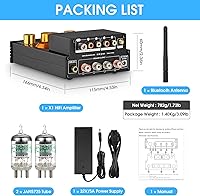
  • Tube Type: Equipped with two JAN5725 vacuum tubes in pluggable, solderless sockets to allow tube rolling without technical modifications.
  • Bluetooth: Bluetooth 5.0 via the Qualcomm QCC3034 chipset, supporting aptX and aptX-HD codecs for high-resolution wireless audio streaming.
  • Phono Input: Dedicated MM (moving magnet) phono stage using low-noise ICs, designed to accept turntable signals directly without a separate preamp.
  • Analog Inputs: Accepts stereo RCA line-level input in addition to the MM phono input, covering most common analog audio sources.
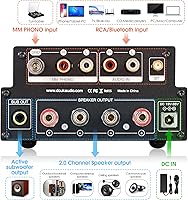
  • Outputs: Provides banana-plug binding posts for passive stereo speakers and a dedicated RCA output for connecting an active subwoofer.
  • Tone Controls: Front-panel treble and bass controls offer ±6dB of adjustment, plus a fixed bass-boost switch and a tone-bypass switch for flat signal response.
  • Frequency Response: Rated frequency response spans 20Hz to 20kHz within ±3dB, covering the full range of human hearing under normal listening conditions.
  • Signal-to-Noise Ratio: SNR is rated above 90dB, indicating a low background noise floor relative to the audio signal under typical operating conditions.
  • Distortion: Total harmonic distortion (THD) is rated at 0.5%, which is acceptable for casual listening though perceptible on critical audio comparisons.
  • Power Supply: Operates on a supplied 32V DC / 5A external power adapter, with a compatible input voltage range of 19V to 35V DC.
  • Chassis Material: Enclosure is constructed from aluminum alloy, providing better rigidity and heat dissipation than plastic alternatives at this price tier.
  • Dimensions: Physical footprint measures 4.53″ wide by 6.54″ deep by 2.36″ tall, compact enough for most desk or shelf placements.
  • Weight: Net weight is 1.72 lbs (782g), with a packaged shipping weight of approximately 3.09 lbs (1,400g).
  • Op Amp: Uses the NE5532 operational amplifier, a widely respected low-noise IC commonly found in audio signal processing applications.
  • Speaker Impedance: Compatible with passive speakers rated between 4 and 8 ohms, covering the majority of consumer bookshelf and floor-standing speaker designs.

Related Reviews
Douk Audio KN102 2-IN-1-OUT XLR Switcher
80%
83%
Build Quality
78%
Signal Integrity
94%
Ease of Setup
89%
Value for Money
76%
Switch Modes & Functionality
More
Douk Audio OK013 Mini 2.1 Channel HiFi Stereo Amplifier
75%
83%
Value for Money
71%
Sound Output & Power
77%
Build Quality
88%
Ease of Installation
58%
Thermal Management
More
Douk Audio VU3
Douk Audio VU3
90%
94%
Build Quality
91%
VU Meter Accuracy
87%
Ease of Setup
89%
Remote Control Functionality
93%
Channel Isolation
More
Douk Audio U3 Headphone Amplifier
89%
94%
Sound Clarity
91%
Frequency Response Accuracy
89%
Output Power
86%
Build Quality
90%
Ease of Setup
More
Fosi Audio Box X1 Phono Preamp
85%
87%
Sound Quality
90%
Noise Performance
83%
Build Quality
88%
Ease of Use
91%
Setup Process
More
Douk Audio T9 Vacuum Tube Phono Preamp
87%
92%
Sound Quality
88%
Ease of Setup
93%
Tube Warmth & Performance
86%
Build Quality
89%
Adjustability (Bass/Treble)
More
Douk Audio P1 Vacuum Tube Bluetooth Preamplifier
85%
89%
Sound Quality
92%
Bluetooth Connectivity
85%
Build Quality
88%
Ease of Use
87%
Tone Control Flexibility
More
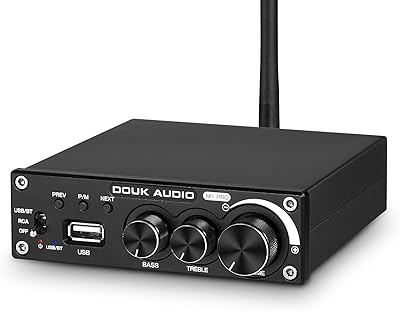
Douk Audio M1 PRO
Douk Audio M1 PRO
79%
83%
Sound Clarity
78%
Power Output
86%
Build Quality
71%
Bluetooth Performance
91%
Value for Money
More
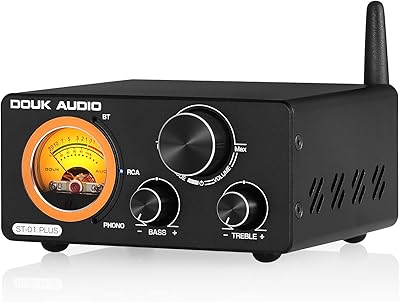
Douk Audio ST-01 Plus
81%
83%
Sound Quality
78%
Phono Preamp Performance
74%
Bluetooth Performance
71%
Build Quality
91%
Value for Money
More
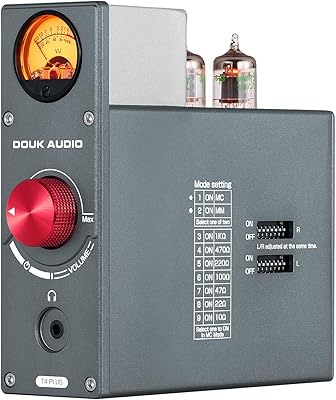
Douk Audio T4 Plus
Douk Audio T4 Plus
78%
78%
Sound Quality
81%
Phono Stage Performance
74%
Headphone Amplifier
88%
Value for Money
76%
Build Quality & Construction
More

FAQ

Yes, as long as your turntable has a moving magnet (MM) cartridge, you can plug it straight into the dedicated phono input on this tube amp. If your turntable already has a built-in preamp, you would connect it to the RCA line input instead and bypass the onboard phono stage.

It works with both iOS and Android devices. The aptX and aptX-HD codecs are primarily Android features, so iPhone users will fall back to AAC transmission instead. Most listeners find the Bluetooth quality solid regardless, though Android users with aptX-HD support will get the best wireless audio performance.

Honestly, the tube influence here is subtle rather than dramatic. The JAN5725 tubes add a mild warmth and slight softness to the midrange, which makes the sound pleasant and easy to listen to over long sessions. If you are expecting the lush, heavily colored tone of a classic valve amplifier, you may find the effect more understated than anticipated.

The stock JAN5725 tubes are pin-compatible with several common alternatives in the same family, including 5725, 6al5, and certain other small signal tube types. Before rolling in any specific tubes, it is worth verifying pin compatibility and operating voltage requirements, as not every similar-looking tube is a safe substitute.

For sensitive speakers like the Klipsch RP-600M, which are rated at 96dB sensitivity, this desktop phono amplifier has more than enough headroom. Keep in mind that the published 160W figure is measured at 4 ohms — at 8 ohms the real-world output is lower, closer to 80–100W — but for most bookshelf speakers in a small to medium room, that is still plenty of power.

Yes, there is a dedicated subwoofer RCA output on the rear panel that feeds an active subwoofer directly. You connect your active sub to that output and adjust its own volume and crossover controls to blend with your main speakers. The subwoofer output level tracks with the main volume knob, so you may need to re-balance the sub level when you make large volume changes.

At normal listening volumes through average-sensitivity speakers, most users report a quiet background. However, with high-sensitivity speakers — anything rated above 92dB or so — a faint hiss from the tube stage can be noticeable at low volumes or during quiet passages. Making sure your turntable ground wire is properly connected also helps reduce hum through the phono input specifically.

No, the Douk X1 does not include any digital inputs. All inputs are analog — Bluetooth, stereo RCA line-in, and the MM phono input. If you want to connect a TV or a computer audio output, you would need to use the headphone jack or an RCA analog output from those devices, or add an external DAC with an RCA output.

Input switching is done manually via the selector on the front panel — there is no automatic source detection. You just rotate the input knob to the source you want, which takes a second but is perfectly straightforward. It does mean you need to physically switch if you are moving back and forth between sources frequently.

A difference in brightness between the two tubes can indicate a weaker tube from the factory, which happens occasionally due to natural variation in tube manufacturing. Since the sockets are solderless, you can simply pull out the dimmer tube and replace it with a compatible substitute without any tools. If both tubes go dark, first check that the unit is receiving power properly and that the tubes are seated firmly in their sockets.