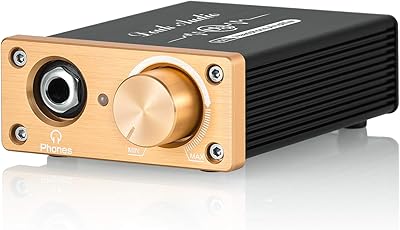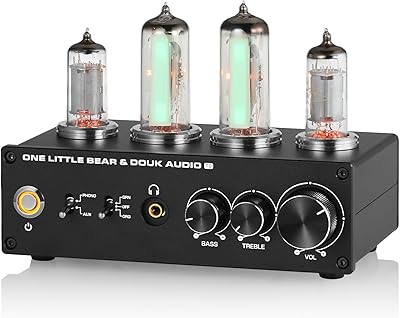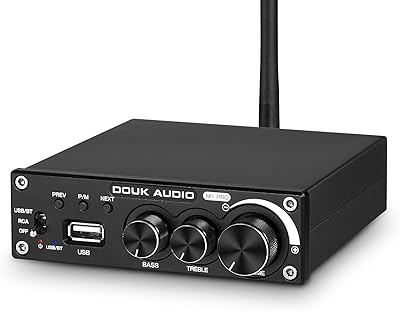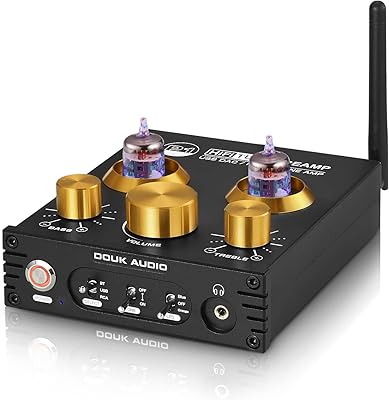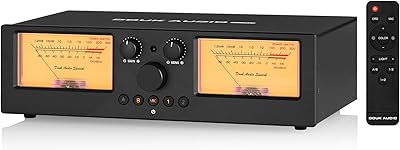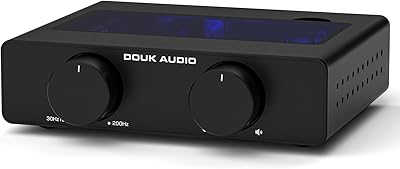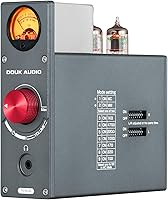
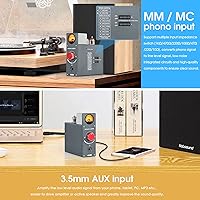

Overview

The Douk Audio T4 Plus is a compact, dual-purpose unit that brings tube-amplified vinyl playback and headphone listening together in a single small box without demanding a significant investment. Douk Audio is a Chinese budget HiFi brand that has quietly built a loyal following among entry-level audiophiles who want genuine analog character at accessible prices. This tube phono preamp won't compete with reference-grade separates costing many times more, and it doesn't pretend to. What it does offer is a warm, inviting sound paired with a retro aesthetic — glowing tubes, an illuminated VU meter — that makes it genuinely enjoyable to own, not just to use.

Features & Benefits

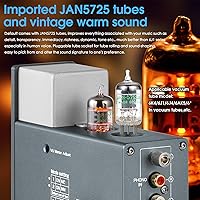
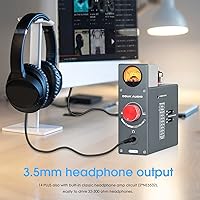
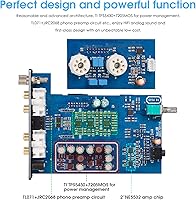
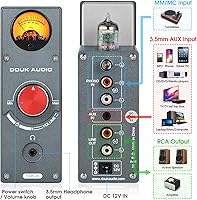
The T4 Plus runs on a pair of JAN5725 vacuum tubes — military-spec components that produce the warm, rounded tone tube enthusiasts are after, with standard replaceable sockets that make swapping tubes straightforward and affordable. On the phono side, the unit handles both MM and MC cartridges with four selectable impedance settings spanning 10Ω to 1kΩ — genuinely uncommon flexibility at this price tier — while RIAA response stays within ±0.3dB across the full audio band, tighter than many competitors. The built-in NE5532 headphone amp delivers clean power to drive most headphones up to 300Ω comfortably, and a 3.5mm AUX input lets you run a phone or laptop through the tube stage for a noticeably warmer digital sound.

Best For

This tube phono preamp is a natural fit for vinyl newcomers who want real tube warmth without building a rack full of separates. Desktop and apartment listeners will particularly appreciate having phono amplification and headphone output in one unit that takes up minimal space. If you've been curious about tube rolling — swapping tubes to shape the sound — this Douk Audio unit makes an excellent, low-risk starting point before committing to pricier gear. It also works well for anyone juggling a turntable alongside digital sources, since the AUX input handles both in a single box. And if aesthetics matter, the glowing VU meter and warm tube light make it a genuine visual centerpiece.

User Feedback

Across well over a hundred reviews, the T4 Plus holds a strong 4.4-star average, with buyers consistently praising its warm, musical character and expressing pleasant surprise at the build quality relative to cost. The VU meter earns frequent appreciation not just for looks but for providing a real-time sense of output levels. On the downside, a handful of users — particularly those with sensitive, high-efficiency headphones — report audible tube hiss at low volumes. MC cartridge owners have had uneven results too; the impedance selector helps, but very low-output MC cartridges can still leave some users wanting more gain. Despite these caveats, the overall buyer sentiment leans genuinely positive, most often anchored to strong value for the price.

Pros

  • Combines a tube phono preamp and headphone amp in one compact unit — genuinely rare at this price.
  • MM cartridge performance is clean and musically satisfying, with tight RIAA equalization across the full audio band.
  • Selectable MC impedance across four settings offers more cartridge flexibility than most competing budget preamps.
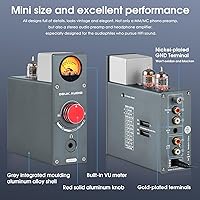
  • The illuminated VU meter and glowing tubes make this one of the most visually appealing units in its price range.
  • Pluggable JAN5725 tubes make experimenting with tube rolling accessible and low-cost for beginners.
  • The 3.5mm AUX input lets digital sources benefit from the tube stage, doubling as a practical desktop audio hub.
  • Most standard headphones in the 32Ω to 250Ω range are driven cleanly without needing a separate amplifier.
  • Compact footprint and light weight make it easy to fit into tight shelf or desktop setups.
  • Simultaneous RCA and headphone output allows feeding speakers and headphones from a single unit at the same time.
  • Build quality feels noticeably solid and well-finished relative to what the price typically delivers in this segment.

Cons

  • Audible tube hiss is a recurring issue with sensitive in-ear monitors and high-efficiency headphones.
  • Very low-output MC cartridges will likely produce insufficient gain and an elevated noise floor.
  • The headphone amp begins to run out of headroom with high-impedance headphones above 250Ω.
  • Stock tubes are entry-level components; sonic improvements from rolling are real but modest, not transformative.
  • The rear panel becomes cramped when multiple cables are connected, complicating cable management.
  • MC mode gain specifications are not clearly disclosed, making cartridge matching a partially educated guess.
  • VU meter calibration is decorative rather than precise — not a reliable tool for accurate output monitoring.
  • The brief user manual offers little guidance on optimal impedance settings for specific cartridge types.
  • Volume interaction between simultaneous outputs suggests a shared signal path, limiting independent level control.
  • Users expecting a dramatic tube coloration on the AUX input may find the effect more subtle than anticipated.

Ratings

The Douk Audio T4 Plus has been evaluated by our AI system after analyzing verified global buyer reviews, with spam, bot-submitted, and incentivized feedback actively filtered out to ensure the scores reflect genuine user experiences. Across categories spanning sound performance to build quality, both the real strengths and recurring frustrations of this tube phono preamp are transparently represented. The result is a balanced scorecard that helps buyers understand exactly what they are getting — and what compromises come with the price point.

Sound Quality
78%
22%
Most users describe the sound as noticeably warmer and more musical than solid-state alternatives at a similar price, particularly when playing well-pressed vinyl through a decent MM cartridge. The tube stage adds a pleasant roundness to midrange frequencies that makes extended listening sessions feel less fatiguing.
At high volumes or with bright recordings, some users note the treble can feel slightly compressed or rolled off compared to cleaner solid-state preamps. This is an entry-level tube implementation, not a reference-grade circuit, and experienced listeners will hear the ceiling fairly quickly.
Phono Stage Performance
81%
19%
The RIAA equalization is impressively accurate for the price, staying within a tight tolerance across the full audible band. Buyers using standard MM cartridges — the Ortofon 2M Red being a common pairing mentioned in reviews — report clean, well-defined playback with good channel balance.
MC cartridge users have had more mixed results. While the selectable impedance options are a genuine plus, very low-output MC cartridges can still leave the gain feeling insufficient, and a small number of users reported a slight noise floor rise when running MC mode.
Headphone Amplifier
74%
26%
For casual private listening sessions, the built-in headphone amp handles popular headphones in the 32Ω to 250Ω range without obvious strain. Users pairing it with mid-impedance cans like the Sennheiser HD 599 or similar closed-backs generally reported satisfying results for vinyl evenings at home.
Sensitive in-ear monitors expose a low-level hiss that several buyers found distracting during quiet passages. High-impedance headphones above 250Ω can also push the amplifier to its limits, with some users noting reduced dynamic headroom compared to dedicated headphone amplifiers.
Value for Money
88%
Combining a tube phono stage, MM/MC switching, a headphone amp, and an AUX input in one unit at this price point is genuinely hard to beat. Buyers frequently cite it as the most feature-rich option they found after comparing several alternatives in the budget segment.
The value calculation shifts slightly if you factor in the cost of replacing the stock tubes or adding an external headphone amp to address the hiss issue. What starts as a straightforward budget buy can gradually accumulate optional upgrades.
Build Quality & Construction
76%
24%
The metal chassis feels solid and well-assembled for the price tier, and the front panel controls have a satisfying tactile click. Several users mentioned it looks and feels more expensive than they expected when it arrived.
The rear panel connectors feel slightly less robust than the front, and a few buyers noted the RCA jacks are a somewhat tight fit for thicker aftermarket cables. It is not a precision-built chassis by any measure, but it holds together reliably under normal desktop use.
VU Meter & Aesthetics
91%
The illuminated VU meter is widely regarded as one of the best visual features at this price, adding genuine retro character to a desktop or shelf setup. The warm amber glow of the tubes combined with the swinging needles makes this unit a conversation piece in any listening room.
The VU meter calibration is purely cosmetic rather than precision-accurate, so it should not be relied on for any serious output level monitoring. A small number of users also noted the meter illumination can appear slightly uneven between the two channels.
Tube Rolling Flexibility
73%
27%
The pluggable JAN5725 tube sockets are a genuinely useful feature for buyers who want to experiment with the sound signature without soldering. Compatible replacement tubes are widely available and affordable, making this a low-commitment introduction to tube rolling.
The sonic differences between affordable JAN5725 substitutes are fairly subtle at this circuit level, and some buyers expecting dramatic transformations were mildly disappointed. The upgrade ceiling is real — rolling tubes will refine but not fundamentally transform the sound.
MM Cartridge Compatibility
84%
Standard moving-magnet cartridges in common output ranges pair cleanly and consistently with this unit. Users running popular entry-level to mid-range MM cartridges reported accurate, well-balanced reproduction without needing any additional adjustments.
The fixed MM input impedance setting is appropriate for most cartridges but not adjustable, which could be a minor limitation for users with non-standard MM designs. In practice this rarely causes issues, but it is worth noting for users with more specialized cartridges.
MC Cartridge Compatibility
61%
39%
The four selectable impedance settings give MC users more flexibility than most competing units in this price range, and buyers running higher-output MC cartridges in the 0.4mV range and above generally had positive experiences.
Low-output MC cartridges below 0.2mV will likely produce insufficient gain and an elevated noise floor, and Douk Audio does not fully disclose the gain specifications for MC mode. Users with high-quality low-output MC cartridges would be better served by a dedicated step-up transformer or a higher-gain phono stage.
AUX Input Functionality
79%
21%
The 3.5mm AUX input is a genuinely practical addition that lets users run streaming audio or a phone through the tube stage for a slightly warmer output character. Several buyers mentioned purchasing the unit specifically for this feature as a desktop audio hub.
The degree of sonic coloration from the AUX path is modest — it adds warmth but is not a dramatic transformation, and some users expecting a more pronounced tube effect on digital sources felt it was subtle to the point of being imperceptible on casual listening.
Noise Floor & Hiss
58%
42%
With standard-sensitivity headphones and speakers in a typical listening environment, the background noise level is reasonably controlled and does not intrude during normal playback. The S/N ratio specification of 110dB holds up reasonably well under MM phono conditions.
This is the most consistently mentioned pain point across user reviews. Sensitive in-ear monitors and high-efficiency headphones reveal a noticeable hiss, particularly in MC mode or with the volume knob near the lower end of its range. Users with quiet, high-sensitivity systems should take this seriously before purchasing.
Ease of Setup
87%
The learning curve is minimal. Switching between MM and MC modes and adjusting the impedance is handled through clearly labeled rear-panel switches, and most buyers reported being up and running within minutes of unboxing. No software or drivers are involved.
The user manual is brief and lacks detail on optimal impedance matching for specific cartridge types, which can leave less experienced users guessing. The impedance selector labels are small and require good lighting to read clearly on the rear panel.
Size & Desk Footprint
83%
At under six inches square and just under 1.5 pounds, this Douk Audio unit is compact enough to slot into tight desktop or shelf setups without dominating the space. Buyers in apartments or small listening corners specifically praised the minimal physical footprint.
The compact size means the rear panel is slightly cramped when multiple cables are connected simultaneously, particularly if using both RCA outputs and the headphone jack at the same time. Cable management around the unit requires a little planning.
Simultaneous Output Capability
77%
23%
The ability to output through both the RCA line out and the headphone jack at the same time is a practical feature that lets users feed a stereo amplifier or active speakers while also monitoring privately through headphones — a genuinely useful setup for shared living spaces.
Some users noted a slight volume interaction between the two outputs when both are active simultaneously, suggesting the headphone amp and line output share part of the signal path. It works, but purists who need fully independent output levels will find this limiting.

Suitable for:

The Douk Audio T4 Plus is an excellent fit for vinyl beginners who want a genuine taste of tube-amplified sound without assembling a full rack of separate components. If you own a turntable with a standard MM cartridge and want to listen privately through headphones — or feed a pair of active speakers — this unit handles both jobs from a single compact box that takes up minimal desk or shelf space. Apartment dwellers and small-room listeners will appreciate that combination especially, since it eliminates the need for multiple devices. It also makes a sensible starting point for anyone curious about tube rolling: the pluggable JAN5725 tubes are easy to swap, affordable replacements are widely available, and the investment risk is low if you decide the hobby isn't for you. Users who split time between vinyl and digital sources will find the 3.5mm AUX input a practical bonus, routing phones or laptops through the tube stage without needing a separate input switcher. And if aesthetics are part of your buying motivation — the glowing tubes, the swinging VU meter needles, the warm amber light — this Douk Audio unit delivers a retro visual experience that genuinely enhances a listening room setup.

Not suitable for:

Buyers running low-output moving-coil cartridges below roughly 0.2mV will likely find the Douk Audio T4 Plus frustrating: the selectable MC impedance is a useful feature in theory, but the gain architecture is not designed for the most demanding MC signals, and the result can be an audible noise floor and insufficient output level. Anyone who owns sensitive in-ear monitors or high-efficiency headphones should also approach this unit cautiously, since tube hiss at low volumes is a recurring complaint that becomes genuinely distracting with revealing transducers. Experienced audiophiles upgrading from a well-regarded phono stage in a higher price bracket will likely hear the ceiling of this circuit quickly — it is an entry-level tube implementation, and the warmth it adds comes with a corresponding reduction in precision and transparency compared to cleaner solid-state or higher-end tube designs. If your primary concern is a dead-quiet, analytically accurate phono stage for critical listening or vinyl archiving, this is not the right tool. Similarly, anyone who needs fully independent volume control over line output and headphone output simultaneously will find the shared signal path a limiting design compromise.

Specifications

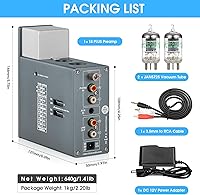
  • Vacuum Tubes: Ships with two JAN5725 military-spec vacuum tubes in pluggable sockets, allowing straightforward tube rolling without soldering.
  • Phono Input: Accepts both moving-magnet (MM) and moving-coil (MC) cartridges, selectable via a rear-panel switch.
  • MC Impedance: Four selectable MC loading options are available: 10Ω, 100Ω, 470Ω, and 1kΩ, adjustable from the rear panel.
  • RIAA Response: Frequency response measures 20Hz to 20kHz within ±0.3dB, indicating accurate RIAA equalization across the full audible range.
  • Signal-to-Noise: Rated signal-to-noise ratio is 110dB or greater, which is competitive for a tube-based phono stage at this price tier.
  • Distortion (THD): Total harmonic distortion is specified at 0.2%, a typical figure for entry-level tube phono circuit designs.
  • Headphone Amp: The built-in headphone amplifier uses an NE5532 op-amp IC and is rated to deliver up to 150mW into a 32Ω load.
  • Headphone Range: Compatible with headphones across an impedance range of 32Ω to 300Ω, covering the majority of consumer and prosumer headphones.
  • AUX Input: A 3.5mm stereo AUX input is provided on the rear panel for connecting phones, tablets, laptops, or other line-level sources.
  • Audio Outputs: Outputs consist of a pair of RCA line-level jacks and a 3.5mm headphone jack, both of which can operate simultaneously.
  • Input Sensitivity: Input sensitivity is rated at 0.775V, consistent with standard line-level operation for the AUX input stage.
  • VU Meter: An analog VU meter with warm backlight illumination is mounted on the front panel, displaying real-time output dynamics.
  • Dimensions: The chassis measures 5.39″ wide by 5.75″ deep by 1.97″ tall, making it compact enough for most desktop or shelf setups.
  • Weight: Unit weight is 1.41 pounds, light enough to reposition easily without anchoring cables or straining connections.
  • Chassis Material: The enclosure is constructed from a metal chassis that provides adequate shielding and a solid feel for the price category.
  • Manufacturer: Designed and produced by Douk Audio, a Chinese consumer HiFi brand known for budget-oriented tube and solid-state audio components.
  • Model Number: The official model designation is SUC-T4 PLUS, as listed in Douk Audio's product documentation.

Related Reviews
Douk Audio ST-01 Plus
81%
83%
Sound Quality
78%
Phono Preamp Performance
74%
Bluetooth Performance
71%
Build Quality
91%
Value for Money
More
Douk Audio KN102 2-IN-1-OUT XLR Switcher
80%
83%
Build Quality
78%
Signal Integrity
94%
Ease of Setup
89%
Value for Money
76%
Switch Modes & Functionality
More
Douk Audio OK013 Mini 2.1 Channel HiFi Stereo Amplifier
75%
83%
Value for Money
71%
Sound Output & Power
77%
Build Quality
88%
Ease of Installation
58%
Thermal Management
More
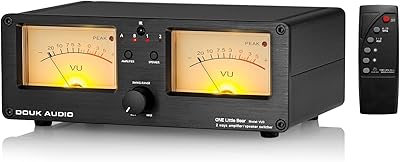
Douk Audio VU3
Douk Audio VU3
90%
94%
Build Quality
91%
VU Meter Accuracy
87%
Ease of Setup
89%
Remote Control Functionality
93%
Channel Isolation
More
Douk Audio U3 Headphone Amplifier
89%
94%
Sound Clarity
91%
Frequency Response Accuracy
89%
Output Power
86%
Build Quality
90%
Ease of Setup
More
Douk Audio T9 Vacuum Tube Phono Preamp
87%
92%
Sound Quality
88%
Ease of Setup
93%
Tube Warmth & Performance
86%
Build Quality
89%
Adjustability (Bass/Treble)
More
Douk Audio M1 PRO
Douk Audio M1 PRO
79%
83%
Sound Clarity
78%
Power Output
86%
Build Quality
71%
Bluetooth Performance
91%
Value for Money
More
Douk Audio P1 Vacuum Tube Bluetooth Preamplifier
85%
89%
Sound Quality
92%
Bluetooth Connectivity
85%
Build Quality
88%
Ease of Use
87%
Tone Control Flexibility
More
Douk Audio VU3 Pro
Douk Audio VU3 Pro
80%
91%
Build Quality
88%
VU Meter Display
86%
Switching Functionality
89%
Amplifier Compatibility
78%
Remote Control
More
Douk Audio A5
Douk Audio A5
81%
88%
Sound Clarity
93%
Value for Money
81%
Build Quality
86%
High-Pass Filter Usability
74%
Op-Amp Swapping Experience
More

FAQ

It works with any turntable that has a standard phono output — either MM or MC — and lacks a built-in phono stage. If your turntable already has a built-in preamp, you would connect it via the AUX input instead of the phono input to avoid double amplification.

The T4 Plus is rated up to 300Ω, so the HD 650 falls right at the edge of its specified range. You will likely get listenable volume levels, but the amplifier will be working near its ceiling — expect somewhat reduced dynamic range and headroom compared to a dedicated headphone amp. For casual listening at moderate volumes it is fine; for critical listening sessions, a dedicated amp would serve the HD 650 better.

A low-level hiss is a known characteristic of entry-level tube circuits and has been noted by several owners of this unit, particularly with sensitive headphones or in-ear monitors. It is not necessarily a defect — tube stages inherently introduce more noise than solid-state designs, and the JAN5725 tubes can contribute a degree of background noise. If the hiss is loud or intermittent, try reseating the tubes in their sockets, as a loose tube connection can worsen the issue.

Yes, the 3.5mm AUX input is designed exactly for this. You can plug a phone, tablet, or laptop into the AUX input and use the headphone output independently of the phono stage. It functions as a tube-buffered headphone amp for digital sources, which is how a number of buyers use it as their primary desktop audio device.

Tube rolling means replacing the stock vacuum tubes with different compatible models to subtly alter the sound character — some tubes sound warmer, others slightly cleaner or more detailed. The T4 Plus uses JAN5725 tubes in standard pluggable sockets, so swapping them requires no tools or soldering. At this circuit level the differences are real but modest, so if you enjoy experimenting it is a fun and affordable exercise, though you should not expect a dramatic transformation.

That output level is very low, and this unit will likely struggle with it. The T4 Plus offers selectable MC impedance loading, which helps with matching, but the gain architecture is not designed for ultra-low-output MC cartridges. Most users with cartridges below roughly 0.2mV find the noise floor becomes problematic. A dedicated step-up transformer or a higher-gain MC phono stage would be a more reliable choice in that case.

Yes, the RCA outputs and 3.5mm headphone jack can run simultaneously, which is useful if you want to switch between private and speaker listening without unplugging anything. One thing to note is that the two outputs share part of the signal path, so they do not have fully independent volume controls — adjusting the main volume knob affects both.

Check your cartridge's specification sheet for its recommended load impedance, which the manufacturer usually lists. As a general rule, MC cartridges are often loaded at around 10 to 100 times their internal coil resistance. If you are unsure, starting at 100Ω is a reasonable default for many medium-output MC cartridges, then comparing the sound with the other settings to find what sounds most balanced to your ear.

It is primarily aesthetic. The meter swings in response to output dynamics and gives a general visual sense of signal activity, but its calibration is not precise enough to rely on for recording or metering purposes. If you need accurate output level monitoring for a recording workflow, a dedicated metering solution would be necessary.

The JAN5725 is a sub-miniature pentode tube, and compatible replacements include the 5725, 403A, 403B, and in some cases the 6AK5 or EF95 family of tubes, though you should verify pin compatibility before purchasing. Affordable new-old-stock options from various military surplus sources are widely available online. If one of your stock tubes develops noise or microphonics over time, replacing just that tube with a matching type is straightforward given the pluggable socket design.