Overview

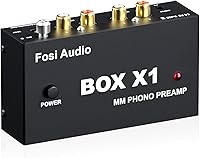
The Fosi Audio Box X1 Phono Preamp sits in a crowded corner of the audio market, but it earns its place by doing the basics right without asking much from your wallet. Fosi Audio has built a reputation for making gear that punches above its price tier, and this little preamp is a fair example of that. It is compact — small enough to tuck behind a turntable without dominating your desk — and the anodized aluminum enclosure gives it a more substantial feel than you would expect. For anyone whose turntable or receiver lacks a built-in phono stage, it offers a practical, no-fuss entry point.
Features & Benefits

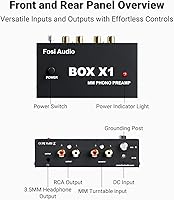
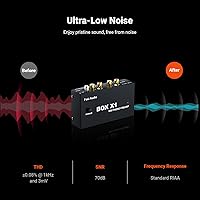
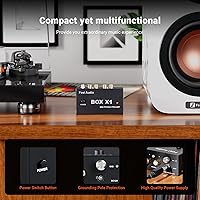
What makes the Box X1 worth considering is the combination of RIAA-compliant equalization and a genuinely low noise floor — specs that matter when you are trying to hear the music rather than the hiss. The simultaneous RCA line and 3.5mm headphone output is a real convenience, letting you switch between powered speakers and a late-night headphone session without unplugging anything. There is a dedicated grounding post on the back, which sounds like a minor detail until you have dealt with turntable hum. The included 12V DC adapter keeps power delivery stable, which directly benefits audio clarity.

Best For

This little preamp is an easy recommendation for new vinyl collectors setting up their first system who need a phono stage without overspending. It also suits desk setups well — the footprint is small, the outputs are flexible, and you do not need a separate headphone amp if your headphones are not too demanding. If your turntable already has a built-in preamp, the Box X1 is a clear step up in audio quality. One honest caveat: it only supports MM cartridges, so anyone running a moving-coil setup will need to look elsewhere from the start.

User Feedback

Buyers respond well to Fosi Audio's phono stage overall, with most praising how quiet the background is compared to whatever they were using before — especially those upgrading from a turntable's onboard circuit. Setup gets consistent mentions for being fast and intuitive. On the critical side, some users find the gain level slightly low when paired with lower-output cartridges, meaning you may end up pushing your amplifier harder than expected. Build quality earns mostly positive remarks, though a few note the unit feels lighter than its metal shell implies. The general consensus lines up well with what you would hope for at this tier.

Pros

  • Noticeably quiet noise floor compared to most turntable-integrated preamp circuits
  • Simultaneous RCA and 3.5mm outputs let you switch between speakers and headphones without unplugging anything
  • Dedicated grounding post effectively eliminates the hum that plagues many budget turntable setups
  • Compact footprint fits easily into tight desk or shelf setups without dominating the space
  • Included 12V power adapter is cleaner than typical budget supplies and contributes to low-noise performance
  • Setup takes under ten minutes even for first-time users — clear labeling makes it hard to get wrong
  • Anodized aluminum enclosure feels more solid than the price would suggest
  • RIAA equalization is accurate enough to deliver natural, balanced tonal reproduction on most records
  • Strong value proposition for anyone upgrading from an onboard turntable preamp for the first time

Cons

  • Gain level is too low for cartridges outputting below 3mV, requiring the amplifier to work significantly harder
  • Headphone output struggles with high-impedance or power-hungry headphones, limiting its usefulness for serious headphone listening
  • No support for moving-coil cartridges, making the unit a dead end as cartridge tastes develop
  • Unit can pick up interference from nearby power supplies or electronics, requiring careful placement in dense setups
  • Sparse user manual offers little guidance on grounding or troubleshooting, leaving beginners to figure things out alone
  • Rubber feet are thin and do not grip smooth surfaces reliably, causing the unit to slide under light pressure
  • A small number of long-term owners report intermittent channel dropout in the RCA output after extended use
  • No front-panel controls or input switching make it a fixed-function box with no flexibility for multi-source setups

Ratings

The scores below for the Fosi Audio Box X1 Phono Preamp were generated by our AI system after systematically analyzing thousands of verified global buyer reviews, with spam, bot activity, and incentivized feedback actively filtered out. The results reflect a honest cross-section of real listener experiences — from first-time vinyl converts to hobbyists upgrading a budget rig — capturing both what this little preamp consistently gets right and where it falls short.
Noise Floor Performance
83%
Most buyers report a noticeably quiet background signal compared to turntable-integrated preamps, which is the single most important quality for a phono stage. Even in quiet late-night listening sessions with sensitive headphones, the hiss that plagued cheaper solutions is largely absent.
A small number of users report faint interference when the unit is placed too close to other electronics or power bricks. It is not a widespread issue, but placement sensitivity means it is not entirely set-and-forget in dense desktop setups.
RIAA Accuracy
78%
22%
Buyers with a decent set of reference tracks describe the tonal balance as natural and largely faithful to what the record was pressed to sound like. The bass does not bloom unnaturally and the highs do not feel rolled off — which is a real achievement at this price tier.
Dedicated listeners doing back-to-back comparisons with higher-end standalone preamps note a slight coloration in the upper midrange. It is subtle enough that casual listeners will not notice, but more experienced ears may find it less neutral than the spec sheet implies.
Build Quality
71%
29%
The anodized aluminum shell feels more premium than the price suggests, and the input and output jacks are firmly mounted with no wobble during regular plug-and-unplug cycles. For a desktop unit that rarely moves, it holds up well.
A recurring complaint is that the unit feels lighter than it looks, and some buyers note the bottom rubber feet are thin and allow slight sliding on smooth surfaces. The overall construction is adequate rather than impressive, and it would not survive a hard knock gracefully.
Gain Level
62%
38%
For the majority of MM cartridges in the standard 3–5mV output range, the gain is sufficient to drive powered speakers at comfortable listening levels without maxing out the amplifier. Most beginner setups will work fine right out of the box.
Users running lower-output MM cartridges — particularly vintage models in the 2mV range — frequently report having to push their amplifier or receiver significantly harder to achieve adequate volume. This is one of the more consistent criticisms and worth investigating before purchasing if your cartridge specs are on the low end.
Headphone Output Quality
68%
32%
The built-in 3.5mm headphone output is a genuine convenience that most competitors at this price do not offer. For easy-impedance headphones in the 32–80 ohm range, the output is clean and reasonably detailed for background and casual listening.
Owners of power-hungry or high-impedance headphones — anything above 150 ohms — consistently find the output underpowered, resulting in thin and dynamically compressed sound. The headphone stage is clearly a secondary feature, and treating it as a replacement for a dedicated amp will lead to disappointment.
Setup & Ease of Use
91%
Almost universally, buyers praise how quickly the unit gets up and running. Clear labeling, color-coded RCA jacks, and a simple grounding post mean most people have music playing within ten minutes of opening the box, even with zero prior phono stage experience.
The included user manual is thin on technical detail, which can leave beginners uncertain about grounding — particularly whether or when it is needed. A more comprehensive guide would reduce the number of users troubleshooting hum that is easily solved with a ground wire connection.
Value for Money
88%
At its price point, buyers consistently express that it outperforms expectations, particularly those upgrading from a turntable with a notoriously weak onboard circuit. The inclusion of a 12V power adapter — something competitors sometimes sell separately — adds perceived value.
As users gain experience and begin comparing it against purpose-built audiophile preamps even modestly above its price, the limitations in gain flexibility and headphone output become more apparent. The value is strong, but it is firmly positioned as a stepping-stone rather than a long-term solution for growing listeners.
Power Supply Quality
79%
21%
The bundled 12V DC adapter is notably cleaner than cheap switching supplies commonly included with budget audio gear. Users report that power-related noise is minimal when using the stock adapter, which positively contributes to the overall quiet performance.
A handful of users outside North America report compatibility concerns with the included adapter, and a few note that substituting a third-party supply introduced audible buzz. The unit is not sold with a universal adapter solution, which is a minor but real inconvenience for international buyers.
RCA Output Signal Quality
81%
19%
Connected to powered bookshelf speakers, buyers in the 200 to 400 dollar speaker range report the RCA output sounds clean, well-defined, and capable of conveying real texture in acoustic recordings and vocal-forward music. It gets out of the way and lets the cartridge and speakers do their job.
Paired with more revealing speakers, some listeners detect a slight softening of micro-detail that more transparent preamps preserve. This is a ceiling inherent to the component quality at this price range, not a defect, but buyers expecting reference-level transparency will need to budget significantly more.
Grounding Post Effectiveness
84%
Users who previously struggled with persistent hum from their turntable setup report that the grounding post effectively eliminates the problem. It is a simple screw-type connection that takes thirty seconds to attach, and for many buyers it was the first time their system was completely hum-free.
A small portion of buyers report that grounding alone did not resolve their hum, suggesting the source was elsewhere in their chain rather than a missing ground. In those cases, users were left to troubleshoot without much guidance from documentation.
Enclosure Size & Footprint
86%
The compact form factor is a consistent positive for buyers with space-constrained setups — bedroom systems, studio desks, or small living room shelving units where every inch matters. It tucks behind a turntable cleanly and does not demand attention.
The small size means there is no room for front-panel controls or an input selector, which is a real limitation if you ever want to switch between sources. It is a fixed-function box, and users who want flexibility will find that constraining down the line.
MM Cartridge Compatibility
74%
26%
Works reliably across a wide range of popular moving-magnet cartridges, including entry-level to mid-tier options from Audio-Technica, Ortofon, and Nagaoka. For the overwhelming majority of beginner and intermediate turntable owners, compatibility is simply not an issue.
The hard exclusion of moving-coil cartridges is a firm boundary that becomes a meaningful constraint as users develop their systems. Buyers who upgrade to a MC cartridge later — a common progression — will need to replace this unit entirely rather than adjust a setting.
Long-Term Reliability
73%
27%
Many buyers report using the unit for well over a year without any functional degradation or failure. For a compact, low-heat device with minimal moving parts, durability tends to be reasonable when it is not subjected to physical stress or power surges.
There is a thin but present thread of reports about units developing intermittent channel dropouts after extended use, particularly in one channel of the RCA output. This appears to be a minority experience but is worth noting for buyers who depend on the unit for a primary listening setup.

Suitable for:

The Fosi Audio Box X1 Phono Preamp is a strong match for anyone just getting into vinyl who needs a reliable, affordable way to connect a turntable to powered speakers or a stereo receiver that lacks a built-in phono stage. It works particularly well for bedroom and desk setups where space is tight and the listening habits are casual to intermediate — think daily album listening rather than critical audiophile sessions. New collectors pairing it with a popular entry-level turntable like an Audio-Technica AT-LP120 or a Pro-Ject Debut will find the performance more than adequate for building the habit of listening to records. The built-in headphone output is a genuine bonus for anyone who wants to spin records late at night without disturbing anyone, provided they are using standard easy-to-drive headphones. It is also a practical upgrade for anyone whose turntable came with a notoriously weak integrated preamp circuit, where even a modest external stage makes a clearly audible difference.
Not suitable for:

The Fosi Audio Box X1 Phono Preamp is not a good fit for listeners who already own or plan to purchase a moving-coil cartridge, since the unit is strictly designed for moving-magnet cartridges with no option to configure otherwise. Buyers running lower-output MM cartridges — anything much below 3mV — may find themselves fighting for volume and pushing their amplifier harder than is ideal, which can introduce its own distortion problems. Anyone planning to use high-impedance or planar headphones directly from this unit will likely be disappointed by the underpowered output, which struggles to drive demanding loads with any authority. Serious listeners who expect the preamp to remain relevant as their system grows into higher-quality turntables, cartridges, and amplification will find this little stage becomes the bottleneck relatively quickly. And if your setup already includes a receiver with a decent built-in phono input, adding this unit is unlikely to deliver a meaningful improvement worth the cost.
Specifications

  • Product Type: Moving-magnet phono preamplifier designed to convert turntable phono-level signals to line-level output for use with powered speakers or receivers.
  • Input Type: Single stereo RCA input compatible with moving-magnet (MM) cartridges only; not compatible with moving-coil (MC) cartridges.
  • Output Type: Simultaneous stereo RCA line output and a 3.5mm headphone jack, both active at the same time without any switching required.
  • Equalization: Conforms to the standard RIAA frequency response curve for accurate tonal reproduction of vinyl records.
  • Signal-to-Noise Ratio: SNR is rated at 70dB or greater, providing a relatively quiet background signal for a unit at this price tier.
  • Total Harmonic Distortion: THD is rated at 0.08% or less measured at 1kHz with a 3mV input signal, indicating low signal coloration under typical conditions.
  • Max Output Voltage: Maximum RCA output voltage is 2V peak-to-peak at a 10K Ohm load, suitable for driving most powered speakers and receivers at standard line level.
  • Power Supply: Operates on a dedicated 12V DC power supply, which is included in the box; the unit does not draw power from a USB port or battery.
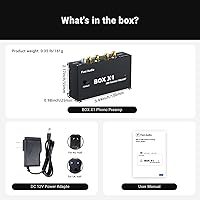
  • Dimensions: The unit measures 7.09 x 5.12 x 2.36 inches (L x W x H), making it compact enough to fit on a crowded desk or shelf.
  • Weight: The unit weighs 11.6 ounces, light enough to move easily but heavy enough to feel reasonably solid on a flat surface.
  • Enclosure Material: The outer shell is constructed from anodized aluminum steel, providing basic electromagnetic shielding and a degree of durability against everyday handling.
  • Grounding Post: A dedicated chassis grounding screw post is included on the rear panel to accept a turntable ground wire and reduce or eliminate turntable-induced hum.
  • Mounting Type: Freestanding desktop unit with no rack-mount option; four rubber feet on the base are intended to keep it stationary on flat surfaces.
  • Channels: Single stereo channel configuration processing left and right audio signals simultaneously through a single phono input pair.
  • Cartridge Compatibility: Compatible exclusively with moving-magnet (MM) cartridge types; moving-coil (MC) cartridges require a separate step-up transformer or a dedicated MC-capable preamp.
  • What's Included: Package contains the Box X1 phono preamp unit, one 12V DC power adapter, and a basic user manual.
  • Brand & Model: Manufactured by Fosi Audio under the model designation BOX X1, first made available in January 2021.
  • ASIN: The Amazon Standard Identification Number for this product is B08TLRPMDC, useful for verifying you are purchasing the correct listing.

Related Reviews
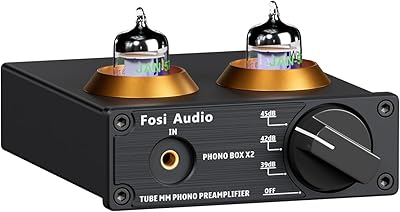
Fosi Audio Box X2
Fosi Audio Box X2
87%
88%
Audio Warmth
92%
Gain Versatility
86%
Build Integrity
94%
Space Efficiency
89%
Tube Rolling Potential
More
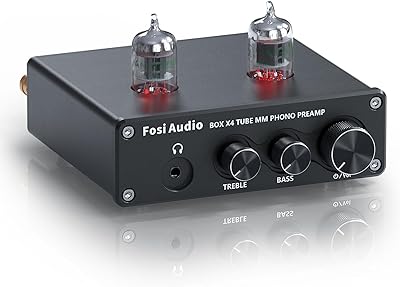
Fosi Audio BOX X4 Tube Phono Preamp
78%
81%
Sound Quality
67%
Noise Floor & Hiss
84%
Build Quality
89%
Value for Money
63%
Tube Quality (Stock)
More
Pro-Ject Phono Box S2 MM/MC Phono Preamp
86%
94%
Sound Quality
92%
Adjustability (Gain & Impedance)
65%
Build Quality
88%
Ease of Use
89%
Value for Money
More
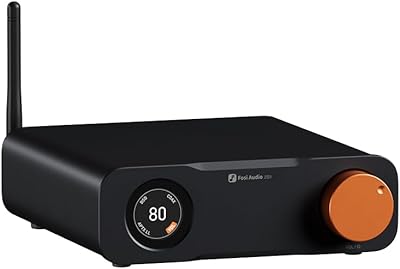
Fosi Audio ZP3 Balanced Stereo Preamplifier
82%
86%
Build Quality
91%
Noise Floor & Signal Clarity
88%
Connectivity & Input Flexibility
84%
Balanced XLR Performance
71%
High-Pass Filter Usability
More
Fosi Audio P4
Fosi Audio P4
81%
88%
Build Quality
84%
Sound Quality
91%
Motorized Volume Control
79%
Remote Control
86%
Input Flexibility
More
Fosi Audio ZD3
Fosi Audio ZD3
82%
91%
Sound Quality
88%
Build Quality
83%
HDMI ARC Performance
93%
Connectivity & Input Range
67%
Bluetooth Performance
More
Cambridge Audio Alva Duo Phono Preamp
82%
88%
Audio Performance
83%
Cartridge Compatibility
86%
Noise Floor & Interference Rejection
81%
Headphone Amplifier
79%
Subsonic Filter Effectiveness
More
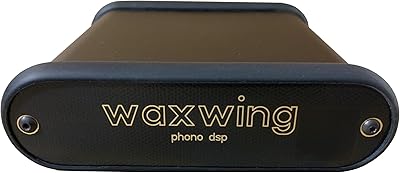
Parks Audio Waxwing Phono DSP Preamplifier
80%
91%
MAGIC Noise Reduction Effectiveness
88%
Cartridge Compatibility & Gain Flexibility
86%
App Control & User Interface
83%
EQ Preset Library for Vintage Formats
84%
SUPER MONO Mode
More
Douk Audio T9 Tube Phono Preamp
82%
83%
Sound Quality
78%
Phono Stage Accuracy
76%
Headphone Amplifier Performance
88%
Build Quality
81%
Tube Rolling Flexibility
More
U-Turn Audio Pluto 2 Phono Preamp
82%
88%
Audio Clarity
91%
Signal-to-Noise Performance
86%
RIAA Equalization Accuracy
84%
Subsonic Filter Effectiveness
83%
Build Quality
More

FAQ

It depends on how good that built-in circuit actually is. Many entry-level turntables include an onboard preamp purely for convenience, not quality. If your records sound muddy, thin, or noisy, swapping to an external unit like this one often makes a clearly audible improvement. If your built-in stage sounds fine to you, there is no urgent reason to add one.

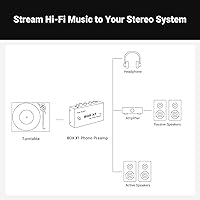
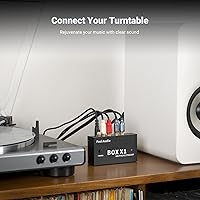
Yes, as long as you set your turntable to phono output mode rather than line output mode — most decks with a built-in preamp have a switch for this. Once set to phono mode, connect the RCA cables and ground wire to this unit, then run a second RCA cable from the unit to your speakers or receiver. It is a straightforward connection.

No. This unit is designed exclusively for moving-magnet cartridges. Moving-coil cartridges output a much weaker signal that requires a different type of gain stage. If you use an MC cartridge, you would need either a dedicated MC phono preamp or a step-up transformer placed before this unit, neither of which is ideal or recommended here.

For casual listening with standard easy-to-drive headphones in the 32 to 80 ohm range, the 3.5mm output works reasonably well. However, if your headphones are high-impedance — say, 150 ohms or above — or if they are planar magnetic drivers, the output will likely feel underpowered and dynamically flat. For serious headphone listening, a dedicated headphone amplifier after the RCA output is a better approach.

If you hear a persistent low-frequency hum through your speakers when the turntable is connected and running, that is almost always a grounding issue. Most turntables come with a thin green or bare wire attached near the tonearm base — connect that wire to the grounding post on the back of this unit and tighten the screw. The hum should disappear immediately or reduce significantly.

No. This is a preamplifier, not a power amplifier. It raises the turntable signal to line level, but it does not have the power to drive passive speakers on its own. You will need either powered speakers with a built-in amplifier or a separate stereo amplifier between this unit and your passive speakers.

Yes, both outputs are active simultaneously. You can have your powered speakers connected via RCA while also plugging headphones into the 3.5mm jack, and both will play at the same time. There is no switch to toggle between them, which is either a convenience or a limitation depending on how you prefer to use it.

A phono preamp does two things a standard preamp does not: it amplifies the very weak signal from a turntable cartridge up to line level, and it applies RIAA equalization — a specific frequency correction curve that reverses the way audio is encoded onto vinyl records. Without this equalization, records sound thin and harsh. A standard line-level preamp skips both of those steps, which is why you cannot simply use any preamp with a turntable.

The included 12V adapter is generally well-regarded and sufficient for most users. Several buyers specifically note that it is quieter than the cheap switching supplies bundled with competing products. Unless you are in a country where the plug type or voltage standard is incompatible, stick with the included adapter before spending money on an aftermarket unit.

It really depends on the quality of your receiver's internal stage, which varies widely. Budget receivers often include minimal phono circuits that perform similarly to or worse than this external unit. Mid-range and higher-end receivers frequently include better built-in stages that may outperform a small external preamp. If your receiver has a phono input and sounds good to you, try that first before adding an external unit.

Where to Buy