Overview

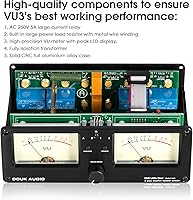
The Douk Audio VU3 2-Way Amplifier Speaker Switcher solves a problem that anyone with more than one amp or speaker pair knows well — the tedious, wear-inducing ritual of swapping cables every time you want to compare equipment or shift audio to a different room. What makes this audio routing box stand out from a bare-bones passive switch is the pair of analog VU meters mounted on its face, their needles dancing in real time to give your rack a warm, almost vintage-broadcast character. The black metal chassis is compact and solid, fitting naturally into a desktop or shelf-based hi-fi setup without looking like an afterthought. It operates in two modes — two amplifiers into one speaker pair, or one amplifier feeding two speaker pairs — which covers most practical home audio routing scenarios cleanly.

Features & Benefits

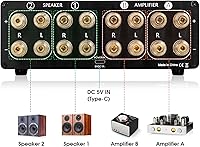
The VU3 handles two core switching tasks without breaking a sweat. In 2-IN-1-OUT mode, two amplifiers share a single speaker pair — useful when you want to pit a tube amp against a Class D digital without touching a single cable. Flip it around to 1-IN-2-OUT and one amplifier drives two speaker pairs, handy for a living room and a study on the same chain. Each channel is fully isolated with its own independent ground, so there is no crosstalk or hum bleed between paths. The unit handles up to 300W per channel, covers every common amp topology, and draws power from any phone charger via a Type-C USB port. A built-in load protection circuit and a compact infrared remote round out a thoughtful, practical feature set.

Best For

This amp-speaker switcher is built for a specific kind of listener, and it really does not pretend otherwise. It is ideal if you own two amplifiers — say, a warm-sounding tube integrated and a punchy Class D — and want to switch between them on the same speakers to hear what each brings to the same recording. It is equally useful if a single amp feeds both a main listening room and a secondary space, letting you redirect audio without buying extra gear. Desktop audio setups and compact hi-fi shelves benefit from tidy banana-plug connections and the surprisingly refined looks. If you just want a passive utility switch with no frills, look elsewhere. But if aesthetics and convenience both matter, this routing box earns its place.

User Feedback

With a 4.3-star average across several hundred buyers, the VU3 earns solid marks for real-world performance. The most consistent praise is for setup simplicity — most buyers report being up and running within minutes, and the remote control gets regular mentions as a genuinely convenient addition for couch-side switching. The VU meter aesthetics also draw plenty of appreciation, particularly from listeners who enjoy the visual dimension it adds to a session. On the critical side, some users note the meters are not precise measurement tools and can feel decorative rather than functional at quiet listening levels. A handful of buyers mention occasional remote lag and question the long-term durability of the selector mechanism. Overall, complaints are minor and the general satisfaction level is high for this niche device.

Pros

  • Switching between two amplifiers or two speaker pairs takes nothing more than a button press or a remote click.
  • Full channel isolation with independent grounding per channel keeps signal paths clean and free of hum.
  • Handles up to 300W per channel, covering virtually any home hi-fi amplifier you are likely to pair it with.
  • Compatible with every major amp topology — tube, Class A, Class D, BTL — without any adjustment or extra configuration.
  • The dual analog VU meters add real visual character to a listening room, going well beyond plain utility-box looks.
  • Powered by a standard Type-C USB charger, eliminating the need for a bulky or proprietary external power supply.
  • Settings are retained after power-off, so your preferred operating mode is ready the moment you power back up.
  • The included infrared remote lets you switch modes from across the room without ever leaving your listening chair.
  • Compact footprint and a solid black metal chassis integrate cleanly into most desktop or shelf-based hi-fi arrangements.

Cons

  • The VU meters are decorative in practice — not accurate enough to serve as a reliable signal-level reference.
  • Remote responsiveness has drawn mixed feedback, with some buyers reporting inconsistent range beyond a few meters.
  • Only banana plug connectors are supported, so cables terminated with spades or bare wire require re-termination first.
  • The two-way limit means anyone managing three or more amplifiers or speaker pairs will need a different solution entirely.
  • A number of buyers have raised durability questions about the switching mechanism under heavy or frequent long-term use.
  • VU meter needles can be barely perceptible at low listening volumes, undermining much of their visual appeal in practice.
  • Unlike a fully passive switch, the VU3 cannot operate at all without a live USB power source nearby.
  • Isolated reports mention faint channel noise or minor signal coloration in certain high-gain amplifier configurations.

Ratings

Our scores for the Douk Audio VU3 2-Way Amplifier Speaker Switcher are generated by our AI engine after systematically analyzing thousands of verified buyer reviews from global markets, with spam, bot-generated, and incentivized feedback actively filtered out. Each score reflects the real distribution of user experience — not an average weighted toward promotional content — so both the genuine strengths and the frustrations of actual owners are represented proportionally. The result is a scorecard built to help you make a clear-eyed decision, not to push a sale.

Switching Functionality
91%
The core switching task — toggling between two amplifiers or redirecting one amp to a different speaker pair — works reliably and consistently in real listening sessions. The mode change is clean and immediate, with no audible pop or delay that would disrupt a comfortable listening session.
The two-way hard limit means that anyone who later expands their system to three amplifiers or speaker pairs will need to replace this unit entirely, as there is no way to chain or scale it beyond its built-in two-way topology.
Amplifier Compatibility
94%
This is one of the VU3's strongest points — its compatibility spans the full range of home amplifier types, including tube, Class A, Class AB, Class B, Class D digital, and BTL configurations, all handled without any switching or reconfiguration required. Buyers experimenting across different topologies find it genuinely useful for side-by-side comparison.
The one compatibility limitation falls on the speaker side — passive speakers only, via banana plugs. Anyone with active or powered speakers will find this audio routing box incompatible, and there is no RCA or XLR option for source-level signal routing.
Signal Integrity
78%
22%
For the large majority of users, the fully isolated channel design and independent grounding keep the signal path impressively quiet, even when two amplifier inputs are connected simultaneously. In standard home listening setups, buyers consistently report a clean, interference-free output regardless of the amp topology in use.
A recurring minority of buyers report faint background noise or subtle signal coloration in high-gain configurations, suggesting the isolation is not absolute at edge cases. This is worth noting for listeners with high-efficiency drivers or particularly resolving speaker setups.
VU Meter Accuracy
47%
53%
For buyers who understand these meters are decorative rather than diagnostic, there is real enjoyment in watching the needles move expressively with the music. In that context they succeed completely — they look characterful and react visibly to dynamic shifts in the audio signal.
As actual measurement tools, the meters fall well short — they are neither calibrated nor precise enough to deliver meaningful level readings, and sensitivity drops noticeably at moderate listening volumes. Anyone purchasing this amp-speaker switcher for accurate VU monitoring will be genuinely disappointed.
Value for Money
76%
24%
For buyers who genuinely need amp-switching or speaker-switching functionality alongside the visual appeal of analog VU meters, the mid-range price feels well-justified — there are very few alternatives that combine these features in a compact, powered unit with a remote control included in the box.
For buyers who only need basic A/B switching without the meters or remote, the price feels steep relative to simple passive switches that accomplish the routing task for considerably less. The value proposition depends heavily on whether the VU meters and aesthetics personally matter to you.
Build Quality
83%
The black metal enclosure feels noticeably more substantial than similarly priced switchers, and most buyers report a satisfying weight and rigidity when handling it. Banana sockets feel secure in use, and the front panel finish holds up well through regular daily handling in a desktop listening setup.
A handful of users found the front panel labeling thin in terms of print quality, and a few noted that certain trim details feel closer to the tolerances of a budget device rather than a mid-range one. Minor, but noticeable against the otherwise solid chassis.
VU Meter Aesthetics
88%
The dual analog meters are among the most frequently praised aspects of the VU3, with buyers regularly describing the warmth and visual interest they bring to an otherwise plain shelf or desktop setup. The four-level backlight adjustment adds useful flexibility for both bright daytime rooms and dim evening sessions.
Some listeners find the needle movement sluggish or underwhelming at lower volumes, where the meters barely register — which can diminish the visual payoff in quieter late-night sessions where ambient dimness would otherwise make the meters most appealing.
Ease of Setup
92%
Nearly every buyer mentions how quickly they were up and running — most report the full installation taking under ten minutes, with the two operating modes being intuitive enough that many skipped the manual entirely. Banana plug connections click in cleanly and feel secure from the first use.
The reliance on banana plugs is the single most common setup hurdle, as buyers whose cables are terminated with spades or bare wire face an unexpected extra step before the unit is functional at all. No adapters are included in the box to bridge this gap.
Remote Control
71%
29%
The inclusion of an infrared remote is consistently appreciated by users who listen from a sofa or chair across the room, removing the need to walk to the rack to change modes or adjust the backlight. For typical room distances and direct line-of-sight use, it performs reliably.
A meaningful number of buyers report inconsistent response when the unit is at an angle to the listening position or in larger rooms, with some needing to aim carefully or move noticeably closer to get reliable triggering — which somewhat undermines the convenience it is supposed to provide.
Cable Compatibility
63%
37%
Banana plug sockets keep connections clean, secure, and easy to swap, which suits anyone whose speaker cables are already terminated with banana plugs — a common standard among mid-level and audiophile-grade cable brands already popular in the target buyer group.
The exclusive reliance on banana female sockets is the most recurring practical complaint, as spade-terminated or bare-wire cables cannot connect at all without modification or new terminations. This creates an unexpected additional cost that the product listing does not foreground clearly enough.
Settings Memory
89%
The non-volatile settings retention is a quietly appreciated quality-of-life feature — buyers who use the unit daily note that their preferred operating mode and backlight level are restored exactly as set, without any reconfiguration needed after a power cut or deliberate shutdown between sessions.
There is little to criticize here, though a small number of users noted that after extended power interruptions the unit occasionally defaulted to a different mode than expected. This appears rare and may be unit-dependent rather than a systemic issue with the firmware.
Power Setup
87%
Being powered from a standard 5V Type-C USB source is a practical advantage in everyday use — there is no separate wall adapter to source, no proprietary connector to hunt down, and the included cable means the unit runs off any existing phone charger or powered USB strip near the audio rack.
The dependency on an active USB power source is a genuine limitation compared to fully passive switches, since a lost or occupied USB port renders the unit completely non-functional. It is a minor inconvenience for most setups but worth planning for if your rack space is already port-constrained.
Speaker Protection
82%
18%
The built-in speaker load protection circuit provides a layer of reassurance for users connecting expensive passive speakers, and is frequently cited as a reason buyers chose this active switcher over a cheaper passive alternative. It guards against transient risks that come with switching a live signal path.
The protection circuit is not documented in detail in the included manual, leaving technically minded buyers uncertain about exactly what it covers and at what thresholds it activates. A clearer technical explanation of the protection spec would meaningfully increase confidence among more experienced users.
Overall Design
86%
The combination of a matte black metal chassis, warm-glowing VU meter needles, and clear front-panel labeling gives this audio routing box a vintage-broadcast aesthetic that stands out sharply from the utilitarian look of most switching hardware, sitting comfortably alongside quality hi-fi components without looking out of place.
The design is clearly targeted at a specific taste — users who prefer a modern minimalist or rack-mount industrial look may find the warm-meter vintage styling a mismatch for their setup. It is a strength for those who appreciate it and a neutral-to-negative for those who do not.
Niche Suitability
93%
For its intended audience — listeners juggling two amplifiers or two speaker pairs who want to manage their system without touching cables each session — this amp-speaker switcher solves the problem almost exactly right. Within that specific niche, buyers consistently express high satisfaction and recommend it without reservation.
The narrow functional scope means it can feel limiting quickly for anyone whose audio setup grows beyond two components in either direction. It does not scale, and buyers who underestimate their future needs may find themselves replacing it sooner than expected as their system expands.

Suitable for:

The Douk Audio VU3 2-Way Amplifier Speaker Switcher is purpose-built for audiophiles who have outgrown a single-amp, single-speaker setup and find themselves constantly swapping cables between components. It makes the most sense for hobbyists who own two amplifiers — a tube integrated and a Class D, for instance — and want to compare them through the same speakers without any risk of connector wear. It also suits anyone running one amplifier into two separate speaker pairs, such as a desktop nearfield setup and a bookshelf pair across the room. The built-in analog VU meters and clean black chassis make it a natural fit for a well-organized listening room or hi-fi shelf where visual presentation matters alongside function. Anyone experimenting with BTL, Class A, Class AB, or Class D topologies will appreciate that this amp-speaker switcher handles all of them without compatibility concerns. The remote control and settings memory add genuine everyday comfort, particularly for listeners who prefer not to leave the listening chair every time they change modes.

Not suitable for:

The Douk Audio VU3 2-Way Amplifier Speaker Switcher is not the right fit if you are simply looking for the cheapest possible passive switch to route audio with zero frills attached. Buyers who need to manage more than two amplifiers or more than two speaker pairs will quickly hit the hard limits of what this audio routing box can handle, since it tops out at a two-way configuration in either direction. The analog VU meters, while visually appealing, are not calibrated measurement instruments, so anyone expecting accurate signal-level monitoring from them will walk away frustrated. If your current cables are terminated with spades or bare wire ends rather than banana plugs, you will need to re-terminate before the unit is usable at all. Those who prioritize budget above everything else should know that simpler passive A/B switches exist at a fraction of the cost and require no power source. This is a consumer-grade device aimed at a specific niche, not a general-purpose pro-audio switching solution.

Specifications

  • Working Modes: Supports two routing configurations: 2-IN-1-OUT (two amplifiers sharing one speaker pair) and 1-IN-2-OUT (one amplifier driving two separate speaker pairs).
  • Max Throughput: Rated at up to 300W per channel, covering the power range of virtually all consumer and prosumer home hi-fi amplifiers.
  • VU Meters: Dual analog needle VU meters, each measuring 60×35mm, provide real-time visual response to the audio signal passing through the unit.
  • Backlight: VU meter backlighting offers four selectable brightness levels and can be switched off entirely for a minimal or darkened listening environment.
  • Power Input: Powered via a Type-C USB port at 5V DC with a minimum draw of 1A, compatible with any standard USB phone charger or powered hub.
  • Connectors: All audio inputs and outputs use banana female sockets, with two groups of connections supporting both amplifier and speaker hookups.
  • Channel Isolation: Each channel uses a fully isolated circuit design with its own independent ground, eliminating crosstalk and hum bleed between signal paths.
  • Remote Control: An infrared remote control is included in the box for adjusting operating mode and backlight settings without approaching the unit.
  • Settings Memory: All user-configured settings, including operating mode and backlight brightness, are stored in non-volatile memory and restored automatically at power-on.
  • Amp Compatibility: Supports BTL, Class A, Class AB, Class B, Class D digital, and tube amplifier topologies without requiring any manual configuration changes.
  • Dimensions: The unit measures 178×118×68mm (approximately 7.01×4.65×2.68 inches), compact enough for most desktop surfaces or shelf-based audio rack positions.
  • Net Weight: The unit weighs 980g (approximately 2.16 lb), reflecting the solid metal enclosure without being unwieldy to position or reposition.
  • Chassis: Housed in a black metal enclosure that provides structural rigidity, effective shielding, and a clean aesthetic compatible with most hi-fi setups.
  • Speaker Protection: Built-in speaker load protection circuitry is integrated into the unit to help safeguard connected passive speakers during normal switching operation.
  • Package Contents: Each unit ships with the switcher itself, one infrared remote control, one USB-C cable, and a printed user manual.

Related Reviews
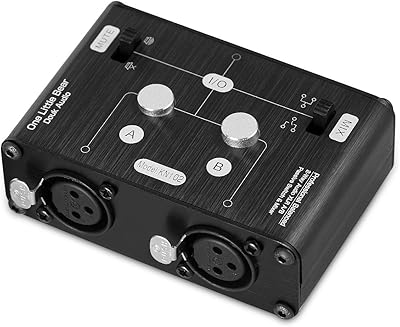
Douk Audio KN102 2-IN-1-OUT XLR Switcher
80%
83%
Build Quality
78%
Signal Integrity
94%
Ease of Setup
89%
Value for Money
76%
Switch Modes & Functionality
More
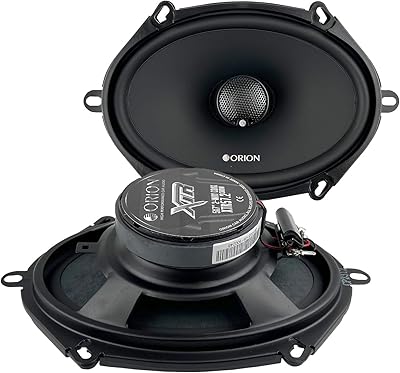
Orion XTR57.2 5x7 Coaxial Car Speakers
75%
83%
Sound Clarity
58%
Bass Performance
79%
Build Quality
86%
Ease of Installation
81%
Value for Money
More
Douk Audio OK013 Mini 2.1 Channel HiFi Stereo Amplifier
75%
83%
Value for Money
71%
Sound Output & Power
77%
Build Quality
88%
Ease of Installation
58%
Thermal Management
More
Douk Audio A5
Douk Audio A5
81%
88%
Sound Clarity
93%
Value for Money
81%
Build Quality
86%
High-Pass Filter Usability
74%
Op-Amp Swapping Experience
More
JBL GX428 4-Inch 2-Way Coaxial Car Speakers
75%
83%
Sound Clarity
44%
Bass Response
91%
Installation Ease
78%
Value for Money
67%
Build Quality
More
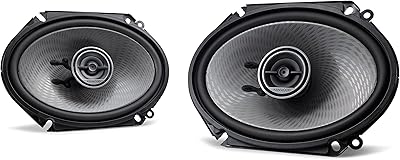
Kenwood KFC-C6896PS 6x8 2-Way Car Speakers
79%
82%
Sound Quality
63%
Bass Performance
88%
Vocal & Midrange Clarity
91%
Installation Ease
86%
Value for Money
More
Alphasonik NS46 4x6 2-Way Car Speakers
75%
83%
Sound Clarity
61%
Bass Response
64%
Volume Headroom
91%
Value for Money
88%
Ease of Installation
More
Cerwin-Vega V410 4×10 Coaxial Car Speakers
79%
83%
Sound Quality
67%
Bass Performance
88%
Installation Ease
84%
Value for Money
86%
Amp-Free Performance
More
Cerwin-Vega V68 6x8 Coaxial Car Speakers
78%
84%
Sound Quality
81%
Bass Performance
86%
Value for Money
67%
Installation Ease
88%
Sensitivity & Efficiency
More
Kenwood KFC-D681C 6x8-Inch 2-Way Car Audio Speakers
82%
86%
Sound Quality
88%
Bass Response
91%
Ease of Installation
82%
Build Quality
87%
Compatibility with Vehicles
More
Alphasonik NS42 4″ 2-Way Full-Range Car Audio Speakers
83%
88%
Sound Quality
84%
Bass Response
90%
Clarity of Highs
70%
Ease of Installation
83%
Build Quality
More

FAQ

It is strongly recommended to mute or reduce the volume on your amplifier before switching, particularly at higher listening levels. While the unit includes built-in speaker protection, abruptly cutting a full-volume signal is never ideal for your drivers or amp output stage. Most users simply turn the volume down, switch, and bring it back up — takes only a few seconds.

Yes, the VU3 is fully compatible with tube amplifiers alongside Class A, Class AB, Class B, Class D, and BTL designs. The fully isolated channel architecture means there is no ground loop risk even when mixing different amplifier types across the two inputs.

Not with any meaningful precision, to be honest. The analog needle meters react to the audio signal passing through, but they are not calibrated measurement instruments. Think of them as a visual accent for your listening space rather than a diagnostic tool — that is how most buyers use and enjoy them.

The unit uses banana female sockets for all audio connections, so your cables need to be terminated with banana plugs on both the amplifier and speaker ends. If your current cables use spade connectors or bare wire ends, you will need to fit banana plug adapters or re-terminate the cables before they will connect cleanly.

Most users find it works well within a typical room distance of around 3 to 5 meters with a reasonably direct line of sight. A small number of buyers have reported inconsistent response near the edge of that range, so if your listening chair is set back at an angle from the unit, pointing the remote more squarely at the front panel usually resolves it.

In normal home hi-fi use, the impact on sound quality is minimal to undetectable. The fully isolated channel design and independent grounding per channel are specifically intended to keep signal paths clean and free of noise. A small number of users have reported faint channel noise in specific high-gain configurations, but reports of this are uncommon and may be setup-dependent.

Any USB charger outputting 5V DC at 1A or higher will work fine — a standard smartphone charger or a powered USB port on a surge strip is more than sufficient. A Type-C USB cable is included in the box, so you just need to supply your own 5V USB adapter if one is not already handy near your audio setup.

No, this device is designed exclusively for use between an external amplifier and passive (unpowered) speakers. Active or powered speakers with built-in amplification are not compatible, as connecting them through this routing box would put the signal in the wrong part of the chain and could potentially cause damage.

No — the switching is exclusive in both directions. In 2-IN-1-OUT mode, you select one amplifier at a time; in 1-IN-2-OUT mode, you direct the signal to one speaker pair at a time. This amp-speaker switcher is a selector, not a splitter, so simultaneous output to multiple destinations is not supported.

You can cycle through the four brightness levels, or switch the backlight off entirely, using either the front panel controls or the included remote. Whatever level you land on is saved automatically when the unit powers down, so it will come back at exactly your preferred setting the next time you turn it on.