
Overview

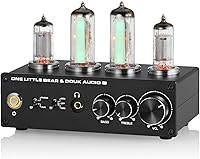
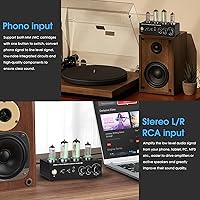
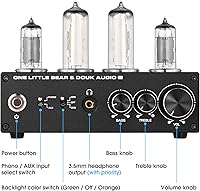
The Douk Audio T9 Tube Phono Preamp sits in an interesting spot in the market — mid-range pricing, but with a look and feature set that punches noticeably above it. It pairs a proper phono stage with a built-in headphone amplifier inside a compact all-metal chassis, which is genuinely useful rather than just a spec-sheet bonus. The 6E2 magic eye tubes glow front and center, giving the unit a visual identity that most preamps at this price simply don't have. MM and MC cartridge support, plus an auxiliary RCA input, means it works with a wider range of setups than many rivals. A solid starting point for anyone exploring tube audio.

Features & Benefits

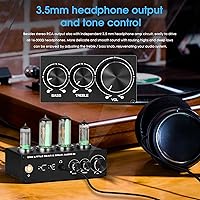
What sets the T9 apart from a basic phono stage is the combination of features packed into one unit. The RIAA-equalized phono stage handles both MM and MC cartridges accurately, while the dedicated headphone amplifier delivers real output power — up to 250mW at 32 ohms — not just a passive tap. Treble and bass controls (±10dB each) let you shape the sound to your liking, which is rare at this level. Perhaps the most intriguing feature for enthusiasts is the swappable tube sockets, which accept compatible types like the 6K4 or 6BA6. That means you can gradually experiment with different tubes to shift the sound character without buying an entirely new unit.

Best For

This phono stage makes the most sense for vinyl listeners taking their first steps into tube audio — people who want the sonic warmth tubes can offer without committing to a high-end dedicated unit. It is equally well-suited to anyone running both MM and MC cartridges who needs a single flexible device instead of two. Private late-night listening is another strong use case: the headphone output with tone control makes it genuinely practical for desktop or bedroom setups. Audiophile purists chasing the absolute lowest noise floor may eventually outgrow it, but for someone building a compact hi-fi system around a turntable, the T9 covers a lot of ground in one tidy box.

User Feedback

Across its reviews, the phono stage earns consistent praise for build quality and aesthetics — buyers frequently mention the solid feel of the chassis and how the glowing tubes look in a real listening space. Sound-wise, most describe an appreciable warmth without obvious coloration, and the headphone output gets positive remarks for driving mid-impedance headphones cleanly. On the downside, a handful of users report a faint hum, particularly with high-sensitivity headphones, and a few note the included manual could be clearer for first-time tube preamp owners. Background noise is the most common technical complaint. With 62 ratings averaging 4.6 stars, the consensus is genuinely positive, though the modest sample size means edge cases may not yet be fully represented.

Pros

  • Supports both MM and MC cartridges in one unit, eliminating the need for separate preamps.
  • The built-in headphone amplifier drives headphones from 16 to 300 ohms with real authority.
  • Tone controls with a ±10dB range let you meaningfully shape the sound to your system and taste.
  • Swappable tube sockets allow sound customization through tube rolling without buying a new unit.
  • The all-metal CNC aluminum chassis feels and looks more expensive than the price suggests.
  • Glowing 6E2 magic eye tubes with switchable backlight color make this a genuinely attractive desk piece.
  • Plug-and-play setup means most users are listening within minutes of unboxing.
  • SNR of 106dB on the line input delivers a clean, quiet background in typical home setups.
  • The auxiliary RCA input lets you connect non-turntable sources like a phone or media player.
  • Strong value proposition given the combination of features packed into one compact unit.

Cons

  • A faint hum is a recurring complaint from users running high-sensitivity headphones or in-ear monitors.
  • The MC input impedance is fixed, which may not suit low-impedance or very low-output MC cartridges.
  • The included manual is thin and offers little practical guidance for first-time tube preamp users.
  • Magic eye tubes dim over time and will eventually need sourcing and replacing.
  • The volume pot lacks a center detent on tone controls, making it hard to return to flat by feel.
  • No long-term reliability data exists yet, given the unit only launched in late 2023.
  • Background hiss on the phono input becomes noticeable when paired with high-gain amplifiers.
  • Output power drops at 300 ohms, leaving some users short of a satisfying listening level.
  • Sourcing compatible NOS replacement tubes can be confusing without better documentation.
  • Rear panel labeling is small and difficult to read clearly in low-light listening environments.

Ratings

The Douk Audio T9 Tube Phono Preamp scores below are generated by AI after systematically analyzing verified buyer reviews from global markets, with spam, bot-generated, and incentivized feedback actively filtered out. The result is an honest, balanced picture of where this tube phono stage genuinely delivers and where real users have run into friction. Both standout strengths and recurring pain points are reflected transparently in every category.

Sound Quality
83%
Most buyers describe a noticeably warm, full-bodied character that makes vinyl feel more engaging than a typical solid-state preamp at the same price. Listeners playing jazz, blues, and classic rock especially appreciate the natural midrange presence during long evening sessions.
A small but consistent group notes that the warmth can tip into slight softness at the top end, and detail retrieval with analytical headphones or speakers occasionally feels slightly rounded compared to dedicated audiophile-grade stages.
Phono Stage Accuracy
78%
22%
The RIAA equalization handles both MM and MC cartridges with respectable accuracy, and users with a variety of turntable setups report clean, well-balanced playback without obvious frequency tilt. MC support at this price point is a genuine plus that buyers consistently call out.
The phono output level is modest, and a handful of users with low-output MC cartridges note they have to push their amplifier gain higher than expected. The ±2dB RIAA tolerance, while acceptable, does not satisfy the most demanding listeners comparing it to pricier dedicated phono stages.
Headphone Amplifier Performance
76%
24%
The independent headphone circuit drives mid-impedance headphones — around 60 to 150 ohms — with solid authority, and users listening to records privately at night frequently praise the clean, controlled output at moderate volumes. The tone controls add real practical value in this context.
With high-sensitivity in-ear monitors or very efficient headphones, a faint background hum is the most commonly reported issue. At 300 ohms, output power drops and a few users feel the stage runs out of headroom before reaching a satisfying listening level.
Build Quality
88%
The CNC aluminum chassis feels reassuringly solid for the price tier, and buyers regularly remark that it looks and feels more expensive than expected when it arrives. The knurled knobs turn smoothly with good resistance, and the gold-plated jacks fit cables snugly without wobble.
The rear panel labeling on some units has been reported as slightly small and hard to read in low light, and while the overall fit is good, a few users noticed minor channel imbalance at very low volume positions on the pot — a classic budget-component limitation.
Tube Rolling Flexibility
81%
19%
The ability to swap in compatible tube types like the 6K4 or 6BA6 is a meaningful differentiator that experienced buyers genuinely use, not just a marketing bullet. Forum users report that swapping tubes noticeably shifts the sound character, extending the useful life of the unit well beyond the stock configuration.
First-time tube owners sometimes find sourcing compatible NOS tubes confusing, and the manual offers limited guidance on safe alternatives. The stock tubes are functional but modest, meaning the unit arguably sounds best only after the user invests in better glass.
Magic Eye Display
86%
The dual 6E2 magic eye tubes are a genuine visual highlight — buyers consistently describe how the glowing indicators look in a darkened listening room, and the switchable green or orange backlight adds a personalization element that makes the unit stand out on a shelf or desk.
A few long-term owners report that the magic eye indicators can dim noticeably after extended use, which is a known characteristic of 6E2 tubes. Replacement tubes are available but add a small ongoing maintenance cost that buyers should factor in.
Noise Floor
67%
33%
In typical home hi-fi setups with standard sensitivity speakers and headphones, the noise floor is perfectly acceptable and most users report quiet, clean background during quiet passages. The SNR spec of 106dB on the line input is genuinely strong and audibly confirmed by satisfied buyers.
The phono input noise floor at 80dB SNR is the weaker link, and users with high-gain amplifiers or sensitive headphones are more likely to notice hiss. This is the single most common technical complaint across verified reviews and limits the unit in demanding low-noise setups.
Tone Controls
82%
18%
The ±10dB treble and bass adjustment range is wider than typical, and buyers find real-world use for it when compensating for bright speakers or a lean-sounding turntable setup. The controls are smooth and interactive enough that users actually engage with them rather than leaving them flat.
The controls lack center detents on some units, making it harder to return precisely to flat by feel alone. Purists who prefer a zero-coloration signal path also note that the tone circuit introduces a subtle character even when nominally centered.
MM/MC Versatility
84%
Supporting both MM and MC cartridges via a single unit is a practical convenience that buyers upgrading from a basic MM-only stage specifically seek out. Users who rotate between multiple turntables or cartridge types praise not having to swap preamps or use adapters.
The MC input impedance is fixed at 330 ohms, which suits many popular MC cartridges but not all. Buyers with low-impedance or very low-output MC cartridges may find the loading non-optimal and gain insufficient without an additional step-up transformer.
Setup & Ease of Use
89%
The plug-and-play nature of the unit is repeatedly praised by buyers who had it outputting audio within minutes of unboxing. The included power supply and straightforward RCA connections mean there is essentially no learning curve for anyone who has ever connected a stereo component before.
The included manual is frequently described as thin and generic, offering little guidance on cartridge loading options or tube-rolling safety. First-time phono preamp users occasionally post confusion about input switching, suggesting a more detailed quick-start guide would help.
Value for Money
85%
Buyers consistently describe the T9 as offering more tangible hardware and features per dollar than comparable units at the same price. The combination of phono stage, headphone amp, tone controls, and visual tube display in one chassis makes it easy for reviewers to recommend without hesitation.
Users who later upgrade to dedicated separates sometimes feel the all-in-one approach introduces compromises in each individual function. At its price point the value is strong, but buyers chasing the best possible phono stage or the best possible headphone amp would get more by spending the same budget on a single-purpose unit.
Aesthetic Design
91%
Few competitors at this tier offer the same combination of glowing tubes, a quality metal enclosure, and selectable backlight color in such a compact footprint. Buyers regularly mention that the unit becomes a visual focal point of their listening setup, which adds intangible but real satisfaction.
The compact dimensions mean the unit can feel slightly crowded on the rear panel when multiple cables are connected simultaneously. Some users also note that the orange backlight, while atmospheric, can look slightly undersaturated compared to the vivid cold-green mode.
Compatibility
79%
21%
The wide headphone impedance range of 16 to 300 ohms and the dual phono and line inputs mean the T9 works with a broad range of real-world equipment. Buyers connecting it to integrated amplifiers, powered speakers, or mixing into desktop systems report consistent compatibility without level-matching issues.
The fixed RCA output level may require gain-structure attention when pairing with high-sensitivity amplifiers, and the line input at 0.775V RMS is slightly low for sources that output a full 2V line level. These are minor but occasionally cause confusion during initial setup.
Durability & Longevity
72%
28%
The all-metal chassis shows no signs of degradation in medium-term ownership reports, and the gold-plated jacks resist oxidation better than cheaper plated alternatives. Users who have owned the unit for over a year report stable performance without component drift or increasing noise.
Vacuum tubes are consumable components by nature, and the magic eye indicators in particular have a finite lifespan that some buyers underestimate. There is limited long-term ownership data given the product launched in late 2023, so longevity conclusions remain somewhat preliminary.

Suitable for:

The Douk Audio T9 Tube Phono Preamp is an excellent match for vinyl enthusiasts who are curious about tube audio but not yet ready to invest in a high-end separates setup. It works particularly well for listeners building a compact desktop or bedroom hi-fi system around a turntable, where a single unit handling phono amplification, tone shaping, and headphone output saves both space and money. Anyone who rotates between MM and MC cartridges will appreciate not needing a separate device for each, and the headphone output with tone control makes it a genuinely practical choice for late-night private listening sessions. The tube-rolling capability gives more experienced buyers room to grow — swapping in different compatible tubes over time means the unit can evolve with your tastes rather than becoming obsolete. It is also a strong pick for anyone who values the aesthetic dimension of audio gear, since the glowing magic eye tubes and selectable backlight make it a visual centerpiece as much as a functional one.

Not suitable for:

Buyers chasing absolute technical performance in either the phono stage or the headphone amplifier department will likely find the all-in-one nature of this unit a limiting factor, since combining both functions in one chassis at this price point inevitably involves trade-offs in each. Audiophiles with high-sensitivity in-ear monitors or very efficient headphones should be aware that a faint background hum has been a recurring complaint — it is not universal, but it is reported often enough to be a real consideration. Users with very low-output MC cartridges may also find the fixed 330-ohm MC loading and available gain insufficient without adding a step-up transformer, which adds cost and complexity. The Douk Audio T9 Tube Phono Preamp is equally not the right tool for anyone who needs a dead-silent, clinically neutral signal path for critical recording or mastering work — its character is warm and slightly colored by design. Finally, buyers who prefer a completely maintenance-free device should note that tubes are consumable components; the magic eye indicators in particular have a finite lifespan and will eventually need replacement.

Specifications

  • Tube Complement: The unit uses two 6E2 tubes for the magic eye signal display and two 6A2 tubes for audio amplification.
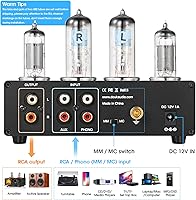
  • Phono Input: The phono stage accepts both MM cartridges (47K ohm input impedance) and MC cartridges (330 ohm input impedance) via a single switchable input.
  • Line Input: A stereo RCA auxiliary input accepts a standard line-level signal with a 100K ohm input impedance and a nominal input level of 0.775V RMS.
  • Output Connections: The unit provides a stereo RCA line output and a 3.5mm headphone jack, both active simultaneously.
  • Headphone Power: The headphone amplifier delivers 250mW at 32 ohms, 100mW at 64 ohms, and 60mW at 128 ohms.
  • Headphone Impedance: The headphone output supports headphones within a 16 to 300 ohm impedance range.
  • Line Output Level: The RCA line output provides 1.5V RMS when fed from the auxiliary input and 0.6V RMS from the phono input.
  • Signal-to-Noise Ratio: SNR measures at 106dB or greater on the line input and 80dB or greater on the phono input.
  • Frequency Response: The line input delivers 20Hz to 20kHz within ±0.5dB; the phono input follows the RIAA curve within ±2dB.
  • Total Harmonic Distortion: Total harmonic distortion is rated at 0.1% or less across the operating frequency range.
  • Tone Controls: Independent treble and bass controls each offer an adjustment range of ±10dB.
  • Backlight Options: The front-panel backlight for the magic eye tubes can be set to cold green, warm orange, or switched off entirely.
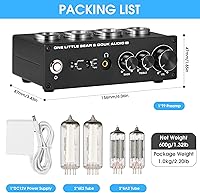
  • Power Supply: The unit operates on DC 12V at a minimum of 1A; a compatible power adapter is included in the box.
  • Chassis Material: The enclosure is constructed from CNC-machined aluminum with an all-metal build for electromagnetic shielding.
  • I/O Connectors: All RCA input and output jacks are gold-plated to minimize oxidation and signal loss at connection points.
  • Tube Socket Type: The pluggable tube sockets are compatible with alternative tube types including 6K4, EF93, 6BA6, and W727.
  • Dimensions: The unit measures 154mm wide by 87mm deep by 47mm tall (approximately 6.06″ × 3.43″ × 1.85″).
  • Net Weight: The unit weighs 600g (approximately 1.32 lb) without packaging.
  • Package Contents: Each unit ships with the preamp, a DC 12V power supply, and a user manual.
  • Availability Date: The product was first made available for purchase in November 2023.

Related Reviews
Douk Audio T4 Plus
Douk Audio T4 Plus
78%
78%
Sound Quality
81%
Phono Stage Performance
74%
Headphone Amplifier
88%
Value for Money
76%
Build Quality & Construction
More
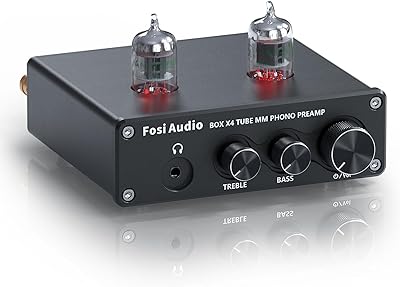
Fosi Audio BOX X4 Tube Phono Preamp
78%
81%
Sound Quality
67%
Noise Floor & Hiss
84%
Build Quality
89%
Value for Money
63%
Tube Quality (Stock)
More
Douk Audio T8 Pro Tube EQ Preamplifier
77%
91%
Value for Money
78%
Sound Quality
83%
EQ Performance
81%
Build Quality
87%
Tube Rolling Flexibility
More
Fosi Audio Box X2
Fosi Audio Box X2
87%
88%
Audio Warmth
92%
Gain Versatility
86%
Build Integrity
94%
Space Efficiency
89%
Tube Rolling Potential
More
Parks Audio Waxwing Phono DSP Preamplifier
80%
91%
MAGIC Noise Reduction Effectiveness
88%
Cartridge Compatibility & Gain Flexibility
86%
App Control & User Interface
83%
EQ Preset Library for Vintage Formats
84%
SUPER MONO Mode
More
Cambridge Audio Alva Duo Phono Preamp
82%
88%
Audio Performance
83%
Cartridge Compatibility
86%
Noise Floor & Interference Rejection
81%
Headphone Amplifier
79%
Subsonic Filter Effectiveness
More
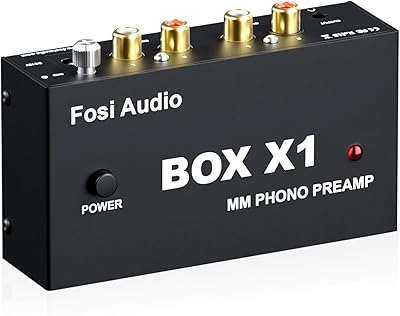
Fosi Audio Box X1 Phono Preamp
78%
83%
Noise Floor Performance
78%
RIAA Accuracy
71%
Build Quality
62%
Gain Level
68%
Headphone Output Quality
More
AMPAPA A1
AMPAPA A1
82%
88%
Sound Quality
83%
Phono Stage Accuracy
72%
Headphone Amplifier Performance
91%
Build Quality
86%
Tone Controls
More
Douk Audio P1 Vacuum Tube Preamplifier
79%
83%
Sound Quality
78%
Bluetooth Performance
81%
USB DAC Quality
61%
Headphone Amplifier Power
74%
Build Quality
More
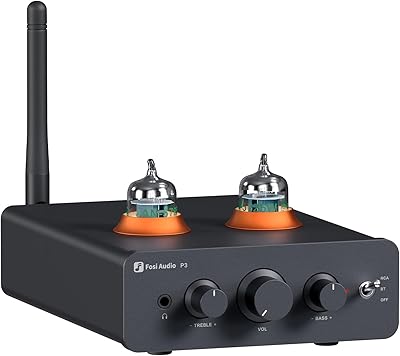
Fosi Audio P3 Tube Preamplifier
82%
83%
Sound Quality
76%
Bluetooth Performance
81%
Headphone Amplification
79%
Build Quality
71%
Noise Floor
More

FAQ

Yes, absolutely. The MM phono input is set to the standard 47K ohm loading that virtually all moving magnet cartridges — including the AT-VM95 series — are designed to work with. Just make sure you are plugging into the phono input rather than the RCA line input, and you will be good to go.

Both outputs are active simultaneously, so you can listen on headphones while your amplifier or powered speakers are also connected. There is no switch to toggle between them, which is convenient for most users but worth knowing if you were hoping to use the headphone jack as a mute for your speakers.

The DL-103 has an output of around 0.3mV, which is on the higher end of low-output MC territory. The unit should handle it, but users with very low-output MC cartridges — those below 0.1mV — occasionally find the gain insufficient without a step-up transformer. If you notice the volume is too quiet even at maximum amplifier gain, a SUT would solve the problem.

Tube rolling simply means swapping the stock tubes for different compatible types to alter the sound character. The Douk Audio T9 Tube Phono Preamp accepts several alternatives including the 6K4 and 6BA6, which are generally easy to find online. Whether it is worth it depends on you — experienced listeners do report audible differences, but if you are new to vinyl, the stock tubes are perfectly fine to start with.

This is the most commonly reported issue in user reviews, so it is worth being upfront about. With very sensitive IEMs or highly efficient headphones, some users do notice a faint hum. Over-ear headphones in the 32 to 150 ohm range tend to fare much better. If you primarily plan to use sensitive IEMs, this may be a dealbreaker worth considering before purchasing.

The RCA line input accepts any standard line-level signal, so connecting a phone, tablet, or laptop via a 3.5mm-to-RCA adapter works perfectly. It bypasses the phono stage entirely and sends the signal straight through to the outputs, which is ideal if you want to use the headphone amp and tone controls with a digital source.

6E2 magic eye tubes have a lifespan that varies depending on usage, but dimming after a few thousand hours of use is a known characteristic of the type. If you leave the unit on for several hours daily, you might notice a gradual reduction in brightness over one to two years. Replacement 6E2 tubes are available from online tube suppliers and are not expensive.

Like most tube equipment, giving it five to ten minutes after switching on before critical listening is a good habit. The tubes stabilize thermally during that period, and some users report the sound settles and opens up slightly once fully warmed. It is a minor consideration, not a major inconvenience.

If your turntable connects directly to this preamp without a built-in preamp of its own, use the phono input — that is the one labeled for MM or MC. If your turntable already has a built-in preamp, or if you are connecting any other audio source like a phone or CD player, use the RCA line input instead. Running a pre-amplified turntable signal into the phono input will result in a loud, distorted output.

Ideally the tone circuit should be transparent at the center position, but a small number of users have noted a very subtle character even when the controls are nominally flat. This is not unusual for passive tone circuits at this price level. If you prefer a completely uncolored signal path, leaving both controls as close to center as possible is the best approach, but true purists may prefer a preamp without tone controls altogether.