Overview

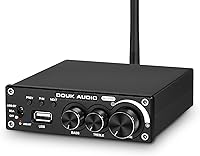
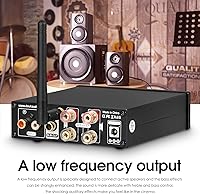
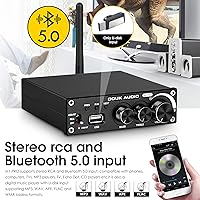
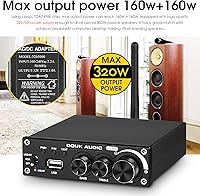
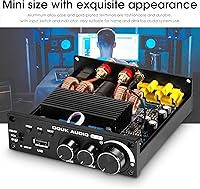
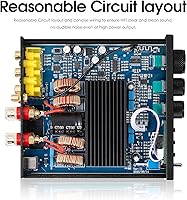
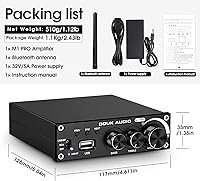
The Douk Audio M1 PRO is a compact stereo power amplifier that punches well above its price in the budget HiFi segment. Built around the TDA7498E class-D chip, it delivers up to 160W per channel into a 4Ω load — though the advertised 320W figure refers to peak combined output, not continuous RMS, so keep expectations calibrated. This desktop stereo amp handles Bluetooth 5.0, stereo RCA, and USB flash drive input all in one small box measuring roughly 118 x 117 x 35mm. The aluminum alloy chassis and gold-plated speaker terminals give it a look that feels more expensive than it is. A dedicated low-frequency RCA output rounds out the package, making a 2.1-channel setup straightforward.

Features & Benefits

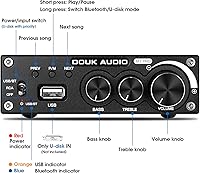
The one-click reset button is a small touch that makes a real difference — clearing all paired devices instantly so you can hand off listening to a new source without frustration. Bluetooth 5.0 holds a stable connection at typical room distances, and the USB input supports lossless formats including FLAC, APE, and WAV up to 32GB, so you can play a drive full of high-quality audio without a phone or computer involved at all. Basic treble and bass controls let you nudge the sound to suit your speakers, and with an SNR of 98dB and THD of 0.04%, the measured performance is genuinely clean for the price. Speaker impedance support from 2 to 8Ω adds further flexibility.

Best For

This compact amp is well suited to desktop or bookshelf speaker setups where cabinet space is at a premium. It makes a strong case as a first proper HiFi amplifier for someone stepping up from a soundbar or all-in-one system, offering enough inputs to cover both wired and wireless sources without extra hardware. The subwoofer output is a genuine bonus — you can build a 2.1-channel setup without buying a separate crossover box. That said, it is sized for smaller listening rooms and personal workspaces rather than large living areas; expecting it to fill a big room at high volumes with demanding speakers would be asking too much of it.

User Feedback

Owners consistently highlight sound clarity and build quality — the aluminum shell and quality terminals tend to surprise buyers who expected something cheaper-feeling at this tier. Bluetooth stability draws mixed but mostly positive comments, particularly on units running the newer firmware. On the less flattering side, some users notice a slight channel imbalance at the very bottom of the volume range, a known quirk of many budget amplifiers at low settings. The unit also runs noticeably warm during long high-volume sessions; that is normal for a class-D amp working hard, but worth keeping ventilation in mind. Overall, feedback reflects a product that consistently over-delivers relative to what it costs.

Pros

  • Clean, low-noise audio output with a measured THD of 0.04% — impressive for a budget-tier amplifier.
  • Aluminum alloy chassis and gold-plated terminals feel substantially more premium than the price suggests.
  • Built-in USB lossless playback supports FLAC, APE, and WAV without needing a phone or computer connected.
  • Bluetooth 5.0 pairs quickly, and the one-click device reset makes switching sources genuinely painless.
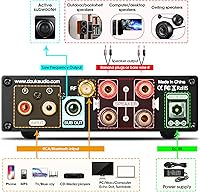
  • Dedicated subwoofer RCA output lets you build a 2.1-channel system with no extra crossover hardware needed.
  • Wide 2–8Ω impedance support means this compact amp works with most passive speakers buyers already own.
  • The included 32V power supply removes one common budget-amp frustration — you are ready to go out of the box.
  • Compact 118 x 117 x 35mm footprint fits easily on a crowded desk or tight shelf without dominating the space.
  • Onboard treble and bass controls let you adjust the sound to your room without adding an external equalizer.

Cons

  • The 320W headline figure is peak combined power, not continuous RMS — real sustained output is meaningfully lower.
  • Channel imbalance at very low volume settings affects late-night or quiet-environment listening noticeably.
  • No 3.5mm AUX input is a frustrating omission for users with portable devices or older computers.
  • Bluetooth range struggles with walls or obstacles between the source and the amp, limiting multi-room use.
  • The USB player maxes out at 32GB capacity with no on-screen track display, making large library navigation awkward.
  • Bass and treble controls lack a center detent, so returning to a flat response setting requires guesswork.
  • The unit runs hot during extended high-volume sessions and has no active cooling, requiring clear ventilation space.
  • The included manual is poorly translated and leaves basic operational questions unanswered for new users.

Ratings

The Douk Audio M1 PRO has been scored by our AI system after analyzing verified buyer reviews from global markets, with spam, incentivized, and bot-generated feedback actively filtered out. The ratings below reflect a balanced picture — real strengths and genuine frustrations included — to help you make a confident, informed decision.

Sound Clarity
83%
For a class-D amp at this price, the TDA7498E chip produces a noticeably clean signal — background noise stays buried and instruments have decent separation during casual listening sessions at a desk or in a small bedroom setup.
At higher volumes pushing demanding 4Ω speakers, some users detect a slight hardness in the upper midrange. It is capable and clean for its tier, but it will not satisfy listeners used to higher-grade separates.
Power Output
78%
22%
160W per channel into 4Ω is more than enough headroom for bookshelf and desktop speakers in a typical home office or small living room — most users never need to push it past half volume to fill the space comfortably.
The headline 320W figure trips up a lot of buyers; it is peak combined power, not continuous RMS. Real-world sustained output is lower, and pairing this compact amp with large floor-standing speakers in a big room will expose that ceiling quickly.
Build Quality
86%
The aluminum alloy shell and gold-plated banana terminals consistently impress buyers who expect plastic-heavy construction at this price point. It feels dense and solid on a desk, and the finish holds up well after months of daily use.
The front-panel controls have a slightly loose feel under the fingers, and the indicator LEDs are basic. Nothing feels fragile, but close inspection reveals the fit-and-finish gap between this and mid-range competition.
Bluetooth Performance
71%
29%
Bluetooth 5.0 locks onto a phone or laptop quickly, and the one-click pairing reset is a practical touch for households where multiple people swap source devices regularly. Stability across a normal-sized room is generally reliable after firmware updates.
A portion of users report occasional dropouts when walls or obstacles are between the source device and the amp. Range is adequate for single-room use but disappoints anyone expecting it to hold a signal across a larger home.
Value for Money
91%
Stacking up what this desktop stereo amp includes — lossless USB playback, subwoofer output, tone controls, and a proper power supply in the box — against its asking price makes it a difficult deal to argue with for anyone building a first HiFi setup on a tight budget.
The value case weakens slightly if you factor in the ceiling on Bluetooth range and the minor channel imbalance at low volumes. For buyers who are happy within its limits, it is strong; for those who will push it, the savings may cost more later.
USB Music Playback
82%
18%
Being able to plug in a flash drive loaded with FLAC and WAV files and press play without touching a phone or computer is a genuine quality-of-life feature — especially useful for a workshop, office, or secondary room setup where convenience matters more than app control.
The supported USB capacity tops out at 32GB, which feels limiting for users with large lossless libraries. There is no display to show track or file information, so navigation by ear and button-feel is the only option.
Subwoofer Integration
77%
23%
Having a dedicated low-frequency RCA output means building a 2.1-channel system requires no additional crossover hardware — just connect an active subwoofer directly and the M1 PRO amplifier handles the signal split automatically, which is a real convenience at this price.
The crossover point is fixed and non-adjustable, which limits how precisely you can blend the subwoofer with different main speakers. Buyers with particular bass-tuning preferences may find this a frustrating constraint.
Tone Controls
68%
32%
The onboard treble and bass knobs give enough range to compensate for a bright-sounding bookshelf speaker or a room that lacks low-end reinforcement — useful for users who do not want to add an external equalizer to a simple desktop system.
The controls are basic rotary knobs with no center-detent to easily return to flat, and the adjustment range is broad rather than surgical. Audiophiles used to parametric EQ options will find them too blunt to be genuinely useful.
Thermal Management
66%
34%
During typical listening at moderate volumes, the unit stays only mildly warm — perfectly normal for a class-D design working within its comfort zone. Most users in office or bedroom environments never encounter any heat-related issues during everyday use.
Extended high-volume sessions cause the chassis to become noticeably hot to the touch. The amp has no active cooling fan, so users running it hard in enclosed spaces or home theater racks should ensure there is clear airflow around it.
Input Versatility
84%
Having Bluetooth, stereo RCA, and USB input on one compact amp means this desktop stereo amp can serve a TV, turntable with a preamp, a computer, and a phone without requiring a separate switcher or splitter — a meaningful benefit in a cluttered desk setup.
There is no 3.5mm AUX input, which some users find surprising given how common that connector is on computers and portable players. Owners relying on a 3.5mm source need an adapter or a different cable, adding a small but unnecessary step.
Setup & Ease of Use
88%
The whole system — amplifier, power supply, and connections — can be running in under ten minutes. Inputs are clearly labeled, the power supply is included, and the Bluetooth pairing requires no app or complicated configuration.
The manual is thin and translated imperfectly from Chinese, leaving some questions about the input switching and Bluetooth reset function unanswered for less experienced buyers. A clearer printed guide would remove a lot of the early confusion.
Channel Balance
63%
37%
At normal listening volumes — say, the volume knob sitting between the 9 o-clock and 3 o-clock positions — channel balance is even and consistent, and stereo imaging holds up well for a budget-class amplifier.
A recurring complaint across user reviews is a noticeable channel imbalance at very low volume settings, where the left or right channel dominates before the other catches up. It is a known limitation of the potentiometer used and affects late-night low-volume listening noticeably.
Form Factor & Size
89%
At roughly 118 x 117 x 35mm and just over 450 grams, this compact amp slides neatly behind a monitor, onto a shelf, or into a tight AV rack without demanding much real estate — a meaningful advantage for small-apartment and desktop users.
The minimal footprint means the rear panel connections are closely spaced, and plugging in multiple cables simultaneously can feel cramped, especially with thicker RCA cables or large banana plug connectors.
Compatibility with Speakers
81%
19%
Supporting speaker impedances from 2 to 8Ω covers the vast majority of passive bookshelf, desktop, and ceiling speakers available, giving buyers flexibility to pair this amp with what they already own or plan to buy without worrying about mismatches.
While impedance compatibility is wide, the amp works best with efficient speakers that do not demand huge current. Driving low-sensitivity floor-standers at room-filling levels is where the real-world output ceiling becomes a limitation rather than a theoretical spec.

Suitable for:

The Douk Audio M1 PRO is a strong match for anyone building or upgrading a compact desktop or bookshelf speaker system without wanting to spend a lot doing it. If your listening space is a home office, bedroom, or small living area, this compact amp delivers more than enough power and versatility to keep you satisfied daily. It suits first-time HiFi buyers especially well — people who are stepping away from a Bluetooth speaker or soundbar and want to experience passive speakers properly for the first time without committing to a large investment. The combination of Bluetooth, RCA, and USB input in one box also makes it a practical choice for users who switch between a laptop, a TV, and a phone regularly, since everything connects at once and input switching is simple. Anyone who wants to run a subwoofer alongside bookshelf speakers without buying separate crossover hardware will also find real value in the built-in low-frequency output.

Not suitable for:

The Douk Audio M1 PRO is not the right tool for large-room audio or high-demand speaker pairings — if you are trying to fill a living room with low-sensitivity floor-standers, this desktop stereo amp will run out of steam before you get where you want to be. The advertised 320W total is a peak combined figure, not a continuous RMS rating, so buyers expecting sustained high-output performance at that number will be disappointed. Critical listeners who care deeply about channel balance at low volumes will likely notice a slight imbalance near the bottom of the volume range, which makes late-night whisper-level listening less precise than it should be. The Bluetooth range is adequate for a single room but falls short for anyone hoping to stream from a different floor or through walls reliably. There is also no 3.5mm AUX input, which is an overlooked gap for users with portable players or older laptops that lack RCA or Bluetooth output. Anyone expecting audiophile-grade resolution and the tonal refinement of higher-tier separates should look considerably further up the price ladder.

Specifications

  • Amplifier Chip: Powered by the TDA7498E class-D amplifier chip, known for efficient power delivery and low heat generation relative to its output class.
  • Max Output Power: Delivers up to 160W per channel into a 4Ω load, with a combined peak rating of 320W — note this is a peak figure, not continuous RMS.
  • Channels: Operates as a 2.0 stereo amplifier with a dedicated low-frequency RCA output that enables an optional 2.1-channel setup with an active subwoofer.
  • Bluetooth: Equipped with Bluetooth 5.0 for stable wireless streaming from phones, tablets, computers, and other compatible source devices.
  • Inputs: Accepts audio from three sources: Bluetooth 5.0, stereo RCA line-in, and a USB flash drive port for direct file playback.
  • Speaker Output: Connects to passive speakers via gold-plated banana plug terminals, supporting speaker impedances between 2Ω and 8Ω.
  • Subwoofer Output: Provides a dedicated RCA low-frequency output for connecting a single active subwoofer without requiring an external crossover unit.
  • Frequency Response: Rated frequency response of 20Hz to 20kHz within ±3dB, covering the full range of human hearing under normal operating conditions.
  • THD: Total harmonic distortion measures 0.04% at 1kHz and 1W output — a low figure that contributes to the clean, noise-free sound character at this price tier.
  • SNR: Signal-to-noise ratio is rated at 98dB or greater, meaning background hiss and electrical noise remain well below audible thresholds during typical listening.
  • USB Playback: The USB input supports flash drives up to 32GB in capacity and plays MP3, WMA, APE, FLAC, and WAV audio formats including lossless files.
  • Tone Controls: Onboard rotary treble and bass controls allow basic tonal adjustment without the need for an external equalizer or preamplifier.
  • Power Supply: Operates on DC 19–35V input and ships with a 32V/5A power supply included in the box, providing sufficient headroom for full-power operation.
  • Dimensions: The amplifier unit measures 118 x 117 x 35mm (approximately 4.65 x 4.61 x 1.38 inches), making it one of the more compact options in its output class.
  • Weight: Net weight of the unit is 0.455kg (approximately 1.0 lb), with total package weight including power supply and accessories reaching approximately 1.1kg.
  • Chassis Material: The outer enclosure is constructed from aluminum alloy with gold-plated speaker terminals, providing durability and passive heat dissipation.
  • Input Sensitivity: Input sensitivity is rated at 0.775V, which is compatible with standard line-level outputs from most consumer audio sources.
  • Certifications: The unit carries FCC certification, confirming it meets applicable US electromagnetic interference and safety standards for consumer electronics.

Related Reviews
Douk Audio VU3 Pro
Douk Audio VU3 Pro
80%
91%
Build Quality
88%
VU Meter Display
86%
Switching Functionality
89%
Amplifier Compatibility
78%
Remote Control
More
Douk Audio ST-01 PRO
74%
84%
Sound Character & Warmth
88%
Value for Money
91%
Input Versatility
67%
Build Quality
93%
Visual Design & VU Meters
More
Douk Audio T8 PRO HiFi Vacuum Tube 7-Band EQ Preamp
86%
91%
Sound Quality
87%
Ease of Use
93%
Build Quality
89%
Customization Options
88%
Value for Money
More
Douk Audio KN102 2-IN-1-OUT XLR Switcher
80%
83%
Build Quality
78%
Signal Integrity
94%
Ease of Setup
89%
Value for Money
76%
Switch Modes & Functionality
More
Douk Audio OK013 Mini 2.1 Channel HiFi Stereo Amplifier
75%
83%
Value for Money
71%
Sound Output & Power
77%
Build Quality
88%
Ease of Installation
58%
Thermal Management
More
DS18 PRO-ZXI10MBASS 10-inch Pro Audio Mid Bass Loudspeaker
86%
88%
Sound Quality
91%
Bass Performance
85%
Ease of Installation
87%
Durability and Build Quality
92%
Value for Money
More
Apple MacBook Pro 14-inch M1 Pro 16GB RAM 1TB SSD
87%
95%
Performance
92%
Display Quality
89%
Battery Life
91%
Build Quality
82%
Value for Money
More
Douk Audio VU3
Douk Audio VU3
90%
94%
Build Quality
91%
VU Meter Accuracy
87%
Ease of Setup
89%
Remote Control Functionality
93%
Channel Isolation
More
Meze Audio 109 Pro
Meze Audio 109 Pro
86%
94%
Sound Quality
88%
Comfort for Long Sessions
92%
Build Quality
65%
Noise Isolation
87%
Value for Money
More
Douk Audio U3 Headphone Amplifier
89%
94%
Sound Clarity
91%
Frequency Response Accuracy
89%
Output Power
86%
Build Quality
90%
Ease of Setup
More

FAQ

Not in the way most people expect. The 320W figure is the combined peak power across both channels into a 4Ω load — it is not a continuous RMS rating per channel. In practical terms, real sustained output is lower, though still more than adequate for desktop and bookshelf speakers in a small to medium room.

Yes, as long as your TV has an RCA audio output or you use a Bluetooth connection. Most modern TVs support Bluetooth audio output, and many still have RCA outputs on the back. Either way, this compact amp connects without any special adapters in most cases.

Absolutely — the amp supports speaker impedances from 2Ω to 8Ω, so standard 8Ω bookshelf speakers are right in the sweet spot. You will not run into any compatibility issues there.

No, a 32V 5A power supply is included in the box. It provides enough headroom for full-power operation, so you are ready to connect and listen straight away without sourcing extra components.

There is a dedicated RCA low-frequency output on the rear panel specifically for this purpose. Run a standard RCA cable from that output to the line input on any active powered subwoofer and you have a working 2.1 setup — no external crossover needed.

Yes, and this is one of the more useful features on the M1 PRO amplifier. Load a flash drive with your music files — FLAC, WAV, APE, MP3, or WMA — plug it into the USB port, and the amp plays back directly. The drive can hold up to 32GB of content, though there is no screen to display track information.

A few things to try: first, use the one-click Bluetooth reset button on the unit to clear all previously paired devices and start fresh. Walls and other obstacles between your phone and the amp will reduce range noticeably, so keeping the source device in the same room helps significantly. Units running updated firmware tend to be more stable than older stock.

It is a limitation of the volume potentiometer used rather than a defect specific to individual units. At very low volume settings — think the very bottom of the knob's travel — one channel can come in slightly ahead of the other. Once you move past that narrow range, balance evens out. It mainly affects whisper-level late-night listening.

It runs warm during extended or high-volume sessions, which is completely normal for a class-D amplifier working at higher output levels. It is not a fault or a sign of damage. Just make sure there is clear airflow around the unit — do not stack things on top of it or place it inside a closed cabinet.

There is no 3.5mm input of any kind on this desktop stereo amp — neither a headphone jack nor an AUX input. If your source device only has a 3.5mm output, you will need a 3.5mm to RCA adapter cable to use the RCA input. Bluetooth is the easier workaround for most modern phones and laptops.