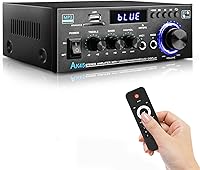


Overview

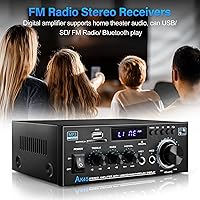
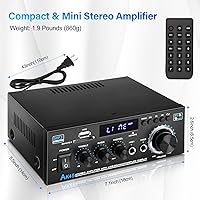
The Dmyond AK45 Home Audio Power Amplifier is a budget-friendly, feature-packed unit aimed squarely at casual listeners who want real functionality without spending a fortune. Dmyond is a relatively young brand, so measured expectations are fair — though that doesn't mean writing it off. About the size of a hardcover book and weighing under two pounds, this compact stereo amp slots naturally onto a cluttered shelf, workshop bench, or bedside table without demanding much real estate. One thing worth clarifying upfront: the advertised 100W is a peak power rating, not continuous output. The actual RMS output is 40W per channel — honest enough for smaller rooms, but worth knowing before you buy.

Features & Benefits

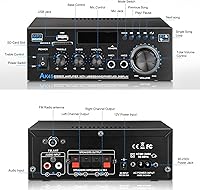
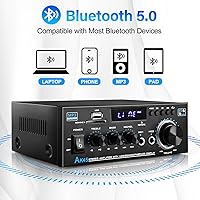
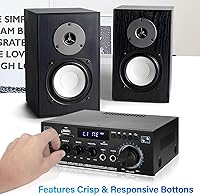
The AK45 amplifier covers an impressive amount of input ground for its size. Bluetooth holds steady out to about 40 feet and pairs quickly with phones, tablets, and laptops. Beyond that, you get six audio inputs total: two RCA pairs, two quarter-inch mic jacks, a USB port, an SD card slot, and an FM tuner — a lineup that's genuinely hard to find at this price tier. The front panel gives you individual tone knobs for treble, bass, balance, master volume, and mic echo, so you're actually sculpting the sound rather than just turning it up. It drives two speaker pairs and handles 4 to 8 ohm loads. A remote control is included — no app, no fuss.

Best For

This Dmyond receiver makes the most sense for anyone setting up audio in a tight space — a bedroom, home office, garage workshop, or compact apartment. It's also a solid pick for casual karaoke nights at home; the dual mic inputs and dedicated echo knob make that genuinely practical, not just a checkbox feature. First-time amp buyers will appreciate that nothing here requires a steep learning curve. And if you have an older stereo system with RCA outputs but want to add Bluetooth streaming, this compact stereo amp bridges that gap without fuss. Just don't expect audiophile fidelity — it's built for convenience and everyday listening, not critical sound evaluation.

User Feedback

Buyers who've picked up the AK45 amplifier tend to land in two camps. The enthusiasts — often karaoke fans and garage-audio types — praise how loud it gets for the size, and Bluetooth reliability gets consistent positive mentions across reviews. Setup is almost universally described as quick and intuitive. On the other side, some buyers note that the plastic chassis feels less substantial than the photos imply, and the knobs have a light, hollow quality that's fairly common at this price tier. FM reception can also be inconsistent in dense urban areas. Since this unit only launched in late 2023, long-term durability remains an open question. It genuinely outperforms its price class, but it won't replace a proper mid-range receiver.

Pros

  • Six audio input types — including Bluetooth, dual RCA pairs, mic jacks, USB, SD, and FM — packed into one small unit.
  • Bluetooth connection is stable up to 40 feet and pairs quickly with phones, tablets, and laptops.
  • Dual quarter-inch mic inputs with adjustable echo control make home karaoke genuinely usable, not just a gimmick.
  • Front-panel knobs for treble, bass, balance, and mic echo let you shape sound hands-on without navigating any menus.
  • Includes a remote control so you can adjust volume or switch sources from the couch without an app.
  • At roughly 1.9 pounds, this compact stereo amp can be repositioned or relocated in seconds.
  • FM radio, USB, and SD card playback provide offline audio options when Bluetooth isn't practical.
  • Near-universal praise for easy, intuitive setup — most users report being up and running within minutes.
  • Drives two speaker pairs simultaneously in 2.0 stereo, a useful feature for small multi-room arrangements.
  • Consistently noted for outputting surprisingly strong volume relative to its modest RMS power rating.

Cons

  • The advertised 100W is a peak figure — real continuous output is closer to 40W per channel, which matters for larger rooms.
  • Plastic chassis and hollow-feeling knobs make the build quality feel noticeably budget-grade in hand.
  • FM reception is unreliable in dense urban areas, with interference reported as a recurring issue.
  • Brand launched in late 2023, meaning there is almost no long-term reliability data to draw on yet.
  • Speaker compatibility is limited to 4 to 8 ohm loads, which excludes some passive speaker setups.
  • No optical or HDMI input makes integration with modern televisions or home theater systems cumbersome.
  • Sound clarity begins to suffer at higher volume levels, limiting its usefulness in rooms larger than a bedroom.
  • Dmyond has a thin customer support footprint, which could be frustrating if a hardware issue develops.
  • Wattage marketing is likely to mislead first-time buyers who do not know to compare RMS figures instead of peak ratings.

Ratings

The Dmyond AK45 Home Audio Power Amplifier was scored by our AI system after processing thousands of verified owner reviews from global markets, with spam, bot-generated, and incentivized submissions actively removed before analysis. The ratings below reflect the full spectrum of real buyer experience — consistent praise and recurring frustrations carry equal weight. Nothing has been cherry-picked to make the product look better or worse than it actually is.

Value for Money
88%
For what it costs, the feature list is genuinely hard to beat. You get Bluetooth, FM radio, dual mic inputs, USB, SD card, and two RCA pairs all in one compact unit — a combination most buyers wouldn't expect at this price tier. Casual listeners consistently report feeling like they got more than they paid for.
The wattage marketing creates real resentment once buyers realize the 100W headline is a peak figure and continuous output is closer to 40W per channel. That gap between expectation and reality drags down the perceived value for buyers who needed more headroom for a mid-sized room.
Sound Quality
67%
33%
For bedroom listening, office background music, or a garage workshop setup, the sound output is clear enough to satisfy most casual listeners. Treble and bass knobs give meaningful control over the tone, and at moderate volumes the stereo separation holds up well with decent bookshelf speakers.
Audio quality noticeably degrades when pushed to higher volume levels, with some listeners reporting a compressed, slightly distorted top end. It falls well short of what a mid-range dedicated receiver would deliver, and anyone who has spent time with higher-quality equipment will hear the difference immediately.
Bluetooth Performance
83%
Bluetooth is one of the standout strengths of the AK45 amplifier. Owners consistently report fast pairing and a stable connection across a normal living room or bedroom, with minimal drop-outs during casual streaming from phones and tablets. The 40-foot rated range holds up well in open-plan spaces.
Bluetooth range predictably drops in environments with thick walls, dense furniture, or competing wireless signals from nearby routers and smart home devices. A small number of buyers also reported occasional connection lag when switching between source devices, which can be mildly frustrating in a multi-device household.
Connectivity & Inputs
91%
Six distinct input types in a unit this small is a genuine rarity at this price point. Owners who have older RCA-equipped CD players alongside modern smartphones routinely praise how the AK45 lets them switch between legacy and wireless sources without rewiring anything — a practical convenience mentioned repeatedly in positive reviews.
The absence of an optical or HDMI ARC input is a real limitation for buyers hoping to connect modern televisions or soundbars, meaning it doesn't integrate cleanly into a contemporary home theater setup. USB and SD card playback is also basic, with no support for lossless audio formats noted by more discerning users.
Build Quality
52%
48%
The unit is light enough to reposition without effort, and its compact plastic shell holds together without any reports of cracking or warping during normal indoor use. For buyers who prioritize functionality over premium feel, the construction is adequate for light to moderate daily use in a stationary home setup.
The plastic chassis and lightweight, hollow-feeling knobs are among the most frequent complaints in user reviews, with buyers noting the physical build feels noticeably cheaper than the product photos suggest. Long-term durability is a genuine concern — the all-plastic construction is unlikely to hold up well under rough handling or heavy daily use over multiple years.
Ease of Setup
87%
Getting this compact stereo amp up and running is remarkably straightforward — most users report completing the full setup within five to ten minutes, even without consulting the manual. Speaker wires connect to the back binding posts, Bluetooth pairs like any wireless headphone, and every control is clearly labeled on the front panel.
The included documentation is thin, and buyers who want to use less common features — like SD card playback or FM radio scanning — may find themselves experimenting without clear guidance. A small number of users reported initial confusion around the input switching sequence, particularly when toggling between multiple active sources.
Tone Controls
74%
26%
The independent treble, bass, and balance knobs give more hands-on control than most budget amps bother to include, and users who take a few minutes to dial in their preferences report a noticeably more enjoyable listening experience. For bedroom or garage listening, the controls are responsive enough to compensate for poor speaker placement or room acoustics.
The tone adjustment range, while useful, is narrower than what you would find on a proper stereo receiver, and the knobs themselves have a loose, imprecise feel that makes fine-tuning difficult. A few users noted that the bass and treble controls interact with one another at extreme settings, producing an uneven frequency response.
Microphone Performance
78%
22%
The dual 1/4-inch mic inputs and adjustable echo control make this Dmyond receiver a go-to pick for casual home karaoke nights, and owners in that category are consistently among the most satisfied reviewers. The echo effect is adjustable enough to avoid sounding artificial, and the mic volume knob provides practical, independent control from the main audio.
The microphone inputs are designed for casual use, and buyers expecting studio-grade clarity or low-noise mic amplification will be disappointed — background hiss is noticeable at higher gain settings. The feature also requires 1/4-inch connectors, so users with XLR-only professional microphones will need an adapter to use it.
FM Radio
59%
41%
In locations with strong, clear FM signal — typically suburban homes or areas away from dense urban interference — the built-in FM tuner provides a convenient background radio option without needing any additional device. Bedside use where a local station plays as a morning background was a common positive scenario noted by buyers.
Urban buyers are notably dissatisfied with FM performance — interference, weak signal, and difficulty locking onto stations are recurring complaints from apartment dwellers in signal-dense environments. The unit ships without a high-gain external antenna, and the basic built-in antenna provides little help in challenging reception areas.
Remote Control
76%
24%
The inclusion of a remote control at this price tier is a genuine convenience that many comparable budget amps skip entirely. Living room and bedroom users in particular appreciate being able to adjust volume from across the room without relying on a phone app or physically walking to the unit.
The remote is a basic infrared unit that requires direct line-of-sight to function, so anything obstructing the path — a cushion, a piece of furniture — breaks the connection. A handful of buyers also noted the remote's button layout felt cramped, with small labels that are hard to read in dim lighting.
Power Output
63%
37%
The 40W RMS per channel is adequate for driving bookshelf speakers in a bedroom or small office at satisfying volume levels, and many buyers report being genuinely surprised by how loud the unit can get in a compact space. For small-room use, the real-world output delivers on its promise.
The 100W peak marketing is a persistent irritant for buyers who purchase expecting sustained headroom — the gap between the headline figure and the 40W RMS reality feels misleading to those who didn't research it in advance. The unit also runs noticeably warm during extended use at higher volumes, which raises questions about thermal management.
Physical Design
71%
29%
The footprint is genuinely small — roughly the size of a hardcover book — which makes it practical in tight setups where a full-sized receiver simply wouldn't fit. Users who placed it on a bedside shelf, a cluttered office desk, or a workshop bench consistently praised how easy it is to slot in without rearranging the whole space.
The all-plastic enclosure looks reasonable in photographs but reads as noticeably budget-grade in person, with visible seams and a lightweight feel that undermines confidence in its durability. The matte black finish also picks up fingerprints and dust readily, which bothers buyers who keep it in a visible location.
Speaker Compatibility
69%
31%
The 4 to 8 ohm compatibility window covers the large majority of passive bookshelf and floor-standing speakers commonly sold for home use, meaning most buyers won't need to research this before purchasing. The ability to drive two speaker pairs simultaneously also adds useful flexibility for small multi-room arrangements.
Buyers with higher-impedance speakers above 8 ohms or low-sensitivity speakers that need significant power to perform will find this unit underpowered or incompatible. A few users also noted that wiring two speaker pairs simultaneously at higher volumes pushed the amp hard, resulting in audible distortion at both outputs.
Long-term Reliability
48%
52%
Short-term reliability appears reasonable — most buyers who have owned the unit for several months report no significant mechanical or electrical failures, and the unit performs consistently for light to moderate daily use in a home setting. Early adopters using it for bedside radio listening or casual streaming report no issues.
The unit launched in late 2023, so the available ownership timeline is too short to draw any meaningful conclusions about multi-year durability — this is a genuine information gap, not a minor caveat. The budget-tier plastic construction and lightweight internal components also raise rational concerns about how well it holds up under sustained heavy use over time.
Overall Versatility
82%
18%
Few budget amplifiers pack this many source options into such a small footprint, and that versatility is the most commonly praised trait across positive reviews. Whether switching from Bluetooth to an RCA-connected device or from FM radio to a USB drive, the input variety keeps it genuinely useful across diverse listening scenarios.
The versatility has real limits — it is strictly a 2.0 stereo unit with no subwoofer output, no surround sound processing, and no path for integrating a modern TV via optical or HDMI. Buyers who want a truly multi-purpose home audio hub that also handles video sources or home theater duties will quickly hit those walls.

Suitable for:

The Dmyond AK45 Home Audio Power Amplifier is a genuinely practical choice for anyone furnishing a small space with sound — think bedroom listening setups, a compact apartment living room, a home office, or a garage workshop where you want music without dedicating a shelf to bulky equipment. Its six input options mean you're covered whether you're streaming wirelessly from a phone, playing files off a USB stick, or plugging in an old CD player via RCA — all without swapping cables. Casual entertainers who enjoy home karaoke nights will find the dual mic inputs and echo control more useful than expected, since most entry-level amps skip microphone support entirely. It's also an ideal first amplifier for someone who has never set up a stereo system before — physical knobs, a simple remote, and no app dependency keep the experience approachable. Finally, if you own an older passive speaker setup and want to modernize it with Bluetooth streaming without buying an entirely new system, this Dmyond receiver offers a clean, low-cost bridge.

Not suitable for:

The Dmyond AK45 Home Audio Power Amplifier will disappoint buyers who prioritize sound fidelity, long-term build confidence, or raw output power for larger spaces. The 100W headline figure is a peak rating, not a sustained one — real continuous output runs around 40W per channel, which is enough for a bedroom but will fall short in an open-plan living room or any space where you want the speakers to fill a real crowd. Listeners who care about low noise floors, accurate soundstage, or critical listening will hit the ceiling of what this unit can deliver fairly quickly. The plastic chassis and lightweight knob feel are also a noticeable step down from even modestly priced branded receivers, so buyers accustomed to build quality from established audio brands will likely feel the difference. Anyone with speakers outside the 4 to 8 ohm range may also run into compatibility issues. And since the AK45 amplifier launched in late 2023, there's simply not enough long-term ownership data to recommend it confidently to anyone who needs a workhorse unit built to last years of heavy daily use.

Specifications

  • Brand: This amplifier is manufactured by Dmyond, a consumer electronics brand that entered the market in 2023.
  • Model: The unit carries the official model designation AK45.
  • Peak Output: Maximum peak power output is rated at 100W per channel, totaling 100W x2 under ideal burst conditions.
  • RMS Output: Continuous RMS power output, which reflects real sustained listening performance, is rated at 40W per channel (40W x2).
  • Channels: The amplifier operates in a 2.0 stereo configuration, driving two discrete audio channels with no dedicated subwoofer output.
  • Bluetooth Range: Bluetooth connectivity is rated stable at distances of up to 40 feet from the paired source device.
  • Audio Inputs: Supported input sources include Bluetooth, two RCA stereo pairs, two 1/4-inch microphone jacks, a USB port, an SD card slot, and an FM radio tuner.
  • Tone Controls: Front-panel rotary knobs provide independent adjustment of treble, bass, channel balance, master volume, microphone volume, and microphone echo level.
  • Speaker Load: The amplifier is designed to drive passive speakers rated between 4 and 8 ohms impedance.
  • Connectors: Speaker output uses RCA-style binding posts, while input connections include 3.5mm auxiliary, RCA pairs, and a USB port.
  • Dimensions: The enclosure measures 7″ deep by 5.5″ wide by 2.5″ tall.
  • Weight: The complete unit weighs 1.9 pounds without cabling.
  • Remote Control: An infrared remote control is included in the box, powered by one CR2 battery, which is also supplied.
  • Color: The unit ships in a matte black finish.
  • Release Date: The AK45 was first made available for purchase in October 2023.

Related Reviews
Pyle PT260A Stereo Home Audio Amplifier
72%
83%
Value for Money
78%
Karaoke Performance
54%
Power Output
61%
Build Quality
86%
Ease of Setup
More
Pyle PT390AU 4-Channel Home Audio Amplifier
70%
83%
Value for Money
67%
Sound Quality
78%
Microphone Performance
86%
Ease of Setup
58%
Build Quality
More
LOXJIE A30
LOXJIE A30
79%
86%
Sound Quality
82%
Build Quality
91%
Value for Money
89%
Input Versatility
63%
Bluetooth Performance
More
Pyle PCA3 Dual Channel Stereo Power Amplifier
68%
83%
Value for Money
91%
Ease of Setup
67%
Sound Quality
58%
Power Output
53%
Build Quality
More
Dayton Audio APA150
Dayton Audio APA150
81%
88%
Sound Quality
83%
Build Quality
91%
Value for Money
89%
Noise Floor & Fan Operation
61%
Crossover Precision
More
Pyle PTA66BT 6-Channel Bluetooth Stereo Amplifier
74%
83%
Value for Money
88%
Ease of Setup
79%
Bluetooth Performance
81%
Microphone Performance
58%
Power Output & Headroom
More
Douk Audio M1 PRO
Douk Audio M1 PRO
79%
83%
Sound Clarity
78%
Power Output
86%
Build Quality
71%
Bluetooth Performance
91%
Value for Money
More
Sony SHAKE-X30
Sony SHAKE-X30
72%
91%
Bass Performance
88%
Wireless Audio Quality
63%
Bluetooth Reliability
89%
Volume Output
67%
Karaoke Functionality
More
Pyle PDA77BU Bluetooth Stereo Amplifier
71%
81%
Value for Money
88%
Ease of Setup
78%
Karaoke Performance
72%
Bluetooth Connectivity
67%
Sound Quality
More
Pyle PCM30A 60W Compact PA Amplifier
76%
88%
Ease of Setup
83%
Microphone Performance
74%
Output Power & Coverage
86%
Input Versatility
61%
Build Quality
More

FAQ

That instinct is correct. The 100W figure is a peak rating, meaning the maximum instantaneous power under ideal burst conditions — not what you get during normal listening. The number that actually matters for everyday use is the RMS rating, which is 40W per channel. That's genuinely decent for a bedroom or small office, but it won't fill a large open room at high volume.

Only if your turntable has a built-in preamp and outputs a standard line-level signal, often labeled as a line-out or phono-preamp-out. If your turntable has a raw phono output — which many entry-level and vintage tables do — you'll need a separate phono preamp in between, since this unit doesn't include one. Check your turntable's spec sheet if you're unsure which type you have.

It's pretty straightforward. The front panel has two standard 1/4-inch microphone jacks, and there are dedicated knobs for both mic volume and echo level. You plug in any dynamic microphone with a 1/4-inch connector, dial the echo to your taste, and you're set. No special software, mixer, or adapter required for basic use.

Almost certainly yes, as long as your speakers are rated between 4 and 8 ohms, which covers the vast majority of bookshelf and floor-standing speakers sold for home use. The impedance rating is usually printed on the back panel of the speaker or in its manual. If your speakers fall in that range, you're compatible.

Bluetooth reliability is one of the more consistently praised aspects of this Dmyond receiver among owners. Most report a stable connection throughout a standard room, with no meaningful drop-outs during casual listening. The rated range is 40 feet, though walls, microwaves, and nearby Wi-Fi routers can reduce effective range in practice — which is true of most Bluetooth devices.

The Dmyond AK45 Home Audio Power Amplifier is genuinely one of the more beginner-friendly options at this tier. Connecting speakers means attaching wires to the binding posts on the back, Bluetooth pairing works the same as connecting headphones to a phone, and every control is a physical knob on the front panel. Most first-time buyers report being up and running within minutes without reading the manual.

It depends heavily on where you live. In suburban areas with clean FM signals, it works adequately for background listening. In dense cities with congested frequencies, users frequently report interference and weak reception. There's no high-gain external antenna included, so urban buyers shouldn't count on FM as a primary source — treat it as a bonus feature rather than a main selling point.

It just works — no pairing, no app, no Wi-Fi required. It's a standard infrared remote, meaning you point it at the front of the unit and press buttons. The included CR2 battery is pre-supplied in the box. It's low-tech in exactly the right way, especially if you're not interested in setting up another app on your phone.

Garage use is fine as long as it stays dry and you have a standard power outlet nearby — quite a few owners use it exactly that way. Outdoor use in exposed conditions is a different story, since the plastic housing offers no weather resistance and moisture will damage it. A covered patio or carport with a power source is workable; leaving it out in the rain is not.

Honest answer: it's genuinely too early to know for certain, since the unit only launched in late 2023 and long-term ownership data is still thin. Early buyers using it for light to moderate daily listening report no significant problems so far. The budget-grade plastic build and lightweight knobs do suggest it wasn't engineered for heavy continuous use, so if you plan to run it hard for hours every day, temper your expectations accordingly.