Overview

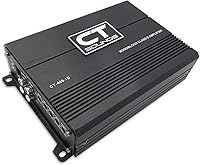
The CT Sounds CT-400.1D Monoblock Amplifier is a compact Class D amp aimed squarely at the under-$150 market, and it holds its own surprisingly well. CT Sounds is a direct-to-consumer brand that has been building a genuine enthusiast following — not a household name yet, but earning credibility through solid specs and competitive pricing. The small chassis fits neatly into tight trunk builds or under-seat installations where a full-size amp simply won't go. What's worth examining is whether the efficiency claims hold up in practice. Based on what buyers report, the answer leans toward yes — this budget monoblock punches above its price class more often than not.
Features & Benefits

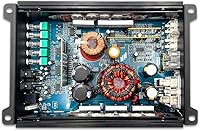
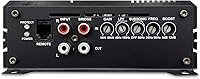
Power flexibility is one of the CT-400.1D's more practical strengths. Rated at 400W RMS into a 1-ohm load, 300W at 2 ohms, and 150W at 4 ohms, it adapts cleanly to different subwoofer configurations without much fuss. The MOSFET PWM power supply helps maintain stable output even when the electrical system dips, while the proprietary heat dissipation design keeps things cool during extended listening sessions. A 4-way protection circuit handles high voltage, low voltage, over-current, and thermal overload — that's meaningful coverage for a budget-tier unit. The included bass knob and onboard crossover let you tune on the fly without sourcing extra components separately.

Best For

This compact mono amp makes the most sense for builders who need real subwoofer power without the overhead of a premium brand price tag. It's a natural fit for single-subwoofer builds in smaller cars and hatchbacks, especially when trunk real estate is tight. First-time DIYers will appreciate the straightforward install and the fact that a tuning knob ships in the box — fewer parts to track down separately. Anyone running a 1-ohm stable sub load will find the power headroom particularly useful at this price point. It also works well as a practical upgrade from a factory head unit setup that lacks any real low-end foundation.

User Feedback

Across 137 ratings averaging 4.4 out of 5, the most consistent praise centers on output strength relative to the amp's footprint — buyers are genuinely surprised by how hard it hits for the money. Thermal performance also gets regular mentions, with many users noting the unit stays cooler than expected on longer drives. On the critical side, a few owners flag the wiring terminals as feeling less substantial than you'd hope at this output level, and the included documentation leaves some first-timers guessing during setup. Neither issue is a dealbreaker, but both are worth knowing going in. For a budget-tier build, the CT-400.1D earns its rating honestly.

Pros

  • Delivers surprisingly strong bass output relative to its compact size and price tier.
  • The 1-ohm stable rating gives subwoofer builders meaningful power headroom without overspending.
  • MOSFET power supply helps maintain stable performance even during voltage fluctuations.
  • Runs cooler than expected during extended listening sessions, which is a genuine reliability plus.
  • 4-way protection circuit covers the most common amp failure scenarios right out of the box.
  • Compact chassis fits neatly into tight trunk builds or under-seat installs with minimal hassle.
  • Bass knob and onboard crossover are included, saving you the cost of sourcing them separately.
  • Easy enough to install that first-time DIYers report a smooth experience without professional help.
  • Holds a 4.4 out of 5 rating across over 130 buyers, reflecting consistent real-world satisfaction.
  • Certifications including FCC, RoHS, and CE add a baseline layer of build quality assurance.

Cons

  • Wiring terminals feel less solid than you would expect at this power level, according to multiple buyers.
  • Included documentation is thin, leaving beginners to figure out crossover and gain tuning on their own.
  • CT Sounds lacks the long track record and brand support infrastructure of more established competitors.
  • Not a viable option for multi-subwoofer builds or any setup that demands significantly more headroom.
  • The frequency response ceiling of 320 Hz means this amp has no use case outside dedicated bass duty.
  • No mention of a warranty card or clearly documented support process in buyer feedback, which is a concern.
  • Relatively low sample size of ratings makes it harder to assess long-term durability with full confidence.

Ratings

The scores below for the CT Sounds CT-400.1D Monoblock Amplifier were generated by our AI rating engine after analyzing verified global buyer reviews, actively filtering out incentivized, bot-generated, and spam submissions to surface what real owners actually experience. Both the genuine strengths and the recurring frustrations are reflected transparently — no category has been inflated to make the product look better than it is. Where this compact mono amp earns high marks, buyers consistently back it up; where it falls short, those patterns are just as clearly represented.
Value for Money
91%
For a budget-tier monoblock, the real-world output relative to cost is where this amp genuinely shines. Buyers running single-subwoofer builds consistently report getting more audible bass impact than they expected at this price point, which is the clearest indicator of honest value in this segment.
A small portion of buyers feel the included accessories — particularly the wiring hardware — do not match the amp's power rating, meaning you may need to budget for better connectors or terminals separately, slightly eroding the out-of-box value proposition.
Power Output
86%
The 1-ohm stable rating is a meaningful real-world advantage for enthusiasts who want to squeeze maximum output from a single subwoofer without jumping to a higher-cost amp. Buyers pairing it with a dual voice coil sub wired to 1 ohm consistently report satisfying, punchy low-end performance during daily driving.
At 2-ohm and 4-ohm loads, the output steps down considerably, and a few buyers running less efficient subwoofer setups felt the headroom was tighter than expected at higher volumes. It is not an amp for builders who anticipate needing significant overhead beyond their current subwoofer demands.
Thermal Management
88%
Thermal performance is one of the most frequently praised aspects across buyer feedback. Owners report the unit stays noticeably cooler than competing amps in this price range during extended highway drives and long listening sessions, which builds genuine confidence in its daily reliability.
A handful of buyers who installed the amp in poorly ventilated enclosures or tight under-seat spaces reported occasional thermal protection triggers. The heat dissipation system works well when airflow is adequate, but it is not a substitute for a thoughtful installation layout.
Build Quality
71%
29%
The chassis itself feels solid for a budget-tier amplifier, and the overall construction does not feel flimsy in hand. Most buyers who install it in a trunk build report that it holds up well over months of regular use without any physical deterioration.
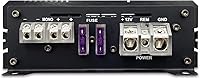
The wiring terminals are the most cited build concern — multiple buyers note they feel undersized and less robust than expected for an amp at this output level. Getting a clean, secure connection with thicker gauge wire requires patience, and the terminals do not inspire the same confidence as the rest of the chassis.
Ease of Installation
84%
First-time installers make up a meaningful share of the buyer base, and most report a smoother install experience than they anticipated. The compact footprint helps a lot in vehicles where routing wires to a full-size amp would be awkward, and the included bass knob connects cleanly without additional hardware.
The documentation packaged with the amp is thin, and buyers who have never set amplifier gain or configured a low-pass crossover before were largely left to find guidance on their own. A basic setup guide with gain-setting instructions would meaningfully reduce the friction for new builders.
Documentation & Setup Guidance
53%
47%
For experienced installers who already know how to set gain by ear or with a multimeter, the sparse documentation is a non-issue — they will tune it the way they always do regardless of what is in the box.
For the significant portion of buyers who are new to aftermarket audio, the lack of clear tuning guidance is a genuine pain point. Several buyers admitted to running the amp improperly for weeks before discovering the correct crossover and gain settings online, which is a real miss for a product targeting entry-level builders.
Compactness & Fit
89%
The physical footprint is a consistent selling point among buyers who have struggled to fit traditional amplifiers in compact sedans, hatchbacks, and small SUVs. It slides into shallow trunk corners and slim under-seat spaces where many competitors simply cannot go.
While the chassis is compact, the package dimensions are notably larger than the unit itself, so buyers should confirm measurements before assuming it will fit a very tight space. A small number of reviewers found the actual clearance tighter than anticipated after accounting for wiring egress.
Bass Performance
87%
Buyers regularly describe the bass as hitting harder than the size and price suggest it should, particularly when the subwoofer is tuned to a 1-ohm load. During genre-heavy playback — hip-hop, EDM, trap — the low-end output draws repeated positive comments about impact and depth.
A few audiophile-leaning buyers felt the bass character was slightly loose at the upper edges of the frequency range, though this is largely a function of how the crossover is set rather than an inherent amp deficiency. Proper low-pass tuning resolves most of these complaints.
Protection Circuitry
83%
The 4-way protection suite covering high voltage, low voltage, over-current, and thermal events is a meaningful spec for a budget monoblock, and buyers report it functions correctly — catching real fault conditions without nuisance tripping under normal use.
A small number of buyers experienced protection mode activation that they could not immediately diagnose, which was frustrating without detailed troubleshooting documentation. The protection system does its job, but the lack of diagnostic feedback makes identifying the root cause harder than it needs to be.
MOSFET Power Supply Stability
81%
19%
Buyers running the amp in vehicles with moderate electrical systems — factory alternators and standard batteries — generally report stable, consistent output without noticeable drop during bass transients. The MOSFET PWM supply handles real-world voltage fluctuations better than some competing budget units.
In vehicles with aging or undersized electrical systems, some buyers noticed output instability that required an upgraded battery or capacitor bank to resolve. This is not unusual for any amp at this power level, but it is worth factoring into the total install budget.
Included Accessories
66%
34%
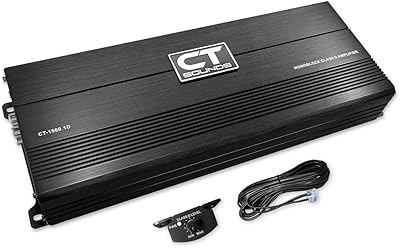
The included remote bass knob is a practical touch that many budget amps skip entirely, giving daily drivers a convenient way to adjust bass level between tracks or driving environments without touching the head unit.
Beyond the bass knob, the accessory package is lean. Buyers looking for mounting hardware, RCA cables, or wiring components will need to source those separately, and the wiring terminals included with the unit have drawn criticism for not being up to the task at higher current draw.
Brand Reliability Perception
69%
31%
CT Sounds has been gaining traction in enthusiast communities, and buyers who researched the brand before purchasing generally report feeling their confidence was justified. The direct-to-consumer model keeps costs competitive and the product lineup is focused enough to suggest real engineering intent.
For buyers who place heavy weight on brand legacy and established dealer support networks, CT Sounds is still an unknown quantity compared to names with decades of market presence. Long-term reliability data is limited simply because the brand and product are relatively new to the market.
Noise Floor & Signal Clarity
74%
26%
At typical gain settings, the amp operates quietly in the background — no audible hiss or alternator whine reported by the majority of buyers, which is a meaningful baseline for a budget-tier unit powering a dedicated subwoofer channel.
A few buyers reported picking up low-level noise after installation, typically traced back to grounding issues rather than the amp itself. Getting a truly clean ground connection is more critical at this power level than many first-time installers realize going in.
Warranty & Support
58%
42%
CT Sounds does offer a warranty on their amplifiers, and some buyers report positive direct interactions when reaching out with questions pre-purchase through online channels.
Post-purchase support infrastructure is not as well developed as established brands, and several buyers noted difficulty finding clear warranty claim procedures in the product documentation. For buyers who prioritize robust after-sale coverage, this remains an area where CT Sounds has room to improve.

Suitable for:

The CT Sounds CT-400.1D Monoblock Amplifier is a strong pick for anyone building a budget-friendly bass setup in a compact or mid-size vehicle where space and cost are the primary constraints. It's particularly well-matched for first-time car audio enthusiasts who want a meaningful upgrade over their factory system without navigating a steep learning curve or a steep price tag. Builders working with a single subwoofer — especially those running a 1-ohm stable load — will find the power output genuinely competitive for the money. The small chassis makes it easy to tuck into tight trunk corners or under seats, which matters a lot in hatchbacks, sedans, and smaller SUVs where real estate is limited. Anyone who values having a bass knob and onboard crossover included out of the box will also appreciate not having to source additional tuning components separately.
Not suitable for:

The CT Sounds CT-400.1D Monoblock Amplifier is not the right tool for builders chasing serious SPL output or running demanding multi-subwoofer configurations that require significantly higher headroom. If you are planning a competition-level build or pushing a high-power dual-voice-coil setup to its limits, you will likely outgrow this amp quickly and should budget for a higher-tier unit from the start. Experienced installers who are used to robust, industrial-grade wiring terminals may find the hardware here underwhelming for a high-current application. The sparse documentation can also be a real friction point if you are new to tuning crossover settings and subsonic filters without guidance. CT Sounds is still a developing brand in a market dominated by long-established names, so buyers who strongly prioritize brand reputation or long-term dealer support may want to look elsewhere.
Specifications

  • Output Power: Delivers 400W RMS at 1 ohm, 300W RMS at 2 ohms, and 150W RMS at 4 ohms, all measured at 14.4V.
  • Amplifier Class: Built on a Class D monoblock topology, optimized for subwoofer duty with high efficiency and low heat output.
  • Power Supply: Uses a MOSFET pulse width modulated power supply for stable, consistent output across varying electrical conditions.
  • Frequency Response: Covers 0 to 320 Hz, making it suited exclusively for bass and subwoofer applications rather than full-range use.
  • Protection Circuit: Features 4-way protection covering high voltage, low voltage, over-current, and thermal overload conditions.
  • Rated Voltage: Designed to operate at a nominal 14.4V DC, consistent with standard automotive electrical systems.
  • Min Supply Voltage: Requires a minimum supply voltage of 8.8V DC to function, providing headroom for low-voltage engine-off listening.
  • Channels: Single-channel monoblock configuration, dedicated entirely to powering one subwoofer or a parallel woofer load.
  • Dimensions: Package measures 13.46 x 7.99 x 4.88 inches, with a compact chassis well-suited to tight trunk or under-seat installs.
  • Weight: The unit weighs 5.3 pounds, light enough for flexible mounting in most vehicle configurations.
  • Mount Type: Designed for surface mounting, compatible with standard flat mounting surfaces inside a vehicle trunk or enclosure.
  • Bass Control: Ships with an external bass knob for real-time low-frequency level adjustment without reaching for the head unit.
  • Crossover: Onboard low-pass crossover filters the signal appropriately for subwoofer use, with no external processor required.
  • Heat Dissipation: Incorporates a proprietary thermal management design intended to keep operating temperatures stable during prolonged high-volume use.
  • Certifications: Meets CE, CSA, FCC, RoHS, and WEEE standards, confirming compliance with North American and European safety and environmental requirements.
  • UPC: Universal Product Code is 850021258818, useful for identifying the exact unit when purchasing through third-party retailers.
  • Model Number: Officially designated as the CT-400.1D, the model identifier used across CT Sounds product documentation and listings.
  • Brand: Manufactured by CT Sounds, a direct-to-consumer car audio brand growing its presence in the enthusiast segment.

Related Reviews
CT Sounds CT-700.1D Monoblock Amplifier
80%
91%
Value for Money
88%
Bass Output
86%
Thermal Performance
87%
Ease of Installation
74%
Build Quality
More
CT Sounds CT-2000.1D Monoblock Amplifier
77%
88%
Value for Money
74%
Power Output
71%
Build Quality
69%
Thermal Management
86%
Ease of Installation
More
CT Sounds CT-1000.1D Monoblock Car Amplifier
77%
88%
Value for Money
79%
Power Output
84%
Thermal Management
72%
Build Quality
71%
Installation Ease
More
CT Sounds CT-1500.1D Class D Car Audio Amplifier
82%
94%
Power Output
86%
Build Quality
91%
Ease of Installation
72%
Thermal Performance
88%
Sound Quality
More
CT Sounds CT-80.4D 4-Channel Car Amplifier
74%
91%
Value for Money
78%
Power Output Accuracy
84%
Installation Ease
61%
Heat Management
67%
Build Quality
More
CT Sounds CT-150.4D 4-Channel Car Amplifier
75%
83%
Value for Money
78%
Sound Quality
61%
Build Quality
86%
Ease of Installation
77%
Thermal Management
More
CT Sounds CT-7EQ 7-Band Car Audio Equalizer
76%
88%
Sound Quality Improvement
91%
Value for Money
84%
Ease of Installation
74%
Build Quality
58%
Faceplate Readability
More
Orion CBA2000.1D Monoblock Car Amplifier
72%
83%
Value for Money
78%
Bass Output
41%
Power Accuracy
62%
Thermal Management
59%
Build Quality
More
NVX VAD27001 Monoblock Class D Amplifier
79%
91%
Power Output Accuracy
88%
Build Quality
72%
Thermal Management
69%
Installation Experience
86%
Bass Control & Tuning
More
Audiobank P1601 Monoblock Car Amplifier
73%
84%
Value for Money
57%
Power Output Accuracy
88%
Installation Experience
61%
Thermal Management
76%
Bass Quality
More

FAQ

It is rated and designed to run at 1 ohm, and buyer feedback generally supports that it holds up under sustained 1-ohm loads without triggering protection shutoffs. That said, like any amp at this price point, keeping your electrical system in good shape — clean ground, proper fusing, adequate wire gauge — makes a real difference in how stable it stays.

For an amp putting out this level of power, 4-gauge power and ground wire is the standard recommendation. Going with 8-gauge would leave you undersupplied at the higher output levels, so it is worth doing the wiring correctly from the start rather than troubleshooting dropouts later.

Yes, the CT-400.1D runs cleanly at 2 ohms as well, putting out 300W RMS at that impedance. It is a solid match for a single 2-ohm DVC sub wired to a 1-ohm final load, or simply run as a straightforward 2-ohm setup if you prefer a more conservative operating point.

Most buyers find it functional and convenient — it is nothing fancy, but having any remote bass control included at this price is genuinely useful for daily driving. If you want more precise control or already have a preferred aftermarket bass controller, you can swap it out, but there is no urgent reason to.

It depends on your specific vehicle, but the compact chassis does make under-seat installs feasible in many cars. Measure your available clearance carefully — the chassis itself is smaller than the listed package dimensions — and make sure there is adequate airflow so the heat dissipation system can do its job.

Thermal management is actually one of the more consistent positives in buyer feedback. Multiple owners report that the amp stays cooler than they expected during extended listening sessions. The 4-way protection circuit will also shut the unit down safely if temperatures do get out of range, which gives some peace of mind.

A single 10-inch or 12-inch subwoofer in a ported or sealed enclosure is the sweet spot. If your sub has dual 2-ohm voice coils, wiring them in parallel to a 1-ohm load gets you the full rated output. Avoid pairing it with power-hungry subs that need significantly more headroom than this unit provides.

They are functional, but a handful of buyers have noted that the terminals feel less robust than expected for an amp at this output level. Thicker gauge wire can be a little snug, so stripping your wire ends cleanly and using a proper trim tool will make the job easier and ensure a secure connection.

The included documentation is minimal, which is one of the more common complaints from first-time builders. If you are new to setting amp gain, it is worth watching a few tutorial videos online before dialing it in — setting gain by ear or guessing tends to result in distortion or underperformance, and the amp deserves better than that.

CT Sounds is a relatively newer direct-to-consumer brand, and while the community reception has been positive, it does not have the decades-long track record of brands like Rockford Fosgate or JL Audio. Check the current warranty terms directly with CT Sounds before purchasing, and make sure you keep your receipt, as documentation tends to matter a lot if you ever need to make a claim.

Where to Buy