
Overview

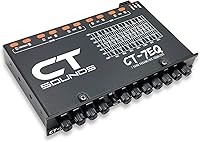
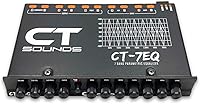
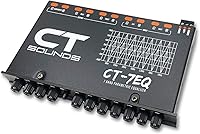
The CT Sounds CT-7EQ 7-Band Car Audio Equalizer is a half-DIN parametric unit built for drivers who want real control over how their system sounds — not just a three-knob bass-treble adjustment. It sits comfortably in the budget-to-mid-range tier, which means you get meaningful functionality without the steep cost of a dedicated DSP processor. Physically, it slots into a standard half-DIN dash opening, so if your head unit only occupies the top half of a double-DIN cutout, this fits right into the remaining space. The payoff is tangible: precise frequency correction that can turn a flat, lifeless factory sound into something genuinely enjoyable.

Features & Benefits

What sets this car equalizer apart from a basic tone control is the depth of adjustment available. Seven bands cover the full audible range, with center points at 50Hz, 125Hz, 315Hz, 750Hz, 2.2kHz, and 12kHz — letting you notch out a boomy mid-bass or bring out some air in dull-sounding highs with real precision. The dual sub-bass filter at 43Hz and 60Hz is particularly handy when running a subwoofer, giving you a clean frequency handoff instead of a muddy overlap. Channel separation above 60dB keeps left and right channels distinct, and the wide frequency response extending to 50kHz is a nice bonus for high-resolution audio playback.

Best For

This half-DIN EQ unit makes the most sense for a few specific types of buyers. If you have already invested in an aftermarket amp and subwoofer but your sound still feels unbalanced, this is the missing link — it gives you the surgical control to target problem frequencies instead of just cranking things louder. It also suits anyone dealing with an acoustically tricky cabin, like a large SUV or a vehicle with an interior that creates standing waves. Older stereo setups without any DSP capability benefit significantly here too. And if your dash has a spare half-DIN slot, there is really no simpler way to add serious tuning capability to an existing system.

User Feedback

Buyers consistently praise easy installation and the immediate, audible improvement once the CT-7EQ is dialed in — many note it transformed a muddled, bass-heavy system into something far more balanced. Build quality earns decent marks at this price point, though a handful of reviewers flag the faceplate labeling as hard to read in dim light, and the included manual is thin if you have never worked with a parametric EQ before. That learning curve is real — expect to spend some time experimenting before your settings click. Long-term reliability has been solid for most. Buyers who compared it to costlier DSP units generally found the value proposition more than reasonable for everyday listening.

Pros

  • Seven frequency bands give far more precise tone control than any standard head unit EQ can offer.
  • The dual sub-bass filter options make it noticeably easier to blend a subwoofer cleanly with full-range speakers.
  • Installation hardware is included in the box, so most DIY installs won't require a separate trip to the hardware store.
  • Channel separation above 60dB keeps the stereo image clean, even at higher output levels.
  • The half-DIN form factor makes it a practical fit for dashboards where a full-DIN slot simply isn't available.
  • At this price tier, the level of parametric control on offer is genuinely hard to match with competing products.
  • A frequency response extending to 50kHz means it won't become a bottleneck if you're playing high-resolution audio files.
  • Build quality has held up well for most long-term owners, with few reports of hardware failure under normal use.
  • The CT-7EQ ranks among the top sellers in its category, reflecting consistent buyer satisfaction across hundreds of real-world installs.

Cons

  • The faceplate labeling can be difficult to read clearly in low-light or nighttime conditions.
  • The included manual is thin and offers little practical guidance for buyers new to parametric equalization.
  • Dialing in a good sound profile takes real experimentation — there is no quick-start preset to fall back on.
  • No digital inputs or outputs means it won't integrate cleanly into more modern, DSP-centric audio setups.
  • Lacks time alignment and active crossover features that similarly priced digital processors sometimes include.
  • The ±10dB adjustment range per band, while useful, may not be enough to correct severely flawed factory speaker placements.
  • No remote control or app connectivity means any adjustments require reaching into the dash directly.
  • First-time EQ users may find the parametric format less intuitive than a simpler graphic equalizer interface.

Ratings

Our AI-generated scores for the CT Sounds CT-7EQ 7-Band Car Audio Equalizer are based on deep analysis of verified global buyer reviews, with spam, bot activity, and incentivized feedback actively filtered out before scoring. Each category reflects what real owners actually experienced — from first install through long-term daily use — with both the genuine highlights and the honest frustrations weighted transparently into every number.

Sound Quality Improvement
88%
The most consistent theme across buyer feedback is how noticeably the CT-7EQ improves a car audio system that previously sounded flat or unbalanced. Owners running subwoofers report particularly satisfying results, with low-end overlap cleaned up and midrange clarity restored after a few tuning sessions.
The improvement is only as good as the time you invest in dialing it in — buyers who set it and forgot it often reported modest gains. Those with already well-tuned systems noted diminishing returns compared to users starting from a poor acoustic baseline.
Value for Money
91%
At its price point, this car equalizer delivers a level of parametric control that competing units typically charge significantly more for. Buyers consistently express surprise at how much tuning flexibility they get, especially those who had previously accepted the basic EQ built into their head unit as sufficient.
A small segment of buyers who compared it closely against entry-level DSP processors felt the gap in features — no time alignment, no digital connectivity — made the value equation less clear-cut. For pure analog parametric control, though, the consensus is strongly positive.
Ease of Installation
84%
Most buyers with even modest car audio experience report a clean, straightforward installation, with the included brackets and hardware covering the basics without requiring a hardware store run. The half-DIN form factor drops into available dash space neatly, and RCA wiring is familiar territory for anyone who has installed an amp before.
Vehicles with tight or non-standard dash configurations occasionally caused fitment headaches, and a few owners noted the wiring harness routing required more creativity than expected. First-timers with no prior car audio install experience found the process more time-consuming than anticipated.
Build Quality
74%
26%
For a value-tier unit, the CT-7EQ holds up reasonably well under everyday use, with most long-term owners reporting no hardware failures after a year or more of operation. The chassis feels solid enough for a permanently mounted dash component where it won't be handled roughly.
Up close, the plastics and knob feel make it clear this is not a premium-grade product — a noticeable step down from professional or prosumer car audio hardware. A handful of buyers reported knobs that felt slightly loose out of the box, which raised durability concerns even if function was unaffected.
Faceplate Readability
58%
42%
The layout of controls is logical enough that experienced EQ users can navigate the faceplate intuitively once they have familiarized themselves with it. Illumination is present, making the unit at least visible during nighttime driving.
This is one of the most recurring criticisms in buyer feedback — the labeling is small, low-contrast, and genuinely difficult to read in a dimly lit cabin. Users who need to make adjustments while parked at night often find themselves squinting or using a phone flashlight to identify the correct knob.
Parametric Control Range
82%
18%
The seven-band layout with parametric center frequencies gives drivers a meaningful ability to target specific problem frequencies rather than sweeping broad ranges blindly. The dual sub-bass filter options at 43Hz and 60Hz are a practical touch that subwoofer users in particular appreciate for clean low-end crossover blending.
The ±10dB adjustment ceiling per band can feel restrictive when dealing with severely problematic acoustic environments, such as vehicles with extreme interior resonance or very poor factory speaker placement. Advanced users occasionally wish for wider sweep ranges on the parametric centers.
Documentation & Manual
47%
53%
The physical package arrives complete and organized, and buyers who already understand parametric EQ fundamentals find they can get up and running without consulting the manual at all. The installation hardware instructions are clear enough for the mechanical side of the install.
The manual is widely criticized as too thin to be genuinely useful, offering little practical guidance on how to actually tune the unit for common scenarios. First-time EQ users are effectively left to figure out frequency shaping through trial and error or external online resources, which is a real gap for a product marketed to a broad audience.
Subwoofer Integration
86%
Buyers running dedicated subwoofers frequently highlight this as the specific feature that pushed them toward purchasing the CT-7EQ — the sub-bass filter gives them a clean, dedicated tool for managing low-end extension without muddying the midbass. The results in bass-heavy listening environments are consistently praised.
The sub-bass filter offers only two fixed frequency options, which can feel limiting for users who want finer control over exactly where the low-end rolls off. Those looking for a fully variable low-pass crossover may find the two-position switch a compromise rather than a solution.
Signal Clarity
83%
The combination of 60dB-plus channel separation and a generous output headroom of +16dB means the CT-7EQ adds very little noise or coloration to the signal chain under normal operating conditions. Buyers who upgraded from budget graphic EQs often note a cleaner, quieter signal path.
At very high output levels, a small number of buyers reported subtle noise floor increases, particularly in systems running high-gain amplifiers downstream. This is not a widespread issue but is worth noting for users building particularly sensitive or high-powered setups.
Compatibility
89%
Standard RCA connectivity means this half-DIN EQ unit works cleanly with virtually any aftermarket head unit, amplifier, or active speaker system on the market. Buyers across a wide range of vehicle types and system configurations report no compatibility issues.
The analog-only signal path means it will not integrate with digital signal processors or head units that use optical or proprietary digital outputs without an intermediate converter. Modern systems built around DSP platforms may not benefit from adding this unit to the chain.
Long-Term Reliability
77%
23%
The majority of buyers who have owned the CT-7EQ for a year or longer report no functional issues, which is encouraging for a unit installed in a high-vibration environment like a vehicle dash. The one-year manufacturer warranty provides a reasonable safety net for early failures.
There are isolated but not negligible reports of controls becoming intermittent or crackling after extended use, particularly in climates with significant temperature swings. The warranty period is shorter than what some competitors offer at a comparable price tier.
Aesthetic Fit
69%
31%
The clean, understated faceplate design avoids the garish LED overload common in budget car audio products, which helps it blend reasonably well into most dash environments. The half-DIN profile looks intentional rather than like an afterthought in a properly fitted installation.
The overall finish lacks the polished look of premium car audio brands, and buyers with modern vehicle interiors sometimes feel the unit looks slightly out of place. Color and trim options are nonexistent, which limits how well it integrates visually into upscale or factory-premium cabin designs.
Learning Curve
61%
39%
For buyers with prior EQ experience, the CT-7EQ is intuitive and quick to configure, with the parametric layout following a conventional and familiar format. Enthusiasts who enjoy tinkering with their audio setup find the process genuinely engaging rather than frustrating.
Buyers without a background in audio tuning face a steep initial learning curve that the product itself does little to address. Without adequate documentation, newcomers often spend hours achieving results that an experienced user would dial in within minutes, leading to a polarizing ownership experience depending on prior knowledge.

Suitable for:

The CT Sounds CT-7EQ 7-Band Car Audio Equalizer is an excellent fit for car audio enthusiasts who have already built out a system with an aftermarket amplifier and subwoofer but feel like the sound still isn't quite right. If your vehicle has an acoustically tricky interior — think hard plastic panels, unusual speaker placement, or a large cabin that creates an uneven soundstage — this car equalizer gives you the targeted adjustment tools to actually fix those problems rather than mask them. It's also a smart pick for anyone upgrading an older head unit that offers little more than basic bass and treble knobs, since the jump to seven parametric bands makes a genuinely audible difference. Buyers with a spare half-DIN slot in their dash will find it slots in cleanly without requiring major modifications. At its price point, it offers a level of frequency control that would otherwise demand spending considerably more on a standalone DSP unit.

Not suitable for:

The CT Sounds CT-7EQ 7-Band Car Audio Equalizer is not the right tool for someone who just wants to plug something in and have it sound better immediately — parametric EQs require time, patience, and at least a basic understanding of frequency response to use effectively. If you have never worked with an equalizer beyond a smartphone app slider, expect a real learning curve, and the included documentation won't hold your hand through it. Buyers who need advanced features like digital signal processing, time alignment, or active crossover management will quickly find this unit limiting, as it is fundamentally an analog equalizer without those capabilities. It also won't appeal to anyone working with a full-DIN-only dash configuration since the half-DIN form factor is a hard physical constraint. If your existing head unit already includes a capable built-in DSP with multiple bands and tuning presets, adding this half-DIN EQ unit may deliver only marginal gains that don't justify the installation effort.

Specifications

  • Form Factor: The unit is built in a half-DIN (1/2 DIN) format, designed to fit the lower or upper half of a standard double-DIN dash opening.
  • Frequency Bands: Seven independently adjustable parametric bands cover the full audible spectrum from 20Hz to 20kHz.
  • Band Centers: The six primary parametric center frequencies are fixed at 50Hz, 125Hz, 315Hz, 750Hz, 2.2kHz, and 12kHz.
  • Frequency Response: The unit maintains signal integrity across a range of 25Hz to 50kHz, accommodating both standard and high-resolution audio sources.
  • Output Level: Maximum output headroom reaches +16dB, providing ample signal strength to drive downstream amplifiers cleanly.
  • Channel Separation: Left and right channel separation exceeds 60dB, preserving stereo imaging and reducing channel crosstalk.
  • Bass Adjustment: The bass band supports a boost or cut range of ±10dB for low-frequency shaping.
  • Mid Adjustment: The midrange band offers ±10dB of adjustment to address presence, warmth, or harshness in the vocal frequency range.
  • Treble Adjustment: The treble band provides ±10dB of control for shaping high-frequency brightness and air.
  • Sub-Bass Filter: A dedicated sub-bass filter offers two selectable frequency points at 43Hz and 60Hz for low-end extension and subwoofer integration.
  • Dimensions: The packaged unit measures 9.17 x 6.06 x 1.93 inches, consistent with standard half-DIN installation requirements.
  • Weight: The unit weighs 1.65 pounds, making it lightweight enough for straightforward single-person installation.
  • Included Hardware: The package includes dedicated installation brackets and all necessary mounting hardware for a complete dash installation.
  • Warranty: CT Sounds covers this unit with a one-year manufacturer warranty against defects in materials and workmanship.
  • Manufacturer: The CT-7EQ is designed and sold by CT Sounds, a brand focused on value-oriented car audio components.
  • Model Number: The official model designation for this unit is CT-7EQ, as assigned by the manufacturer.
  • Customer Rating: Based on over 400 verified purchaser ratings, the unit holds an average score of 4.4 out of 5 stars.
  • Market Ranking: At the time of listing, this equalizer holds a position of #8 in the Car Amplifier Equalizers category on Amazon.

Related Reviews
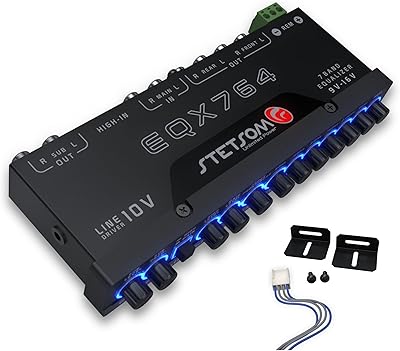
Stetsom EQX764 7-Band Car Audio Equalizer
85%
91%
Sound Quality Enhancement
89%
Ease of Installation
93%
Bass Control
85%
Frequency Band Flexibility
88%
Output Channels
More
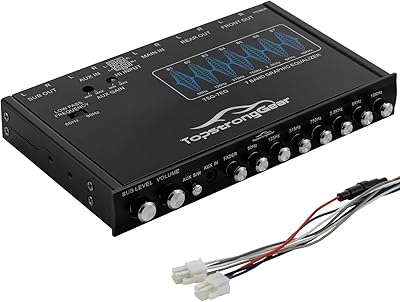
TOPSTRONGGEAR TSG7EQ 7-Band Car Audio Equalizer
83%
87%
Sound Quality
91%
Ease of Installation
84%
Bass Control
80%
Build Quality
85%
Connectivity Options
More
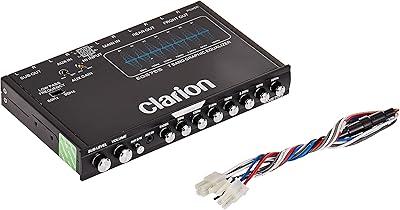
Clarion EQS755 7-Band Car Audio Equalizer
85%
89%
Sound Quality
85%
Connectivity Options
92%
Ease of Installation
87%
Build Quality
90%
Subwoofer Control
More
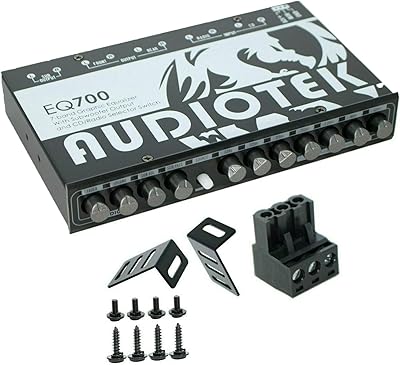
Audiotek AT-EQ700 7 Band Car Audio Equalizer
85%
91%
Bass Control
84%
Ease of Installation
87%
Sound Quality
85%
Compatibility with Audio Devices
92%
Customizability (Frequency Bands)
More
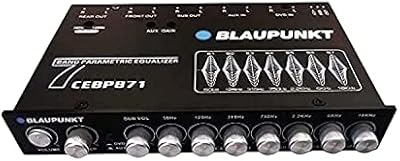
Blaupunkt CEBP871 7-Band Car Audio Graphic Equalizer
86%
89%
Sound Quality
91%
Ease of Installation
85%
Customization Options
87%
Input Versatility
82%
Build Quality
More
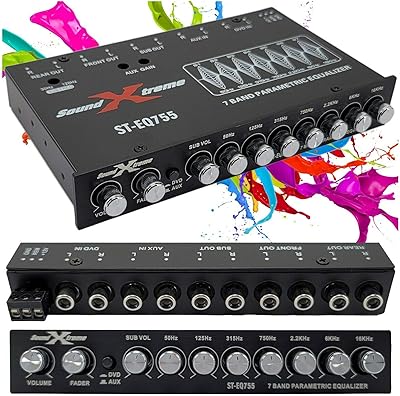
Xtremevision ST-EQ755 7-Band Car Audio Equalizer
82%
88%
Sound Quality
90%
Bass Performance
76%
Ease of Use
83%
Build Quality
71%
Setup & Installation
More
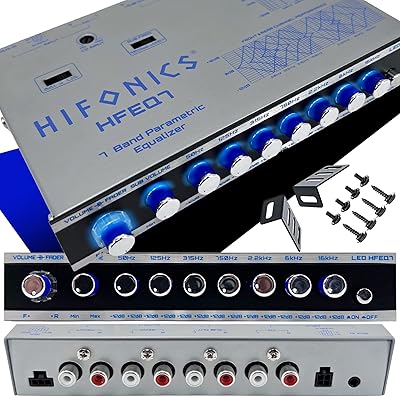
Hifonics HFEQ7 7-Band Pre-Amp Car Audio Equalizer
85%
88%
Sound Quality
94%
Ease of Installation
90%
Bass Control
85%
Build Quality
91%
Value for Money
More
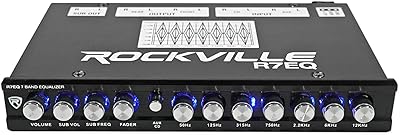
Rockville R7EQ 1/2 Din 7 Band Car Audio Equalizer

85%
89%
Bass Control
85%
Sound Clarity
72%
Ease of Setup
91%
LED Visibility
81%
Durability
More
Sound Storm Laboratories S4EQ 4 Band Pre-Amp Car Audio Stereo Equalizer
84%
88%
Sound Quality
93%
Ease of Installation
85%
Bass Response
80%
Build Quality
87%
Subwoofer Control
More
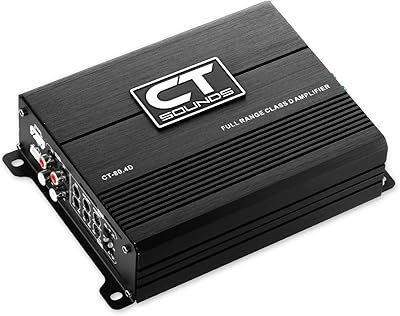
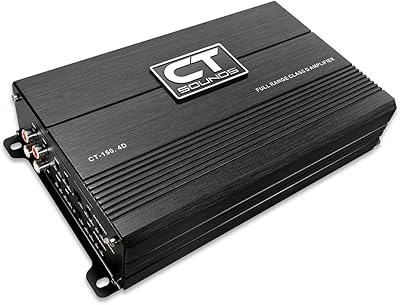
CT Sounds CT-80.4D 4-Channel Car Amplifier
74%
91%
Value for Money
78%
Power Output Accuracy
84%
Installation Ease
61%
Heat Management
67%
Build Quality
More
CT Sounds CT-150.4D 4-Channel Car Amplifier
75%
83%
Value for Money
78%
Sound Quality
61%
Build Quality
86%
Ease of Installation
77%
Thermal Management
More

FAQ

It works with virtually any head unit that has standard RCA preamp outputs, regardless of brand. You simply run RCA cables from your head unit into the equalizer, then from the equalizer out to your amplifier or directly to active speakers. Brand compatibility is not a concern here.

It is honest to say there is a learning curve, especially if you are used to graphic EQ sliders. Parametric EQs let you choose not just the level of a frequency but precisely which frequency you are targeting, which is more powerful but takes some getting used to. If you are willing to spend an evening experimenting and reading a few online tutorials about parametric equalization, you will get there. The included manual is fairly basic, so external resources will help.

Technically yes, since it passes signal through even without an amp in the chain. However, this equalizer is really designed as a signal processor that sits between your source and your amplifier. Using it as a standalone tone control feeding passive speakers directly through a head unit is possible but not where it shines.

A single-DIN head unit occupies the same amount of vertical space as a half-DIN unit, so they are not directly interchangeable in the same slot. However, many vehicles with a double-DIN opening and a single-DIN head unit have a storage pocket or blank panel below it — that lower half-DIN space is exactly where this equalizer would mount.

A graphic EQ has fixed frequency bands with fixed center points — you just boost or cut each one. A parametric EQ like this one lets you also select or sweep the center frequency of each band, which means you can target a very specific problem frequency rather than affecting a broad range around a fixed point. It gives you more surgical control, at the cost of a slightly steeper learning curve.

The unit does have illumination to make it visible in a dark cabin, but several buyers have noted that the labeling on the faceplate can be hard to read clearly in low light. It is functional, but do not expect the crisp, high-contrast display you would get from a premium head unit.

This is actually one of its strongest use cases. The dedicated sub-bass filter with selectable 43Hz and 60Hz options makes it well suited for integrating a subwoofer into your system. You can use it to shape the low-end crossover point and keep the sub from overlapping messily with your door speakers.

Most people with basic car audio experience and a set of standard tools can handle this themselves. The package includes mounting brackets and hardware, so you are not scrambling for parts. You will need to route RCA cables and potentially deal with tight dash spaces, but it is not a professional-only job. If you have never installed car audio before, watching a few installation videos beforehand is a good idea.

No, there is no remote control functionality and no steering wheel control integration. Any adjustments require physically reaching the unit in the dash. For most users this is fine since you set it once and rarely need to change it, but if you want something you can tweak on the fly, that is a limitation worth knowing about.

CT Sounds provides a one-year manufacturer warranty on this unit. For warranty claims you would need to contact CT Sounds directly with proof of purchase. As with most value-tier car audio brands, the warranty covers manufacturing defects but not damage from improper installation or misuse, so making sure the wiring is correct from the start is important.

Where to Buy