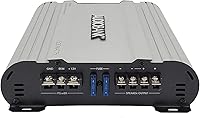
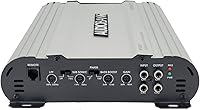
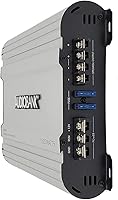
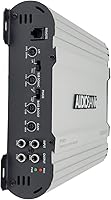
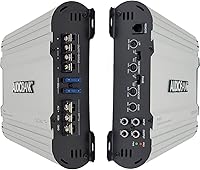
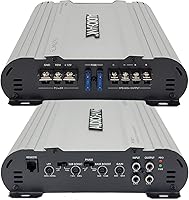
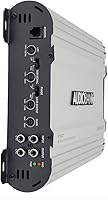
Overview

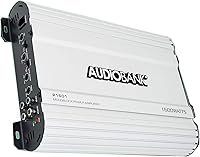
The Audiobank P1601 Monoblock Car Amplifier sits in an interesting spot for anyone building a bass-focused car audio system without breaking the bank. It runs on a Class AB MOSFET design — a topology that splits the difference between the raw efficiency of Class D and the more controlled output you get from Class A. On paper the power figures look aggressive: 1600W max, but 800W RMS is the number that actually matters when sizing it against a subwoofer. The form factor is compact enough to tuck into a trunk or under a rear seat without much fuss. The value here is real, though at this price tier there are trade-offs worth understanding before you commit.

Features & Benefits

What separates this monoblock amp from cheaper Class D units at similar price points is the MOSFET transistor stage, which handles heat more gracefully and keeps bass tighter under sustained load. The included remote subwoofer control is genuinely useful — being able to dial back the low end without reaching into the trunk is the kind of small convenience daily drivers actually appreciate. The dual-channel inputs play nicely with virtually any head unit, factory or aftermarket. At 800W RMS continuous, it has enough muscle to properly drive a single 10- or 12-inch sub at 2 or 4 ohms, and built-in thermal and short-circuit protection adds a meaningful reliability baseline for the price.

Best For

The P1601 is a natural fit for first-time installers who want a real, functional amplifier without wading through spec sheets padded with inflated peak-watt figures. If you are pairing it with a single 10- or 12-inch sub in a ported or sealed enclosure, this is the kind of setup it was built for. It also makes strong sense as a secondary vehicle build — a truck, a daily beater, or a weekend car where you want solid bass without committing serious money. Anyone wanting adjustable bass on demand without buying a standalone DSP will appreciate the included remote. For flagship-level ambitions, look further up the shelf.

User Feedback

Buyers consistently praise this Audiobank unit for being easy to install — the terminal layout is clearly labeled, and most people report getting it wired up without needing forum help. The jump in bass output over a factory system is the most commonly cited upside. On the downside, a notable portion of owners flag that measured output falls short of the rated 800W RMS figure, which is common in this segment but worth knowing ahead of time. Heat is another recurring theme; give this amp real airflow during extended high-volume sessions. Long-term reliability reports are mixed — some owners run it for years without issue, while others report problems after heavy use.

Pros

  • Class AB MOSFET design produces noticeably cleaner, tighter bass than typical Class D units at this price point.
  • The included remote subwoofer control lets you adjust bass level from the driver seat without touching the amp.
  • 800W RMS continuous output is enough muscle to properly drive a single 10- or 12-inch subwoofer at 2 or 4 ohms.
  • Compact dimensions make trunk or under-seat mounting straightforward even in tighter vehicle interiors.
  • Dual-channel inputs ensure compatibility with virtually any factory or aftermarket head unit right out of the box.
  • Terminal labeling is clear and installer-friendly, making the wiring process accessible for beginners.
  • Built-in thermal and short-circuit protection provides a meaningful safety baseline for the price.
  • Represents genuine value for first builds or secondary vehicle audio setups where budget is the primary constraint.
  • Ranked among the top car mono amplifiers on a major retail platform, reflecting broad buyer satisfaction at this tier.

Cons

  • Measured power output frequently falls short of the advertised 800W RMS figure, according to real-world user reports.
  • The unit can run noticeably warm during extended high-volume use, requiring adequate ventilation for reliable operation.
  • Long-term durability is inconsistent, with a meaningful portion of owners reporting performance issues after heavy sustained use.
  • No onboard bass boost or crossover adjustment options, limiting fine-tuning flexibility compared to similarly priced competitors.
  • Build materials and component quality reflect the budget tier, which may concern buyers planning a long-term permanent install.
  • Max power figures prominently displayed in marketing can mislead buyers who do not know to focus on RMS ratings.
  • No dedicated low-level outputs, which limits system expansion if you later want to add a second amplifier cleanly.

Ratings

The scores below reflect an AI-driven analysis of verified global buyer reviews for the Audiobank P1601 Monoblock Car Amplifier, with spam, bot-generated, and incentivized feedback actively filtered out before scoring. Each category captures what real owners experienced across a wide range of vehicle types, installation skill levels, and listening habits. Both the genuine strengths and the recurring frustrations are represented transparently, so you can make a fully informed call before purchasing.

Value for Money
84%
For buyers building their first subwoofer setup or outfitting a secondary vehicle, this monoblock amp delivers a level of bass performance that would have cost significantly more a few years ago. Most owners feel the price-to-output ratio holds up well, especially when compared to similarly priced competitors that offer less honest power ratings.
A portion of users who later measured actual output felt the value proposition weakened once they realized the amp falls short of its rated RMS figure under real load. If your budget cannot stretch to account for that gap, the value equation shifts.
Power Output Accuracy
57%
43%
At moderate listening volumes and with a well-matched 4-ohm subwoofer, the P1601 delivers enough usable bass output to satisfy most daily drivers who are not chasing reference-level SPL numbers. For casual listening environments, the power on hand is more than adequate.
Independent testing and user reports consistently show that measured output falls meaningfully short of the advertised 800W RMS figure, particularly at 4 ohms under sustained load. This is the most cited disappointment among technically informed buyers, and it is a real concern when sizing a subwoofer to match.
Installation Experience
88%
The terminal layout is among the clearer examples in this price class — inputs, outputs, and ground points are all labeled legibly, and the included hardware covers the basics without requiring an extra parts run. First-time installers repeatedly call out how approachable the wiring process felt compared to competing amps.
The unit does not include a full wiring kit, so buyers still need to source power cable, fuse holder, and RCA cables separately. A small number of users also noted that the remote bass control cable length is shorter than ideal for certain dashboard mounting locations.
Thermal Management
61%
39%
Under typical daily driving conditions at moderate volumes, the heatsink handles operating temperatures without issue, and the built-in thermal protection gives a meaningful safety net if things do get too warm. Most owners who give the amp adequate airflow report no persistent heat problems.
Running this Audiobank unit hard for extended sessions in a confined space — like a fully sealed trunk compartment — causes it to run noticeably warm, and some owners report thermal shutdowns during long highway drives at high volume. The passive cooling design simply has limits that become apparent under sustained stress.
Bass Quality
76%
24%
The Class AB MOSFET design produces bass that sounds tighter and less muddy than you typically get from budget Class D alternatives, and daily drivers pairing it with a ported 12-inch sub frequently describe the low-end output as punchy and satisfying for everyday music listening. For hip-hop, EDM, and bass-heavy genres, the character of the output gets consistent praise.
At the upper limits of the volume range, some listeners detect a degree of looseness and compression in the low end that more controlled amplifiers avoid. Audiophiles or anyone tuning a system for accuracy rather than impact will find the bass character a bit blunt.
Build Quality
63%
37%
The chassis feels reasonably solid for a budget amp, and the heatsink construction is adequate for the intended use case. Most owners do not report any cosmetic or structural issues right out of the box, and the overall assembly appears consistent across units.
The internal component quality reflects the price tier, and longer-term durability reports are noticeably mixed. A subset of owners have experienced performance degradation or outright failure after a year or more of regular use, which suggests the unit was not designed for the long haul.
Long-Term Reliability
58%
42%
A solid portion of owners have been running this monoblock amp for over a year without any functional issues, particularly those who installed it with proper ventilation and matched it to a reasonably efficient subwoofer. For light-to-moderate daily use, many units hold up fine.
Failure rates over the 12-to-18-month mark appear higher than average for this category, with overheating under heavy use being the most frequently cited precursor to problems. Buyers planning a permanent, long-running install should weigh this risk seriously before committing.
Compatibility
86%
The dual RCA inputs and standard impedance support make this amp compatible with the vast majority of factory and aftermarket head units without any additional adapters in most cases. Whether you are running a double-DIN Android unit or a stock receiver with a line output converter, integration is generally plug-and-play.
Owners with DSP-based systems or high-output preamp voltages from premium head units occasionally report signal matching challenges. There is no adjustable input sensitivity display, so dialing in gain precisely requires a multimeter or an experienced ear.
Remote Bass Control
81%
19%
The wired remote level knob is a practical addition that daily drivers genuinely appreciate — being able to roll back the bass when switching from hip-hop to podcasts without pulling over is exactly the kind of usability feature that improves the ownership experience. The knob action feels smooth and responsive.
The control cable included in the box is on the shorter side, which can be limiting depending on where the amp is mounted relative to the dashboard. A small number of users have also reported the pot developing a slight crackle after extended use.
Noise Floor
71%
29%
Under normal installation conditions with proper grounding, most users report a clean signal with no audible hiss or hum at idle. For a budget amp, the noise performance is acceptable and unlikely to be noticeable once music is playing.
Grounding issues or poor-quality RCA cables can introduce ground loop hum, and the amp does not include any built-in noise filtering to compensate. A subset of owners experienced persistent low-level hum that required troubleshooting the ground path to resolve.
Size & Fitment
83%
At under 15 inches long and roughly 3 inches tall, this amp fits comfortably in most trunk installations and can be tucked under a rear seat platform in many SUVs and hatchbacks. The lightweight chassis makes it easy to handle solo during a DIY install.
While compact by monoblock standards, it is still too large for truly tight under-seat installs in smaller sedans or sports cars with low floor clearance. Buyers in vehicles with minimal trunk space should measure carefully before purchasing.
Gain & Crossover Controls
67%
33%
The onboard gain control is accessible and functional, and the low-pass crossover gives enough basic adjustability to get a subwoofer blending reasonably well with most factory speaker setups. For a straightforward single-sub build, the control set covers the fundamentals.
There is no subsonic filter, which is a meaningful omission for anyone running a ported enclosure, where unloaded cone excursion at very low frequencies can damage a sub over time. The crossover adjustment range is also narrower than what you get on competing amps at a similar price point.
Packaging & Unboxing
78%
22%
The unit arrives well-protected and includes the remote bass control and basic mounting hardware, which is a step above some competitors that ship nothing but the amp itself. First impressions from unboxing are generally positive, with no reports of shipping damage in the majority of feedback reviewed.
The instruction manual is minimal and lacks detail for buyers who are new to car audio installation. A few users noted that clearer guidance on gain setting and crossover adjustment would have saved them significant time during setup.

Suitable for:

The Audiobank P1601 Monoblock Car Amplifier is a strong match for first-time car audio builders who want to add real, felt bass to their vehicle without spending a lot or navigating complex installation procedures. If you are pairing a single 10- or 12-inch subwoofer with a standard aftermarket or even factory head unit, this amp is sized and spec'd for exactly that kind of build. Daily drivers who want the convenience of adjustable bass from the front seat will find the included remote level control a practical bonus that normally costs extra at this price tier. It also makes a lot of sense for secondary vehicles — a truck, a commuter car, or a seasonal build — where the goal is solid, enjoyable bass on a controlled budget. Buyers who understand that 800W RMS is the meaningful power figure and plan their subwoofer pairing accordingly will get the most out of this monoblock amp.

Not suitable for:

The Audiobank P1601 Monoblock Car Amplifier is not the right tool for enthusiasts who need verified, measured power output to match a high-sensitivity subwoofer or a demanding competition build. If you are running multiple subs, need bridged multi-channel capability, or are building a system where thermal headroom during long high-volume sessions is non-negotiable, this unit has real limitations worth taking seriously. Buyers who prioritize long-term durability above all else should note that field reliability reports are genuinely mixed, and the unit may not hold up as well under sustained heavy use as a mid-range or premium amplifier would. Audio purists chasing flat frequency response and precision tuning will also find the feature set too basic for their needs. If your build depends on consistently delivering close to rated RMS output under load, independent measurements suggest you should set your expectations accordingly or budget for a step-up option.

Specifications

  • Power Output: This monoblock amp delivers 800W RMS of continuous power, with a 1600W peak (max) rating that reflects short-burst headroom rather than sustained output.
  • Amplifier Class: Operates as a Class AB amplifier, balancing the efficiency of Class D with the smoother audio characteristics typically associated with Class A designs.
  • Transistor Type: Uses MOSFET transistors, which contribute to improved thermal stability and more controlled bass reproduction compared to bipolar transistor designs common at this price tier.
  • Channels: Single-channel monoblock configuration, purpose-built for driving one subwoofer or a pair of subs wired to a single combined load.
  • Input Channels: Accepts a 2-channel (stereo) input signal, making it straightforward to connect to both factory and aftermarket head units using standard RCA cables.
  • Mounting Type: Designed for surface mounting, allowing installation on flat surfaces in a trunk floor, cargo area wall, or the underside of a rear seat platform.
  • Dimensions: The chassis measures 14.21 x 9.21 x 2.95 inches, a compact profile for an 800W RMS monoblock that fits in tight installation spaces.
  • Weight: At 4.89 pounds, the unit is light enough for a single-person install and does not require reinforced mounting surfaces in most vehicles.
  • Remote Control: Includes a wired remote subwoofer level control, allowing the driver to adjust bass output from the front seat without accessing the amplifier directly.
  • Protection Circuits: Built-in thermal protection and short-circuit protection help prevent damage from overheating or wiring faults during normal and aggressive use.
  • Model Number: Officially designated as the P1601, manufactured and sold under the Audiobank brand since its introduction in October 2019.
  • Impedance Load: Compatible with 2-ohm and 4-ohm subwoofer loads, giving buyers flexibility when choosing a matching subwoofer or wiring dual voice coil drivers.
  • Signal Input: Accepts low-level RCA inputs, the standard connection type for virtually all aftermarket and most OEM-integration head units with preamp outputs.
  • Cooling Design: Relies on passive heatsink cooling through its chassis; proper airflow clearance around the unit is required to maintain operating temperatures within safe limits.

Related Reviews
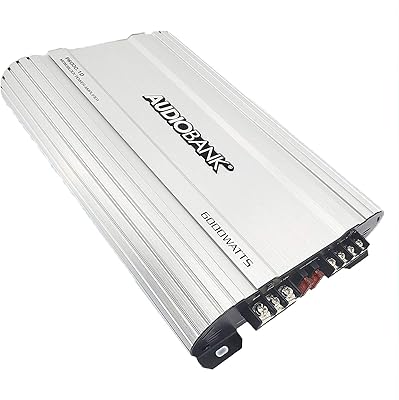
Audiobank P6001 6000W Class D Monoblock Car Amplifier
86%
90%
Audio Performance
87%
Ease of Installation
91%
Thermal Protection
85%
Build Quality
89%
Power Output
More
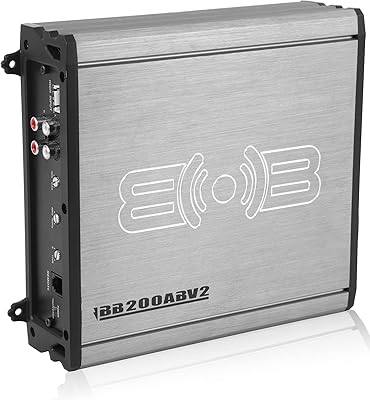
Belva BB200ABv2 500W Monoblock Car Amplifier
85%
88%
Bass Performance
91%
Installation Ease
85%
Sound Clarity
89%
2-Ohm Stability
82%
Build Quality
More
LKC PHF450D Car Audio Monoblock Amplifier
88%
91%
Power Output (2 Ohms)
87%
Power Output (4 Ohms)
93%
Heat Dissipation
88%
Build Quality
85%
Ease of Integration
More
Audiobank P8001 Monoblock Car Amplifier
63%
74%
Value for Money
31%
Power Accuracy
81%
Ease of Installation
57%
Build Quality
53%
Thermal Management
More
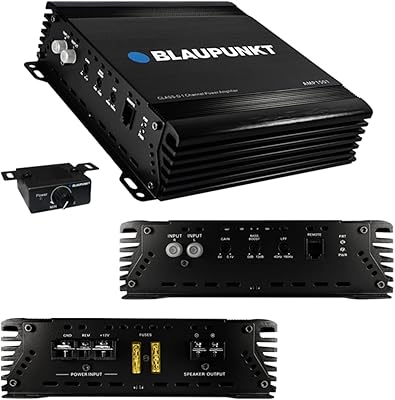
Blaupunkt AMP1500M Monoblock Car Amplifier
73%
81%
Value for Money
63%
Real-World Power Output
88%
Ease of Installation
77%
Audio Clarity
58%
Build Quality
More
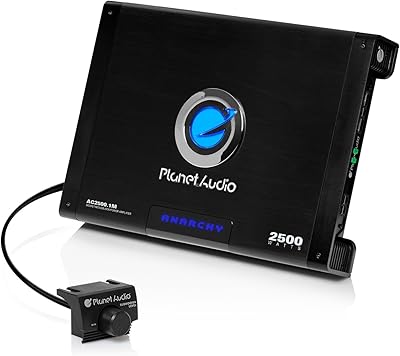
Planet Audio AC2500.1M Monoblock Car Amplifier
85%
92%
Performance
95%
Bass Output
85%
Ease of Installation
65%
Thermal Performance
88%
Build Quality
More
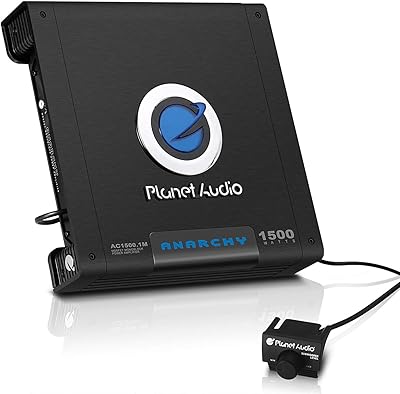
Planet Audio AC1500.1M Monoblock Car Amplifier
75%
91%
Value for Money
78%
Bass Output Quality
86%
Ease of Installation
61%
Thermal Management
67%
Build Quality
More
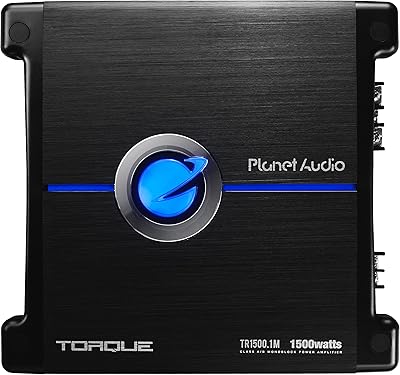
Planet Audio TR1500.1M Monoblock Car Amplifier
70%
88%
Value for Money
79%
Bass Output & Performance
83%
Ease of Installation
63%
Build Quality
57%
Thermal Management
More
BOSS Audio R1600M Monoblock Car Amplifier
72%
83%
Value for Money
88%
Ease of Installation
79%
Bass Output
61%
Build Quality
86%
Signal Flexibility
More
Audiobank P1502 2-Channel Car Amplifier
69%
83%
Value for Money
81%
Ease of Installation
68%
Sound Quality
78%
Bass Performance
58%
Build Quality
More

FAQ

A single 10-inch or 12-inch subwoofer is the sweet spot for this monoblock amp. Wired at 2 or 4 ohms, either size will draw power efficiently from the 800W RMS output. Going with a higher-sensitivity sub will help you get the most perceived volume from the available wattage.

Yes, you can, though it depends on your factory unit. If your stock head unit has RCA preamp outputs, the connection is straightforward. If it does not, you will need a line output converter to step the speaker-level signal down to RCA level before running it to the amp. That is a common and inexpensive fix.

The 800W RMS figure is what the Audiobank P1601 Monoblock Car Amplifier can actually sustain continuously under normal operating conditions. The 1600W max number refers to brief, instantaneous peaks and is not a reliable measure of everyday power delivery. When matching an amp to a subwoofer, always compare RMS ratings on both sides.

It genuinely works and is one of the more practical features on this unit. It is a simple wired knob that plugs into the amp and can be mounted within reach of the driver seat. If you are someone who switches between music genres or drives in varied environments, being able to pull the bass back without touching the amp is a real convenience.

Give it at least a few inches of open airspace on all sides, especially above and behind the unit where heat tends to accumulate. If you are tucking it into a sealed enclosure or under a carpet without airflow, you will likely trigger the thermal protection during longer sessions at high volume. A small cooling fan nearby is a simple fix if installation space is very tight.

Not really. The terminal layout is clearly labeled, and the connection points are standard enough that most people with basic car audio knowledge can get it wired up in a few hours. You will need to run a power cable from the battery, a ground cable to the chassis, a signal cable from the head unit, and the speaker wire to your sub. Plenty of installation guides online cover exactly this type of setup.

Technically yes, if you wire them in parallel to hit a compatible total impedance — typically 2 ohms — but you will be splitting the available power between both drivers. The amp is really designed with a single subwoofer build in mind, and running two subs increases the thermal load. If two subs are your goal, you would be better served by an amp rated for that from the start.

It does run on the warmer side under sustained hard use, which is consistent with Class AB designs in general. Most owners who report heat issues are running it in confined spaces without adequate airflow. Proper mounting with clearance around the heatsink resolves the problem for the majority of users. The built-in thermal protection will shut the unit down before damage occurs if it does overheat.

Durability reports are genuinely mixed. A lot of owners run it without issue for a year or more, while others have reported problems after heavy extended use. It is a budget amp, and the component tolerances reflect that. If you are building a permanent system in a vehicle you plan to keep long term and listening loud regularly, it may be worth budgeting for something a step up in build quality.

The amp itself and the remote bass control come in the box, but you will need to source the installation hardware separately. That means a wiring kit with power cable, fuse, ground wire, and RCA cables. These are sold as bundled kits and are widely available — budget an additional amount for a quality wiring kit sized appropriately for 800W RMS, which typically means at least 4-gauge power wire.

Where to Buy