Overview

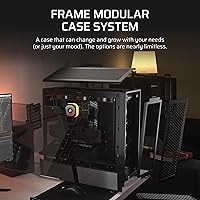
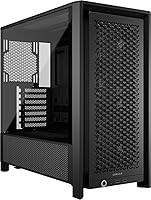
The Corsair FRAME 4000D RS Mid-Tower Case sits in an interesting spot — competitive enough on price to attract budget-conscious builders, capable enough to satisfy enthusiasts who know what they want from an airflow-focused design. What separates it from the usual mid-tower crowd is the FRAME modular system, which lets you swap out panels, the motherboard tray, and front I/O as your needs evolve — not just cosmetically, but functionally. It also ships with reverse-connector motherboard support, a meaningful nod to where modern builds are heading. Sitting at #15 in Computer Cases with a 4.7-star average across nearly 20,000 ratings, reception has been strong — though GPU width constraints are worth noting before you commit.
Features & Benefits

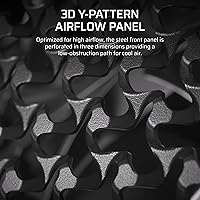
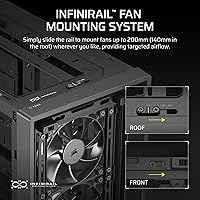
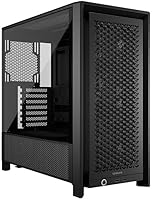
The InfiniRail mounting system is one of the genuinely clever ideas here. Rather than drilling fans into fixed screw points and hoping your radiator lines up, you slide the steel rail to position fans exactly where airflow logic — not case design limitations — dictates. The front intake uses a perforated steel panel with a 3D Y-pattern that reduces restriction compared to typical mesh designs. Three RS PWM fans come pre-installed up front with daisy-chain support that simplifies wiring considerably, and Zero RPM mode keeps things quiet at idle. The internal side panel doubles as either a cable cover or an extra fan mount — a small choice that reflects real builder flexibility.

Best For

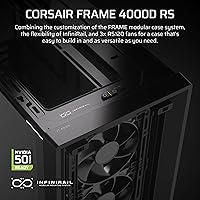
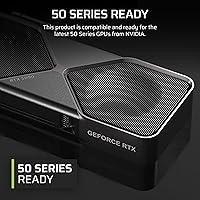
This modular case makes the most sense for builders pairing it with a high-TDP card like the RTX 5090 Founders Edition, which fits within clearance specs — though owners of oversized AIB cards like the Asus ROG Astral or Gigabyte AORUS variants will need a 90-degree cable adapter to clear the 158mm width limit. Beyond GPU compatibility, it suits enthusiasts who expect to iterate on their build over the next few years, since the FRAME system means you're not locked into today's I/O or layout choices. It also works well for BTF-style builds using reverse-connector motherboards, and for anyone who wants near-silent idle behavior without sacrificing serious cooling headroom when loads spike.

User Feedback

Across verified buyer reviews, out-of-box fan performance and overall build quality get consistent praise — people appreciate that the included fans are actually worth keeping rather than being placeholder hardware. The cable management options also draw favorable mentions, particularly the flexibility of the removable side panel. On the critical side, the front I/O offering just two USB 3.0 ports feels thin for a case at this tier, and a handful of buyers found the InfiniRail system less intuitive than expected during initial setup. Some users with large AIB GPUs had to source 90-degree cables separately, which wasn't clearly flagged at purchase. That said, several reviewers directly compared the FRAME 4000D RS to pricier Lian Li and Fractal options and felt it held its own comfortably.

Pros

  • The modular FRAME system lets you swap panels, I/O, and the motherboard tray as your build needs evolve over time.
  • Three RS PWM fans come pre-installed and are genuinely worth keeping — not the usual throwaway placeholders.
  • InfiniRail lets you position fans exactly where airflow logic demands, not where fixed screw holes happen to land.
  • Zero RPM mode keeps the system near-silent at idle without any manual fan curve tweaking required.
  • The 3D Y-pattern steel front panel provides a notably less restrictive intake path than typical solid mesh panels.
  • Fits the RTX 5090 Founders Edition without modification — confirmed clearance for long, wide flagship GPUs.
  • Reverse-connector motherboard compatibility makes this a practical choice for modern BTF-style builds.
  • The internal side panel doubles as a cable management cover or an additional fan mount depending on your priorities.
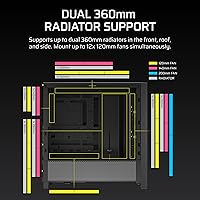
  • Radiator support up to 360mm across multiple locations gives liquid cooling builds real flexibility in loop design.
  • At this price tier, the build quality and included hardware compare favorably to cases costing noticeably more.

Cons

  • Only two USB 3.0 ports on the front I/O panel feels underwhelming for a case at this price and feature level.
  • Owners of oversized AIB GPUs must purchase a 90-degree cable adapter separately — this is rarely flagged clearly at the point of sale.
  • The InfiniRail system has a steeper setup learning curve than traditional fixed fan mounts, especially for first-time builders.
  • No USB-C port on the front I/O in the base configuration is a real omission as modern peripherals increasingly depend on it.
  • The modular upgrade ecosystem is promising in theory, but additional FRAME components cost extra and availability can be inconsistent.
  • At 18 pounds, this Corsair mid-tower is on the heavier end of the segment, which matters if you move your rig frequently.
  • Daisy-chaining the included fans requires attention to header compatibility — not all motherboards handle this configuration without additional adapters.
  • Tempered glass side panels look sharp but add weight and are unforgiving if a build needs frequent internal access for testing or iteration.

Ratings

The scores below reflect an AI-driven analysis of thousands of verified global buyer reviews for the Corsair FRAME 4000D RS Mid-Tower Case, with spam, bot-generated, and incentivized feedback actively filtered out before scoring. Each category is weighted against real-world usage patterns reported by builders across a range of experience levels and build configurations. Both the standout strengths and the recurring frustrations are represented transparently — nothing is glossed over to make the product look better than it actually performs in practice.

Airflow Performance
91%
Buyers consistently report lower CPU and GPU temperatures compared to their previous cases, crediting the 3D Y-pattern front panel for genuinely reducing intake restriction rather than just looking the part. The combination of three front-mounted RS fans and an open internal layout means air moves through the chassis with minimal dead zones even under sustained gaming or rendering loads.
A small number of users noted that the roof exhaust configuration, while capable, requires deliberate fan placement via InfiniRail to reach its full potential — builders who left the roof empty reported slightly warmer results than those who populated it. The case rewards thoughtful setup but does not self-optimize.
Build Quality
88%
The steel frame feels rigid without being unnecessarily heavy, and panel fitment is tighter than what buyers typically expect at this price tier. Multiple reviewers who had previously owned cases from Fractal Design and Lian Li noted that the FRAME 4000D RS felt comparable in material quality, which is meaningful praise given the price gap.
A few buyers flagged that some of the removable modular panels have slightly looser tolerances than the fixed structural elements, occasionally producing a faint rattle under vibration from high-RPM fans. It is not a widespread complaint, but it comes up often enough to be worth noting for noise-sensitive builders.
Modularity & Upgradability
86%
The FRAME platform genuinely delivers on its promise of future-proofing — the ability to swap out the front I/O panel or upgrade the motherboard tray material down the line is something enthusiasts actively praised, particularly those who have been burned by cases that felt outdated within two years. It reframes the case as a long-term platform rather than a one-build purchase.
The upgrade ecosystem is compelling in concept but requires additional spending, and accessory availability has been inconsistent depending on region and retailer. Builders who expected out-of-box completeness felt the modular angle was more of a future promise than an immediate benefit.
Fan Mounting System
83%
The InfiniRail sliding system earned genuine appreciation from experienced builders who have dealt with misaligned radiators and fixed-hole frustration in other cases. Being able to dial in fan positioning without worrying about hole spacing makes radiator and push-pull configurations noticeably less stressful to execute.
First-time and intermediate builders had a harder time with it — the lack of clear tactile positioning feedback during initial setup led to some trial-and-error that added time to the build. The system is better than fixed mounting in every objective sense, but the learning curve is real and not everyone enjoyed figuring it out.
GPU Compatibility
78%
22%
The 430mm length clearance handles virtually every current consumer GPU without issue, and the RTX 5090 Founders Edition fits cleanly with room to spare. Builders using standard-width cards had zero fitment problems and appreciated the extra breathing room around the GPU for airflow.
The 140mm standard-cable width limit becomes a real obstacle for oversized AIB cards like the Asus ROG Astral and Gigabyte AORUS variants, which require a 90-degree power cable adapter that does not come in the box. Several buyers felt this should be called out more prominently before purchase, and a handful had to delay their build while waiting for the adapter to arrive.
Cable Management
87%
The dual-purpose internal side panel is a genuinely smart design choice — using it as a cable cover lets builders achieve a clean finished look without extensive cable routing discipline, which many reviewers found refreshing. Routing channels and anchor points are well-placed for ATX motherboard layouts specifically.
Builders using modular power supplies with particularly thick or stiff cables noted that the rear routing channels, while adequate, do not offer as much depth as some competing cases. Getting the side panel to sit flush after routing can require patience with bulkier cable bundles.
Noise Level
84%
Zero RPM mode on the pre-installed RS fans makes idle operation genuinely quiet — multiple reviewers working from home noted they could barely tell the machine was running during low-load tasks. At moderate loads, fan noise stays controlled and is described as a neutral hum rather than an intrusive whine.
Under full sustained load with all three front fans at high RPM, noise becomes more noticeable, which is expected physics but worth flagging for home studio users or those in shared spaces. The case has no foam dampening on any panels, so vibration noise at high fan speeds passes through more directly than in acoustically treated alternatives.
Front I/O Connectivity
58%
42%
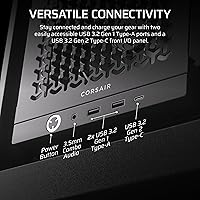
The two USB 3.0 ports are reliable and solidly built — no loose connector complaints surfaced in the review data, and they provide enough bandwidth for typical peripheral connections during a normal gaming or productivity session.
Two USB 3.0 Type-A ports and no USB-C is a notable shortcoming for a case at this price and feature level in 2025. Buyers who regularly connect external SSDs, modern controllers, or capture cards found themselves reaching for a USB hub almost immediately, which undermines the clean build aesthetic the case is otherwise designed to achieve.
Liquid Cooling Support
89%
360mm radiator support at the front and flexible roof mounting give liquid cooling enthusiasts real configuration options without needing to compromise placement. Reviewers running custom loops specifically appreciated the InfiniRail compatibility with radiator mounting, which simplified alignment considerably.
The roof is limited to 140mm fans in the rail configuration, which means a 360mm roof radiator is not a realistic option — builders planning aggressive dual-radiator setups may find this limiting. Pump and reservoir placement also requires planning since internal space around the PSU shroud is not generous.
Ease of Assembly
74%
26%
Experienced builders generally found the assembly process straightforward, with logical component placement and enough internal space to work comfortably without cramped hands. The removable side panel and modular components make reaching tight areas easier than in traditionally fixed designs.
Newer builders ran into friction with the InfiniRail setup and the modular panel system, which behaves differently from the standard screw-in approach most tutorials assume. Documentation included in the box is functional but thin, and a few users wished Corsair offered more detailed video guidance for the FRAME-specific assembly steps.
Aesthetics
82%
18%
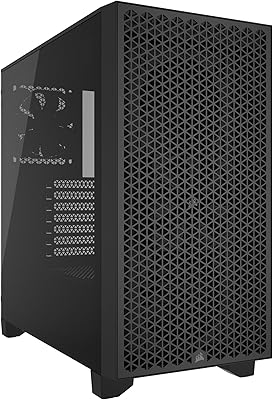
The matte black finish and clean external lines give this Corsair mid-tower a restrained, purposeful look that holds up well in both minimalist and RGB-heavy builds. The tempered glass panel provides a clear view of internals without the greenish tint that cheaper glass panels tend to produce.
There is no RGB lighting included on the case itself, and the exterior styling is deliberately understated — builders who want the case to be a visual centerpiece on its own will likely find it too plain. The perforated front panel, while airflow-optimized, does not have the premium visual weight of some fabric mesh competitors.
Value for Money
85%
The combination of three usable pre-installed fans, a modular upgrade platform, and build quality that competes with pricier alternatives makes the overall package feel well-priced for what it delivers. Reviewers who compared it directly to Fractal and Lian Li cases in a higher price bracket felt they were not meaningfully sacrificing quality.
Buyers who need the FRAME upgrade accessories to unlock the full modular benefit will find that the total cost climbs quickly, and the base price starts to feel less competitive when those additions are factored in. For builders who will never swap components, some competitors offer similar performance for slightly less.
Reverse Connector Compatibility
91%
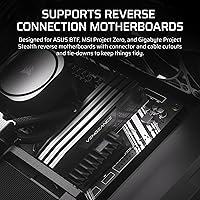
Confirmed BTF motherboard compatibility from day one positions this modular case as one of the more forward-looking options currently available at this price. Builders investing in reverse-connector systems appreciated not having to cross-check compatibility or make routing compromises.
The benefit only applies to a still-growing subset of builders using BTF-style boards, so for the majority of standard ATX builds it reads as a neutral feature rather than an active advantage. Corsair does not provide detailed guidance on optimal cable routing for reverse-connector configurations, leaving some builders to work it out independently.
Packaging & Unboxing
76%
24%
Components arrived well-protected in the majority of cases reviewed, with adequate foam and cardboard separation preventing damage to the tempered glass panel during shipping — a common weak point for mid-tower cases. Most buyers described the unboxing experience as clean and organized.
A small but consistent number of reviewers reported cosmetic damage to the steel frame or minor panel misalignment upon arrival, suggesting some variability in packaging robustness across fulfillment centers. Replacement part requests through Corsair support were generally resolved, but the initial disappointment for those buyers was real.

Suitable for:

The Corsair FRAME 4000D RS Mid-Tower Case is a strong match for PC builders who think beyond their current build and want a chassis that can actually keep pace with future upgrades. If you are pairing it with a power-hungry GPU like the RTX 5090 Founders Edition and need confirmed clearance alongside serious intake airflow, this case checks both boxes without requiring you to immediately buy additional fans. It also makes a lot of sense for anyone exploring BTF-style or reverse-connector motherboard builds, since compatibility is baked in rather than bolted on as an afterthought. Gamers and content creators who want a quiet system at idle but need the cooling headroom when workloads spike will appreciate the Zero RPM fan behavior combined with the genuinely open front intake geometry. Builders in the mid-to-upper-mid budget range who want modular flexibility — swappable I/O, repositionable fan rails, adaptable panel layout — without paying flagship prices will find the value proposition here hard to argue with.
Not suitable for:

Buyers planning to install oversized AIB graphics cards — think Asus ROG Astral, Gigabyte AORUS Master, or MSI Vanguard variants of the RTX 5090 — should know upfront that standard cables will not clear the 158mm GPU width limit; a 90-degree adapter cable becomes a required purchase, not an optional one, and that extra step frustrates builders who expect everything to fit cleanly out of the box. The Corsair FRAME 4000D RS Mid-Tower Case also runs into limitations on front I/O, offering just two USB 3.0 ports in its base configuration — a genuine inconvenience for desks loaded with peripherals, external drives, or streaming gear that constantly cycles connections. The InfiniRail system, while genuinely flexible once understood, has a learning curve that some less experienced builders find unexpectedly fiddly, particularly when trying to configure radiators and fans simultaneously. Those who prefer an ITX or Micro-ATX form factor will need to look elsewhere entirely, and anyone who wants a case that simply opens up and builds intuitively without consulting documentation may prefer a more conventional layout from competing brands.
Specifications

  • Form Factor: Mid-Tower chassis compatible with ATX motherboards in a standard desktop upright orientation.
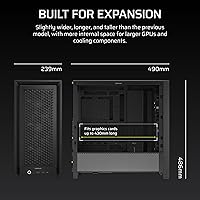
  • Dimensions: The case measures 19.17 x 9.41 x 19.13 inches (L x W x H), providing ample internal volume for high-end component configurations.
  • Weight: Fully assembled unit weighs 18.04 pounds (approximately 8.2 kg) before components are installed.
  • Included Fans: Three CORSAIR RS PWM fans come pre-installed at the front intake, each supporting 4-pin daisy-chain connections and Zero RPM low-load mode.
  • Fan Mounting: The InfiniRail sliding steel rail system allows front fans up to 200mm and roof fans up to 140mm to be repositioned freely along the rail without fixed screw points.
  • Radiator Support: Supports radiators up to 360mm in the front and roof positions, accommodating most standard all-in-one and custom liquid cooling configurations.
  • GPU Clearance: Maximum GPU length is 430mm with no fans installed; maximum GPU width is 158mm when using a 90-degree power cable, and 140mm with a standard cable.
  • Front Panel: Perforated steel front panel features a three-dimensional Y-pattern perforation geometry engineered to minimize airflow restriction at the intake.
  • Side Panel: Full-length tempered glass side panel provides a clear view of internal components with a tool-assisted removal mechanism.
  • Motherboard Support: Officially compatible with ATX form factor motherboards, including reverse-connector BTF-style variants from major manufacturers.
  • Front I/O: Front panel I/O includes two USB 3.0 Type-A ports; no USB Type-C port is present in the base configuration.
  • PSU Mount: Power supply unit mounts at the bottom of the chassis with a dedicated shroud area to conceal cabling and improve interior aesthetics.
  • Internal Panel: A removable internal side panel adjacent to the motherboard tray functions either as a cable management cover or as an additional fan mounting surface.
  • Modular System: The FRAME modular platform supports swappable front I/O panels, motherboard trays, and structural panels sold separately as upgrade accessories.
  • Front Fan Size: Front InfiniRail accommodates fans up to 200mm, allowing a mix of standard 120mm, 140mm, or oversized fan configurations.
  • Roof Fan Size: Roof mounting via InfiniRail supports fans up to 140mm in diameter for exhaust or radiator configurations.
  • Model Number: Official Corsair model number is CC-9011312-WW, which can be used to verify compatibility with FRAME ecosystem accessories.
  • Color: Available in matte black finish across the steel frame, panels, and fan shroud components.

Related Reviews

Corsair 6500D Airflow Mid-Tower ATX Case
85%
88%
Cooling Performance
93%
Build Quality
91%
Airflow Efficiency
85%
Ease of Setup
90%
Cable Management
More
Corsair 3000D Airflow Mid-Tower PC Case
81%
93%
Airflow Performance
88%
Build Quality & Materials
91%
Thermal Management Design
84%
Cable Management
61%
Included Fans Quality
More
Corsair iCUE 5000T RGB Mid-Tower Case
87%
91%
Build Quality
89%
Cooling Performance
87%
Ease of Setup
92%
Design & Aesthetics
85%
Cable Management
More
Corsair iCUE 4000X RGB Mid-Tower Case
81%
88%
Build Quality
71%
Airflow Performance
93%
RGB Lighting Quality
86%
Cable Management
74%
iCUE Software Integration
More
Corsair 3500X ARGB Mid-Tower ATX PC Case
84%
92%
Cooling Performance
87%
Build Quality
90%
Design & Aesthetics
85%
Ease of Installation
89%
Airflow Support
More
Corsair iCUE LINK 6500X RGB PC Case
79%
91%
Build Quality
93%
Aesthetic Design
88%
RGB Lighting
79%
Cable Management
87%
Cooling Performance
More
Thermaltake Tower 600 Mid-Tower ATX Case
79%
91%
Build Quality
93%
Aesthetic Design
88%
Cable Management
94%
Cooling Capacity
71%
Installation Experience
More
HYTE Y40 Mid-Tower ATX Case
85%
89%
Design & Aesthetics
86%
Cooling Performance
91%
Cable Management
93%
Build Quality
72%
GPU Compatibility
More
SAMA 3509 ATX Mid Tower PC Case
74%
88%
Value for Money
74%
Build Quality
81%
Airflow & Cooling Performance
67%
Pre-installed Fan Quality
86%
Tempered Glass Panel
More
SAMA V60 Mid Tower PC Case
80%
93%
Out-of-Box Cooling Value
78%
Airflow Performance
91%
AIO & Radiator Flexibility
88%
Tempered Glass & Aesthetics
71%
Build Quality & Materials
More

FAQ

Yes, the RTX 5090 Founders Edition fits within the GPU length clearance of 430mm. Width is not an issue for the FE card specifically. Where things get more complicated is with oversized AIB cards like the Asus ROG Astral or Gigabyte AORUS variants — those require a 90-degree power cable adapter to clear the 158mm width limit, which is not included in the box.

Instead of drilling fans into fixed screw holes, the InfiniRail is a sliding steel rail that lets you move fans to any position along the front or roof track. It is genuinely more flexible than traditional mounting, but a handful of buyers found the initial setup less intuitive than expected — particularly when trying to align a radiator and fans at the same time. Worth reading the instructions once before diving in.

No, the base configuration only includes two USB 3.0 Type-A ports on the front panel. There is no USB-C in the standard setup, which is a real limitation if your workflow involves frequently connecting modern peripherals or external SSDs. Corsair's FRAME modular system theoretically allows I/O panel upgrades, but that requires purchasing a separate accessory.

Yes, the Corsair FRAME 4000D RS Mid-Tower Case is confirmed compatible with reverse-connector motherboards, including BTF-style designs from Asus and MSI. The internal layout accounts for the different cable routing that these boards require, making it a practical choice if you are building a clean rear-cable system.
The three RS PWM fans support Zero RPM mode, which means they stop spinning entirely at low loads — so at idle or during light tasks, the case is effectively silent. Under heavy GPU or CPU load they ramp up, but the consensus from buyers is that noise levels remain reasonable compared to similarly specced cases.

The case is officially designed around ATX motherboards. Micro-ATX boards will physically fit in most ATX cases including this one, but the layout and fan positioning are optimized for full ATX. Mini-ITX is not a practical fit here given the case size and internal layout.

Yes, the front of the case supports a 360mm radiator, which is where most builders will put one. The roof also supports radiator mounting, though it is limited to 140mm fans in that position, so a 280mm radiator is more realistic there. You will want to plan fan and radiator placement before building since the InfiniRail system gives you flexibility but also requires deliberate configuration.

The FRAME system allows you to swap out the front I/O panel, the motherboard tray material (an aluminum upgrade tray is available), and structural panels. The base case comes fully functional, but the upgrade accessories are sold separately and can add up depending on how far you want to take the customization. Think of the modular aspect as a long-term investment rather than something you need to act on right away.

Buyers consistently rate the cable management options highly. The removable internal side panel near the motherboard tray is a particularly practical feature — you can use it as a cover to hide cables for a clean look, or remove it entirely and mount additional fans there for more airflow. Routing channels and tie-down points are well positioned for ATX builds.

Several verified buyers who had previously owned cases from Fractal Design and Lian Li noted that the FRAME 4000D RS held up well in build quality and airflow performance comparisons, and often came in at a lower price for similar or better included fan hardware. Where it falls short is front I/O — Fractal and Lian Li cases at comparable prices are more likely to include USB-C. If connectivity on the front panel matters to you, that is worth factoring into the comparison.

Where to Buy