Overview

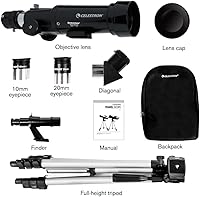
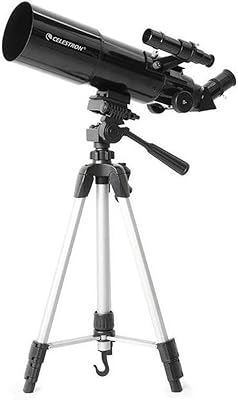
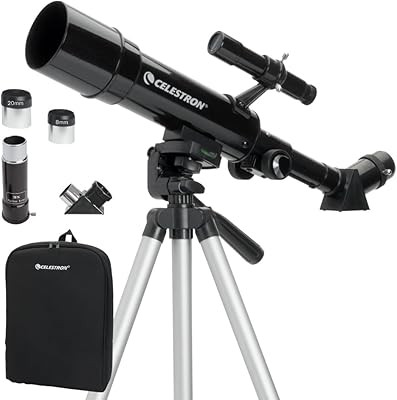
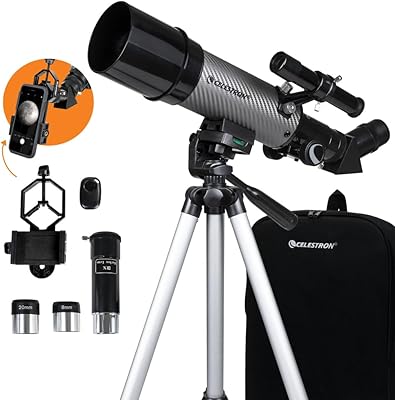
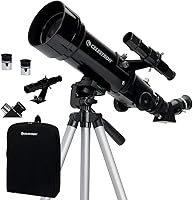
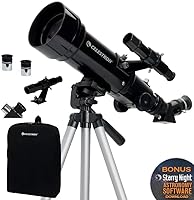
The Celestron Travel Scope 70 is an entry-level refractor built for beginners and families who want genuine optical quality in a package light enough to take anywhere. Its 70mm aperture and 400mm focal length put it squarely in the beginner-to-intermediate range — capable of rewarding lunar views and basic planetary observations, but not a substitute for a larger instrument. Celestron has been making telescopes since 1960, so the brand credibility is real and earned. The kit ships complete: tripod, finderscope, star diagonal, two eyepieces, and a padded backpack all included. It handles nighttime astronomy and daytime terrestrial viewing equally well, which extends its practical value beyond a single use case.
Features & Benefits

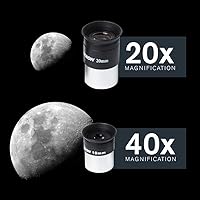
What lifts this travel refractor above cheaper rivals is the glass. Fully-coated lenses make a real difference in contrast and sharpness — craters on the Moon genuinely pop in a way that uncoated optics at this price tier rarely deliver. The two included eyepieces give you 20x for wide, orientation-style views and 40x for a closer look at lunar surface detail or a distant bird in a tree. The altazimuth mount is deliberately simple: point, adjust, no polar alignment needed. Setup requires no tools and takes minutes, which matters more than it sounds when conditions are right and you want the scope out fast. The Starry Night software download rounds things out nicely for anyone just learning the sky.

Best For

This beginner telescope is clearly aimed at a specific buyer, and it genuinely serves that buyer well. First-timers, gift-givers, and parents looking for something the whole family can enjoy without a steep learning curve will find it an easy fit. It's a particularly strong pick for travelers and campers — at 4.2 lbs packed into a purpose-built backpack, it carries without complaint on a hike. Kids around eight and up can operate it independently. Just be realistic about its ceiling: Saturn's rings are visible, but fine planetary detail requires more aperture. For casual lunar observing, wildlife spotting, and building confidence as a new astronomer, the Travel Scope 70 covers the ground you actually need it to cover.

User Feedback

With over 15,000 ratings averaging 4.2 out of 5, the buyer consensus here is hard to dismiss — that's a meaningful sample, not a handful of enthusiastic early reviews. The praise clusters around Moon image quality, how quickly the kit comes together out of the box, and the overall value of what's included. The honest criticisms are worth knowing: tripod wobble at 40x is a recurring complaint, particularly on uneven ground where any vibration gets amplified noticeably. The backpack fit is snug and won't accommodate aftermarket eyepieces comfortably. That said, a number of longer-term owners point out that the optical tube pairs well with a sturdier third-party mount, giving this scope a longer useful life than its entry-level status might suggest.

Pros

  • Fully-coated glass optics deliver noticeably sharper, higher-contrast lunar views than most rivals in this price bracket.
  • The complete kit ships ready to use — no extra purchases needed before your first night out.
  • At 4.2 lbs, this travel refractor is light enough to bring on a hike without second-guessing the decision.
  • No-tool setup in under five minutes makes spontaneous observing sessions realistic, not aspirational.
  • The altazimuth mount removes all the complexity of polar alignment, keeping the focus on actually looking through the scope.
  • Works equally well for daytime wildlife and scenery spotting, extending its practical value beyond astronomy alone.
  • Starry Night software is a genuinely useful learning companion for beginners still mapping the night sky.
  • Celestron's 2-year warranty and US-based support provide meaningful purchase confidence from a brand with a proven track record.
  • Over 15,000 verified global ratings averaging 4.2 out of 5 reflects unusually strong consensus for a beginner instrument.
  • The optical tube is compatible with third-party mounts, giving the scope a credible upgrade path as your skills grow.

Cons

  • Tripod wobble at 40x magnification is a persistent, well-documented issue — any vibration takes seconds to settle.
  • The reflex finderscope alignment is not intuitive and regularly frustrates first-time users during initial setup.
  • The padded backpack fits the stock accessories snugly with no practical room for aftermarket eyepieces or extras.
  • At 70mm aperture, deep-sky objects like galaxies and nebulae reveal very little structure or detail.
  • The included eyepieces, while functional, are the weakest components and typically get replaced within a year by committed observers.
  • Performance on soft or uneven ground is noticeably worse due to the lightweight tripod legs flexing underfoot.
  • The Starry Night download is a legacy version, not the current release, limiting its usefulness for more advanced planning.
  • Manual focus requires patience — slight adjustments at higher magnification can feel fiddlier than expected for absolute beginners.
  • International buyers may find warranty support access more limited compared to the US-based service experience.

Ratings

The Celestron Travel Scope 70 has earned its place as one of the most-reviewed beginner telescopes on the market, and our AI-driven scoring reflects that depth — drawing from tens of thousands of verified global purchases while actively filtering out incentivized, duplicate, and bot-generated submissions. Every score below is shaped by real buyer experiences, balancing genuine strengths against the recurring frustrations that show up consistently enough to matter. You'll find both sides represented honestly.
Optical Clarity
83%
The fully-coated glass optics punch noticeably above what most budget scopes offer at this tier. Lunar craters resolve with crisp edges, and daytime terrestrial views — wildlife, landscapes, distant architecture — are sharp and well-contrasted at both included magnifications.
At 70mm aperture, deep-sky performance is limited; faint nebulae appear as smudges rather than structured objects. Planetary detail is modest — Saturn's rings are identifiable, but expect soft edges and little surface texture on Jupiter without ideal atmospheric conditions.
Portability & Weight
91%
At 4.2 lbs fully assembled, this travel refractor genuinely earns the word 'travel' in its name. Hikers and campers consistently cite it as one of the few telescopes they'd actually bring on a trail, especially paired with the included backpack that keeps everything organized and protected.
The backpack fit is tight, and there's minimal room for accessories beyond what ships in the box. Taller users may find the packed dimensions slightly awkward to carry for extended distances, particularly when combined with other hiking gear.
Build Quality
67%
33%
The optical tube itself feels solid and well-finished for the price bracket, and the focuser operates smoothly without excessive play. Celestron's quality control at this level is reliably consistent — buyers rarely report defective units straight out of the box.
The tripod is the obvious weak link. Its legs lack rigidity, and at 40x magnification even a light breeze or an accidental nudge causes enough vibration to blur the view for several seconds. The plastic components in the mount feel noticeably less substantial than the optical tube they support.
Ease of Setup
93%
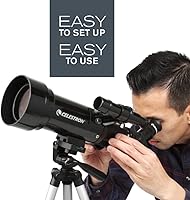
No tools, no complicated assembly steps — the tube slides onto the mount and the tripod unfolds in under five minutes flat. For spontaneous use, this matters enormously; when a clear night appears unexpectedly, you're not spending the first half-hour reading instructions.
The reflex finderscope alignment trips up a fair number of first-time users. The adjustment process isn't intuitive without some prior knowledge, and a misaligned finder makes locating objects frustratingly difficult until it's sorted out properly.
Tripod Stability
54%
46%
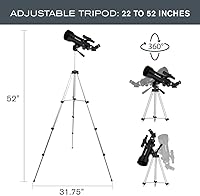
The full-height tripod does allow comfortable seated or standing observation without awkward crouching, and on a flat, hard surface it holds reasonably steady at lower magnifications. For lunar viewing at 20x, most users find it acceptably stable.
At 40x — the scope's higher setting — tripod wobble becomes a genuine nuisance. Any vibration takes several seconds to dampen, and on grass or soft ground the problem worsens significantly. This is the single most cited frustration across the entire user review base.
Value for Money
88%
The complete kit — telescope, two eyepieces, finderscope, star diagonal, backpack, and software — represents strong overall value when compared to buying components individually. For a first telescope that requires zero additional purchases to start observing, the pricing is genuinely competitive.
Buyers who outgrow the included accessories quickly may feel the bundled eyepieces are the weakest components relative to the optics. Upgrading to a sturdier tripod or mount, which many experienced users recommend, adds cost that undercuts the initial value calculation.
Accessory Quality
62%
38%
Having a star diagonal, two eyepieces, and a finderscope included right out of the box is a real practical advantage for beginners. The 20mm and 10mm eyepieces are functional and deliver usable views without any immediate need for replacement.
The accessories are clearly cost-engineered. The finderscope bracket feels fragile, and the eyepiece barrel tolerances are loose enough that some users notice slight image shift. Enthusiasts typically replace the eyepieces within a year, viewing the originals as functional starter pieces rather than long-term tools.
Magnification Range
74%
26%
The two included eyepieces cover the most practical range for a beginner — 20x for orientation and wide views, 40x for closer inspection of lunar features or a bird on a distant branch. Switching between them takes seconds and covers the majority of real-world use cases.
The gap between 20x and 40x is fairly coarse, and there is no intermediate option included. Buyers who want to experiment with finer magnification steps will need to purchase additional eyepieces separately, which also highlights the snug backpack storage limitation.
Software & Learning Tools
78%
22%
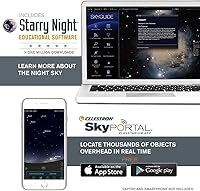
The Starry Night software download is a genuinely useful addition for beginners still learning their way around the night sky. It helps with planning sessions, identifying what's visible on a given night, and understanding basic celestial mechanics in an engaging visual format.
The software is a download code rather than a physical disc, which causes occasional confusion with redemption. It is also a legacy version of Starry Night, not the current full release, so more advanced users may find its features somewhat dated compared to current free alternatives.
Beginner Friendliness
89%
The altazimuth mount requires no understanding of polar alignment, equatorial coordinates, or tracking motors — you simply point it where you want to look. Combined with the quick setup, this dramatically lowers the intimidation factor that causes many beginner telescopes to end up unused in a closet.
The finderscope alignment learning curve and the manual focus adjustment can frustrate complete novices during the first few sessions. A short printed quick-start guide covering common beginner mistakes would meaningfully reduce the early friction that some users describe.
Daytime Terrestrial Use
81%
19%
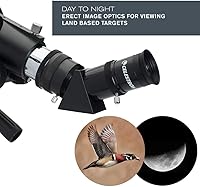
The Travel Scope 70 doubles surprisingly well as a spotting scope for wildlife, scenery, or sporting events. The image orientation through the star diagonal is correct for daytime viewing, and the 70mm aperture gathers enough light for bright, clear daytime images at both magnification settings.
The tripod's wobble issue affects daytime use just as much as nighttime astronomy, particularly when tracking a moving subject like a bird in flight. Users who primarily want a daytime spotting scope should be aware that a dedicated spotting scope tripod would serve them better.
Carrying & Storage Solution
76%
24%
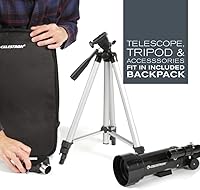
A purpose-built padded backpack that fits the entire kit is a meaningful differentiator over scopes sold without any carrying solution. It protects the optical tube during transit and keeps eyepieces and accessories organized, which is especially practical for families taking the scope on trips.
The backpack's interior layout is optimized only for the included accessories. There is no practical room for aftermarket eyepieces, a red-light torch, or a star atlas — items that most astronomers accumulate quickly. The padding, while present, is on the thin side for rough outdoor conditions.
Brand Reputation & Warranty
92%
Celestron's six-decade track record in telescope manufacturing carries real weight here. The 2-year US warranty is backed by an accessible US-based support team, and Celestron's parts availability and customer service responsiveness compare favorably to off-brand alternatives in the same segment.
The warranty covers manufacturing defects but not damage from use, and international buyers outside the US may find the support access more limited. A small number of users report longer-than-expected wait times for support responses during peak gift-buying seasons.
Upgrade Potential
79%
21%
The optical tube is a standard format that fits third-party mounts and tripods, giving this beginner telescope a longer useful lifespan than its entry-level status might imply. Several experienced users keep the tube and replace only the mount as their skills and expectations grow.
Upgrading the mount negates a significant portion of the original value proposition, and by the time most buyers consider that step, they are also considering a larger aperture instrument entirely. The upgrade path is real, but it is more of a consolation than a planned feature.

Suitable for:

The Celestron Travel Scope 70 is a strong match for anyone taking their first serious step into astronomy without wanting to commit to a large, expensive, or complicated instrument. Families with children aged eight and up will find it a genuinely shared experience — the simple altazimuth mount means kids can operate it independently after one short learning session, and the Moon alone provides enough visual payoff to hold their attention. Campers, hikers, and travelers who want an optical instrument that earns its pack weight will appreciate how the complete kit fits into a single backpack without fuss. It also works well as a daytime spotting scope, making it useful year-round rather than only on clear nights. Gift buyers will find it particularly well-suited to the task — everything needed to start observing is already in the box, so the recipient does not face a hidden list of additional purchases before they can use it.
Not suitable for:

Buyers who have already owned a beginner scope and are looking to step up their game will likely find this travel refractor underwhelming fairly quickly. At 70mm aperture, the Celestron Travel Scope 70 has a real ceiling: faint deep-sky objects like galaxies and nebulae show little detail, and planetary views, while rewarding for a first look, lack the surface resolution that more experienced observers expect. Anyone who gets serious about astronomy within a year or two will almost certainly want a larger aperture and a more stable mount — the included tripod, in particular, is not a long-term solution for high-magnification work. Astrophotographers should look elsewhere entirely; the altazimuth mount has no tracking capability, and long-exposure imaging is not a realistic use case here. If your primary interest is deep-sky observation rather than casual lunar and planetary viewing, a larger reflector telescope at a comparable price point will serve you significantly better.
Specifications

  • Aperture: The objective lens measures 70mm (2.76″) in diameter, determining how much light the telescope gathers for viewing.
  • Focal Length: The optical tube has a focal length of 400mm, which combined with the aperture produces a focal ratio of f/5.71.
  • Magnification: The two included eyepieces deliver 20x magnification with the 20mm and 40x magnification with the 10mm.
  • Max Magnification: The highest theoretically usable magnification is 165x, though practical viewing quality diminishes well before that ceiling.
  • Limiting Magnitude: Under dark skies, this refractor can reveal objects as faint as magnitude 11.7, suitable for bright star clusters and the Moon.
  • Optical Coating: All air-to-glass surfaces feature full anti-reflective coatings to maximize light transmission and improve image contrast.
  • Optical Design: The telescope uses a refracting optical design with a glass objective lens and a straight-through optical path corrected by the included star diagonal.
  • Mount Type: The scope ships on an altazimuth mount that moves freely on two axes — up/down and left/right — with no motorization or polar alignment required.
  • Finderscope: A reflex-style finderscope is included to help aim the telescope at targets before looking through the main eyepiece.
  • Tube Length: The optical tube measures 17 inches in length and fits inside the included backpack for compact transport.
  • Assembled Weight: The fully assembled telescope, mount, and tripod weigh 4.2 lbs (1.9 kg), making it one of the lighter complete telescope kits available.
  • Dimensions: Packaged product dimensions measure 18″ x 7″ x 14″, sized to fit within the included carry backpack.
  • Eyepieces: Two 1.25-inch barrel eyepieces are included: a 20mm for wide, lower-power views and a 10mm for closer, higher-power observation.
  • Focus Mechanism: Focusing is achieved manually via a rack-and-pinion focuser located at the rear of the optical tube.
  • Included Accessories: The kit includes a star diagonal, reflex finderscope, two eyepieces, a full-height tripod, a padded backpack, and a download code for Starry Night software.
  • Software: A free download of Starry Night beginner astronomy software is included to help users identify celestial objects and plan observation sessions.
  • Warranty: Celestron provides a 2-year limited warranty for US buyers, supported by a US-based customer service team.
  • Manufacturer: Made by Celestron, a California-based telescope brand founded in 1960 with over six decades of optical instrument manufacturing experience.
  • Model Number: The official Celestron model number for this telescope is 21035.
  • Use Cases: Designed for both nighttime astronomical viewing (Moon, planets, star clusters) and daytime terrestrial use (wildlife, landscapes, distant scenery).

Related Reviews

Celestron Travel Scope 80 Portable Telescope
83%
92%
Value for Money
88%
Ease of Setup
94%
Portability/Weight
83%
Optical Quality
75%
Magnification Power
More
Celestron Travel Scope 60DX Portable Refractor Telescope
81%
91%
Portability & Size
89%
Ease of Setup
84%
Optical Clarity
78%
Build Quality
90%
User-Friendliness
More
Celestron Travel Scope 50 Portable Refractor Telescope
85%
93%
Portability & Weight
91%
Ease of Setup
68%
Magnification Performance
85%
Image Clarity & Optics
83%
Build Quality
More
GHERSON 40L Travel Backpack for Air Travel
88%
88%
Ease of Use
91%
Comfort
85%
Durability
89%
Water Resistance
90%
Size and Capacity
More
Travel Backpack for Traveling on Airplane, 18x14x8, Airline Approved
87%
94%
Airline Carry-On Compatibility
88%
Comfort and Ergonomics
91%
Laptop Compartment Fit
87%
Durability and Build Quality
85%
Portability and Weight
More
Travel Makeup Bag for Women, Large Travel Toiletry Bag (Dog Paws)
87%
94%
Storage Capacity
91%
Waterproof Performance
89%
Design & Aesthetics
88%
Ease of Cleaning
90%
Durability
More
Convenience Kits International Men's 11 Piece Travel Kit & Women's 10 Piece Deluxe Travel Kit
86%
89%
Convenience of Travel Size
91%
Ease of Use
96%
TSA Compliance
87%
Quality of Included Brands
93%
Compactness & Portability
More
Moroccanoil Travel Set
87%
91%
Hydration Effectiveness
89%
Frizz Control
94%
Packaging & Travel Convenience
86%
Hand Cream Performance
88%
Hair Texture Improvement
More
ECOHUB Travel Backpack
87%
85%
Organization and Storage
88%
Comfort and Fit
91%
Durability and Build Quality
90%
Eco-Friendly Materials
93%
Airline Compatibility
More
Celestron SkyMaster 12x60
87%
95%
Optical Clarity
92%
Low-Light Performance
90%
Magnification Accuracy
88%
Build Quality
87%
Durability
More

FAQ

Most users have it assembled and ready to observe in under five minutes. There are no tools required — the tube mounts onto the altazimuth head and the tripod legs unfold and lock into place without any complicated steps. The one part that takes a little more time is aligning the finderscope, which is worth doing carefully before your first session.

Children around eight and up can generally operate the Travel Scope 70 independently once an adult has done the initial setup and finderscope alignment. The altazimuth mount is intuitive — there is no tracking system or alignment procedure to manage mid-session. Younger kids will likely need guidance pointing it at specific targets, but viewing the Moon once it is in the eyepiece is something almost any child can do on their own.

Yes, Saturn's rings are visible, but keep your expectations calibrated. At 40x magnification through a 70mm aperture, the rings are clearly distinguishable from the planet's disk, which is genuinely exciting for a first look. You will not see the Cassini Division or fine ring structure at this aperture, but the view is rewarding enough that most beginners find it a real wow moment.

It is a real limitation, not an exaggeration. At 20x magnification on a hard, flat surface, the tripod is acceptably stable for casual viewing. At 40x, any vibration — a nudge, a gust of wind, even footsteps nearby — causes the image to shake for a few seconds before settling. On grass or soft ground it is noticeably worse. If you plan to do most of your observing at higher magnifications, investing in a sturdier third-party tripod is worth considering.

The included accessories all fit back into the backpack, but it is a snug fit with very little spare room. If you purchase additional eyepieces or want to pack a red-light torch and a star chart alongside the scope, you will find the bag runs out of space quickly. The padding is adequate for casual use but on the thin side for rough outdoor conditions.

Yes, and it works quite well for terrestrial use. The star diagonal corrects the image orientation so that daytime views appear right-side-up, unlike some telescope configurations that invert the image. The 70mm aperture gathers plenty of light in daytime conditions, so wildlife, distant landscapes, and outdoor events all look sharp and bright at both available magnifications.

For a genuine beginner, it adds real value. Starry Night helps you understand what is visible on any given night, where to point the scope, and how to recognize constellations and planets. The version included with the Celestron Travel Scope 70 is a legacy edition rather than the current release, so it lacks some modern features, but it is more than sufficient for learning the basics. Free apps like Stellarium are worth having alongside it.
Finderscope alignment means making sure the finderscope and the main telescope are both pointing at exactly the same spot. To do it, center a distant daytime object in the main eyepiece, then adjust the finderscope's bracket screws until that same object appears in the finderscope's crosshairs. It only takes a few minutes, but skipping this step makes finding objects at night significantly harder, especially for beginners who are still learning the sky.

Basic afocal smartphone photography is possible — you hold the phone's camera lens up to the eyepiece and take a shot — and the Moon tends to photograph reasonably well this way with a little patience. Dedicated smartphone adapters for 1.25-inch eyepieces are available separately and make the process much easier. Serious photography is not a practical use case here since the mount has no tracking capability, but casual lunar snapshots are achievable.

Not necessarily. The optical tube uses a standard format and is compatible with third-party altazimuth and even equatorial mounts, so upgrading the mount is a realistic option as your skills develop. Many users continue using the tube for years while progressively improving the supporting hardware. That said, if your aspirations grow significantly toward deep-sky imaging or very high magnification planetary work, a larger aperture telescope will eventually make more sense than continuing to upgrade around this tube.