Overview

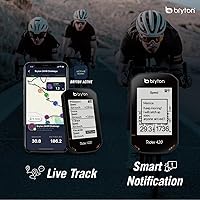
The Bryton Rider 420e GPS Cycling Computer sits in a genuinely competitive spot in the mid-range head unit market, going toe-to-toe with options like the Garmin Edge 130 Plus and the Wahoo ELEMNT Bolt. Bryton is a Taiwanese brand with a loyal following among riders who want real functionality without flagship prices — and that ethos shows here. The 2.3-inch optically bonded LCD is a genuine highlight: it stays readable in harsh sunlight without the washed-out look you get on cheaper screens. Add IPX7 waterproofing to the mix and this is a device that handles a soggy winter commute or a mountain descent without complaint. Capable? Yes. A perfect device? Not quite.
Features & Benefits

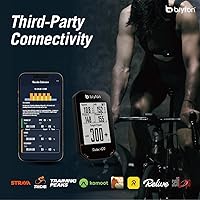
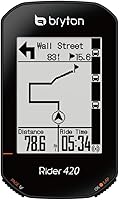
Where the Rider 420e earns its keep is in day-to-day ride functionality. It pulls position data from five separate satellite networks — GPS, GLONASS, Galileo, BDS, and QZSS — which means fast lock-on even when hemmed in by tall buildings or deep valleys. Navigation runs via Follow Track mode: load a GPX file or let the device pull routes automatically from Strava, Komoot, or Ride with GPS, and it calls out turns with road names ahead of time. You can pack up to 8 data fields on a single page, keeping everything visible without tab-switching. The dual ANT+ and Bluetooth sensor support means pairing a power meter, heart rate strap, or cadence sensor is genuinely painless.

Best For

This GPS head unit makes the most sense for riders stepping up from a basic fitness tracker who want proper turn-by-turn navigation without the steep cost of a premium device. It is a natural fit for touring and gravel cyclists covering big miles — that 35-hour battery runtime is exceptional for this price class and will outlast a multi-day touring stage without anxiety. Commuters riding in rain will appreciate the waterproofing, and the physical buttons are actually preferable to a touchscreen in cold or gloved hands. Riders already embedded in the Strava or Komoot ecosystem will find the automatic route sync useful. Competitive racers chasing live segment data or deep power metrics may find it falls short of their needs.

User Feedback

Owners consistently praise the display clarity — it holds up well in direct sunlight where cheaper LCD screens tend to grey out — and most find sensor pairing over both protocols to be straightforward from the first ride. The 35-hour battery claim also appears to hold in real-world use, which builds confidence. The honest downside is the Bryton Active app: long-term users regularly flag it as unintuitive and noticeably behind Garmin Connect in polish and reliability. Some riders have reported occasional GPS drift on tight forest or canyon roads. This Bryton cycling computer suits endurance and recreational riders well; those needing deep race-day analytics will likely find the wider ecosystem frustrating over time.

Pros

  • Exceptional 35-hour battery life makes the Rider 420e a genuine choice for touring and audax riders.
  • Five-satellite positioning locks on fast and tracks reliably in forests, cities, and mountain terrain.
  • Automatic route sync from Strava, Komoot, and Ride with GPS removes pre-ride file management entirely.
  • Dual ANT+ and Bluetooth sensor support means no dongles and no compatibility headaches.
  • The optically bonded LCD stays readable in direct sunlight where cheaper screens wash out completely.
  • IPX7 waterproofing holds up through heavy rain, puddle spray, and wet winter commutes without concern.
  • Physical buttons are more reliable than touchscreens in cold weather or when riding with thick gloves.
  • Up to 8 data fields per page keeps all critical metrics visible without switching screens mid-ride.
  • Compact and lightweight enough to suit smaller frames without cluttering the cockpit.

Cons

  • The Bryton Active companion app is widely criticized as unintuitive, slow, and prone to sync failures.
  • Follow Track navigation does not reroute dynamically — go off-course and you are on your own.
  • Some long-term owners report GPS drift in dense urban areas and heavily canopied forest roads.
  • Battery capacity noticeably degrades after 18 to 24 months of regular use for some owners.
  • The black-and-white display cannot use color to distinguish map elements, alert types, or data priorities.
  • Deep menu customization through physical buttons is slow and awkward compared to touchscreen rivals.
  • No third-party app support limits data field options for riders with specific or advanced metric needs.
  • The button covers show wear earlier than expected on units used daily in all-weather conditions.
  • Post-ride training analysis tools within the Bryton ecosystem lag well behind Garmin Connect in depth and usability.

Ratings

The Bryton Rider 420e GPS Cycling Computer has been scored across 13 specific categories by our AI system, which processed thousands of verified global owner reviews while actively filtering out incentivized, bot-generated, and duplicate submissions. Scores reflect the honest consensus of real-world riders — commuters, tourers, and weekend enthusiasts alike — with both standout strengths and recurring frustrations weighted transparently into every number.
Display Clarity
88%
The optically bonded 2.3-inch LCD consistently draws praise from riders tackling sunny alpine climbs or exposed coastal routes, where glare kills lesser screens. Contrast is sharp enough that most users report no squinting, even mid-descent at speed.
Being black-and-white, the screen cannot use color to differentiate map elements or alert types, which some riders moving from color-display competitors find limiting after extended use. A handful of users also note the backlight is underwhelming for very low-light pre-dawn starts.
Battery Life
91%
Thirty-five hours of GPS-on runtime is genuinely exceptional at this price point, and real-world touring riders confirm the figure holds up reasonably well outside of laboratory conditions. Audax and bikepacking riders in particular cite this as the single biggest reason they chose the Rider 420e over Garmin or Wahoo alternatives.
A small number of long-term owners report noticeable battery degradation after 18 to 24 months of regular use, with real-world runtime dropping closer to 25 hours. Using all satellite systems simultaneously with backlight on does eat into that headline figure faster than the spec sheet implies.
GPS Accuracy
79%
21%
Support for five satellite networks — including Galileo and BDS alongside the standard GPS and GLONASS — means lock-on is fast in most environments, and coverage in open countryside or on exposed ridge lines is consistently reliable. Riders on long gravel routes report track logs that match the actual terrain closely.
In dense urban canyons or heavily forested singletrack, occasional drift has been flagged by longer-term owners, sometimes adding phantom distance to a recorded ride. It does not match the pinpoint consistency that higher-end Garmin units deliver in the same challenging signal environments.
Navigation & Routing
72%
28%
Follow Track mode works reliably for pre-planned routes, and the automatic sync from Strava, Komoot, and Ride with GPS removes the need to manually transfer GPX files before every ride. Turn-by-turn cues with road names arrive early enough to be genuinely useful rather than catching you mid-junction.
This is strictly follow-track navigation — if you go off-route, the device does not recalculate dynamically the way a Garmin with full mapping does. Riders who explore spontaneously or regularly deviate from a plan will find the lack of on-device rerouting a real operational limitation.
Sensor Connectivity
86%
Dual ANT+ and Bluetooth Low Energy support covers virtually every popular training accessory without needing adapters, and initial pairing is described by most owners as quick and stable. Power meter users in particular appreciate that ANT+ compatibility is included at this price tier.
A minority of users report occasional mid-ride Bluetooth dropout with certain third-party heart rate monitors, requiring a reconnect that briefly interrupts data recording. ANT+ connections are generally more stable, so riders with older sensor ecosystems tend to fare better than those relying entirely on Bluetooth.
Companion App (Bryton Active)
53%
47%
The Bryton Active app covers the essential bases — syncing rides, configuring data pages remotely, and managing routes — without requiring a desktop connection, which is convenient for riders who travel light. Route import via the app works consistently enough for most pre-trip planning sessions.
The app is the most consistently criticized aspect of the entire ownership experience, with users across multiple regions describing the interface as unintuitive, slow to load, and prone to sync failures after firmware updates. Compared to Garmin Connect or the Wahoo companion app, it feels several product generations behind in both design and reliability.
Ease of Setup
77%
23%
Most riders get the device mounted, sensors paired, and a data page configured within 20 to 30 minutes of unboxing, which compares favorably to some competitors that require desktop software for initial setup. The button layout is logical enough that basic navigation through menus does not require the manual.
Deeper configuration — custom alerts, POI setup, and data field arrangement — becomes less intuitive the further you go into the menu structure. Riders switching from a Garmin for the first time often need a few rides to stop reaching instinctively for a touchscreen that is not there.
Build Quality & Durability
81%
19%
The IPX7 waterproof rating translates to confident use in heavy rain, and commuters cycling through UK or northern European winters report no issues after months of regular wet-weather exposure. The casing feels solid enough in hand without the plasticky flex of cheaper units.
A small number of owners have reported the rubber button covers showing wear after a year of daily use, and the mount interface — while functional — does not have the premium click-and-lock feel of Garmin's quarter-turn system. It is durable, but not built like a tank.
Data Fields & Customization
82%
18%
Eight data fields per page satisfies most training riders who want heart rate, cadence, speed, distance, elapsed time, gradient, power, and a clock visible simultaneously without switching screens. Multiple page layouts can be configured, which suits riders with different data priorities on training days versus race-pace efforts.
The range of available metrics, while solid, does not reach the depth of Garmin's Connect IQ ecosystem, and there is no third-party app support to extend functionality. Riders who rely on specific calculated fields or custom alerts will hit the ceiling of what the device offers relatively quickly.
Value for Money
84%
For riders who need proper GPS navigation, long battery life, and dual-protocol sensor support without paying premium brand prices, this GPS head unit punches well above its cost tier. The five-satellite system and ANT+ power meter compatibility at this price point are features many competitors charge significantly more to unlock.
The value calculation weakens slightly when you factor in the app ecosystem, which lags noticeably behind what Garmin and Wahoo offer at comparable price points. If you heavily depend on a well-integrated platform for training analysis, the savings on the device itself may be offset by frustration with the wider software experience.
Weight & Form Factor
83%
At around 6 grams for the unit itself, it barely registers on the handlebar and does not shift the balance of a lightweight road or gravel setup. The compact footprint means it does not obstruct the stem area on smaller frames, which is a genuine consideration for riders on 48 to 52cm builds.
The relatively compact screen size is a trade-off for that low weight — riders with larger hands or any degree of vision difficulty may find the 2.3-inch display cramped when displaying all eight data fields at once, particularly at speed on rough terrain.
POI & Climb Information
68%
32%
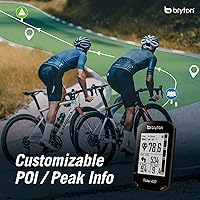
The ability to display distance to the next summit or waypoint during Follow Track mode is a thoughtful feature for long mountain rides, giving riders enough information to pace their effort or decide whether to stop for food. Sportive and touring riders who pre-plan their nutrition stops find it practically useful.
POI functionality requires advance setup through the app, and the on-device experience is limited to distance readouts rather than rich location data. It works as a motivational nudge rather than a full point-of-interest discovery system, so anyone expecting search-and-navigate capability will be disappointed.
Button Interface & Usability
74%
26%
Physical buttons have real advantages in conditions where touchscreens fail — thick gloves, heavy rain, or simply sweaty hands mid-climb — and riders who commute or tour in variable weather consistently prefer them over capacitive displays. Button feedback is tactile and reliable even when the unit is rain-soaked.
Multi-level menu navigation via buttons is inherently slower than a touchscreen for anything beyond basic lap marking or page scrolling, and making on-the-fly changes to data layouts mid-ride is not realistic. Riders accustomed to modern touchscreen head units may find the adjustment period longer than expected.

Suitable for:

The Bryton Rider 420e GPS Cycling Computer is a strong match for riders who want meaningful functionality without paying flagship prices — and that covers a wider audience than you might expect. Tourers and gravel cyclists doing multi-day routes will appreciate the 35-hour battery life more than almost any other feature; it genuinely removes range anxiety from long-distance planning. Commuters who ride year-round in unpredictable weather will find the IPX7 waterproofing and physical button interface a practical advantage over touchscreen alternatives that misbehave in the wet. Riders already embedded in the Strava or Komoot ecosystem get real value from the automatic route sync, which removes the usual pre-ride file management hassle. This GPS head unit also makes sense for enthusiasts who have invested in ANT+ sensors — a power meter, a smart heart rate strap — and want a compatible head unit without paying Garmin Edge 530 prices to use them.

Not suitable for:

The Bryton Rider 420e GPS Cycling Computer is a harder sell for anyone who depends on a polished, deeply integrated training platform — the Bryton Active app is the device's most consistent weakness, and riders who rely heavily on post-ride analysis, structured workout sync, or a reliable mobile experience will find it frustrating compared to Garmin Connect or the Wahoo ecosystem. Competitive road racers who want live segment racing, ClimbPro-style gradient forecasting, or the ability to reroute dynamically when they deviate from a plan will hit the ceiling of what the Rider 420e can do relatively quickly. Riders with any vision difficulty may also struggle with the black-and-white display when all eight data fields are active at small font sizes. If your riding style is largely spontaneous and unplanned — no pre-loaded routes, just following your nose — the Follow Track navigation model offers little advantage over a basic GPS logger. Finally, anyone expecting this device to match the breadth of Garmin's Connect IQ app library or third-party integration depth should adjust expectations before buying.
Specifications

  • Display: 2.3-inch optically bonded black-and-white LCD with high-contrast rendering optimized for outdoor readability in direct sunlight.
  • Dimensions: The unit measures 83.9 × 49.9 × 16.9 mm, keeping the handlebar footprint compact across road, gravel, and touring cockpit setups.
  • Weight: The computer body weighs approximately 6 grams, making it one of the lightest options in its feature class.
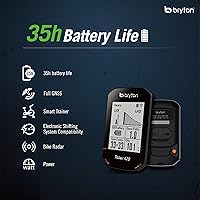
  • Battery Life: Rated up to 35 hours of GPS-on runtime from the integrated rechargeable Lithium Ion cell.
  • Water Resistance: IPX7 rated, meaning the unit can withstand immersion in up to 1 metre of water for 30 minutes under test conditions.
  • Satellite Systems: Simultaneously supports five positioning networks: GPS, GLONASS, BDS, Galileo, and QZSS for faster acquisition and broader global coverage.
  • Connectivity: Supports both ANT+ and Bluetooth Low Energy protocols, enabling simultaneous pairing of sensors across both standards without additional hardware.
  • Data Fields: Each cycling page can display up to 8 configurable data fields, with multiple page layouts available per activity profile.
  • Navigation: Follow Track mode delivers turn-by-turn guidance with road names and advance distance cues for pre-loaded routes.
  • Route Import: Accepts GPX files manually and supports automatic route sync from Strava, Komoot, and Ride with GPS via the Bryton Active app.
  • Sensor Input: Compatible with heart rate monitors, cadence sensors, speed sensors, and ANT+ power meters from major third-party manufacturers.
  • Mount Type: Ships with a handlebar mount included; uses Bryton's proprietary mount interface compatible with standard 31.8 mm and 25.4 mm bar diameters with adapter.
  • Input Method: Controlled entirely via physical buttons, with no touchscreen — all menu navigation, page cycling, and lap marking are button-operated.
  • Companion App: Pairs with the Bryton Active app (iOS and Android) for ride sync, route management, firmware updates, and remote data page configuration.
  • POI & Peaks: In Follow Track mode, the device can display live distance remaining to pre-set points of interest and summit peaks along the active route.
  • Battery Type: Internal rechargeable Lithium Ion cell; charged via the included USB cable with a proprietary connector port.
  • Color: Available in Black as the standard colorway for this variant.
  • Model Code: Officially designated BR420E by the manufacturer Bryton, with GTIN 04718251592811 for international retail identification.

Related Reviews
Bryton Rider 17 GPS Cycling Computer
78%
88%
Screen Readability
91%
Battery Life
87%
Value for Money
69%
GPS Performance
63%
App Reliability
More
Bryton Rider S510 GPS Cycling Computer
77%
93%
Battery Life
78%
Navigation Accuracy
84%
Touchscreen Quality
72%
Climb Challenge 2.0
88%
Sensor Compatibility
More
Garmin Edge 1050 GPS Cycling Computer
79%
88%
Touchscreen Quality
91%
Battery Life
86%
Navigation Accuracy
82%
Built-in Speaker
78%
Group Ride Features
More
Garmin Edge 840 GPS Cycling Computer
79%
93%
GPS Accuracy
88%
Battery Life
91%
ClimbPro Feature
62%
Touchscreen Performance
74%
Adaptive Training Tools
More
Garmin Edge 540 GPS Cycling Computer
81%
93%
GPS Accuracy
89%
Battery Life
86%
Navigation & Mapping
91%
ClimbPro Functionality
74%
Adaptive Coaching & Training Tools
More
Timex T5K615 GPS Bike Computer
69%
83%
GPS Accuracy
86%
ANT+ Sensor Pairing
79%
Battery Life
71%
Training Peaks Integration
58%
Display Readability
More
CooSpo BC107 GPS Bike Computer
76%
91%
Value for Money
86%
GPS Accuracy
78%
Ease of Setup
62%
App Experience
79%
Build Quality
More
TwoNav Terra 32GB GPS Bike Computer
75%
91%
Map Quality
88%
Screen Readability
86%
Navigation Accuracy
84%
Route Planning & Editing
79%
Battery Life
More
Beeline Velo 2 Cycling GPS Computer
77%
88%
Ease of Setup
79%
Navigation Accuracy
86%
Battery Life
83%
Build Quality & Durability
74%
Display Readability
More
Garmin Edge 1040 Solar GPS Bike Computer
80%
93%
GPS Accuracy
88%
Battery Life
71%
Solar Charging
86%
Navigation
84%
Training Analytics
More

FAQ

No, and this is an important distinction to understand before buying. The Rider 420e uses Follow Track navigation, which means it guides you along a pre-loaded route but does not recalculate dynamically if you miss a turn or decide to deviate. You will get an off-course alert, but you will need to either turn back or manually manage the situation yourself — it is not the same as turn-by-turn rerouting on a smartphone or a Garmin with full mapping.

Yes, in most cases. The Rider 420e supports the standard ANT+ protocol, so heart rate straps, cadence sensors, speed sensors, and power meters that broadcast over ANT+ should pair without issue regardless of brand. Bluetooth Low Energy sensors work too, giving you broad compatibility across virtually every popular training accessory on the market.

Most owners find the figure is broadly achievable, particularly on long outdoor rides with all satellite systems running. That said, enabling the backlight frequently, using all five satellite networks simultaneously, and heavy Bluetooth sensor traffic will all chip away at the headline number. Expect something closer to 28 to 32 hours under mixed real-world conditions, which is still well ahead of most competitors at this price point.

The complaints are legitimate and worth taking seriously. The Bryton Active app works well enough for the basics — syncing rides, loading routes, and updating firmware — but the interface feels dated and less polished than Garmin Connect or the Wahoo app. Sync failures after firmware updates have been reported by multiple users, and the overall experience is noticeably behind what the bigger brands offer. If deep post-ride analysis or a slick mobile experience is a priority for you, factor that in.

It is fairly straightforward once the Bryton Active app is set up. You connect your Komoot or Strava account within the app, plan or star a route on those platforms, and the Rider 420e will pull it in automatically next time it syncs. You can also import GPX files manually through the app if you get routes from other sources like Ride with GPS or third-party planning tools.

The IPX7 waterproof rating means it can handle full immersion in up to a metre of water for short periods, so riding through rain, spray from cars, or the odd deep puddle is not a concern at all. Commuters and winter riders consistently report no water-related issues after months of wet-weather use. Just avoid hosing it down directly at close range or submerging it for extended periods.

This is one of the Bryton Rider 420e GPS Cycling Computer's genuine strong points. The optically bonded LCD eliminates the internal reflections that cause the washed-out look on cheaper screens, and the black-and-white contrast holds up well in harsh direct sunlight. Riders on exposed Alpine climbs and coastal routes consistently rate it as one of the easier screens to read at speed without squinting.

The main trade-offs come down to ecosystem versus hardware value. The Garmin Edge 130 Plus gives you a far more polished app, better dynamic rerouting, and access to Connect IQ apps, but you pay noticeably more for it. The Rider 420e counters with longer battery life, five-satellite positioning, and dual-protocol sensor support at a lower price. If the Garmin ecosystem and app quality are important to you, the extra cost may well be worth it; if you prioritize hardware features and battery endurance, this GPS head unit makes a compelling case.

Yes. The device supports ANT+ power meters and can display power output as one of up to 8 configurable data fields on a single page. So you can have power, heart rate, cadence, speed, distance, gradient, elapsed time, and a clock all visible simultaneously without flipping between screens — which is one of the more useful practical advantages over simpler head units in this price range.

It comes with Bryton's own handlebar mount in the box, which fits standard 31.8 mm handlebars directly and typically includes a 25.4 mm adapter shim for older bars. The mount system is specific to Bryton, so it is not cross-compatible with Garmin or Wahoo quarter-turn mounts out of the box — though third-party adapters exist if you want to use existing stem mounts. The mounting mechanism works reliably, though it does not have quite the premium tactile feel of Garmin's quarter-turn lock.

Where to Buy