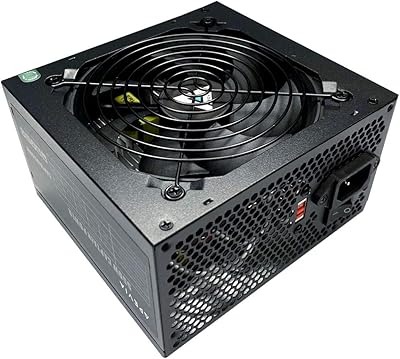
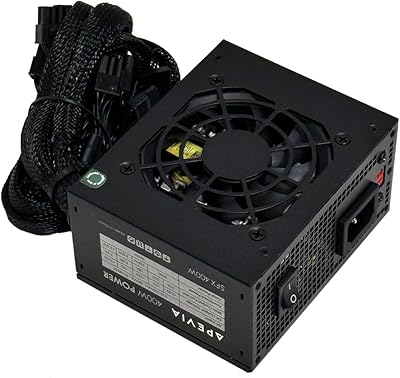
Overview

The Apevia ITX-PFC400W 400W Flex ATX Power Supply exists because finding a quality PSU in the flex ATX form factor is genuinely difficult — most builders discover this the hard way. What makes this compact power supply stand out at its price point is the fully modular design, which is almost unheard of in this category. Most flex ATX units force you to deal with a rat's nest of fixed cables in an already cramped chassis. The wide input voltage range of 90–264V adds practical value beyond typical desktop use, covering international deployments and specialized applications like point-of-sale terminals or all-in-one systems where space and power reliability both matter.
Features & Benefits

The fully modular cable system is the headline feature here, and it earns that status. In a mini-ITX or 1U chassis, every millimeter of clearance counts — being able to omit cables you are not using is not just tidy, it can mean the difference between adequate airflow and thermal throttling. The +12V rail delivers 28A, enough headroom for an entry-level discrete GPU alongside a mainstream CPU. Active PFC across the full input range improves real-world efficiency and cleaner power delivery. The dual ball-bearing fan is rated for longer service life than sleeve-bearing alternatives, which matters in always-on deployments. Protections covering overvoltage, overcurrent, overload, thermal, and short-circuit scenarios round out a surprisingly capable package.

Best For

This flex ATX unit is squarely aimed at a specific kind of builder — one dealing with cases where a standard ATX or SFX supply simply will not fit. Mini-ITX gaming builds and home-theater PCs are the obvious sweet spot, but the use case extends to IT integrators deploying compact commercial systems like POS terminals or 1U rack servers that need a reliable, always-on supply. Hobbyists breathing new life into slim OEM chassis will appreciate the modular cabling for keeping things manageable in constrained spaces. The 400W ceiling suits light-to-moderate GPU loads, so if you are pairing this with a high-end power-hungry graphics card, you will want to look elsewhere. Full-range input also makes it a sound pick for international use.

User Feedback

Across roughly 87 ratings, the ITX-PFC400W lands at 3.9 stars — a respectable but not outstanding score that reflects a genuinely mixed picture. Buyers who value the rare modular design in this niche form factor tend to be satisfied; it solves a real frustration that cheaper fixed-cable rivals ignore. That said, two recurring complaints deserve honest mention. The 40mm cooling fan can get noticeably loud under sustained load, an inherent trade-off with any small high-RPM fan running in a sealed enclosure. Cable length also draws occasional criticism in deeper or non-standard cases. One well-documented gotcha: the unit requires a connected load to power on, which has caught several first-time builders off guard despite being clearly noted in the manual.

Pros

  • Fully modular design is genuinely rare in the flex ATX category, making cable management far less of a headache.
  • The 400W output with a solid +12V rail handles mainstream CPUs and entry-level GPUs without breaking a sweat.
  • Active PFC across a 90–264V input range means you can use this unit internationally or on variable-quality mains.
  • Five built-in protections — covering voltage, current, load, heat, and short circuits — make it a trustworthy choice for unattended or commercial systems.
  • The dual ball-bearing 40mm fan is built to last longer than cheaper sleeve-bearing alternatives, which matters in high-uptime deployments.
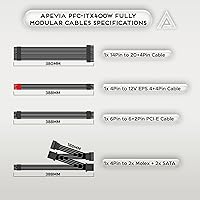
  • Connector selection covers the essentials for most compact builds: 24-pin, 4+4 EPS, 6+2 PCIe, 2x SATA, and 2x Molex.
  • At its price point, finding another fully modular flex ATX unit with this spec sheet is surprisingly difficult.
  • Compact 160 x 73.66 x 35.5mm footprint fits cases where virtually no other quality modular supply will.

Cons

  • The 40mm cooling fan can become noticeably loud under sustained load — a real issue in quiet living room or office environments.
  • 400W is a firm ceiling; pairing this with a power-hungry GPU will likely cause instability or shutdowns.
  • The unit will not power on without a load connected, which has confused and frustrated a meaningful number of first-time builders.
  • Cable lengths may fall short in non-standard or deeper enclosures, forcing awkward routing or limiting case compatibility.
  • Only two SATA connectors are included, which can be a bottleneck for storage-heavy builds or NAS-adjacent systems.
  • With a 3.9-star average across 87 reviews, there are enough reliability outliers to warrant keeping your receipt handy.
  • Apevia is not a tier-one brand, and long-term reliability data remains thinner than you would get from more established PSU manufacturers.
  • No 80 PLUS efficiency certification is listed, making it harder to benchmark real-world efficiency against certified competitors.

Ratings

Our AI-generated scores for the Apevia ITX-PFC400W 400W Flex ATX Power Supply were produced by analyzing verified global user reviews, with spam, bot activity, and incentivized feedback actively filtered out. The ratings reflect a balanced picture — genuine strengths are recognized, but recurring pain points are weighted just as honestly. Buyers at both ends of the experience curve, from first-time ITX builders to seasoned integrators, contributed to these scores.
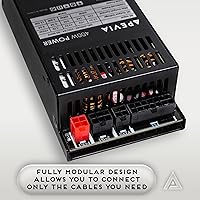
Modular Design
88%
For a flex ATX unit at this price, fully detachable cables are a standout feature that buyers consistently single out. In ultra-compact cases where routing even a single unnecessary cable can block airflow or prevent the panel from closing, having that control matters enormously.
A small number of users noted that the modular connectors feel slightly looser than they would prefer, raising minor concerns about long-term connection integrity under vibration in rack or commercial deployments.
Value for Money
83%
Buyers routinely point out that finding a fully modular flex ATX supply at this price tier is genuinely difficult — most alternatives are either fixed-cable or cost significantly more. For the niche it serves, the price-to-feature ratio holds up well.
A handful of reviewers feel the lack of an 80 PLUS efficiency certification leaves a gap in justifying the cost for efficiency-conscious buyers, and a few reliability outliers in the feedback pool do create some hesitation around long-term value.
Form Factor Fit
91%
The physical dimensions align precisely with the flex ATX standard, and builders report it dropping into compatible mini-ITX and 1U cases without fitment issues. For a format where alternatives are scarce, finding a unit that simply fits is already half the battle.
Compatibility is entirely dependent on the case supporting the flex ATX standard specifically — buyers who assumed it would fit non-standard slim OEM enclosures occasionally found dimensional mismatches that required case modifications.
Fan Noise
54%
46%
Under light loads — basic desktop tasks, idle servers, low-demand POS terminals — the 40mm fan stays at an acceptable noise level that most users in commercial or office environments can tolerate without issue.
Under sustained load, the fan becomes audibly noticeable and is one of the most consistently mentioned complaints. In a living room HTPC setup or quiet office, it can be distracting, and there is no fan curve control available to the end user.
Cable Length
63%
37%
For standard slim ITX cases the cable lengths are adequate, and modular routing keeps slack manageable. Builders working within the intended form factor rarely report length as a problem when the case depth is typical.
In deeper or unconventional enclosures the cables can feel uncomfortably short, and a few builders working with modified or repurposed chassis had to source extension cables separately, adding cost and another potential point of failure.
Power Output Adequacy
74%
26%
The 400W ceiling with a 28A 12V rail comfortably handles mainstream CPUs paired with entry-level discrete GPUs, which covers the majority of mini-ITX and compact build scenarios this unit was designed for.
Anyone planning to use a mid-range or higher GPU will find 400W constraining — sustained gaming loads can push the supply to its limits, and users who underestimated their system power draw reported instability under stress.
Build Quality
77%
23%
The physical construction receives generally positive feedback relative to the price point — the housing feels solid, connector insertion is firm, and the unit does not exhibit the flex or rattle sometimes found in budget flex ATX alternatives.
Apevia is not a top-tier PSU brand, and a measurable portion of reviews mention units that failed within months of use, which prevents the build quality score from climbing higher despite the majority of buyers being satisfied.
Protection Features
84%
Having five discrete hardware protection circuits — covering voltage spikes, overcurrent events, overload, thermal shutdown, and short circuits — is reassuring for always-on deployments like POS terminals or small servers where manual monitoring is not always practical.
Protection features are only as reliable as the underlying hardware that implements them, and given the occasional reliability reports in user feedback, some buyers are uncertain whether these circuits perform consistently across all units.
Connector Variety
69%
31%
The included connector set — 24-pin motherboard, 4+4 EPS, one 6+2 PCIe, two SATA, two Molex — covers the basics for a typical compact build without requiring adapters in most standard configurations.
Only one PCIe connector and two SATA ports is a tight allowance; storage-heavy builds or systems with multiple drives will hit the limit quickly, and the absence of additional PCIe connectors rules out multi-GPU configurations entirely.
First-Time Setup Experience
51%
49%
Buyers who read the included documentation before powering up generally had a smooth installation experience, and the modular design makes the physical cable connection process more intuitive than fixed-cable alternatives in cramped spaces.
The no-load power-on behavior — the unit will not start without components connected — has generated a disproportionate number of negative first impressions from builders who assumed the supply was defective before consulting the manual.
Input Voltage Flexibility
89%
Full-range active PFC covering 90–264V is a genuinely useful feature for international deployments, commercial integrators shipping systems abroad, or anyone operating in regions with inconsistent mains quality. No manual voltage switching is required.
This benefit is largely invisible to domestic buyers on stable 120V mains, so for a significant portion of the user base it is a feature they will never actively appreciate or test.
Thermal Management
62%
38%
The dual ball-bearing 40mm fan is a deliberate engineering choice for longevity in high-uptime environments — ball bearings outlast sleeve bearings meaningfully in continuous operation scenarios like servers or commercial terminals.
The thermal trade-off is real: a 40mm fan must spin considerably faster than a 120mm fan to move equivalent air volume, and in enclosed cases with limited exhaust, temperatures under load can climb in ways that affect long-term component confidence.
Reliability & Longevity
67%
33%
The majority of buyers report units that have been running without incident for months, and for typical light-duty or intermittent-use scenarios the ITX-PFC400W appears to hold up reasonably well within its rated operating envelope.
The 3.9-star aggregate rating is partially anchored by a cluster of reliability-related complaints — dead-on-arrival units and early failures appear at a frequency higher than you would see from established tier-one PSU brands, which is worth factoring into a long-term purchase decision.

Suitable for:

The Apevia ITX-PFC400W 400W Flex ATX Power Supply is purpose-built for anyone working within the very real physical constraints of mini-ITX and flex ATX cases, where a standard ATX or even SFX unit simply will not fit. This compact power supply makes the most sense for hobbyist builders assembling small gaming rigs or HTPCs, where cable management in a tight chassis is as important as the hardware itself — and where the fully modular design pays genuine dividends. IT professionals and system integrators deploying point-of-sale terminals, all-in-one kiosks, or 1U rack servers will also find it a practical choice, particularly given the comprehensive protection suite that benefits always-on commercial environments. The full-range active PFC input spanning 90–264V makes it a sensible option for international deployments or locations with inconsistent mains voltage. If your power draw stays comfortably under 400W and your use case demands a compact, modular supply, this flex ATX unit slots into a frustratingly sparse market as one of the more capable options available.
Not suitable for:

The Apevia ITX-PFC400W 400W Flex ATX Power Supply is not the right tool if your build demands serious GPU power. Pairing it with anything above an entry-level discrete graphics card is pushing the limits of its 400W ceiling and +12V@28A rail — a mid-range or high-end GPU under gaming load will likely stress this unit beyond its comfort zone. Builders who prioritize near-silent operation should also think carefully before committing: the 40mm fan is a physical necessity in this form factor, but it runs audibly at sustained loads, and there is no way around that trade-off when you shrink the cooling surface this much. Cable length may also become an issue if you are working with a deeper or non-standard enclosure rather than a typical slim ITX shell. First-time builders prone to skipping documentation should be warned that this compact power supply will not power on without a connected load — a quirk that has led to unnecessary confusion and unwarranted returns. If your needs include higher wattage, quiet acoustics, or a larger connector inventory, you will need to look at a different class of supply.
Specifications

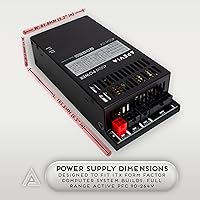
  • Form Factor: This unit follows the Mini-ITX / Flex ATX / 1U standard, measuring 160 x 73.66 x 35.5mm (6.3″ x 2.9″ x 1.4″), making it compatible with cases that cannot accommodate SFX or ATX supplies.
  • Max Output: The power supply delivers a maximum continuous output of 400W across all combined rails.
  • 12V Rail: The primary +12V rail is rated at 28A, providing the main power budget for CPU and GPU loads in compact builds.
  • Minor Rails: Output rails include +3.3V at 12A, +5V at 12A, -12V at 0.3A, and a +5V standby rail at 2.5A.
  • Modular Design: All cables are fully detachable, allowing builders to connect only the cables required for their specific configuration and omit the rest entirely.
  • Input Voltage: The supply accepts a full-range input of 90–264V AC, covering virtually all global mains voltages without requiring a manual voltage switch.
  • Power Factor: Active PFC (Power Factor Correction) is included, improving the efficiency of power draw from the wall and reducing harmonic distortion on the AC line.
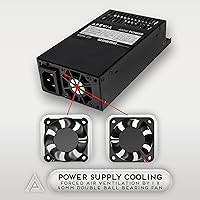
  • Cooling: A single 40mm dual ball-bearing fan provides forced-air ventilation; ball-bearing construction extends operational lifespan compared to sleeve-bearing alternatives.
  • Main Connector: Includes one 20+4 pin motherboard connector that can be physically split into a 20-pin and a separate 4-pin section for legacy board compatibility.
  • CPU Connector: One 8-pin EPS connector is included, which separates into two 4-pin halves to support motherboards requiring only a 4-pin CPU power input.
  • GPU Connector: One 6+2 pin PCIe connector is included, supporting entry-level to mid-range discrete graphics cards with a single power connector requirement.
  • Storage Connectors: Two SATA power connectors and two 4-pin Molex connectors are provided, covering typical storage and legacy peripheral needs in compact systems.
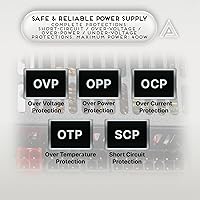
  • Protections: Five hardware protection circuits are built in: Overvoltage (OVP), Overload (OLP), Overcurrent (OCP), Over-Temperature (OTP), and Short Circuit (SCP).
  • Weight: The unit weighs 2.23 pounds, keeping the overall system weight impact minimal for portable or rack-mounted deployments.
  • Compatible Uses: Designed for use in desktop PCs, mini-ITX gaming builds, home-theater PCs, point-of-sale terminals, all-in-one systems, and 1U rack servers.
  • Brand & Model: Manufactured by Apevia Corp under the model designation ITX-PFC400W, first listed for retail in March 2024.

Related Reviews
Apevia ITX-PFC500W 500W Flex ATX Power Supply
77%
88%
Cable Management
91%
Form Factor Compatibility
79%
Power Delivery & Rail Stability
54%
Fan Noise & Acoustics
72%
Build & Component Quality
More
Apevia TFX-AP300W 300W Flex ATX Power Supply
80%
83%
Performance
89%
Value for Money
78%
Build Quality
75%
Cooling Efficiency
60%
Noise Level
More
Apevia ATX-SP700 Spirit 700W ATX Power Supply
85%
93%
Power Output
88%
Build Quality
85%
Cooling Performance
90%
Value for Money
80%
Ease of Installation
More
Apevia ATX-ES600W Essence 600W ATX Semi-Modular Power Supply
85%
88%
Value for Money
84%
Performance under Load
87%
Cooling Efficiency
90%
Cable Management Ease
82%
Build Quality
More
Apevia ATX-ES700-RGB Essence 700W ATX Semi-Modular Power Supply
81%
85%
Performance & Power Output
78%
Cooling & Noise Control
82%
Build Quality
90%
Installation & Cable Management
87%
RGB Customization & Aesthetics
More
Apevia CAPTAIN550 550W ATX Power Supply
70%
78%
Value for Money
54%
Reliability
83%
Cable Quality & Aesthetics
81%
Connector Compatibility
84%
Ease of Installation
More
Apevia Venus 500W ATX Power Supply
86%
92%
Value for Money
88%
Cooling Efficiency
91%
Protection Features
84%
Build Quality
85%
Compatibility with Components
More
Apevia Raptor 500W ATX Power Supply
72%
83%
Value for Money
88%
Ease of Installation
74%
Connector Availability
58%
Reliability & Longevity
79%
Fan Noise
More
Apevia Venus 450W ATX Power Supply
70%
83%
Value for Money
88%
Installation Ease
81%
Noise Level
74%
Connector Availability
62%
Build Quality
More
Apevia ATX-JP600W Jupiter 600W Power Supply
87%
89%
Performance
93%
Power Efficiency
85%
Cooling Efficiency
88%
Build Quality
87%
Cable Management
More

FAQ

This is the most common stumbling block with this unit, and it catches a surprising number of first-time builders off guard. This compact power supply requires an actual load — meaning your motherboard and other components need to be connected — before it will power on. It will not start from the AC cord alone, which is standard behavior for ATX-compliant supplies but not always obvious if you are testing it on the bench without a system attached.

If your case explicitly supports Flex ATX or Mini-ITX power supplies, you should be fine — the dimensions are 160 x 73.66 x 35.5mm (6.3″ x 2.9″ x 1.4″). That said, always double-check your case's PSU clearance spec against those numbers before ordering, because not every ITX case uses the same PSU format.

Yes, but with a realistic expectation of what 400W can handle. Entry-level discrete GPUs — think budget cards with a single 6-pin or 8-pin connector — will work fine. If you are planning to run a mid-range or high-end GPU that pulls 150W or more on its own, you will likely be pushing this unit to or past its safe operating limits, especially under sustained gaming loads.

Honestly, this is one area where you need to temper your expectations. The 40mm fan is a physical necessity in a chassis this small, but smaller fans have to spin faster to move the same volume of air — and faster means louder. Under light loads it is manageable, but under sustained workloads in an enclosed case it can become noticeable. If near-silent operation is a hard requirement, this form factor in general will challenge you, not just this particular unit.

The 8-pin EPS connector is designed to physically separate into two 4-pin halves. Push one half of the connector down while pushing the other up and they will come apart. It takes a bit of firm pressure but it is intentional — no tools required.

Yes. The full-range active PFC input handles 90–264V AC, which covers North American 120V and European or Asian 220–240V standards without any manual switching. It is genuinely plug-and-play across most global power grids.

No official 80 PLUS efficiency certification is listed for this unit. That does not mean it is inefficient, but it does mean you cannot benchmark its efficiency against certified competitors using a standardized rating. If efficiency certification is important for your build or deployment, you will want to factor that in.

The included cable set gives you two SATA power connectors and two 4-pin Molex connectors. For a typical compact build with one or two drives, that is perfectly adequate. If you are planning a storage-heavy setup with three or more SATA devices, you will hit the limit of what the included cables can support without adapters.

It is a reasonable fit for that use case. The five-layer protection suite — covering overvoltage, overcurrent, overload, thermal, and short-circuit events — provides the kind of safety net you want in an unattended or always-on environment. The wide input voltage range also helps in commercial locations where power quality is not always consistent. Just make sure your total system draw stays comfortably under 400W to avoid running the supply near its ceiling continuously.

Apevia typically offers a limited warranty on their PSU products, but the exact duration is best confirmed directly with them or through the retailer at the time of purchase, as terms can vary. Apevia is a budget-to-mid-tier brand with a reasonable track record in this niche, but they do not carry the same reputation for long-term reliability support as tier-one manufacturers like Seasonic or Corsair. Keep your purchase documentation in case you need to follow up on a warranty claim.

Where to Buy