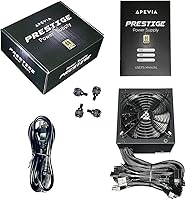
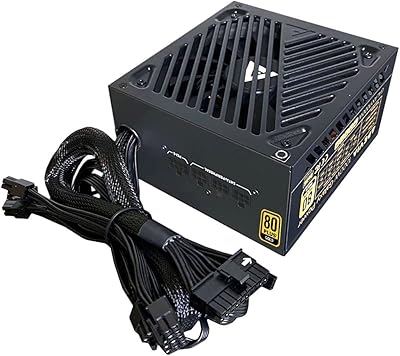
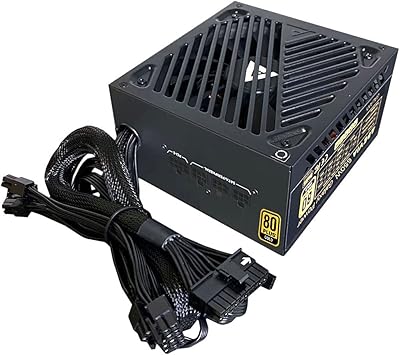
Overview

The Apevia ATX-PR800W 800W ATX Gaming Power Supply sits in an interesting spot in the market — it's not trying to compete with the Seasonic or EVGA Supernova crowd, but it does punch above its weight with an 80 Plus Gold certification that you don't always find at this price point. Apevia has been around long enough to build a modest following among budget builders, though the brand doesn't carry the same engineering pedigree as tier-one names. What it does offer is a solid feature set, a 3-year warranty, and enough headroom for a capable mid-range gaming rig without a significant financial stretch.
Features & Benefits

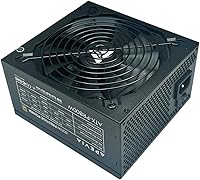
The single 12V rail configuration is probably the most practically useful aspect of this unit's design — rather than splitting power across multiple rails, it channels the full output wherever your system needs it most, which matters when running a power-hungry GPU. The DC-to-DC converter topology tightens voltage regulation, so your components see cleaner, more consistent power under varying loads. On the connectivity side, seven SATA ports is genuinely generous, and the dual 6+2 pin PCIe leads cover most single-card setups without needing adapters. The 135mm fan stays quiet during everyday use, only spinning up noticeably when the Prestige 800W is under sustained heavy load.

Best For

This gaming PSU fits best in standard ATX mid-tower or full-tower cases — it's not an option for compact or ITX builds, so that's worth knowing upfront. It suits builders pairing something like an RTX 4060 Ti or RX 7700 XT with a modern multi-core CPU, where 800W of headroom gives a comfortable buffer without overspending on capacity you'll never use. If you're loading up a rig with multiple drives, the abundant SATA connectors make that easy. First-time builders will appreciate the warranty coverage as a practical backstop, even if this Apevia unit doesn't carry the reputation of pricier alternatives from Corsair or be Quiet.

User Feedback

Most buyers come away satisfied with the connector variety and how straightforward installation is — cable lengths are workable for mid-tower cases, and the labeling is clear enough that first-timers rarely struggle. The Gold efficiency rating gets positive mentions, particularly from users monitoring power draw. That said, recurring concerns exist around long-term reliability; some users report units failing after a year or two, which appears more frequently in Apevia feedback than with tier-one brands. A small number of DOA reports show up as well. The warranty is there, but some buyers note the claims process requires patience. It's a fair tradeoff at this price — not a worry-free one.

Pros

  • 80 Plus Gold certification delivers genuinely better efficiency than cheaper Bronze-rated alternatives at this price range.
  • The single 12V rail design gives your GPU and CPU stable, undivided power access under demanding gaming loads.
  • Seven SATA connectors is unusually generous, making this gaming PSU a strong choice for multi-drive storage builds.
  • DC-to-DC converter topology provides tighter voltage regulation than older designs, which benefits system stability.
  • The 135mm fan runs quietly during everyday workloads and only ramps up under sustained heavy use.
  • Dual 6+2 pin PCIe connectors support a wide range of current-gen GPUs without needing adapters.
  • The 3-year warranty adds meaningful peace of mind for first-time builders unfamiliar with PSU quality tiers.
  • Active PFC helps the unit play nicely with power conditioners and UPS devices.
  • At this price tier, the overall connector variety and cable lengths are well-suited to standard mid-tower builds.
  • RoHS compliance signals adherence to basic environmental and component safety standards.

Cons

  • Apevia lacks the community trust and independent testing pedigree of tier-one PSU brands like Seasonic or Corsair.
  • Some users have reported units failing within one to two years, raising durability questions for long-term builds.
  • DOA (dead on arrival) reports appear more frequently in user feedback than is typical for higher-tier competitors.
  • The warranty claims process has drawn criticism for slow turnaround times, making it less reassuring in practice.
  • Fan noise increases noticeably under sustained high loads, which may bother users in quieter environments.
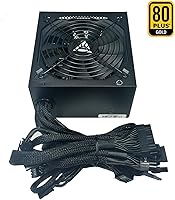
  • No modular or semi-modular cable management means extra cable clutter inside the case regardless of what you need.
  • Independent stress-test data from reputable PSU review sites is limited, making it harder to verify advertised specs.
  • Not compatible with small-form-factor or ITX case builds, narrowing its use-case significantly.
  • Buyers who compare the Prestige 800W against similarly priced Corsair CX or EVGA units often find those brands better supported by community reviews and reliability data.

Ratings

The scores below reflect our AI-assisted analysis of verified global buyer reviews for the Apevia ATX-PR800W 800W ATX Gaming Power Supply, with spam, bot-generated, and incentivized feedback actively filtered out before scoring. We looked at patterns across thousands of real purchase experiences to surface what this unit genuinely does well — and where it falls short. Both the strengths and the frustrations are represented honestly, so you can make a confident, clear-eyed buying decision.

Value for Money
81%
19%
For builders who need Gold-rated efficiency without stretching their budget, the price-to-wattage ratio here is genuinely hard to argue with. Most buyers feel they got more than their money's worth in raw specs, especially when comparing wattage and efficiency tier against similarly priced competitors.
The value calculus shifts if you factor in the brand's reliability track record. A handful of buyers who experienced early failures felt the savings weren't worth the hassle, particularly when replacement costs and downtime are considered.
Reliability & Longevity
61%
39%
Many users report trouble-free operation across the first year or two of regular gaming use, and a portion of buyers have run the unit without issues for longer stretches in moderate-load systems. For non-critical builds, it holds up reasonably well day to day.
Durability concerns show up more frequently in feedback for this gaming PSU than for tier-one alternatives. A noticeable subset of reviewers reported failures between the 12 and 24-month mark, and DOA unit reports, while not dominant, appear at a rate that warrants caution for expensive component pairings.
Efficiency & Power Delivery
84%
The 80 Plus Gold certification is not just a badge here — users building systems with power-monitoring tools have noted clean, consistent delivery under mixed workloads. The single 12V rail design means the GPU gets what it needs without current-sharing compromises that can plague multi-rail budget units.
While the Gold rating is legitimate, independent verification data from third-party PSU review labs is thin for this unit, so buyers have to take advertised voltage tolerances largely on faith rather than confirmed benchmarks.
Cable & Connector Variety
86%
Seven SATA connectors genuinely stands out in this price bracket, and builders with multiple drives consistently praise not needing splitters or adapters. The dual 6+2 pin PCIe leads cover a wide range of current-gen GPUs without any extra hardware.
Because the unit is non-modular, all cables are permanently attached. Builders in smaller mid-towers sometimes find managing the unused peripheral and SATA leads tedious, and cable clutter behind the motherboard tray is a common complaint.
Noise Level
72%
28%
During web browsing, light gaming, or any scenario where the system stays below roughly 50 to 60 percent load, the 135mm fan is nearly unnoticeable. Builders who run productivity workloads alongside gaming appreciate the quiet baseline behavior.
Push the system into sustained full-load gaming sessions and the fan becomes clearly audible. Users sensitive to PSU noise, or those running open-bench setups, find the ramp-up under stress more noticeable than they expected for a thermally controlled design.
Build Quality & Materials
67%
33%
The chassis feels solid enough for a unit at this price point, and the connector housings clip in with adequate firmness. Most users report no physical issues out of the box, and the overall construction meets basic expectations for a non-premium ATX PSU.
Compared to tier-one units, the internal component quality and finishing are visibly less refined to experienced builders. The cabling insulation feels a step below what you get from Corsair or Seasonic products at a similar or slightly higher price.
Installation Ease
88%
Connector labeling is clear and intuitive, and the cable lengths work well for standard mid-tower builds without much wrestling. First-time builders consistently mention that the installation process was straightforward, with no confusing proprietary connectors or awkward routing challenges.
In full-tower cases with bottom-mount PSU bays and extensive cable management routing, some users found certain leads — particularly the 24-pin and rear SATA strings — just barely long enough, requiring careful planning rather than a relaxed install.
Fan & Thermal Management
74%
26%
The automatic thermal control means the fan does not spin at full speed needlessly, which extends fan bearing life and keeps the acoustic profile reasonable during everyday use. Builders in well-ventilated cases report the PSU running cool under moderate gaming loads.
The thermal curve seems to prioritize a late but aggressive ramp rather than a gradual linear increase, which causes the noise jump under load to feel more sudden than smooth. A more progressive curve would have improved the experience noticeably.
Compatibility
83%
The 20/24-pin main connector and 4/8-pin CPU lead cover virtually every modern ATX motherboard on the market. PCIe connector options are broad enough to support most single-GPU builds without needing third-party adapters, which buyers appreciate straight out of the box.
This is strictly a standard ATX unit with no SFX or compact variant available, which locks out anyone building in a small-form-factor case. Builders who later want to downsize their case must replace the PSU entirely.
Warranty & Support
58%
42%
The 3-year warranty period itself is a genuine positive, and it does provide a meaningful backstop for buyers who experience a manufacturing defect. For first-time builders especially, having any multi-year coverage offers basic reassurance during the initial build period.
The support experience behind the warranty is where things fall apart for some users. Feedback around claims processing describes slow response times and a less streamlined RMA process than what established brands offer, which undermines confidence in the warranty as a practical safety net.
Voltage Stability
77%
23%
The DC-to-DC converter topology is a meaningful design choice that delivers tighter voltage regulation than older group-regulated budget PSUs. Users running voltage-sensitive workloads like overclocked CPUs report stable readings across extended sessions under moderate load.
Without published third-party crossload test data, it is difficult to confirm how well the unit maintains voltage tolerances at the extremes of its rated output. Builders pushing close to 800W sustained draw are operating in less well-documented territory.
Protection Circuits
69%
31%
Standard protection features — including overvoltage, overcurrent, short circuit, and overtemperature shutoffs — are present and have functioned correctly for most users who reported triggering them. The unit shuts down safely rather than passing harmful current to connected components in the common failure scenarios reported.
There is no independently verified data confirming how precisely these protection thresholds are calibrated. For budget-tier PSUs generally, protection circuits can be tuned loosely, and this Apevia unit has not been subjected to the same public teardown scrutiny as higher-profile competitors.
Aesthetics
71%
29%
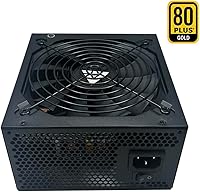
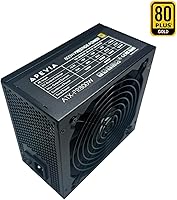
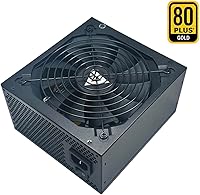
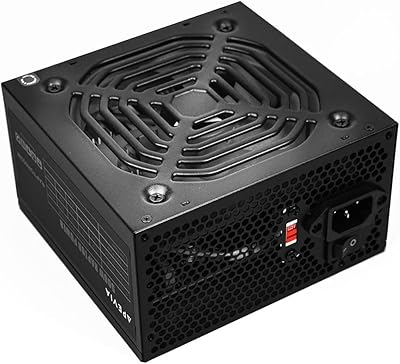
The matte black fan grille and clean exterior give the unit an inoffensive, understated look that blends into most builds without drawing unwanted attention. For builders who are not using a windowed panel or lighting the PSU chamber, the appearance is a non-issue.
There is no RGB lighting, no sleeved cable option in the box, and no premium finish to speak of. Builders putting effort into a showcase build with a windowed case will likely find the stock cables and plain aesthetic underwhelming compared to modular units with braided leads.
Documentation & Setup Guidance
75%
25%
The included documentation covers connector identification and basic installation steps clearly enough for most first-time builders to get through setup without outside help. Connector labeling on the cables themselves reinforces what is printed in the manual.
There is no wiring diagram specific to common GPU or CPU configurations, and no guidance on cable management techniques for cleaner builds. Builders looking for installation tutorials specific to this unit will need to rely on general ATX PSU guides online.

Suitable for:

The Apevia ATX-PR800W 800W ATX Gaming Power Supply is a solid pick for budget-conscious PC builders who want Gold-rated efficiency without paying a premium for it. It fits naturally into mid-range gaming builds centered around a single powerful GPU and a modern multi-core processor, where 800W provides a comfortable power buffer without unnecessary excess. Builders planning storage-heavy systems will appreciate having seven SATA connectors available, removing the need for splitters or adapters. First-time builders also benefit from the included 3-year warranty, which offers a meaningful safety net even if Apevia's support process isn't the fastest in the industry. As long as you're working with a standard ATX mid-tower or full-tower case, this gaming PSU fits the bill for everyday gaming rigs on a practical budget.
Not suitable for:

Builders who prioritize long-term reliability above all else may want to look elsewhere before committing to the Apevia ATX-PR800W 800W ATX Gaming Power Supply. Apevia doesn't carry the same engineering reputation or community trust as brands like Seasonic, Corsair, or be Quiet, and user feedback reflects a slightly higher rate of early failures than you'd see with tier-one options. This unit is also a non-starter for compact or small-form-factor builds, since it only comes in a standard ATX footprint. Enthusiast builders planning a high-end dual-GPU configuration or running extreme overclocks should look at more rigorously tested PSUs with stronger protection circuitry track records. Anyone who has had bad experiences with budget PSU brands in the past, or who is powering expensive components they can't afford to replace, would be better served by spending a bit more on a unit from a more established lineage.

Specifications

  • Rated Output: The unit delivers a total continuous output of 800W, sufficient for most single-GPU mid-range gaming builds.
  • Efficiency Rating: It carries an 80 Plus Gold certification, meaning it operates at 90% efficiency or better at 50% load, reducing heat and wasted electricity.
  • Rail Configuration: Power is delivered over a single 12V rail, which consolidates output and avoids current-limiting issues common in multi-rail designs.
  • Topology: The DC-to-DC converter design improves voltage stability and transient response compared to older group-regulated designs.
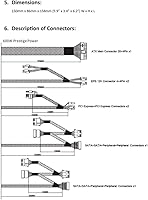
  • Form Factor: This is a standard ATX unit measuring 6.2 x 5.9 x 3.4 inches, compatible with mid-tower and full-tower cases only.
  • Cooling: A single 135mm fan with automatic thermal control adjusts speed based on internal temperature, keeping noise low during lighter workloads.
  • Main Connector: Includes one 20/24-pin main motherboard connector compatible with virtually all modern ATX motherboards.
  • CPU Connector: One 4/8-pin 12V CPU power connector supports both standard and high-performance motherboard configurations.
  • PCIe Connectors: Two 6+2 pin PCIe connectors are included, supporting a wide range of current-generation discrete graphics cards without adapters.
  • SATA Connectors: Seven SATA power connectors provide ample support for storage-heavy builds with multiple SSDs or HDDs.
  • Peripheral Connectors: Four standard 4-pin peripheral (Molex) connectors are available for older drives, fan controllers, or other accessories.
  • Power Factor Correction: Active PFC improves compatibility with power conditioners and UPS devices while reducing harmonic distortion on the AC line.
  • Compliance: The unit is RoHS compliant, meaning it meets restrictions on hazardous substances used in its construction.
  • Warranty: Apevia covers this unit with a 3-year limited warranty from the date of purchase.
  • Weight: The unit weighs 4.7 pounds, which is typical for a non-modular ATX PSU of this wattage class.
  • Modular Design: This is a non-modular PSU, meaning all cables are hardwired and must be managed or tucked away regardless of whether they are used.
  • Protection Features: The unit includes standard protection circuits covering overvoltage, undervoltage, overcurrent, overpower, short circuit, and overtemperature conditions.
  • Manufacturer: Made by Apevia Corp, a US-based brand that has produced consumer PC components for over two decades.

Related Reviews
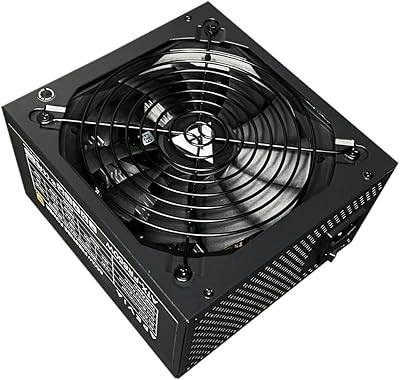
Apevia ATX-PR850W Prestige 850W ATX Power Supply
73%
83%
Value for Money
88%
Connector Selection
84%
Efficiency & Power Quality
54%
Long-Term Reliability
48%
Brand Confidence
More
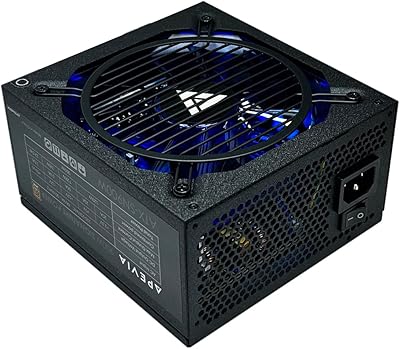
Apevia ATX-PM650W 650W 80+ Gold Semi-Modular Gaming Power Supply
87%
88%
Performance
85%
Ease of Installation
91%
RGB Aesthetics
90%
Cable Management
92%
Energy Efficiency
More
Apevia ATX-GX1000W 1000W Semi-Modular Power Supply
74%
83%
Value for Money
67%
Build Quality
58%
Long-Term Reliability
88%
Ease of Installation
79%
Cable Management
More
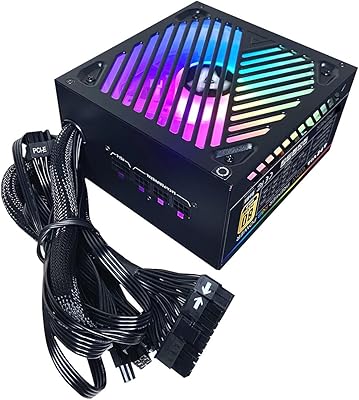
Apevia ATX-SN900 900W Semi-Modular Power Supply
77%
88%
Value for Money
91%
Wattage Headroom
82%
Cable Management
61%
Long-Term Reliability
74%
Noise Level
More
Apevia Galaxy 650W Semi-Modular Power Supply
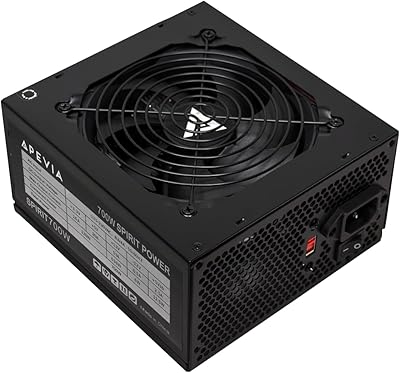
71%
84%
Value for Money
81%
Efficiency Rating
79%
Cable Management
63%
Build Quality
77%
Fan Noise
More
Apevia ATX-SP700 700W ATX Power Supply
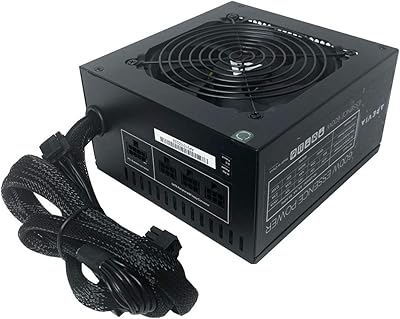
71%
83%
Value for Money
88%
Installation Ease
54%
Long-Term Reliability
71%
Noise Level
79%
Connector Variety
More
Apevia Essence 600W Semi-Modular ATX Power Supply
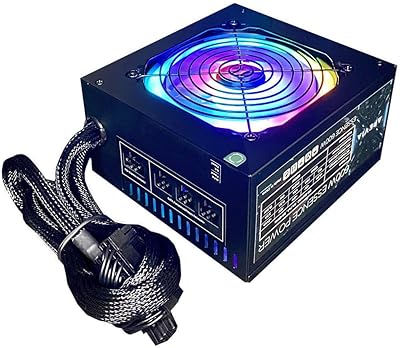
72%
78%
Value for Money
81%
Cable Management
74%
Noise Level
86%
Ease of Installation
62%
Build Quality
More
Apevia Essence 700W ATX Power Supply
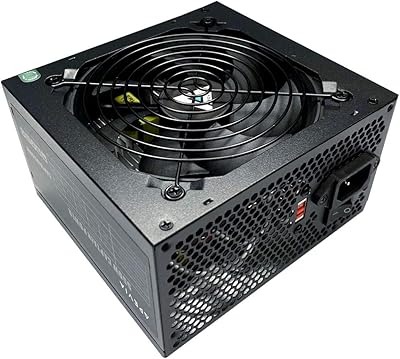
71%
81%
Value for Money
78%
Cable Management
74%
Power Stability
49%
Efficiency
63%
Build Quality
More
Apevia CAPTAIN550 550W ATX Power Supply
70%
78%
Value for Money
54%
Reliability
83%
Cable Quality & Aesthetics
81%
Connector Compatibility
84%
Ease of Installation
More
Apevia Venus 450W ATX Power Supply
70%
83%
Value for Money
88%
Installation Ease
81%
Noise Level
74%
Connector Availability
62%
Build Quality
More

FAQ

Yes, for most mid-range single-GPU builds with those cards it should be fine. Both draw well under 300W at peak, and paired with a modern CPU you will be using roughly 400-500W under full load, leaving a reasonable buffer. Just make sure your system does not exceed the 800W total capacity when you add up all components.

For the vast majority of single-GPU gaming rigs, 800W is more than adequate. Problems arise only if you are running dual high-end GPUs or pushing extreme overclocks on both CPU and GPU simultaneously. For a typical build with one graphics card, 800W gives you headroom to spare.

It fits standard micro-ATX cases that accept full ATX power supplies, which most do. However, mini-ITX and small-form-factor cases often require SFX or SFX-L units, and this one will not physically fit those enclosures. Always check your case specs before buying.

During everyday use and lighter workloads the fan is fairly quiet and you will likely not notice it over your case fans. Under sustained heavy gaming it does spin up and becomes audible, but it is not unusually loud for a PSU in this class. If near-silent operation is a priority, a fully fanless or semi-passive PSU would suit you better.

Corsair and EVGA have more extensively tested units with stronger community reputations and more available independent review data. The Prestige 800W gives you more raw wattage for the money and the same Gold rating, but if brand reliability history is your main concern, Corsair and EVGA generally edge it out. It comes down to whether the wattage difference is worth the trade-off in proven track record for you.

Apevia offers a 3-year warranty, but user feedback suggests the claims process can be slow and requires some patience. You will generally need to contact their support team directly and may be asked to ship the unit back. It is a legitimate warranty, just not as frictionless as what you get from brands with larger dedicated support operations.

Yes. The included 4/8-pin CPU connector is designed exactly for that — the two halves can be used together for an 8-pin socket or separated for a standard 4-pin connection. Most modern motherboards use the full 8-pin, but the connector handles both cases.

Most users report that cable lengths are workable for standard mid-tower builds, but in a large full-tower you may find some cables, particularly the 24-pin and SATA leads, a bit snug depending on your cable routing. If you are building in an extended full-tower with a bottom-mount PSU bay and cables routed behind the motherboard tray, measure your routing path before assuming everything will reach comfortably.

It includes two 6+2 pin PCIe connectors which technically enables connecting two graphics cards. However, 800W is on the tight side for a dual high-end GPU setup, and Apevia is not a brand typically recommended for powering expensive multi-GPU configurations where PSU reliability under sustained load really matters. For a dual-GPU rig, a higher-wattage unit from a tier-one brand is a smarter choice.

It does include standard protection circuits for overvoltage, overcurrent, and short circuits, which are designed to shut the unit down rather than send harmful current to your motherboard or GPU. That said, no budget PSU carries an absolute guarantee, and the protection circuitry in tier-one units tends to be more rigorously tested. For builds with very expensive components, the extra peace of mind from a premium PSU is worth considering.

Where to Buy