Overview

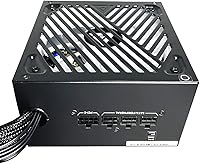
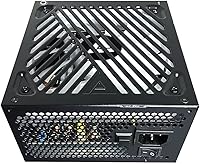
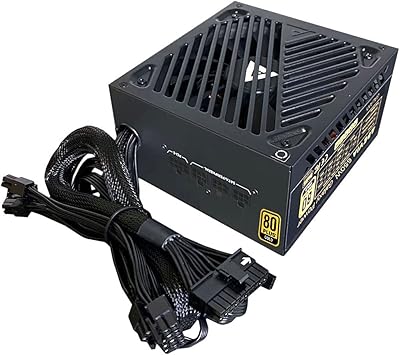
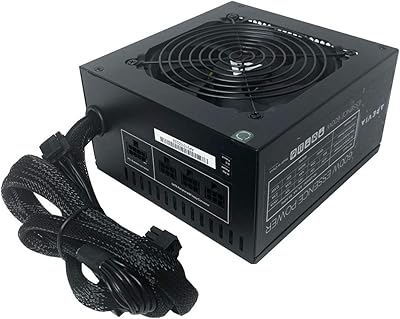
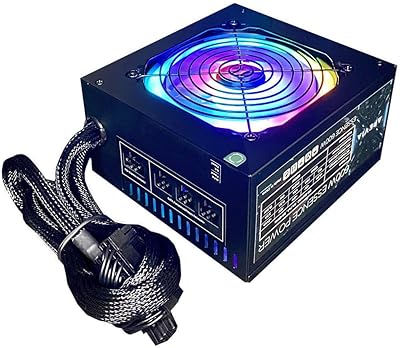
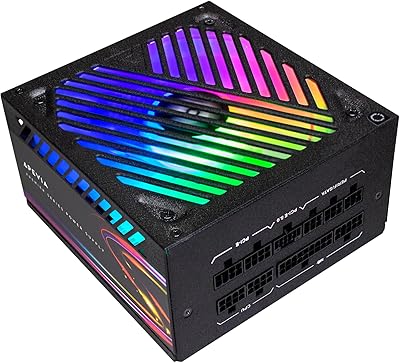
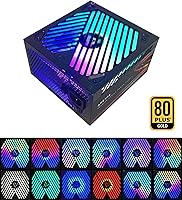
The Apevia ATX-PM650W 650W Semi-Modular Power Supply sits squarely in the budget tier, but it brings something most cheap PSUs skip: 80+ Gold certification. That alone puts it ahead of the crowd at this price point, where Bronze-rated units dominate. It's built for entry-level and mid-range gaming builds — not workstation rigs or power-hungry flagship GPUs. The RGB fan is a nice touch for anyone building inside a windowed case, though it's not the main reason to buy this unit. Sitting at #107 in Computer Power Supplies on Amazon, it clearly moves units, which says something real about its appeal among budget-conscious builders.

Features & Benefits

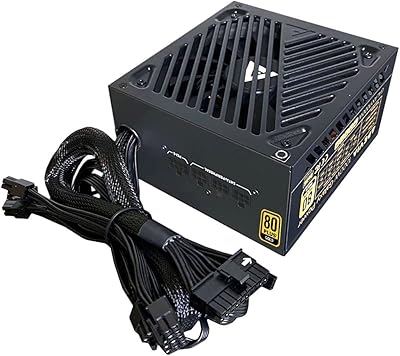
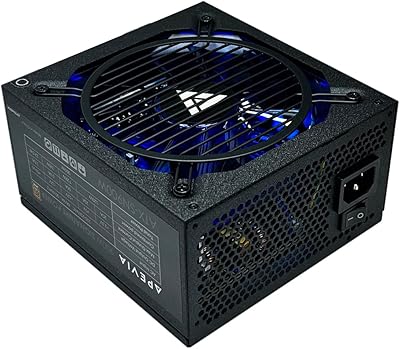
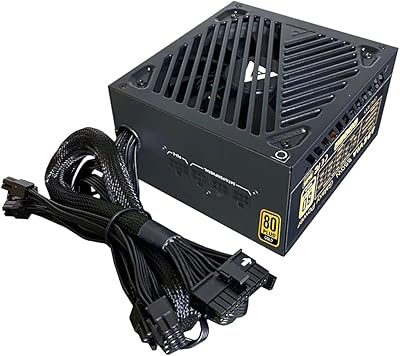
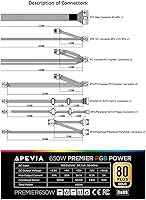
The semi-modular design is one of the more practical aspects of this Apevia PSU — you only plug in the cables you actually need, which cuts down on the bundle of unused wires stuffed into a corner of your case. The 80+ Gold rating translates to real benefits over time: less heat, lower electricity waste, and a unit that isn't working harder than it needs to. The 135mm fan runs quietly at low and moderate loads, spinning up only when temperatures demand it. On the connector front, you get dual 4+4 CPU plugs, four PCIe connectors, and four SATA ports — enough to cover most mainstream builds without reaching for adapters. The single 12V rail keeps power delivery straightforward.

Best For

This semi-modular unit makes the most sense for first-time builders who want clean cable runs without paying premium prices for a fully modular option. It's a strong fit for mid-range gaming setups built around cards like an RTX 4060 or RX 7600 — nothing that demands 750W or more. Tighter ATX cases benefit most from the semi-modular layout, since fewer dangling cables make routing noticeably easier. If you've been running an old Bronze-rated or unrated PSU and want a meaningful efficiency upgrade, this is a sensible step up. Anyone building with a windowed case who wants some RGB without buying a separate controller will also find value here.

User Feedback

Buyers tend to highlight easy installation and tidy cable management as the biggest wins — the semi-modular layout earns consistent praise from newer builders in particular. The RGB fan gets positive mentions too, especially from those with glass-panel cases. On the critical side, some users note the fan becomes audible under sustained heavy loads, which is worth considering if your system regularly pushes near the wattage ceiling. A handful of buyers have raised questions about long-term reliability, a fair concern given Apevia's standing compared to tier-one brands like Seasonic or Corsair. The 8-pin CPU connector can split into two 4-pin halves for compatible motherboards — useful, though a few users found the mechanism stiff initially.

Pros

  • 80+ Gold certification is genuinely rare at this price tier and translates to real efficiency gains over cheaper alternatives.
  • The semi-modular layout keeps unused cables out of your case without the cost of a fully modular unit.
  • Connector selection covers most mainstream builds right out of the box, including dual CPU power headers.
  • The 135mm fan stays quiet during light and moderate workloads, which suits everyday gaming sessions well.
  • A single 12V rail at 83.3A simplifies power delivery and pairs cleanly with modern mid-range GPUs.
  • Built-in protections — including short-circuit, over-voltage, and over-power — provide a reasonable safety net for your components.
  • The RGB fan adds interior lighting without requiring a separate controller or extra budget.
  • Japanese-brand primary capacitor is a meaningful quality detail that budget PSUs often skip entirely.
  • Strong sales rank suggests a large install base, meaning real-world feedback and community experience are easy to find.
  • SLI and CrossFire support future-proofs the connector set for multi-GPU experimentation on a budget platform.

Cons

  • Fan noise increases noticeably under sustained heavy loads, which may bother users in quiet environments.
  • Apevia does not carry the same long-term reliability reputation as established PSU brands like Seasonic or Corsair.
  • Some users report the 8-pin CPU connector splitting mechanism feels stiff and requires firm pressure to separate cleanly.
  • Cable quality and connector fit have drawn occasional complaints, particularly around how snugly plugs seat into headers.
  • No fully modular option exists in this line, so the fixed cables must be managed regardless of how simple your build is.
  • 650W headroom is tight for anyone planning GPU upgrades beyond the current mid-range generation.
  • Warranty terms and after-sale support are not on par with what premium PSU brands typically offer.
  • Long-term durability data is limited compared to PSUs with years of community stress-testing behind them.
  • The unit will not power on without all cables properly connected, which can confuse first-time builders during initial testing.
  • RGB modes, while plentiful, cannot be controlled via motherboard software, limiting lighting sync options.

Ratings

The scores below reflect an AI-driven analysis of verified global user reviews for the Apevia ATX-PM650W 650W Semi-Modular Power Supply, with spam, incentivized, and bot-generated submissions actively filtered out before scoring. Each category captures both the genuine enthusiasm and the honest frustrations real buyers have shared after putting this unit inside working machines. Nothing has been smoothed over — where the unit earns praise, it shows, and where it falls short, that shows too.

Value for Money
88%
Buyers consistently point to this as one of the few units at this price that actually delivers 80+ Gold certification without asking you to compromise on connector count. For builders on tight budgets assembling mid-range gaming rigs, the ratio of what you get to what you spend is genuinely hard to argue with.
A handful of users feel the value calculation shifts once you factor in Apevia's thinner warranty support versus tier-one brands. If you compare it against occasional sales on Corsair or EVGA units at similar prices, the gap narrows in ways that make the decision less automatic.
Efficiency & Power Delivery
84%
The 80+ Gold rating is not just a sticker — users running mid-range GPUs report stable, consistent power without voltage irregularities during gaming sessions. The single 12V rail design keeps delivery clean, which is exactly what a build around an RTX 4060 or RX 7600 needs day to day.
At loads pushing close to the 650W ceiling, some users report slight instability concerns, and the efficiency advantage over Bronze units narrows under sustained heavy draw. It is not the right choice if your components routinely pull anywhere near the rated maximum.
Cable Management
86%
The semi-modular layout is one of the most appreciated aspects among first-time builders, who specifically mention being able to leave unused cable bundles in the box rather than zip-tying them out of sight. Builders working inside tight mid-towers note it makes routing significantly less frustrating compared to fully fixed PSUs.
The fixed cables that come permanently attached — including the 24-pin main power — are on the shorter side for some full-tower cases, which forces awkward routing in larger builds. A few users also find the cable sleeving quality a step below what branded competitors include at this price.
Noise Level
69%
31%
During everyday desktop use and light gaming, the thermally controlled 135mm fan runs quietly enough that most users do not notice it above their case fans. For builds that are not pushing the system hard for extended periods, the acoustic experience is genuinely acceptable.
Under sustained heavy gaming or stress loads, the fan audibly ramps up, and several users describe it as noticeably louder than expected compared to competing units at similar price points. Builders who prioritize quiet operation in an otherwise silent build should treat this as a real consideration, not a minor footnote.
Build Quality & Materials
67%
33%
The chassis feels solid for the price class, and the inclusion of a Japanese-brand primary capacitor signals that Apevia made at least one meaningful quality-tier decision inside the unit. Buyers who have handled cheaper no-name PSUs note that this one feels more substantial by comparison.
Connector fit quality draws recurring criticism — some users find that plugs seat loosely or require more force than expected to click in properly. The overall internal build does not inspire the same confidence as units from brands with established reliability track records, and that concern surfaces consistently in longer-term feedback.
Ease of Installation
89%
First-time builders are the most vocal positive reviewers here, frequently describing the installation process as intuitive and well-suited to beginners. The semi-modular design reduces the decision fatigue of figuring out which cables to route, and the connector labeling is clear enough that most users get it right on the first try.
The 8-pin CPU connector splitting mechanism — designed to convert into two 4-pin halves — confuses a subset of users who are not expecting to apply firm physical force to separate it. Without reading the manual note about this, some buyers initially assume the connector is defective.
RGB Lighting
79%
21%
The 366-mode RGB fan produces a genuinely bright, colorful effect that shows well through windowed cases, and users appreciate getting this feature without buying a separate RGB component. For builds where aesthetics matter on a budget, it adds a visible payoff inside the case.
Because the lighting is self-contained and not addressable through motherboard software like Asus Aura or MSI Mystic Light, users who care about synchronized RGB themes cannot integrate it into their ecosystem. The auto-cycling modes look lively but offer no user control over color selection or pattern timing.
Connector Variety
83%
The connector set covers the realistic needs of most mainstream builds without requiring adapters — four PCIe plugs, dual CPU headers, four SATA, and four Molex means most builders find everything they need in the box. Users putting together mid-range single-GPU rigs consistently report having exactly the right connectors available.
For more complex builds with numerous storage drives or specialty peripherals, four SATA ports can feel limiting. Users with older hardware that still relies on Molex connections also note the peripheral count starts to feel tight once a few devices are connected.
Thermal Management
72%
28%
Under typical gaming workloads, the auto-thermally controlled fan does its job — internal temperatures stay in a reasonable range and the unit does not run unusually hot to the touch during normal use. The 80+ Gold efficiency rating contributes here by generating less waste heat than lower-rated units would.
Under prolonged heavy loads, users report the fan working considerably harder and the unit running warmer than expected. For builds in cases with restricted airflow or ambient environments that run hot, there are enough user reports of thermal-related noise to take seriously.
Component Protection
81%
19%
The full suite of protections — short-circuit, over-voltage, under-voltage, over-power, and over-current — gives builders reasonable confidence that a fault event will shut down the PSU before damaging connected components. Several users specifically mention this coverage as a reassuring feature for a budget unit.
Protection features are table stakes for modern PSUs and not unique to this unit, so they do not meaningfully differentiate it from competing options. Users with particularly sensitive or expensive component sets may still prefer a unit from a brand with more documented real-world protection performance data.
Long-Term Reliability
58%
42%
A meaningful portion of buyers report the unit running without issue for a year or more in standard gaming use, which is a reasonable baseline for the price tier. For builders who cycle systems every few years, the expected lifespan aligns reasonably with how the product is priced.
Reliability is the category where Apevia's brand reputation creates the most friction — longer-term reviews carry a higher rate of failure reports than comparable units from Seasonic or Corsair. Users who plan to keep their build running for four or more years without touching the PSU may find this concern hard to dismiss.
Warranty & Support
53%
47%
The unit does come with manufacturer warranty coverage, and some users report successful resolution of issues through Apevia's support channels when they encountered defects early in ownership. For basic factory-defect scenarios, the process works.
Apevia's warranty terms and post-sale support are noticeably thinner than what established PSU brands offer, and the response experience varies considerably based on user reports. Buyers who have dealt with Corsair or Seasonic support find the comparison unfavorable on both warranty length and service responsiveness.
Compatibility
87%
ATX 12V 2.3 compliance combined with support for Haswell CPUs, SLI, and CrossFire means this unit works with a broad range of current and slightly older platforms without compatibility headaches. The 20/24-pin main connector also supports older motherboards, which matters for budget system recyclers.
The unit is not suited for modern PCIe 5.0 GPU connector standards, which newer flagship cards are beginning to require. Builders planning to pair this with a next-generation high-end GPU should verify power connector compatibility before purchasing.
Packaging & Unboxing
74%
26%
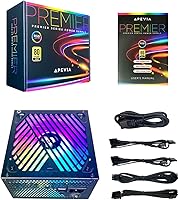
Most users find the unit arrives well-protected, with the modular cables organized and separated in a way that makes the initial unboxing experience straightforward. First-time builders especially appreciate not having to untangle a pile of cables before they can start.
The included documentation is sparse, which matters more than expected given the two non-obvious setup points — the PSU-only power-on behavior and the CPU connector splitting method. A clearer quick-start guide would prevent a measurable number of the confusion-related issues buyers report.

Suitable for:

The Apevia ATX-PM650W 650W Semi-Modular Power Supply is a practical choice for budget-conscious builders putting together their first gaming PC or refreshing an older system on a tight spend. If your build centers around a mid-tier GPU — think RTX 4060, RX 7600, or anything in that performance class — 650W of Gold-rated power is more than sufficient headroom. The semi-modular design makes it particularly appealing for builders working inside compact or mid-tower ATX cases, where managing excess cables is a real frustration. Anyone upgrading from an old Bronze-rated or uncertified PSU will notice genuine improvements in heat output and efficiency without paying a premium price. It also suits buyers who want a windowed case with some interior lighting but don't want to budget separately for RGB components.
Not suitable for:

Enthusiast builders running high-end GPUs, multi-GPU setups, or power-hungry processors should look elsewhere — the Apevia ATX-PM650W 650W Semi-Modular Power Supply simply isn't designed for that level of sustained demand. If you're pairing your PSU with an RTX 4080, RTX 4090, or any flagship card that regularly draws close to 300W on its own, 650W leaves uncomfortably thin headroom and puts the unit under continuous stress. Builders who prioritize long-term system reliability and want a PSU from a brand with a proven multi-year track record — Seasonic, Corsair, or be quiet! — may find Apevia's reputation a sticking point. This unit is also not the right pick for professional workstations, NAS builds with many drives, or any rig where a PSU failure would cause significant downtime or data risk. If quiet operation under full load is a hard requirement, the fan behavior reported by some users may be a concern worth weighing carefully.
Specifications

  • Wattage: This unit delivers a continuous output of 650W, suitable for mainstream gaming builds with mid-tier GPUs.
  • Efficiency Rating: Certified 80+ Gold, meaning it operates at roughly 87–90% efficiency under typical loads, reducing wasted energy as heat.
  • Modular Design: Semi-modular configuration includes fixed essential cables while allowing optional cables to be detached and omitted when not needed.
  • Form Factor: Standard ATX form factor ensures compatibility with the vast majority of mid-tower and full-tower PC cases on the market.
  • Dimensions: The unit measures 6.2 x 5.9 x 3.4 inches, fitting within standard ATX PSU mounting bays without modification.
  • Weight: Weighs 4.24 pounds, which is typical for a PSU in this wattage and efficiency class.
  • 12V Rail: Single 12V rail rated at 83.3A provides straightforward, stable power delivery to CPUs and GPUs without load-balancing complexity.
  • CPU Connectors: Includes two 4+4 pin EPS 12V connectors, with each plug physically separable into two 4-pin halves for motherboards requiring a single 4-pin.
  • PCIe Connectors: Ships with four 8-pin (6+2) PCIe connectors, supporting up to two dual-connector GPUs or four single-connector cards.
  • SATA Connectors: Four SATA power connectors are included, covering typical storage configurations for drives, SSDs, and optical devices.
  • Peripheral Connectors: Four 4-pin Molex peripheral connectors support older devices, fans, and accessories that do not use SATA power.
  • Cooling Fan: A 135mm auto-thermally controlled fan adjusts speed based on internal temperature, reducing noise during light and moderate workloads.
  • RGB Lighting: The fan housing features built-in RGB LEDs with 366 selectable lighting modes, cycling automatically without requiring motherboard software.
  • Capacitors: Uses a Japanese-brand primary capacitor, a quality component choice that supports stable power delivery and longer component lifespan.
  • Protections: Includes short-circuit, over-voltage, under-voltage, over-current, and over-power protections to safeguard connected components during fault events.
  • ATX Standard: Compliant with ATX 12V version 2.3, ensuring compatibility with modern motherboards and current-generation CPU power requirements.
  • Multi-GPU Support: Supports both NVIDIA SLI and AMD CrossFire configurations, providing connector compatibility for dual-GPU setups on supported platforms.
  • CPU Compatibility: Officially supports dual-core, quad-core, and Haswell-generation Intel processors, as well as compatible AMD platforms.
  • Floppy Connector: Includes one legacy floppy power connector for compatibility with older devices or specialty hardware that still uses this connector type.
  • Main Power Connector: Ships with one 20/24-pin ATX main power connector, compatible with both older 20-pin and current 24-pin motherboard designs.

Related Reviews

Apevia Galaxy 650W Semi-Modular Power Supply
71%
84%
Value for Money
81%
Efficiency Rating
79%
Cable Management
63%
Build Quality
77%
Fan Noise
More
Apevia Essence 600W Semi-Modular ATX Power Supply
72%
78%
Value for Money
81%
Cable Management
74%
Noise Level
86%
Ease of Installation
62%
Build Quality
More
Apevia Essence 700W ATX Power Supply
71%
81%
Value for Money
78%
Cable Management
74%
Power Stability
49%
Efficiency
63%
Build Quality
More
Apevia ATX-GX1000W 1000W Semi-Modular Power Supply
74%
83%
Value for Money
67%
Build Quality
58%
Long-Term Reliability
88%
Ease of Installation
79%
Cable Management
More
Apevia ATX-SN900 900W Semi-Modular Power Supply
77%
88%
Value for Money
91%
Wattage Headroom
82%
Cable Management
61%
Long-Term Reliability
74%
Noise Level
More
Apevia ATX-GX850W Galaxy 850W 80+ Gold Certified Semi-Modular Power Supply
87%
94%
Power Delivery Stability
91%
Efficiency (80+ Gold)
88%
Noise Reduction
89%
Cooling Performance
85%
Build Quality
More
Apevia ATX-PM1200W 1200W Modular Gaming Power Supply
77%
78%
Value for Money
83%
Power Delivery
67%
Build Quality
61%
Reliability & Longevity
88%
Cable Management
More
ARESGAME AGW750 750W Semi-Modular ATX Power Supply
81%
88%
Value for Money
83%
Power Delivery Stability
91%
Cable Management
86%
Noise Level
79%
Efficiency
More
EVGA 650 BQ 650W Semi-Modular Power Supply
84%
91%
Reliability & Longevity
83%
Value for Money
88%
Noise Level
72%
Cable Management
76%
Efficiency
More
Corsair CX650M 650W
Corsair CX650M 650W
84%
88%
Value for Money
91%
Noise Level
86%
Build Quality
93%
Voltage Stability
79%
Cable Management
More

FAQ

Yes, it handles mid-tier GPUs like those without issue. Both cards draw well under 200W at peak, and with a 650W Gold-rated unit, you have comfortable headroom for the rest of your system components.

This is a common point of confusion. The Apevia ATX-PM650W 650W Semi-Modular Power Supply will not activate unless it is fully connected to your motherboard and other components inside the PC. It is not designed to power on standalone — once all cables are seated properly and you press your case power button, it will start normally.
Yes. The 8-pin EPS connector is designed to split into two separate 4-pin halves. Push one end of the connector down and the other end up firmly — it takes a bit of force the first time, but it separates cleanly. Use just one of the resulting 4-pin connectors in your motherboard socket.

Under light to moderate loads it stays fairly quiet — you likely won't notice it over your case fans. During extended heavy sessions where the system is consistently pulling high wattage, the fan does spin up and becomes more audible, though it is not unusually loud for this price range.

No, the RGB on this unit is self-contained and cycles through its lighting modes independently. It is not addressable and cannot be synced with your motherboard's RGB ecosystem, so you get the lighting but without software control over colors or patterns.

Seasonic and Corsair have longer track records in the PSU market and tend to win on long-term reliability data and warranty support. This Apevia unit competes on value — the Gold certification at this price is genuinely hard to beat — but if brand pedigree and multi-year warranty are priorities for you, the established names are worth the extra spend.

Yes. It uses a standard ATX footprint measuring 6.2 x 5.9 x 3.4 inches, which fits in virtually any mid-tower or full-tower case with a standard PSU bay.

The unit includes built-in protections for short-circuit, over-voltage, under-voltage, over-current, and over-power conditions. These are designed to shut the PSU down before damage reaches your components, though they are not a substitute for a quality surge protector on your wall outlet.

Technically yes — it includes four PCIe connectors and lists SLI and CrossFire support. In practice, 650W is tight for two discrete GPUs under real gaming loads, so this is better suited to single-GPU builds for reliable performance.

For most builds, yes. You get four SATA power connectors and four Molex peripheral connectors, which covers two to four storage drives alongside other peripherals without needing adapters in a typical configuration.