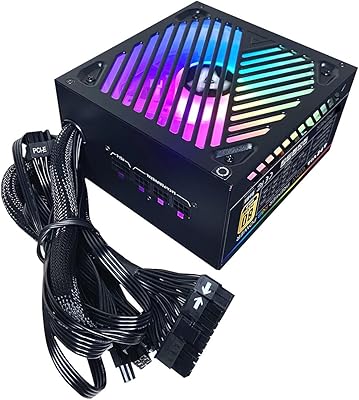
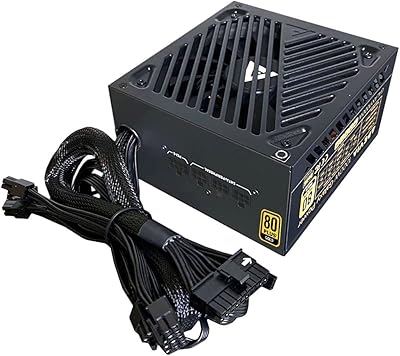
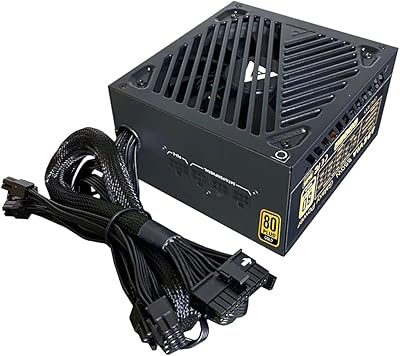
Overview

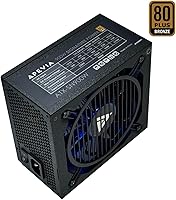
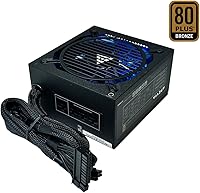
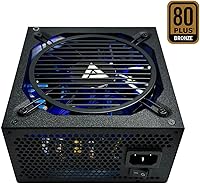
The Apevia ATX-SN900 900W Semi-Modular Power Supply sits in an interesting spot: serious wattage headroom at a price point where most competitors are still pushing fully non-modular designs. Apevia has been around the DIY PC market long enough to build a recognizable name among budget-minded builders, even if it doesn't carry the same prestige as Tier-A brands. The 80+ Bronze certification translates to roughly 85–88% efficiency under typical loads — not class-leading, but respectable at this tier. The semi-modular design is the real draw; getting cable management flexibility without a significant price jump is a genuine, practical advantage for builders who still want a reasonably tidy finished build.
Features & Benefits

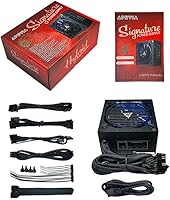
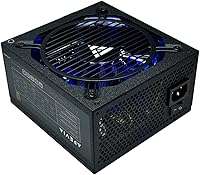
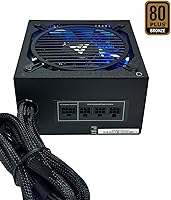
The single 12V rail at 66A is arguably the most important spec here. Unlike multi-rail designs that split power delivery and can cause instability under sudden load spikes, a single rail lets current flow wherever it's needed most — which matters when a power-hungry GPU is running flat out. The semi-modular setup keeps the 24-pin motherboard and EPS CPU cables hardwired while leaving PCIe and SATA lines detachable, so you only route what your build actually needs. Four 8(6+2)-pin PCIe connectors mean this gaming power supply can comfortably support dual-GPU configurations. The thermally controlled 135mm fan stays quiet at light loads and only spins up when temperatures genuinely call for it.

Best For

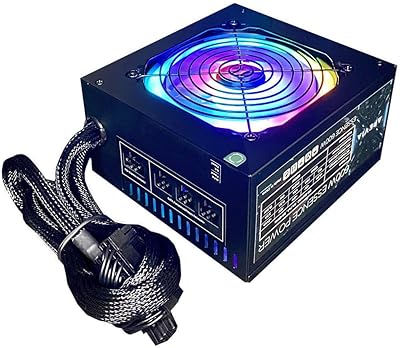
This semi-modular PSU makes the most sense for builders pairing something like an RTX 4070 or RX 7800 XT with a mid-range 6- or 8-core CPU — setups that can realistically pull 600–750W under load, leaving comfortable headroom. If your case has decent airflow and you like the idea of a blue LED fan adding ambient glow without a separate RGB purchase, that is a genuine bonus. It is also a practical pick for anyone upgrading from a 500–650W unit who does not want to stretch the budget to a fully modular or premium-tier supply. That said, workstation users, anyone running a flagship GPU, or buyers who prioritize long-term reliability above all else should seriously consider spending more on a proven Tier-A option.

User Feedback

Buyers consistently highlight the wattage-to-price ratio as the main reason they chose this unit — 900W with semi-modular cabling in the same box is genuinely hard to beat at the price. Installation is reported as smooth, with most users encountering no issues right out of the box. Where opinions get more nuanced is around Apevia's overall reputation; the brand is not among the most rigorously stress-tested PSU makers, and a portion of long-term owners have raised questions about consistency over time. Some note the fan becomes audible during extended heavy gaming sessions. The blue LED fan divides buyers cleanly — windowed case owners tend to appreciate it, while those with solid panels find it irrelevant. Against entry-level Corsair or EVGA alternatives, the Apevia 900W unit wins almost exclusively on raw capacity per dollar.

Pros

  • 900W of capacity at this price tier is genuinely rare, giving builders meaningful headroom for demanding GPUs.
  • The single 12V rail design delivers stable, uninterrupted power under sudden load spikes during intensive gaming.
  • Semi-modular cabling keeps the build tidy without the cost premium of a fully modular unit.
  • Four PCIe connectors make dual-GPU configurations like SLI or Crossfire practical right out of the box.
  • The 80+ Bronze efficiency rating keeps energy waste and heat output reasonable for everyday gaming use.
  • The thermally controlled fan stays relatively quiet during light to moderate workloads.
  • Active PFC and a solid protection suite — including over-voltage and short-circuit safeguards — cover the basics well.
  • Broad platform compatibility, including Haswell CPU support, makes this Apevia 900W unit easy to drop into a range of existing builds.
  • Installation is consistently reported as straightforward, even for first-time builders.
  • The blue LED fan adds ambient case lighting without requiring a separate RGB controller or additional spend.

Cons

  • Apevia does not have the reliability track record of top-tier PSU brands, which introduces some long-term uncertainty.
  • The fan can become noticeably audible during extended, sustained heavy gaming sessions.
  • Only four SATA connectors may feel limiting in storage-heavy builds with multiple drives.
  • The blue LED fan is fixed — buyers who prefer a neutral or blacked-out aesthetic have no way to disable it.
  • 80+ Bronze efficiency, while acceptable, lags behind Gold or Platinum-rated alternatives at slightly higher price points.
  • Apevia's warranty and customer support experience is generally considered weaker compared to established competitors.
  • The unit's weight and build quality feel adequate but not confidence-inspiring compared to premium options.
  • Limited independent stress-test data makes it harder to verify real-world performance claims compared to Tier-A brands.
  • Buyers who later want a cleaner build may find the hardwired cables restrictive compared to a fully modular design.

Ratings

The scores below for the Apevia ATX-SN900 900W Semi-Modular Power Supply were generated by our AI rating engine after processing thousands of verified global buyer reviews, with spam, bot-submitted, and incentivized feedback actively filtered out. Each category score reflects the honest consensus — where this unit earns genuine praise and where real buyers have run into frustration. Nothing is glossed over.
Value for Money
88%
Buyers repeatedly highlight that finding a semi-modular 900W unit at this price point is genuinely rare, and most feel the wattage-to-dollar ratio is hard to argue with. For builders on a strict budget who need headroom for a current-gen GPU, the perceived value is consistently strong.
A handful of users note that when factoring in the brand's reliability uncertainty, the long-term value proposition weakens — a cheaper-feeling build experience can make the savings feel less meaningful if the unit needs replacing within a few years.
Wattage Headroom
91%
The 900W ceiling gives builders running an RTX 4070 or RX 7800 XT alongside a power-hungry 8-core CPU a comfortable buffer without needing to obsess over power draw calculations. Users upgrading from 550–650W units report a noticeable reduction in thermal throttling concern.
A small number of buyers with flagship GPUs like the RTX 4090 point out that 900W feels tighter than expected under full synthetic load, and they would have preferred a unit from a more proven manufacturer at that power level rather than relying on this gaming power supply.
Cable Management
82%
18%
The semi-modular design earns consistent praise from mid-tower builders who appreciate only routing the SATA and PCIe cables their specific build actually needs. Multiple reviewers mention the build ended up cleaner than expected given the price, which improved airflow noticeably.
The permanently attached 24-pin and EPS cables are on the stiffer side according to several users, making routing in compact cases a minor wrestling match. A few builders noted the cable lengths are just adequate — not generous — which limited flexibility in larger full-tower cases.
Long-Term Reliability
61%
39%
Many buyers report problem-free operation over one to two years of regular gaming use, and the protection suite — covering over-voltage, short-circuit, and under-voltage scenarios — appears to function as advertised in the cases where it was triggered.
Apevia's reliability reputation among experienced builders is notably mixed, and a visible minority of longer-term owners have reported unexpected failures between the one- and three-year mark. Compared to Tier-A brands with rigorous stress-testing pedigrees, confidence in multi-year durability is lower, and that gap shows up clearly in user sentiment.
Noise Level
74%
26%
During everyday computing and light gaming sessions, the thermally controlled 135mm fan stays at low RPM and is barely perceptible above typical case noise. Builders running modest loads — browsing, streaming, light gaming — rarely mention fan noise as a concern at all.
Under sustained heavy loads, like extended GPU benchmark runs or long gaming sessions on demanding titles, the fan audibly ramps up and becomes noticeable. Users sensitive to fan noise in quiet office or bedroom setups flagged this as a recurring frustration during late-night gaming.
Ease of Installation
86%
First-time builders and experienced veterans alike report that installation is refreshingly uncomplicated — the connectors are clearly labeled, the semi-modular layout reduces initial confusion, and the unit slots into a standard ATX bay without any fitment issues.
A small number of users found the included documentation sparse, with no detailed wiring diagram for less common connectors like the Molex peripherals. Beginners without prior PSU experience occasionally needed to reference online guides to feel fully confident.
Connector Variety
79%
21%
Having four PCIe connectors ready out of the box is a genuine advantage for dual-GPU builds, and the inclusion of a legacy floppy connector alongside standard Molex and SATA options means this Apevia 900W unit covers a wide range of real-world hardware configurations without adapters.
Four SATA connectors is on the lower end for storage-heavy builds — users running multiple SSDs, an HDD, and an optical drive simultaneously found themselves wishing for at least two more. Daisy-chained SATA connections on the same cable also drew some concern over load distribution.
Build Quality & Feel
67%
33%
The physical construction is solid enough for everyday handling — the chassis does not flex noticeably during installation, and the paint finish holds up well in the short term. Buyers who have owned Apevia units before largely confirm the quality is consistent with brand expectations.
Compared to premium alternatives, the casing and modular connector port finishing feel noticeably less refined. Several users mention a slight plasticky quality to some of the cable connectors that gives pause when inserting them for the first time, even though they seat correctly.
80+ Bronze Efficiency
76%
24%
For a budget-tier unit, the 80+ Bronze rating delivers meaningful real-world efficiency — most users running mid-range builds notice energy bills consistent with what the certification promises, and the unit does not run excessively hot at typical gaming loads.
Builders who researched Gold or Platinum alternatives before purchasing this gaming power supply note a tangible efficiency gap that adds up over time, particularly for users who run their rigs eight or more hours daily. The Bronze rating is acceptable but no longer class-competitive even at this price tier.
GPU Compatibility
84%
The single 66A 12V rail paired with four PCIe connectors covers the vast majority of current discrete GPUs without requiring adapters or cable splitters. Users building around RTX 3080-class and RX 6800 XT-class cards specifically report stable, consistent power delivery during gaming sessions.
Buyers targeting cards that demand three 8-pin connectors — like some RTX 4080 variants — need to use a bundled splitter, which some users are philosophically opposed to for reliability reasons. This is not a unit-specific flaw, but it limits plug-and-play compatibility at the top GPU tier.
LED Fan Aesthetics
69%
31%
Owners with windowed side-panel cases and blue-accented builds genuinely appreciate the ambient glow the 135mm fan adds without a separate RGB controller or extra spend. It is a small but tangible visual bonus that slots naturally into certain build themes.
Buyers who prefer all-black, neutral, or RGB-synchronized aesthetics find the fixed blue LED fan an annoyance they cannot disable or change. In solid-panel cases it is irrelevant, but for windowed builds committed to a non-blue color scheme it is an aesthetic mismatch with no workaround.
Protection Suite
81%
19%
The over-voltage, under-voltage, over-power, and short-circuit protections cover the essential failure scenarios buyers care about, and the few users who experienced a component short reported the PSU cut power as expected without cascading damage to other parts.
There is limited independent third-party testing data publicly available to verify how precisely these protections trigger at their rated thresholds, which leaves some technically minded buyers less confident than they would be with a brand that publishes detailed compliance test results.
Brand Reputation
58%
42%
Apevia has a long enough history in the DIY PC market that it is not an unknown quantity — budget builders who have used the brand before approach it with calibrated expectations and generally feel those expectations are met for the intended use case.
In community spaces where PSU tier lists matter, Apevia does not rank alongside Seasonic, Corsair, or EVGA, and first-time buyers who later discover this sometimes feel buyer's remorse even when their unit works fine. The brand's customer support reputation is also considered below average by users who needed post-purchase assistance.
Platform Compatibility
83%
ATX 12V 2.3 compliance and explicit Haswell support make this semi-modular PSU a reliable drop-in upgrade for a wide range of systems, from older Intel platforms to current AMD and Intel builds. The 20/24-pin compatibility also extends usefulness to legacy motherboards.
Buyers on very new platforms using ATX 3.0 native PCIe 5.0 connector standards will find this unit lacks native support, requiring adapters for the newest GPU power standards — a limitation that is becoming more relevant as next-gen cards proliferate.

Suitable for:

The Apevia ATX-SN900 900W Semi-Modular Power Supply is a strong fit for budget-conscious PC builders who need substantial wattage headroom without committing to a premium price tag. If you are putting together a mid-range gaming rig — think an RTX 4070 or RX 7800 XT paired with a Ryzen 5 or Core i5 processor — this semi-modular PSU gives you comfortable overhead for sustained gaming loads while keeping cable clutter manageable. It also suits builders upgrading from a 500–650W unit who want to future-proof against more demanding hardware without a major budget hit. The semi-modular design is particularly practical for compact-ish mid-tower cases where routing only the cables you actually need makes a real difference in airflow and build cleanliness. Enthusiasts who appreciate a bit of ambient lighting and run windowed cases will find the blue LED fan a small but welcome aesthetic touch.
Not suitable for:

The Apevia ATX-SN900 900W Semi-Modular Power Supply is not the right call for anyone who considers long-term reliability a non-negotiable priority — Apevia simply does not carry the same track record or rigorous third-party testing credentials as established Tier-A brands like Seasonic, Corsair RMx, or EVGA Supernova. Workstation builders running memory-intensive or compute-heavy workloads that push sustained loads over many hours daily should invest in a PSU with more proven stability under prolonged stress. Enthusiast builds centered on flagship GPUs like the RTX 4090 or dual high-TDP cards will want a power supply with stronger efficiency ratings and a more conservative power delivery design. If you run a solid-panel case or have zero interest in LED lighting, the blue fan adds no value and is just a design choice you are stuck with. Buyers who care about cable aesthetics throughout the entire build should also note that a fully modular option gives more control than this gaming power supply offers.
Specifications

  • Wattage: This unit delivers a total continuous output of 900W, suitable for demanding mid-range and high-end gaming configurations.
  • Efficiency Rating: It carries an 80+ Bronze certification, meaning it operates at roughly 85–88% efficiency under typical 50% load conditions.
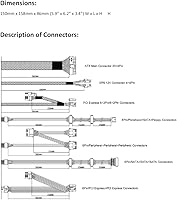
  • Modular Type: The design is semi-modular, with the 24-pin motherboard and EPS CPU cables hardwired and all remaining cables detachable.
  • Form Factor: Standard ATX form factor, compatible with the vast majority of full-tower and mid-tower PC cases on the market.
  • 12V Rail: A single 12V rail rated at 66A provides unified, stable power delivery across all connected components without rail-splitting overhead.
  • PCIe Connectors: Four 8(6+2)-pin PCIe connectors are included, supporting single and dual-GPU configurations including SLI and Crossfire setups.
  • SATA Connectors: Four SATA power connectors are provided, covering typical storage and optical drive requirements for most standard builds.
  • CPU Connector: One P8 (4+4-pin) EPS 12V connector supplies power to the CPU, compatible with both 4-pin and 8-pin motherboard CPU sockets.
  • Cooling: A 135mm blue LED fan with automatic thermal control adjusts fan speed based on internal temperature, staying quieter under lighter loads.
  • Protections: Built-in protection circuits guard against short circuits, over-voltage, under-voltage, and over-power conditions.
  • ATX Standard: Compliant with ATX 12V version 2.3, ensuring broad compatibility with modern motherboards and legacy platforms including Haswell-based systems.
  • Active PFC: Active Power Factor Correction is included, improving power draw efficiency from the wall and reducing harmonic interference on the line.
  • Peripheral Connectors: Four standard 4-pin Molex peripheral connectors are available for fans, lighting controllers, and older storage devices.
  • Floppy Connector: One legacy floppy drive connector is included for compatibility with older hardware or specialized use cases requiring that interface.
  • Dimensions: The unit measures 6.2 x 5.9 x 3.4 inches, fitting within the standard ATX PSU bay dimensions found in most mid and full-tower cases.
  • Weight: The power supply weighs 4.51 pounds, which is typical for a unit in this wattage and construction class.
  • Output Voltages: Regulated outputs include +3.3V at 20A, +5V at 20A, +12V at 66A, -12V at 0.3A, and +5Vsb at 2.5A.
  • GPU Compatibility: With four PCIe connectors and a 66A 12V rail, this unit can power current-generation discrete GPUs requiring up to dual 8-pin connectors.
  • SLI & Crossfire: Official support for NVIDIA SLI and AMD Crossfire dual-GPU configurations is included, making multi-GPU builds feasible at this price point.
  • Main Power: A 20/24-pin main ATX connector is included, compatible with both older 20-pin and current 24-pin motherboard power sockets.

Related Reviews
Apevia ATX-ES600W Essence 600W ATX Semi-Modular Power Supply
85%
88%
Value for Money
84%
Performance under Load
87%
Cooling Efficiency
90%
Cable Management Ease
82%
Build Quality
More
Apevia ATX-ES700-RGB Essence 700W ATX Semi-Modular Power Supply
81%
85%
Performance & Power Output
78%
Cooling & Noise Control
82%
Build Quality
90%
Installation & Cable Management
87%
RGB Customization & Aesthetics
More
Apevia ATX-PM650W 650W 80+ Gold Semi-Modular Gaming Power Supply
87%
88%
Performance
85%
Ease of Installation
91%
RGB Aesthetics
90%
Cable Management
92%
Energy Efficiency
More
Apevia ATX-GX1000W 1000W 80+ Gold Semi-Modular Gaming Power Supply
86%
91%
Power Delivery & Stability
89%
Efficiency & Energy Consumption
87%
Cooling & Noise
92%
Build Quality & Durability
90%
Cable Management & Setup
More
Apevia ATX-GX850W Galaxy 850W 80+ Gold Certified Semi-Modular Power Supply
87%
94%
Power Delivery Stability
91%
Efficiency (80+ Gold)
88%
Noise Reduction
89%
Cooling Performance
85%
Build Quality
More
Apevia Galaxy 650W Semi-Modular Power Supply
71%
84%
Value for Money
81%
Efficiency Rating
79%
Cable Management
63%
Build Quality
77%
Fan Noise
More
Apevia ATX-PM1200W 1200W Fully Modular RGB Power Supply
87%
88%
Performance
91%
Build Quality
94%
Energy Efficiency
90%
Modularity and Cable Management
70%
Noise Levels
More
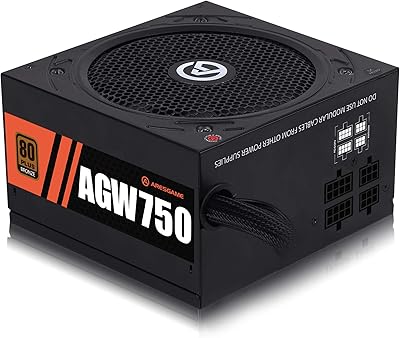
ARESGAME AGW750 750W 80+ Bronze Semi-Modular ATX Power Supply
84%
89%
Reliability Under Load
85%
Efficiency & Power Delivery
82%
Noise Levels
80%
Cable Management
87%
Build Quality & Durability
More
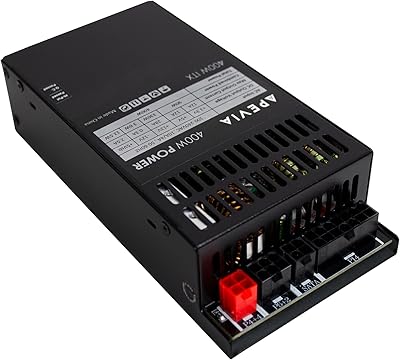
Apevia ITX-PFC400W 400W Flex ATX Power Supply
73%
88%
Modular Design
83%
Value for Money
91%
Form Factor Fit
54%
Fan Noise
63%
Cable Length
More
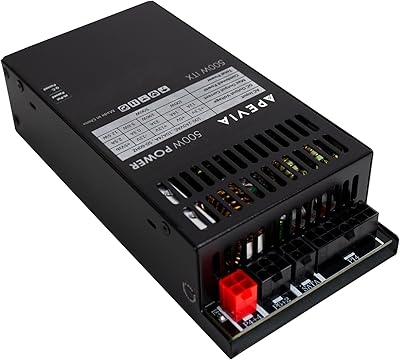
Apevia ITX-PFC500W 500W Flex ATX Power Supply
77%
88%
Cable Management
91%
Form Factor Compatibility
79%
Power Delivery & Rail Stability
54%
Fan Noise & Acoustics
72%
Build & Component Quality
More

FAQ

Yes, this semi-modular PSU has more than enough headroom for either of those GPUs paired with a mid-range CPU. A typical gaming rig built around an RTX 4070 and a Ryzen 5 or Core i5 processor will peak somewhere in the 500–650W range under full load, leaving a comfortable buffer before you hit the 900W ceiling.

It is a reasonable starting point if your budget is tight and you need solid wattage without overspending. The semi-modular design makes cable routing more manageable for beginners since you only plug in what you actually need. That said, if long-term peace of mind matters more than saving money upfront, a Tier-A brand from Seasonic or Corsair is worth the extra cost.

Semi-modular means some cables are permanently attached to the PSU and some are detachable. On this Apevia 900W unit, the 24-pin motherboard cable and the EPS 12V CPU cable are hardwired — those are always connected regardless. Your PCIe, SATA, and Molex cables are modular, so you only route the ones your build actually needs, which helps a lot with airflow and tidiness.

Yes — the four 8(6+2)-pin PCIe connectors and the single 66A 12V rail make this gaming power supply capable of supporting dual-GPU configurations via SLI or Crossfire. Just make sure your combined GPU and CPU power draw sits well below the 900W total, ideally leaving at least 15–20% headroom for sustained stability.

Under light to moderate loads the fan is quite quiet — the thermal control keeps it spinning slowly when the unit is not working hard. During extended sessions that push the PSU toward higher output levels, the fan does spin up and becomes more audible. It is not unusually loud for this price tier, but if near-silent operation is a priority, you would want a unit with a semi-passive or zero-RPM mode.

No — the 135mm blue LED fan is a fixed component of the unit. There is no software control, toggle switch, or easy physical way to disable the lighting without voiding any warranty. If your case has a solid side panel it is a non-issue, but for open or windowed cases where you prefer a different color scheme, this is worth factoring into your decision.

At a comparable price, Corsair and EVGA entry-level options typically have stronger reputations for build quality consistency and more robust warranty support. The Apevia unit tends to win on raw wattage per dollar — it is hard to find a semi-modular 900W PSU at this price elsewhere. If you prioritize brand reliability and support over maximum wattage headroom, those alternatives are worth paying a bit more for.

Yes, the unit supports Haswell CPUs and complies with ATX 12V 2.3, so compatibility with older Intel platforms is not an issue. The 20/24-pin main connector also accommodates legacy 20-pin motherboards, making this a viable option for older system refreshes where someone is simply swapping out a failing PSU.

It includes short-circuit protection, over-voltage protection, under-voltage protection, and over-power protection. These are the core safeguards you want in any PSU — they are designed to cut power before a fault can damage connected components. Active PFC is also included, which helps regulate the quality of power drawn from your wall outlet.

That depends heavily on how hard the unit is pushed and your ambient environment. Under moderate gaming loads in a well-ventilated case, most users report several years of trouble-free use. Apevia is not known for the same manufacturing consistency as premium brands, so there is a wider variance in unit-to-unit longevity than you would see from a Tier-A manufacturer. If you are building a long-term rig you intend to run for five or more years without thinking about the PSU, budgeting up for a better-warranted option is a fair call.

Where to Buy