
Overview

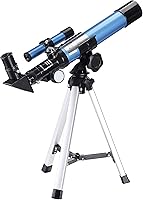
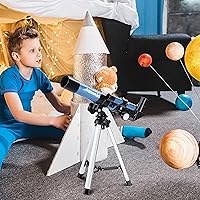
The AOMEKIE 40/400 Refractor Telescope sits squarely in the crowded entry-level market, designed for curious newcomers and anyone hunting for a thoughtful gift rather than a serious observing instrument. Its 40mm aperture and 400mm focal length are modest by any measure — enough to pull in a crisp view of the lunar surface, but not sufficient to chase faint nebulae or resolve fine planetary detail. What this beginner scope does well is set honest expectations through its form: compact, lightweight, and built for a balcony or backyard table rather than a dark-sky site. Its tool-free assembly and child-safe construction give it a clear identity as a gift-first telescope rather than a technical instrument.

Features & Benefits

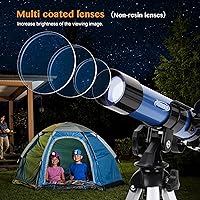
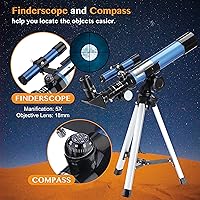
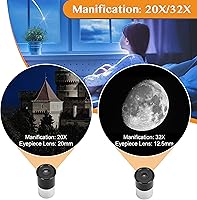
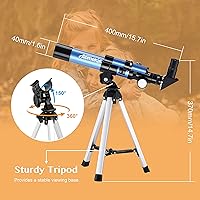
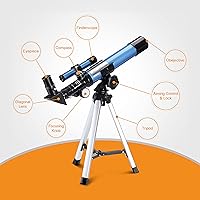
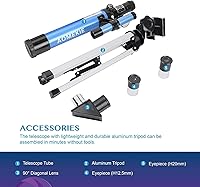
The optics are fully multi-coated glass, which at this aperture genuinely matters — less glare, better light transmission, and noticeably brighter moon views than you might expect from such a small tube. Two eyepieces come in the box: a 20mm for wider low-power views and a 12.5mm for tighter framing, giving you two usable magnification steps without extra cost. The 90-degree diagonal makes sky-gazing far more comfortable than craning your neck at a straight-through eyepiece. A compact 5x18 finderscope and a small compass help beginners orient themselves quickly. The altazimuth tabletop mount rotates a full 360 degrees horizontally and 150 degrees vertically, covering everything from horizon scanning to near-zenith targets with minimal effort.

Best For

This tabletop refractor makes the most sense as a first telescope for children aged around eight and up, or for adults who want a low-stakes introduction to the night sky without a steep learning curve. Moon-watching is where it genuinely shines — the lunar surface on a clear night is impressive through a well-focused 40mm scope. Urban and suburban users will appreciate how easily it packs into a bag and sits on a patio table. Teachers and parents can use it to spark curiosity about space without any prior astronomy knowledge. What it is not suited for: deep-sky observing, serious planetary study, or anyone who already needs real aperture to grow into.

User Feedback

Buyers consistently highlight two things: how quickly the scope goes from box to backyard, and how satisfying the first moon view feels for a child or curious adult. Those are real wins. The pushback, though, is equally consistent — the tripod wobbles noticeably at higher magnifications, which can frustrate anyone trying to hold a steady view. A number of buyers also found that getting the finderscope properly aligned takes trial and error, something a clearer instruction sheet would fix. The overall rating sits around 3.8 stars, which feels accurate: this is a scope that delivers on its promise as a starter gift, provided nobody expects it to perform beyond its modest optical ceiling.

Pros

  • Assembles in minutes with no tools — ideal for impatient kids on Christmas morning.
  • Multi-coated glass optics produce genuinely bright, clear views of the lunar surface.
  • Two eyepieces included out of the box give beginners two usable magnification options immediately.
  • Compact and light enough to slip into a backpack for trips or outdoor classroom sessions.
  • The 90-degree diagonal makes sky-gazing comfortable without awkward neck angles.
  • Child-safe construction with no sharp edges or hazardous materials — parents can relax.
  • The tabletop mount covers a wide range of motion, handling everything from horizon to near-overhead targets.
  • Bundled finderscope helps total beginners locate targets without blind aiming through the main tube.
  • Unboxing experience lands well as a gift — well-packaged and visually appealing for a child to open.
  • At its price point, the cost of entry for a real glass-optic telescope is genuinely low.

Cons

  • Tripod vibration at higher magnifications makes holding a steady view genuinely difficult.
  • The instruction manual has translation issues and vague diagrams that confuse first-time assemblers.
  • Finderscope alignment requires trial and error that the included guide does not adequately explain.
  • No carry case or protective storage included — eyepieces and the diagonal are vulnerable to scratches.
  • Focuser has noticeable play, making precise focus lock at higher magnifications more frustrating than it should be.
  • Plastic components around the focuser show wear relatively quickly with regular use.
  • Maximum useful magnification is limited by aperture, leaving no room to grow into the scope over time.
  • Chromatic fringing around bright objects like the moon's edge is visible and cannot be corrected.
  • The compass, while a nice idea, is too basic to be reliably useful in practice.
  • Image quality degrades noticeably toward the edges of both included eyepieces.

Ratings

The AOMEKIE 40/400 Refractor Telescope has been evaluated by our AI rating engine after processing hundreds of verified global buyer reviews, with spam, bot-generated, and incentivized feedback actively filtered out. The scores below reflect genuine user experiences across every major performance dimension — strengths and shortcomings included, with nothing smoothed over. Whether you are buying for a child or dipping your own toes into backyard astronomy, these ratings give you an honest picture of what to expect.

Optical Clarity
72%
28%
For a scope this small, the multi-coated glass delivers surprisingly clean lunar views on clear nights. Buyers frequently mention being able to pick out crater edges and the moon's terminator line with satisfying sharpness, which is genuinely impressive given the aperture size.
At higher magnifications the image softens noticeably, and chromatic fringing around bright objects like the moon's limb is visible. Users expecting sharp planetary detail will find the optics fall short of that expectation fairly quickly.
Build Quality
67%
33%
The aluminum optical tube feels solid for the price, and the overall assembly holds together well under normal backyard use. Parents and teachers particularly appreciate that there are no sharp edges and the materials feel safe for children to handle without supervision.
Plastic components around the focuser and eyepiece holder show wear faster than expected, and a few buyers noted the diagonal fitting can feel loose over time. It does not inspire confidence for frequent transport or rough handling by younger kids.
Ease of Assembly
88%
This is one area where the scope genuinely delivers on its promise. Most buyers report having it assembled and pointed at the moon within ten to fifteen minutes of opening the box, with no tools required and clear enough steps for a child to follow along.
The instruction manual has been criticized for vague diagrams and occasional translation issues that make a couple of steps ambiguous. Most people figure it out, but a clearer guide would remove the small moment of frustration that some first-timers experience.
Tripod Stability
54%
46%
The tabletop altazimuth mount covers a wide range of motion and works well at low magnifications where vibrations are less of a concern. Placing it on a heavy, flat surface like a concrete patio table helps significantly and is how most satisfied users operate it.
At higher magnifications, any touch to the scope sends the view shaking for several seconds, which makes sustained observation genuinely frustrating. Multiple reviewers describe this as the single biggest practical limitation of the scope during real use sessions.
Magnification Range
61%
39%
The two included eyepieces give beginners a practical low-power and medium-power option without any additional spending, which is a thoughtful inclusion. The 20mm eyepiece in particular provides a wide, comfortable view well suited to scanning the lunar surface.
The maximum useful magnification is relatively limited by the 40mm aperture, and experienced buyers note that higher power just reveals optical weakness rather than more detail. There is no real headroom for those who want to grow into the scope over time.
Finderscope Usability
63%
37%
Having a dedicated finderscope on a scope at this price point is genuinely useful for total beginners who struggle to aim a telescope without one. The included compass alongside it is a nice touch that helps with basic orientation when you are just starting out.
Getting the finderscope aligned with the main tube requires patience and some trial and error that the manual does not adequately guide you through. Several buyers gave up on using it altogether, which defeats its purpose and makes target acquisition harder than it should be.
Portability
84%
Weighing just over two pounds with a compact footprint, this beginner scope slips easily into a backpack or tote bag for trips to a darker backyard or a school event. Urban users especially appreciate being able to set it up on a balcony table and put it away just as quickly.
There is no dedicated carry case included, so protecting the optics during transport requires improvising with a padded bag or wrapping. The eyepieces and diagonal are particularly vulnerable to scratches without some form of protective storage.
Value for Money
78%
22%
Measured against what it actually is — a safe, functional first telescope that shows the moon clearly and assembles in minutes — the price feels fair and sometimes even generous. As a gift for a curious child, the cost-to-wow ratio on that first lunar view is hard to argue with.
Buyers who approach it expecting a capable astronomy tool rather than a starter toy tend to feel underserved. At this price tier you are paying primarily for convenience and simplicity, not optical performance, and that distinction is not always obvious from the listing.
Image Brightness
69%
31%
The multi-coated optics do a reasonable job of maximizing the light that a 40mm aperture can gather, producing moon images that look bright and usable on clear nights. For single bright objects like the moon or Venus, the view holds up respectably.
Dim objects vanish entirely, and even Jupiter shows limited contrast under anything less than ideal conditions. The aperture simply cannot gather enough light for satisfying views of anything beyond the brightest solar system targets.
Focuser Smoothness
58%
42%
The rack-and-pinion focuser achieves sharp focus at its sweet spot and works adequately for casual lunar observation where precision is not critical. Younger users tend to find it straightforward enough to operate on their own after a short learning curve.
The focuser has noticeable play and lacks fine adjustment, which makes locking onto a precise focus point more finicky than it needs to be. At higher magnifications, even small backlash in the focuser mechanism causes the target to drift out of the narrow acceptable focus zone.
Eyepiece Quality
66%
34%
Both included eyepieces are coated glass rather than bare plastic, which shows in the quality of the views they produce at lower powers. The 20mm in particular is the scope's workhorse and gives genuinely pleasant wide-field lunar views for a beginner.
Edge sharpness in both eyepieces falls off noticeably toward the field boundary, and the eye relief on the 12.5mm is tight enough to be uncomfortable for eyeglass wearers. They are functional starter eyepieces but not something you would keep upgrading into a better scope.
Compass Usefulness
55%
45%
The bundled compass is a small but thoughtful addition that helps complete beginners orient the scope relative to cardinal directions, which can be a genuine help when following a basic star chart for the first time.
Experienced users find it largely redundant, and its build quality is basic enough that calibration can drift. Several buyers noted it as a nice-to-have novelty rather than a genuinely useful navigational tool in practice.
Unboxing Experience
81%
19%
The packaging is tidy and the scope arrives well-protected, with all components clearly separated and easy to identify. Gift-givers consistently mention that the unboxing moment lands well with children, which matters a lot when this is meant to be a memorable present.
A couple of buyers noted minor cosmetic scuffs on the optical tube upon arrival, suggesting the internal padding could be slightly more generous. For a gift item especially, first impressions matter and any out-of-box blemish feels disproportionately disappointing.
Instruction Manual
47%
53%
The manual covers the core assembly steps and gives beginners a basic introduction to using the finderscope and swapping eyepieces. For the simplest setup steps it is clear enough that most adults can work through it without outside help.
Translation quality is inconsistent and several diagrams are too small or unlabeled to be genuinely useful. A number of one-star reviews trace directly back to confusion created by the manual rather than any fault with the scope itself, which is an avoidable problem.

Suitable for:

The AOMEKIE 40/400 Refractor Telescope is a natural fit for anyone shopping for a first telescope that removes every possible barrier to getting started. Parents buying a birthday or holiday gift for a child aged eight and up will find it ticks all the right boxes: safe materials, fast setup, and a moon view impressive enough to spark genuine curiosity. Adults who are simply telescope-curious — not committed hobbyists, just people who want to step outside and look at the lunar surface on a clear night — will get real satisfaction from this beginner scope without feeling like they overspent on something they might not stick with. Urban and suburban users who lack a dark backyard or a car trunk full of astronomy gear will appreciate how easily it fits into a bag and sits on a balcony table. Teachers and parents using it as a hands-on classroom or kitchen-table introduction to space science will find its simplicity an asset rather than a limitation.

Not suitable for:

If you are approaching astronomy with any level of seriousness, the AOMEKIE 40/400 Refractor Telescope will frustrate you fairly quickly. The 40mm aperture is genuinely too small to reveal meaningful planetary detail — Saturn's rings are a smudge, Jupiter's cloud bands are barely hinted at, and anything beyond the brightest solar system objects simply will not show up. Teenagers or adults who have already used a telescope before and are looking for a meaningful upgrade will find this tabletop refractor feels like a step sideways rather than forward. The tripod wobble at higher magnifications is not a minor inconvenience but a real obstacle to sustained, focused observation, making it a poor choice for anyone who plans to spend serious time at the eyepiece. Astrophotographers, even casual smartphone-snappers trying to capture the moon through an eyepiece, will struggle with the instability and limited optical quality this beginner scope offers at that use case.

Specifications

  • Aperture: The objective lens measures 40mm in diameter, determining how much light the telescope can gather for observation.
  • Focal Length: The optical tube has a focal length of 400mm, which defines the scope's magnification potential when paired with each eyepiece.
  • Eyepieces: Two eyepieces are included: a 20mm for lower-power wide views and a 12.5mm for higher magnification and tighter framing.
  • Magnification: Using the 20mm eyepiece produces 20x magnification, while the 12.5mm eyepiece delivers approximately 32x magnification.
  • Optical Coating: All optical glass elements feature a fully multi-coated anti-reflective treatment designed to reduce glare and improve light transmission.
  • Finderscope: A 5x18 optical finderscope is mounted on the tube to help users locate and center targets before viewing through the main eyepiece.
  • Diagonal: A 90-degree erecting diagonal is included, allowing for more comfortable upright viewing angles when the telescope is pointed skyward.
  • Mount Type: The scope uses an altazimuth tabletop mount that rotates 360 degrees horizontally and up to 150 degrees vertically for full sky coverage.
  • Tripod Height: The fixed tabletop tripod stands 370mm tall, designed to sit stably on a flat surface such as a table, bench, or wall.
  • Tube Length: The optical tube measures 115mm in length, contributing to the scope's overall compact and portable profile.
  • Dimensions: The fully assembled unit measures 18.8″ deep by 18.8″ wide by 18.1″ high when set up for use.
  • Weight: The complete telescope setup weighs 2.29 pounds, making it light enough to carry in most standard backpacks without strain.
  • Frame Material: The tripod and structural components are constructed from aluminum alloy, providing a stable and reasonably durable base for the optical tube.
  • Focus Mechanism: Focusing is achieved via a manual rack-and-pinion focuser that the user adjusts by hand to achieve a sharp image.
  • Assembly: No tools are required for assembly; all components connect by hand and most users complete setup within ten to fifteen minutes.
  • Accessories Included: The package includes two eyepieces, a 5x18 finderscope, a 90-degree diagonal, a tabletop tripod, and a small compass for orientation.
  • Power Source: The telescope requires no power source for basic optical use; the battery reference in the listing applies only to any optional accessory lighting.
  • Compass: A small magnetic compass is bundled with the scope to assist beginners with basic directional orientation when scanning the night sky.

Related Reviews
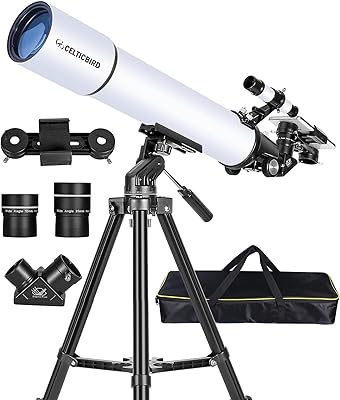
CELTICBIRD 80mm 800mm Refractor Telescope
82%
87%
Optical Clarity
92%
Ease of Setup
90%
Portability
78%
Build Quality
63%
Tripod Stability
More
CELTICBIRD 90700 90mm Refractor Telescope
83%
88%
Optical Performance
91%
Ease of Use
85%
Mount Stability
86%
Build Quality
83%
Portability
More
PISEZ 90mm Refractor Telescope 800mm
82%
92%
Value for Money
89%
Ease of Setup
88%
Image Clarity
85%
Portability
76%
Build Quality
More
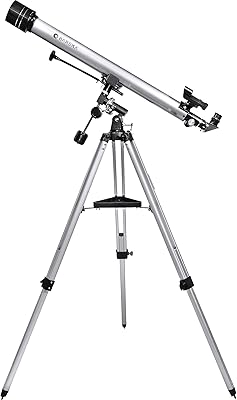
Barska Starwatcher 70mm Refractor Telescope
83%
92%
Value for Money
89%
Ease of Setup
90%
Portability
85%
Optical Clarity
72%
Magnification Power
More
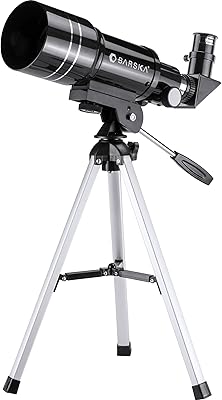
Barska Starwatcher Refractor Telescope 60mm
80%
91%
Value for Money
88%
Ease of Setup
93%
Portability
85%
Performance (Planetary Viewing)
62%
Performance (Deep-Sky Viewing)
More
HEXEUM AZ50070 70mm Refractor Telescope
73%
78%
Optical Clarity
88%
Value for Money
57%
Tripod Stability
66%
Ease of Assembly
63%
Finderscope Usability
More
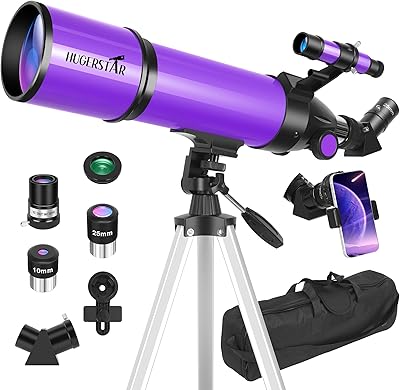
HUGERSTAR 80600Purple 80mm Refractor Telescope
83%
94%
Ease of Setup
92%
Portability
85%
Image Quality
71%
Mount Stability
68%
Tripod Height
More
Hawkko 90mm 900mm Astronomical Refractor Telescope
81%
88%
Setup and Installation
93%
Portability
75%
Magnification Range
85%
Optical Clarity
80%
Build Quality
More
SVBONY SV503 80ED F7 Refractor Telescope
84%
88%
Ease of Use
91%
Image Clarity
87%
Build Quality
85%
Portability
90%
Focus Adjustment
More
SVBONY SV503 102mm F7 Refractor Telescope
85%
90%
Astrophotography Performance
88%
Image Clarity
85%
Ease of Use
83%
Build Quality
87%
Precision of Focus
More

FAQ

The moon is where this beginner scope genuinely shines — crater detail and the terminator line come through clearly on a good night. Saturn's rings are technically visible as a faint elongated shape, but do not expect a crisp, defined ring structure. For that level of planetary detail, you really need a larger aperture telescope. Think of this one as a great lunar viewer with limited planetary reach.

No tools at all — everything connects by hand. Most adults have it assembled and pointed at the sky in about ten to fifteen minutes. The main steps are attaching the tube to the tripod head, inserting the diagonal, and dropping in an eyepiece. The finderscope bracket takes a little extra fiddling, but nothing complicated.

It is designed with child safety in mind — no sharp edges and no toxic materials in the construction. Kids aged eight and up can generally handle it independently once an adult has done the initial setup and finderscope alignment. Younger children will probably need a parent alongside them, mostly to help with focusing and keeping the tripod steady.

Nothing is broken — this is a known limitation of the lightweight tabletop tripod at higher magnifications. The best fix is to place the scope on a heavy, solid surface like a concrete garden table rather than a lightweight folding table. Once you touch the scope, wait a couple of seconds for the vibration to settle before looking through the eyepiece. Using the lower-power 20mm eyepiece also helps significantly, since vibration is far less disruptive at lower magnification.

The easiest method is to start during daylight by pointing the main telescope at a fixed distant object — a rooftop or chimney works well. Then look through the finderscope and adjust its bracket screws until the crosshairs line up with exactly the same object. Once aligned in daylight, the finderscope stays accurate for nighttime use. It takes a few minutes of patience but makes a big difference once it is set up correctly.

Yes, and the 90-degree diagonal actually makes daytime terrestrial viewing quite comfortable. The image will be upright and correctly oriented thanks to the erecting diagonal, which is not always the case with astronomy scopes. It works well as a spotting scope for garden wildlife or distant scenery, though the magnification range is modest.

Easily. The whole setup weighs just over two pounds and the tube itself is compact enough to slip into most medium-sized backpacks alongside the tripod and eyepiece case. The main thing to watch is protecting the eyepieces and diagonal from scratches since no carry case is included — a small padded pouch or even a zip-lock bag for the accessories solves that problem neatly.

Technically yes, but results are inconsistent. Handheld phone-to-eyepiece shots of the moon can turn out surprisingly decent with patience and a steady hand. A universal smartphone adapter clamp, available cheaply online, makes the process much less frustrating than trying to hold the phone by hand. Do not expect professional astrophotography results — think of it more as a fun experiment than a reliable photography setup.

The eyepiece barrel uses a standard 1.25-inch fitting, which is the most common size in amateur astronomy. That means you can buy any compatible 1.25-inch eyepiece and it will work with this tabletop refractor. However, it is worth knowing that the optical limitations of the 40mm aperture put a ceiling on how much any eyepiece upgrade will actually improve your views — better glass helps somewhat, but aperture is the fundamental constraint.

That depends on what killed the interest the first time. If the toy telescope showed nothing recognizable and felt like a disappointment, this beginner scope is a meaningful step up — the moon views are genuinely satisfying and feel like real astronomy. If the issue was boredom with the sky in general, a bigger aperture might be a smarter long-term investment. For most kids who just had a frustrating first experience with a low-quality toy, this scope is enough of an improvement to reignite curiosity.