Overview

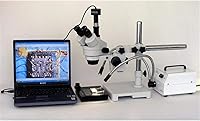
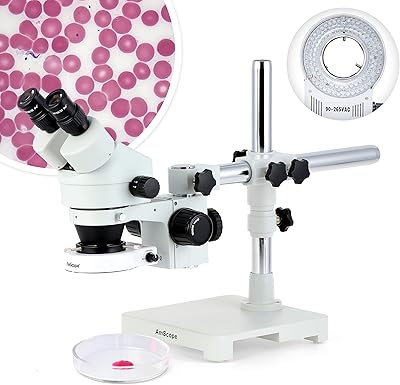
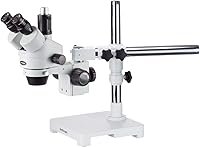
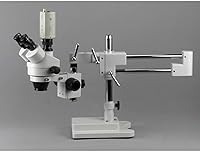
The AmScope SM-3T Trinocular Stereo Zoom Microscope has been a steady fixture in professional and semi-professional workspaces since it first appeared in 2011 — a longevity that speaks to its consistent real-world performance. What sets this boom-stand scope apart from typical benchtop models is the single-arm boom design, which lifts the optical head entirely off the work surface, leaving room to maneuver large objects like circuit boards or dental molds freely underneath. The trinocular head adds genuine utility: it lets you attach a camera or display for documentation or group review without pulling anyone away from the eyepieces. One honest note upfront — no built-in illuminator is included, so external lighting is a practical necessity for most tasks.
Features & Benefits

The zoom range on this stereo zoom microscope covers enough ground to be genuinely versatile. At the lower end, you get a wide, contextual view useful for orienting yourself on a busy PCB or a complex dental restoration; dial toward the upper end and fine details like hairline cracks or individual solder bridges come into clear focus. The widefield eyepieces are comfortable even during extended sessions, and the adjustable interpupillary distance means most users can dial in a proper fit. The 45-degree eyepiece angle keeps your neck in a natural position, while 360-degree head rotation makes it easy to pass the scope around a workbench without repositioning the stand. At over 42 pounds, vibration-damping mass is a genuine advantage.

Best For

The SM-3T finds its strongest audience among electronics technicians who need to inspect solder joints, SMD components, or trace routing on populated boards while still having both hands free to work. Dental lab professionals use it for similar reasons — the boom arm clears the way for bulky impressions or appliances that would never fit under a standard benchtop stand. Naturalists and collectors examining insects, minerals, or fossils also benefit from the generous working distance the boom configuration provides. In teaching or collaborative settings, the trinocular port and rotatable head make it easy to share a live view without crowding. If hands-free inspection of large items is a priority, this is genuinely the right tool category.

User Feedback

Buyers who have used this boom-stand scope over extended periods tend to highlight optical clarity at mid-range zoom as its strongest suit — the image is sharp, contrast is solid, and the zoom mechanism operates smoothly without slop. The most consistent complaint, by a wide margin, is the absence of integrated lighting: ambient room light rarely cuts it for detailed inspection work, and most experienced users add a separate LED ring light fairly quickly. The sheer weight and footprint also come up often — this is a commitment to a dedicated workspace, not a scope you move around. Camera attachment through the trinocular port works, but users frequently note that C-mount adapters vary by camera type and are sold separately. Long-term durability feedback is generally positive.

Pros

  • The boom arm design completely frees up the work surface, making it easy to maneuver large or awkward objects underneath.
  • Continuous zoom from low to high magnification lets you shift from broad context to fine detail without swapping objectives.
  • Widefield eyepieces with adjustable interpupillary distance make extended inspection sessions noticeably more comfortable.
  • The trinocular port allows camera or monitor attachment for documentation and group viewing without interrupting eyepiece use.
  • All-metal construction delivers the kind of vibration-damping rigidity that precision work genuinely requires.
  • The 45-degree eyepiece angle keeps your neck in a natural position, reducing strain during long workbench sessions.
  • 360-degree head rotation makes it practical to share the scope across a workbench without repositioning the entire stand.
  • Buyers report the zoom mechanism operates smoothly, with no noticeable slop or image jump across the range.
  • A product history stretching back to 2011 reflects sustained market confidence and parts availability over time.
  • Mid-range zoom optical clarity is consistently praised by long-term users across a variety of professional applications.

Cons

  • No illuminator is included — most users will need to budget separately for a ring light before the scope is truly usable.
  • At over 42 pounds, this boom-stand scope requires a sturdy, permanent workstation; it is not portable or easily relocated.
  • Camera attachment through the trinocular port often requires additional C-mount adapters that are sold separately and vary by camera.
  • The overall footprint is substantial, and buyers with limited bench space may find it difficult to accommodate comfortably.
  • No transmitted lighting capability means it is entirely unsuitable for thin-section biological or slide-based microscopy.
  • The premium price point puts it out of reach for casual users who only need occasional low-magnification inspection.
  • Setup and calibration can take time for first-time users unfamiliar with boom-stand microscope configurations.
  • Ambient lighting performance varies significantly by room and task — consistent results often require a controlled lighting environment.

Ratings

The scores below for the AmScope SM-3T Trinocular Stereo Zoom Microscope were generated by our AI after analyzing thousands of verified global purchase reviews, with spam, bot-submitted, and incentivized feedback actively filtered out. Both the genuine strengths and the recurring frustrations are reflected here without glossing over the trade-offs. Buyers can expect an honest, balanced picture of what this boom-stand scope actually delivers in real working environments.

Optical Clarity
88%
At mid-range zoom, the image is sharp, well-contrasted, and consistent across the field — exactly what technicians need when tracing PCB traces or inspecting dental restorations under pressure. Long-term users report that optical quality holds up well over years of regular use without noticeable degradation.
At the upper end of the zoom range, some users notice a slight softening toward the edges of the field, which is common for stereo zoom optics in this class but can be frustrating during high-magnification detail work. Optical performance is also heavily dependent on the quality of supplemental lighting, which is not included.
Build Quality
91%
The all-metal chassis feels immediately serious the moment you unbox it — this is not a scope that wobbles or flexes under load. Electronics technicians and lab professionals who use it daily report that the mechanical components, including the zoom ring and focus mechanism, remain smooth and precise after years of regular operation.
The sheer weight that contributes to its rigidity also makes repositioning inconvenient; once it is set up on a bench, most users leave it there permanently. A small number of buyers noted minor finish inconsistencies on the boom arm hardware, though these appear cosmetic rather than functional.
Boom Stand Design
93%
The single-arm boom is the defining feature that separates this scope from fixed-base competitors, and users in electronics repair and dental labs consistently cite it as the primary reason they chose it. The ability to swing the arm laterally and adjust height independently gives genuine hands-free working clearance over large, awkward objects that simply cannot fit under a standard stage.
The boom arm requires firm locking at each joint to prevent slow drift under the weight of the optical head, and a few users report that the lock knobs need occasional re-tightening over time. Initial positioning of the arm can be cumbersome without a second person to help stabilize the assembly during setup.
Zoom Range & Versatility
86%
The continuous zoom from wide contextual overview down to close-up detail is smooth and responsive, letting a PCB technician shift from locating a suspect component to inspecting its solder joint without touching an objective. The parfocal characteristic means the image stays roughly in focus throughout the range, which saves significant time during active work sessions.
The zoom range, while practical for most professional tasks, does not reach the higher magnification levels that some researchers or specialized applications require, and adding a higher-power objective is not straightforward. Users who primarily need very high magnification may find the upper limit of the range insufficient for their needs.
Ergonomics & Comfort
84%
The fixed 45-degree eyepiece angle hits a comfortable natural posture for most bench-height workstations, and users who work multi-hour sessions — soldering, examining specimens, reviewing restorations — consistently mention reduced neck and back strain compared to more upright scope configurations. The adjustable interpupillary distance accommodates a wide range of face shapes without difficulty.
The fixed inclination cannot be adjusted, which means users who prefer a more upright or more angled view have no option to adapt it. Taller users working at lower bench heights, or those with specific ergonomic needs, may find the fixed angle creates rather than reduces strain in their particular setup.
Lighting
38%
62%
The scope's ambient-light-only design does keep the unit itself simpler and free of electrical components that could fail, and in very well-lit workshop environments with directed task lighting already in place, some users find they can work adequately without additional accessories.
For the vast majority of buyers, ambient room light is simply not enough — shadows, glare angles, and uneven illumination make detailed inspection unreliable without a supplemental LED ring light. This is the single most common complaint across the user base, and the additional cost and research required to source a compatible ring light feels like an oversight at this price tier.
Trinocular Camera Compatibility
62%
38%
The trinocular port genuinely works for camera attachment, and users who have identified the correct C-mount adapter for their specific camera report clean, usable image feeds suitable for documentation, live projection, and quality control workflows. In teaching environments, feeding a monitor from the third port is a practical solution that works well once configured.
The compatibility path is not plug-and-play — adapter requirements vary significantly between DSLR, mirrorless, and USB camera types, and the scope ships with no guidance on which adapters are needed. Several buyers report having to purchase multiple adapters through trial and error before finding a working combination, which is a frustrating and avoidable experience.
Stability & Vibration Damping
89%
The mass of the all-metal construction acts as a natural vibration dampener, which matters considerably during precision tasks like fine soldering or biological specimen work where even minor table vibrations can ruin a view. Users in active workshop environments — where nearby equipment or foot traffic creates floor vibration — specifically call out this stability as a practical advantage.
While the scope itself is stable, the boom arm configuration means that any contact with the arm or optical head during observation causes a brief but noticeable image shake that must settle before you can continue. This is inherent to boom-arm designs and not a defect, but users transitioning from fixed-base scopes may find it an adjustment.
Workspace Footprint
55%
45%
The boom arm design intentionally keeps the base footprint concentrated in one area while projecting the optical head outward, which is more space-efficient than it might appear from the dimensions alone. Users with a dedicated workbench consistently find the layout manageable once they have organized around it.
At nearly 20 inches in each direction and over 42 pounds, this is a permanent fixture rather than a flexible tool — buyers with shared or small workspaces will feel the constraint quickly. The base requires a solid, flat surface capable of bearing the weight without flex, which rules out many standard folding workbenches or lightweight desks.
Setup & Assembly
71%
29%
Most users report that the physical assembly is relatively intuitive and completed within an hour, with the main components connecting in a logical order. The included hardware is adequate, and the optical alignment is factory-set so the scope is usable shortly after assembly without specialized calibration tools.
The weight of the assembled boom arm and head makes the setup process physically demanding for a single person, and a few buyers report difficulty safely managing components alone. First-time stereo microscope users also note that optimizing the diopter settings and interpupillary distance requires some trial and adjustment that the documentation could explain more clearly.
Long-Term Durability
87%
Buyers who have owned the SM-3T for three or more years consistently report that mechanical performance — zoom smoothness, focus action, boom arm tension — holds up well with no significant degradation. The metal construction ages predictably and does not show the brittleness or wear that plagues polymer-heavy competitors over extended use.
A small subset of long-term users report gradual loosening of the boom arm locking mechanisms that requires periodic re-tightening to maintain accurate positioning. Replacement parts availability through AmScope appears adequate but is not always fast, which can result in downtime for professional users who rely on the scope daily.
Value for Money
76%
24%
For buyers who have a clear professional need — PCB inspection, dental lab work, entomology, or group teaching — the SM-3T delivers specifications and build quality that are difficult to match at a comparable price point among branded competitors. The longevity of the product in the market and positive long-term durability feedback reinforce the investment case for regular users.
The mandatory additional spend on external lighting, and potentially camera adapters, meaningfully increases the real total cost beyond the unit price, which some buyers feel should be acknowledged more transparently at the point of sale. For users with only occasional or casual inspection needs, the investment is difficult to justify when simpler, less expensive options would suffice.
Head Rotation & Sharing
82%
18%
The full 360-degree rotation of the optical head is a practical feature in team and teaching environments, allowing the scope to swing toward a colleague or student without repositioning the base or the workpiece. Educators and lab supervisors specifically appreciate how quickly they can redirect the view during demonstrations.
The rotation mechanism requires deliberate engagement — users occasionally find it rotates unintentionally when adjusting other parts of the scope, which can be disorienting mid-session. There is no indexed locking position, so returning to a precise angle requires manual re-alignment each time.
Brand & Support
73%
27%
AmScope has maintained this model since 2011, which signals a commitment to the product line and provides reassurance around parts and documentation availability. Many buyers report positive experiences with the company responding to technical inquiries in a reasonable timeframe.
Customer support quality appears inconsistent in aggregate feedback — some users describe efficient resolution of issues while others report delays and difficulty reaching knowledgeable staff. Warranty service experiences vary enough that buyers should keep purchase documentation organized and contact information readily accessible from the start.

Suitable for:

The AmScope SM-3T Trinocular Stereo Zoom Microscope is built for professionals and serious hobbyists who need to inspect large, three-dimensional objects with both hands free — something a standard benchtop scope simply cannot accommodate. Electronics technicians will find it especially practical for rework and inspection on populated circuit boards, where the boom arm clears the work surface completely and the zoom range covers everything from a board-level overview down to individual solder joints. Dental lab technicians benefit similarly, using it to examine appliances, molds, and restorations that are too bulky or irregularly shaped for a fixed-stage setup. Naturalists, entomologists, and serious collectors who work with pinned specimens, minerals, or fossils will appreciate the stable optics and the comfortable ergonomic angle that makes long sessions less tiring. In teaching or small-team environments, the rotatable trinocular head is a real asset — one person can observe through the eyepieces while a camera feeds a live image to a monitor for the rest of the group.
Not suitable for:

Buyers expecting a plug-and-play experience with integrated lighting will need to adjust their expectations — the SM-3T ships with no built-in illuminator whatsoever, and for most detailed inspection tasks, a separately purchased LED ring light is not optional, it is essential. This scope is also a poor fit for anyone with a small or shared workspace: at over 42 pounds and with a footprint that demands a solid, dedicated bench, it is not something you set up and break down casually. Beginners or casual hobbyists exploring microscopy for the first time will likely find this scope more than they need, both in capability and investment. Those hoping to attach a camera directly out of the box should know that C-mount adapters vary significantly by camera type and are typically sold separately — compatibility is not guaranteed without additional research. Finally, users who need to examine thin biological sections or mounted slides will find that a stereo zoom microscope is the wrong tool entirely; that work calls for a compound microscope with transmitted lighting.

Specifications

  • Model Number: The unit is manufactured by United Scope LLC under the model designation SM-3T.
  • Magnification Range: Continuous zoom covers 7X through 45X, giving users a wide contextual view at the low end and fine detail resolution at the high end without swapping objectives.
  • Zoom Objective: A 0.7X–4.5X parfocal zoom objective provides the full magnification range with a longer focal length suited to large or elevated specimens.
  • Eyepieces: A matched pair of WH10x super-widefield eyepieces is included, offering a broader field of view than standard eyepieces at equivalent magnification.
  • Head Type: The trinocular head features two eyepiece ports for direct viewing and a third vertical port for attaching a camera or imaging device.
  • Interpupillary Distance: The distance between eyepieces is user-adjustable to accommodate different face geometries, reducing eye strain during prolonged use.
  • Eyepiece Angle: Eyepieces are fixed at a 45-degree inclination, positioning the viewing angle for comfortable posture at a standard workbench height.
  • Head Rotation: The optical head rotates a full 360 degrees around the boom arm, allowing the scope to be repositioned for different users or workpiece orientations without moving the stand.
  • Stand Type: A single-arm boom stand elevates the optical head entirely off the work surface, leaving the area below the lens completely unobstructed.
  • Boom Arm Length: The horizontal boom arm adjusts up to approximately 16 inches, enabling lateral repositioning over a workpiece without relocating the base.
  • Vertical Travel: The boom arm provides approximately 8 inches of vertical working distance, giving adequate clearance for most bench-level inspection tasks.
  • Lighting: No illuminator is built into the unit; users must supply their own lighting, with an aftermarket LED ring light being the most commonly recommended solution.
  • Body Material: The main structural components are constructed from metal, contributing to both the unit's rigidity and its substantial weight.
  • Item Weight: The assembled unit weighs approximately 42.3 pounds (about 19.2 kg), requiring a sturdy, dedicated workbench for safe and stable operation.
  • Dimensions: The overall footprint measures 19.8″ in length, 19″ in width, and 17.5″ in height, demanding meaningful bench real estate.
  • Power Requirement: The unit is rated for 240V operation; buyers in regions with 110–120V standard outlets should verify compatibility or use an appropriate converter.
  • Camera Port: The third trinocular port accepts C-mount camera adapters, though specific adapter requirements vary by camera model and are typically sold separately.
  • Availability: The SM-3T has been commercially available since March 2011, giving it a well-documented track record in professional and educational settings.

Related Reviews
AmScope SM-4TPZ Trinocular Stereo Zoom Microscope
76%
88%
Optical Clarity
91%
Build Quality
93%
Boom Stand Versatility
86%
Zoom Range & Flexibility
74%
Trinocular Camera Integration
More
AmScope SM-4TZ-144-5MT Trinocular Stereo Microscope
77%
93%
Optical Clarity
91%
Build Quality
89%
LED Ring Illumination
88%
Zoom Range & Versatility
79%
Camera Quality
More
AmScope SM-4B Stereo Zoom Microscope Boom Stand
76%
93%
Build Quality
88%
Optical Clarity
91%
Boom Stand Versatility
41%
Illumination
82%
Ergonomics
More
AmScope SM-3B Binocular Zoom Stereo Microscope
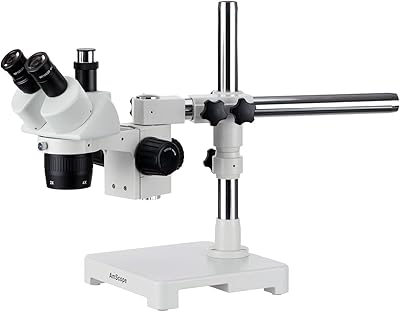
73%
88%
Optical Clarity
91%
Zoom Range & Versatility
83%
Boom Stand Design
86%
LED Ring Light
84%
Build Quality & Durability
More
AmScope SW-3T24Z Trinocular Stereo Microscope
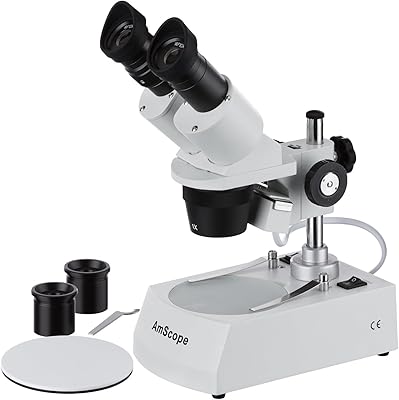
87%
92%
Magnification Quality
88%
Ergonomics & Comfort
84%
Boom Stand Adjustability
91%
Image Clarity
85%
Build Quality & Durability
More
AmScope SE305R-PZ Stereo Microscope
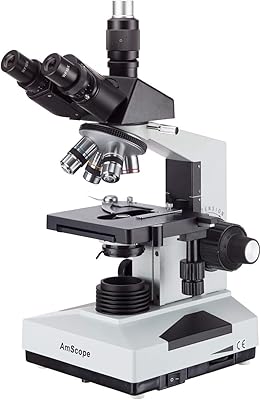
75%
86%
Build Quality
78%
Optical Clarity
71%
Lighting System
91%
Ease of Setup
82%
Ergonomics & Comfort
More
AmScope T490B Compound Trinocular Microscope
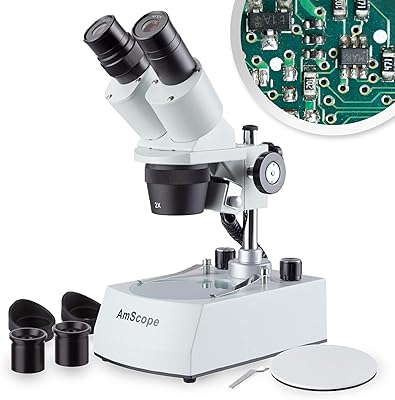
74%
88%
Optical Clarity
91%
Trinocular Head
78%
Camera Integration
86%
Mechanical Stage
89%
Build Quality
More
AmScope SE306R-PZ-LED Stereo Microscope
84%
88%
Value for Money
91%
Build Quality
85%
Ease of Use
78%
Magnification Range
89%
Lighting Performance
More
AmScope SE508 8X Magnification Binocular Stereo Microscope
85%
91%
Build Quality
88%
Usability & Ergonomics
80%
Magnification Performance
85%
LED Illumination Effectiveness
93%
Stability
More
AmScope SE400-Z Binocular Stereo Microscope
77%
88%
Build Quality
79%
Optical Clarity
93%
Working Distance & Clearance
86%
Boom Arm Flexibility
81%
Eyepiece Comfort & Ergonomics
More

FAQ

It relies entirely on ambient room light — there is no built-in illuminator included. For most practical inspection tasks, that is not enough. The vast majority of buyers add a separate LED ring light, which mounts around the objective and provides even, shadow-free illumination. It is a small additional cost but essentially a necessary one.

The trinocular port accepts C-mount connections, but compatibility is not universal out of the box. Depending on your camera — whether it is a DSLR, mirrorless, or USB digital eyepiece — you will likely need a specific C-mount adapter that is sold separately. It is worth researching your exact camera model before purchasing to confirm the right adapter is available.

It is genuinely well-suited for that application. The boom stand design keeps the work surface completely clear, so you can maneuver a board, use both hands with tools, and reposition freely. The zoom range is wide enough to give you a full board overview and then close in on individual joints or SMD pads when needed.

It is substantial — over 42 pounds assembled, with a footprint that takes up a meaningful portion of a workbench. A flimsy or small desk is not a good fit; you want something solid and stable. Most users dedicate a specific bench to it rather than setting it up and putting it away regularly. If space is limited, this is worth factoring into your decision.

Not simultaneously through two eyepieces, no — it has one pair of eyepieces for direct viewing. However, the 360-degree head rotation makes it easy to swing the scope toward a different person without repositioning the stand. If you attach a camera to the trinocular port and connect it to a monitor, a group can follow along on screen while one person views through the eyepieces.

The zoom mechanism on this boom-stand scope is consistently described by long-term users as smooth and continuous, with no noticeable jump or image shift as you move through the range. It is a parfocal design, meaning the image stays roughly in focus as you zoom, which is a significant practical advantage during active work.

Not really. This is a stereo zoom microscope designed for opaque, three-dimensional objects viewed from above. It does not have transmitted lighting from below, which is what you need for thin biological sections or prepared slides. For that kind of work, a compound microscope with a substage illuminator is the appropriate tool.

Assembly is straightforward for most users, though the weight means it helps to have a second person when positioning the boom arm initially. The main learning curve is adjusting the interpupillary distance and diopter settings to suit your eyes, which takes a few minutes but only needs to be done once. Adding external lighting and a camera, if you choose to, requires the most research ahead of time.

The all-metal construction means it ages well mechanically. Long-term owners generally report that the zoom and focusing mechanisms remain smooth over years of regular use, and the optical quality does not degrade noticeably with normal care. AmScope has been responsive to support requests in most user accounts, though experiences with warranty service can vary.

Yes, it is a solid fit for dental lab work. The boom stand accommodates the irregular shapes and bulk of dental appliances, molds, and impressions that would be difficult to position under a fixed-stage scope. The zoom range is practical for moving between detailed inspection and broader orientation, and the ergonomic eyepiece angle holds up well during longer examination sessions.

Where to Buy