Overview

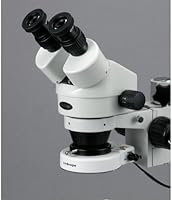
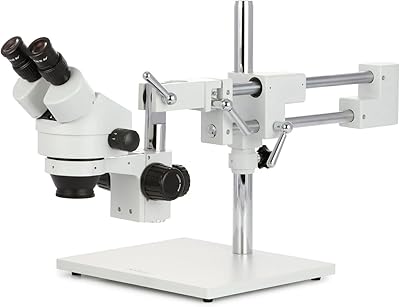
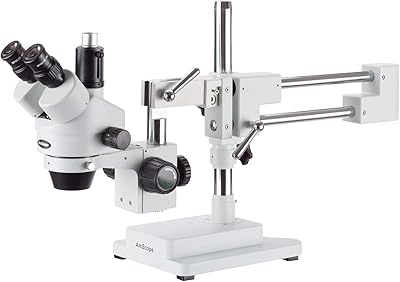
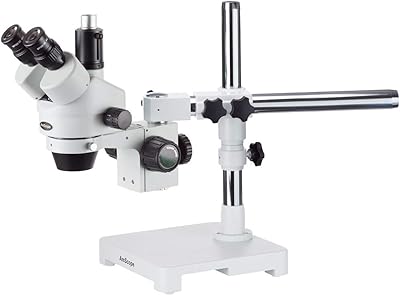
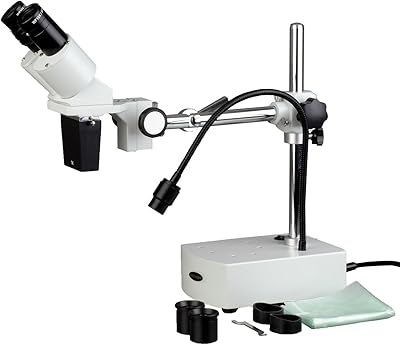
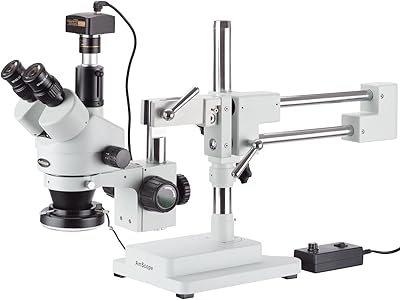
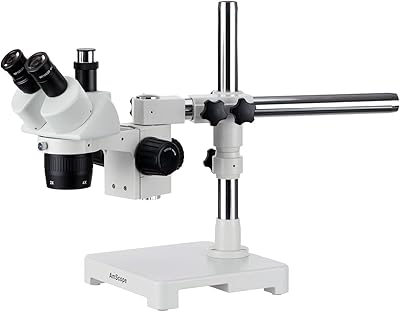
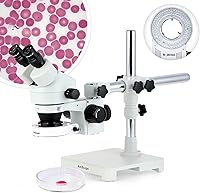
The AmScope SM-3B Binocular Zoom Stereo Microscope has been a steady presence in the market since 2011 — and that longevity is not accidental. AmScope has built a reputation for making professional-grade optics accessible without stripping out the features that serious users actually depend on. This boom-stand scope sits comfortably in the mid-to-upper range, appealing to working professionals, small shop operators, and dedicated hobbyists alike. The defining physical feature is the single-arm boom stand, which fundamentally changes how you interact with your work surface. And with a zoom range stretching from 3.5X all the way to 90X, it handles everything from broad survey work down to fine detail inspection without swapping objectives.
Features & Benefits

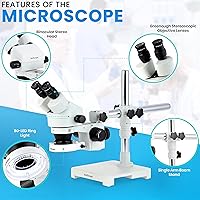
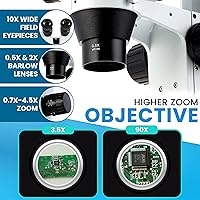
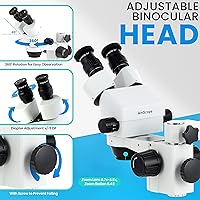
The optical core of this stereo microscope is a Greenough stereoscopic design, which uses two separate optical paths angled toward the same point — the result is genuine three-dimensional depth perception rather than the flat image you get from a compound scope. That matters enormously when you are soldering, carving, or dissecting. The 3.5X–90X continuous zoom covers an impressive working range without any objective changes. The boom stand keeps your entire bench clear, letting you swing the scope over bulky or irregularly shaped objects as needed. Widefield eyepieces with dual diopter adjustment are a quietly important detail — if your two eyes focus differently, this lets you dial each side independently rather than living with compromise.

Best For

The SM-3B is well matched to anyone doing detailed, hands-on technical work. Electronics repair technicians and PCB rework professionals will appreciate the open working distance the boom stand creates — you can maneuver a soldering iron without bumping the optics. Jewelers, engravers, and watchmakers benefit from the high-end magnification and the ability to reposition the scope over a workpiece quickly. Entomology hobbyists, mineral collectors, and anyone examining small specimens will find the wide zoom range genuinely useful day to day. It also performs reliably in small lab or classroom settings where durability matters. Fine-detail crafters — model builders, fly tiers — round out the audience nicely.

User Feedback

With 60 ratings averaging 4.1 out of 5, buyer sentiment around this boom-stand scope is cautiously positive — not universally glowing, but consistently decent. Professionals tend to praise the boom arm flexibility in tight workspaces, while hobbyists frequently mention how well the LED ring light performs straight out of the box. On the other side, some buyers note that zoom calibration takes time at the higher magnification end, and the alloy steel build, while solid, adds real weight and bulk compared to lighter fixed-arm alternatives — worth knowing before purchasing. Sixty reviews is a moderate sample, so treat the overall score as a reasonable signal rather than a definitive verdict.

Pros

  • The 3.5X–90X continuous zoom covers an unusually wide range without any objective swaps.
  • Greenough stereoscopic optics deliver true depth perception, making hands-on work noticeably easier.
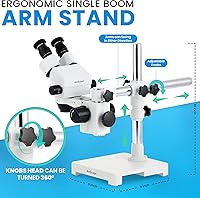
  • The boom stand frees your entire work surface and repositions smoothly over large or irregular objects.
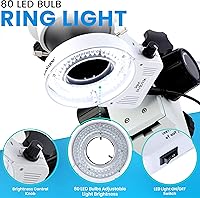
  • 80-LED ring light produces cool, even illumination that does not heat delicate components or specimens.
  • Dual independent diopter adjustment is a real practical benefit for users whose eyes focus differently.
  • Alloy steel construction resists vibration and holds its position firmly during precise work.
  • LED lighting system runs efficiently and lasts far longer than older halogen alternatives.
  • The SM-3B has been on the market since 2011, suggesting stable availability of parts and accessories.
  • Widefield eyepieces give a comfortable, fatigue-reducing view during extended work sessions.
  • AmScope's broad product ecosystem means compatible accessories and upgrades are relatively easy to source.

Cons

  • The boom stand adds significant weight and bulk — not ideal for small or shared workspaces.
  • Dialing in accurate zoom calibration at higher magnifications takes patience and practice.
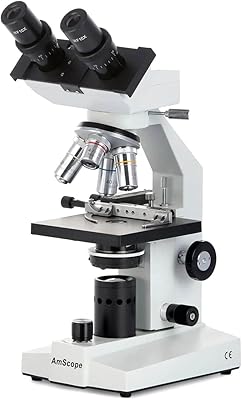
  • No transmitted base light is included, limiting usefulness for traditional slide-based specimen work.
  • Sixty buyer ratings is a relatively modest sample size on which to base full purchasing confidence.
  • The large physical footprint means permanent bench space is essentially required for practical use.
  • Initial assembly and balancing of the boom arm can be fiddly for first-time users.
  • The 110V power requirement limits portability and use in international or field settings without an adapter.
  • At this price tier, buyers upgrading from a basic scope may face a steeper learning curve than expected.

Ratings

The AmScope SM-3B Binocular Zoom Stereo Microscope has been scored by our AI system after analyzing verified buyer feedback from global sources, with spam, bot-generated, and incentivized reviews actively filtered out before any scoring was applied. Based on a moderate but meaningful sample of 60 real-world ratings averaging 4.1 out of 5, both the genuine strengths and the recurring frustrations are transparently reflected below — so you can make a well-informed decision rather than a hopeful one.
Optical Clarity
88%
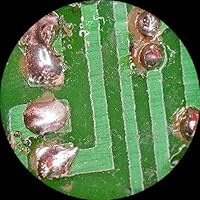
Users across repair shops and hobbyist benches consistently praised the sharpness and depth rendered by the Greenough stereoscopic objectives. The true 3D perception it delivers — rather than the flat image common on cheaper scopes — made a noticeable difference for PCB inspection and fine engraving work.
A subset of buyers noted that image quality drops off noticeably at the very top of the zoom range, with some softness and chromatic fringing appearing near 90X. Getting consistently sharp results at maximum magnification demands careful focus discipline and good lighting conditions.
Zoom Range & Versatility
91%
The 3.5X to 90X continuous zoom is one of the broadest available in this class, and buyers working across multiple tasks — from inspecting circuit boards to examining insect specimens — appreciated not having to swap objectives mid-session. The smooth zoom action was specifically called out as a practical daily-use advantage.
Some users found the zoom calibration at the higher end of the range required repeated fine-tuning, particularly after repositioning the boom arm. The zoom ring can feel slightly stiff until it is broken in, which frustrated buyers expecting instant precision out of the box.
Boom Stand Design
83%
The single-arm boom stand genuinely transforms the working experience — soldering technicians and jewelers repeatedly noted how freeing it is to have the entire bench surface accessible with no base plate in the way. Repositioning over large or irregularly shaped objects takes seconds, which adds up significantly over a full working day.
The boom stand is considerably heavier and bulkier than a fixed-arm base, and several buyers underestimated the footprint before purchasing. Balancing the arm correctly takes patience during initial setup, and a poorly balanced arm can drift slowly under the weight of the optical head.
LED Ring Light
86%
The 80-LED ring light was a consistent highlight across buyer profiles — the illumination is even, cool, and shadow-free in a way that older halogen setups simply cannot match. Electronics repair users specifically appreciated that it does not heat sensitive components, and entomology hobbyists noted how it brings out surface texture on specimens.
On highly reflective surfaces like polished metal or wet specimens, the ring light can produce a circular glare pattern that requires repositioning to manage. A few buyers also noted they would have preferred an adjustable brightness control rather than a single fixed output level.
Build Quality & Durability
84%
The alloy steel frame and stand feel genuinely solid in use — there is no flex or wobble during normal bench work, and the scope holds its focus position reliably between sessions. Buyers who have used cheaper plastic-bodied scopes found the step up in physical quality immediately obvious.
The weight that comes with alloy steel construction is a real trade-off for some users, making the unit difficult to move frequently or store off the bench. A few buyers also reported minor finish inconsistencies on the stand, though none described functional problems as a result.
Ergonomics & Comfort
77%
23%
The 45-degree inclined binocular head puts viewing at a natural angle that reduces neck strain during extended sessions, which technicians doing multi-hour repair work specifically valued. Widefield eyepieces also reduce the sensation of tunnel vision that plagues narrower optics.
Users with larger interpupillary distances reported needing extra adjustment time to find a comfortable eye position. The eyepiece height is fixed relative to the boom arm setting, so very tall or short users may need to improvise a stool or platform to get the right viewing angle.
Diopter Adjustment
79%
21%
Buyers with meaningful vision differences between their two eyes found the dual independent diopter controls genuinely useful — it is the kind of feature that sounds minor until you actually need it. Once calibrated correctly, image consistency across both eyepieces was described as noticeably improved.
The diopter rings can shift slightly if the eyepieces are gripped carelessly during zoom adjustment, requiring periodic recalibration. First-time stereo microscope users sometimes found the dual adjustment process confusing without a clear step-by-step guide in the included documentation.
Setup & Assembly
67%
33%
Most buyers with any prior experience with optical bench equipment found the assembly process manageable within 30 to 45 minutes. Hardware and mounting components were generally reported as included and correctly matched.
First-time users and buyers without a technical background found the boom arm balancing step particularly unintuitive, and the included instructions were described as sparse by several reviewers. A notable number of buyers had to seek out third-party video tutorials to complete setup confidently.
Value for Money
73%
27%
For professional and semi-professional users who need this scope as a working tool, the price-to-performance ratio is broadly considered fair given the optical quality, boom stand, and LED illumination included in the bundle. The long market history also suggests buyers are not paying for an untested design.
Casual hobbyists and buyers who only need occasional magnification may find the investment hard to justify relative to simpler alternatives. A handful of buyers felt that at this price point, a few quality-of-life additions — such as a carry case or a more comprehensive manual — should be standard inclusions.
Illumination Control
58%
42%
The ring light provides immediate, consistent illumination without any warm-up time, which is genuinely convenient during rapid task switching at the bench. For the majority of surface inspection tasks, the default output level is adequate without any adjustment.
The absence of a variable brightness control was a recurring criticism — working with dark matte surfaces versus bright reflective materials ideally requires different light intensities, and the fixed output forces users to compensate through specimen positioning instead. This is a notable omission at this price tier.
Transmitted Light Capability
31%
69%
For its intended applications — surface inspection, hands-on technical work, and three-dimensional specimen examination — the scope performs exactly as designed, and the lack of transmitted light is not a limitation for those use cases.
Buyers who discovered after purchase that this scope cannot be used for traditional glass slide work without a separate base illuminator accessory expressed genuine frustration. The product listing does not prominently flag this limitation, leading to mismatched expectations for buyers coming from a compound microscope background.
Portability & Footprint
44%
56%
Once permanently stationed on a dedicated bench, the SM-3B is stable and takes up a predictable amount of space that experienced users account for in their workspace layout.
Multiple buyers described being surprised by how much physical space the boom stand and base occupy in practice. Moving the unit between workstations or storing it when not in use is impractical for most users, effectively making this a permanent bench installation rather than a flexible tool.
Accessory Compatibility
76%
24%
AmScope's broad product ecosystem means camera adapters, auxiliary lenses, and replacement eyepieces are generally available and reasonably priced, giving this boom-stand scope a meaningful upgrade path over time.
Compatibility between specific accessory models and this exact optical body is not always clearly documented, and a few buyers reported purchasing adapters that did not fit without consulting AmScope support directly. Better compatibility documentation would reduce friction for buyers planning to expand the setup.
Long-Term Reliability
81%
19%
The scope has been on the market since 2011, and buyers who have owned it for several years report continued optical performance without degradation under regular professional use. AmScope's established presence also means replacement parts and service support remain accessible.
With only 60 ratings in total, long-term reliability data is thinner than ideal for a confident assessment. A small number of reviewers reported minor mechanical loosening of the boom arm locking mechanism over extended use, suggesting periodic maintenance checks are advisable.

Suitable for:

The AmScope SM-3B Binocular Zoom Stereo Microscope is purpose-built for people who work with their hands at close range and need reliable, high-quality magnification as a daily tool rather than an occasional novelty. Electronics repair technicians and PCB rework professionals will find the open working distance under the boom stand particularly practical — there is room to maneuver tools, tweezers, and soldering irons without fighting the optics. Jewelers, engravers, and watchmakers benefit from the wide zoom range that lets them shift between inspecting a broad surface and scrutinizing a fine detail without changing objectives. Entomology hobbyists, mineral collectors, and anyone who regularly examines small specimens will appreciate how the continuous zoom handles both survey and close-up work in one smooth motion. Small labs, vocational classrooms, and maker spaces that need a durable, versatile scope that can handle varied tasks from different users are also well served here.
Not suitable for:

The AmScope SM-3B Binocular Zoom Stereo Microscope is not the right choice for buyers who need a compact, lightweight setup or have limited bench space. The alloy steel boom stand is genuinely heavy and occupies a meaningful footprint — if your workspace is cramped, it will feel intrusive rather than freeing. Buyers expecting plug-and-play simplicity may also be surprised by the time needed to calibrate the zoom and diopter settings correctly, especially at higher magnifications. This is not a scope for casual, occasional use where you want to pull something off a shelf and be ready in thirty seconds. Life science researchers or educators who need transmitted base lighting for slide-based work will find the ring light alone insufficient — this scope is built around surface illumination, not transmitted light applications. Finally, buyers on a tight budget who only need occasional magnification for simple tasks would be better served by a more basic, lower-cost alternative.
Specifications

  • Magnification Range: Provides continuous zoom from 3.5X to 90X without requiring objective changes, covering both broad survey and fine detail work.
  • Optical Design: Uses Greenough stereoscopic objectives, which route light through two separate angled paths to produce genuine three-dimensional depth perception.
  • Eyepieces: Widefield binocular eyepieces are fitted as standard, giving a comfortable, expansive field of view suited to extended work sessions.
  • Diopter Adjustment: Dual independent diopter controls allow each eyepiece to be calibrated separately, accommodating users with unequal vision between eyes.
  • Viewing Angle: The binocular head is set at a 45-degree inclined angle, providing a natural, ergonomic viewing posture during bench work.
  • Stand Type: Fitted with a single-arm boom stand that keeps the base off the work surface entirely, allowing free tool access and repositioning over large objects.
  • Illumination: An 80-LED compact ring light is included, delivering cool, even, shadow-free illumination directly around the objective lens.
  • Light Source: LED-based lighting system rated for long service life and energy-efficient operation, with no heat output that could affect sensitive specimens.
  • Voltage: Operates on 110V AC power, standard for North American outlets; an adapter is required for use in regions with different mains voltage.
  • Body Material: The frame and stand are constructed from alloy steel, providing structural rigidity and resistance to vibration during precision work.
  • Dimensions: Assembled unit measures 19 x 17 x 16 inches, requiring a dedicated and reasonably spacious section of bench space for stable placement.
  • Color: Available in white as standard, with the optical body and stand sharing a consistent finish.
  • Model Number: Officially designated SM-3BZ-80S, which identifies the specific zoom body, boom stand, and 80-LED ring light bundle configuration.
  • Manufacturer: Designed and sold by United Scope LLC, the parent company behind the AmScope brand, based in the United States.
  • Product Age: This model has been commercially available since March 2011, indicating a mature, well-established product with a stable supply of parts and accessories.
  • Compatibility: The optical body is compatible with standard AmScope accessory threads, allowing future addition of cameras, barlow lenses, or auxiliary objectives.
  • Weight Note: The alloy steel construction and boom stand assembly add considerable mass, making this a heavy bench instrument rather than a portable one.
  • Warranty: AmScope typically covers its microscopes with a manufacturer warranty; buyers should confirm current warranty terms directly with the seller at time of purchase.

Related Reviews

AmScope SM-4B Stereo Zoom Microscope Boom Stand
76%
93%
Build Quality
88%
Optical Clarity
91%
Boom Stand Versatility
41%
Illumination
82%
Ergonomics
More
AmScope SM-4TPZ Trinocular Stereo Zoom Microscope
76%
88%
Optical Clarity
91%
Build Quality
93%
Boom Stand Versatility
86%
Zoom Range & Flexibility
74%
Trinocular Camera Integration
More
AmScope SM-3T Trinocular Stereo Zoom Microscope
77%
88%
Optical Clarity
91%
Build Quality
93%
Boom Stand Design
86%
Zoom Range & Versatility
84%
Ergonomics & Comfort
More
AmScope SE508 8X Magnification Binocular Stereo Microscope
85%
91%
Build Quality
88%
Usability & Ergonomics
80%
Magnification Performance
85%
LED Illumination Effectiveness
93%
Stability
More
AmScope SE400-Z Binocular Stereo Microscope
77%
88%
Build Quality
79%
Optical Clarity
93%
Working Distance & Clearance
86%
Boom Arm Flexibility
81%
Eyepiece Comfort & Ergonomics
More
AmScope SM-4TZ-144-5MT Trinocular Stereo Microscope
77%
93%
Optical Clarity
91%
Build Quality
89%
LED Ring Illumination
88%
Zoom Range & Versatility
79%
Camera Quality
More
AmScope SE305R-PZ Stereo Microscope
75%
86%
Build Quality
78%
Optical Clarity
71%
Lighting System
91%
Ease of Setup
82%
Ergonomics & Comfort
More
AmScope B490B Compound Binocular Microscope
85%
94%
Optical Clarity
90%
Build Quality
85%
Ease of Use
92%
Value for Money
93%
Magnification Range
More
AmScope SE306R-PZ-LED Stereo Microscope
84%
88%
Value for Money
91%
Build Quality
85%
Ease of Use
78%
Magnification Range
89%
Lighting Performance
More
AmScope B100B-MS Compound Binocular Microscope
69%
83%
Build Quality
74%
Optical Clarity
61%
Illumination
69%
Magnification Range
71%
Mechanical Stage
More

FAQ

Assembly is straightforward but does take some time — expect to spend 20 to 40 minutes attaching the boom arm, balancing the head, and mounting the ring light. The process is not technically demanding, but rushing through the balance adjustment on the boom arm tends to cause instability later, so it is worth doing carefully the first time.

Yes, the SM-3B is compatible with AmScope camera adapters that mount to the eyepiece tube or via a trinocular port on compatible variants. If camera integration is a priority, confirm which adapter model matches your specific optical body configuration before ordering.

More than most people expect. The base of the boom stand and the sweep radius of the arm together occupy a meaningful footprint — roughly in line with the 19 x 17-inch assembled dimensions listed. If your workbench is already crowded, this is something to plan around before the unit arrives.

The upper end of the zoom range is real but does require careful focus technique and good lighting to get sharp results. At 90X on a stereo scope, the depth of field is very shallow, so even minor movement can throw the image out of focus. Most practical work tends to happen in the 10X–45X range, with the high end reserved for very fine detail inspection.

For the vast majority of surface-illumination tasks — PCB inspection, jewelry work, specimen examination — the 80-LED ring light is more than adequate on its own. It runs cool and distributes light evenly with very little shadowing. If you are working with highly reflective surfaces or need transmitted light from below for slide work, you may want a supplemental base light.

The AmScope SM-3B Binocular Zoom Stereo Microscope offers a working distance that is generous enough to comfortably use tools, tweezers, or a soldering iron beneath the lens — typically around 100mm at lower magnifications, which is one of the practical strengths of this optical format. Working distance decreases slightly as you zoom in toward 90X.

Yes, that is exactly what the dual independent diopter adjustments are for. Each eyepiece can be calibrated separately, so users with different prescriptions or a significant difference between their two eyes can each set it to their own needs without affecting the other.

Not really. Stereo microscopes like this one are designed for surface illumination and three-dimensional viewing of solid objects — they are not optimized for transmitted light slide work. If your primary interest is examining thin biological sections on glass slides, a standard compound microscope with a base illuminator is a better fit.

Once the arm is properly balanced and locked, stability is generally good for a boom-stand design. That said, any contact with the bench or the scope itself will be more visible at 60X–90X than at lower zoom levels. A vibration-dampening mat under the base can help if your work environment has significant foot traffic or equipment vibration nearby.

It depends on the level of seriousness. This is a professional-grade instrument with a price to match, and it is best appreciated by someone who already has a specific hands-on application in mind — electronics, jewelry, biology, and so on. For a student exploring microscopy as a general interest, a more affordable entry-level stereo scope would likely be a more sensible starting point.