Overview

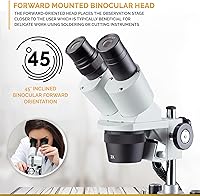
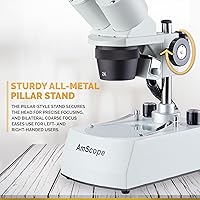
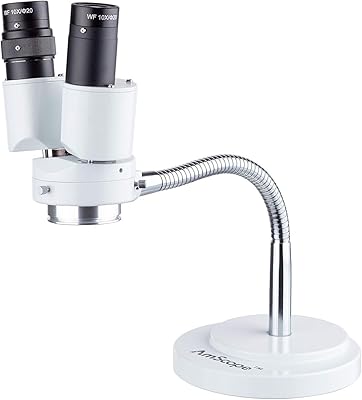
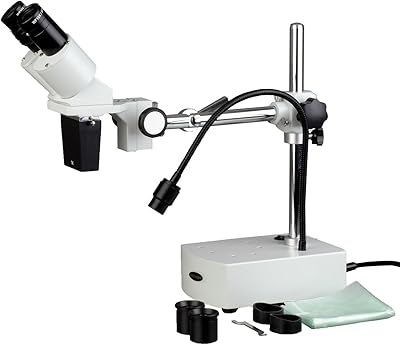
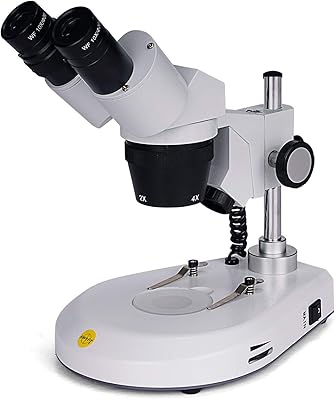
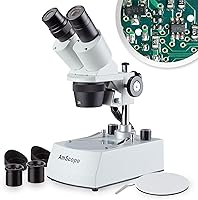
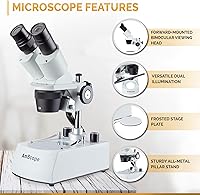
The AmScope SE306R-PZ-LED Binocular Stereo Microscope has been a steady presence in the hobbyist and student microscope market since 2011, which in itself signals something meaningful in a space where brands cycle in and out quickly. It isn't a lab-grade research instrument, and it doesn't pretend to be. At its core, it's a mid-range educational scope built for home users, students, and curious minds who want genuine optical capability without the complexity or cost of professional equipment. The forward-mounted head sits at a 45-degree incline, making prolonged sessions more comfortable, and dual power options — AC or AA batteries — add a layer of real-world practicality.
Features & Benefits

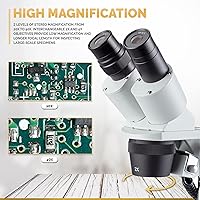
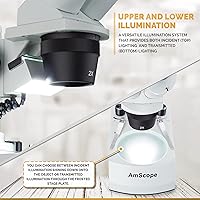
Four magnification settings — 20x, 40x, and 80x — come from swapping between the included eyepiece pairs and the 2x or 4x objectives, covering a surprisingly wide range of specimen types. Both upper and lower LED lights mean you can illuminate opaque surfaces from above or backlight thin, transparent materials from below, with the frosted stage plate supporting that second mode effectively. The reversible stage plate flips between black and white to improve contrast depending on what you're looking at — pale specimens on dark, or vice versa. A compact pillar stand keeps the footprint manageable, and the adjustable interpupillary distance makes this binocular scope comfortable for both adults and younger students.

Best For

This stereo microscope hits a sweet spot for a fairly specific type of buyer. Students working through science curricula will find it accessible enough to use without much guidance, yet capable enough to hold interest past a single project. Hobbyists who inspect coins, stamps, or gemstones will appreciate the longer working distance — there's room to handle and rotate a specimen while viewing, which compound microscopes generally don't allow. Jewelry repair hobbyists will find that particularly useful. It's also a solid gift choice since AmScope is a brand that holds up to scrutiny. Anyone needing cell-level magnification, however, should skip ahead to a higher-powered compound model instead.

User Feedback

Owners of the AmScope SE306R tend to talk about it the same way — simple to set up out of the box, good image quality at lower magnifications, and a notably sturdier feel than competing plastic-bodied scopes. The metal construction gets called out specifically and often. Where opinions split is around 80x magnification: at that level, sharpness depends heavily on specimen preparation, and some users report soft or slightly blurry edges. The battery-powered option earns consistent praise from teachers and parents using it in classrooms or outdoors. A few buyers note the included stage clips feel a bit lightweight for the price. Not a dealbreaker, but worth knowing.

Pros

  • Metal construction feels noticeably more solid than most plastic-bodied competitors in this category.
  • Four usable magnification settings cover a wide range of everyday hobbyist and student specimen types.
  • Upper and lower LED illumination handles both opaque and transparent specimens without swapping accessories.
  • The battery-powered option makes this stereo microscope genuinely portable for classrooms or outdoor sessions.
  • A reversible black-and-white stage plate adds practical contrast control for differently colored specimens.
  • Adjustable interpupillary distance accommodates both adults and younger students comfortably.
  • Setup is straightforward enough for a first-time user to be viewing specimens within a few minutes.
  • AmScope has supported the SE306R line since 2011, suggesting reliable parts availability and long-term brand commitment.
  • The 45-degree inclined viewing head reduces neck strain during longer observation sessions.

Cons

  • Image sharpness at 80x can appear soft or slightly blurry, especially without careful specimen preparation.
  • Included stage clips feel lightweight and may not hold larger or irregularly shaped specimens reliably.
  • The 80x magnification ceiling rules out cell-level or any high-resolution microscopy work entirely.
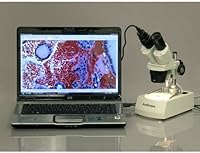
  • No built-in camera port or digital output makes documenting and sharing observations more difficult.
  • Some buyers find the included eyepieces functional but not the sharpest optically at the upper magnification range.
  • Battery drain during extended use can be noticeable if an AC outlet is not conveniently nearby.
  • The pillar stand offers limited vertical adjustment range compared to boom-arm or articulating stand alternatives.
  • Carrying weight of over five pounds makes true one-handed portability impractical for frequent transport.

Ratings

Our AI-generated scores for the AmScope SE306R-PZ-LED Binocular Stereo Microscope were compiled by processing thousands of verified global user reviews, with spam, bot-generated content, and incentivized feedback actively filtered out before any score was assigned. The results reflect both the consistent strengths that have kept this scope near the top of its category for over a decade, and the honest friction points that surface after real-world use — neither exaggerated nor minimized.
Build Quality & Materials
84%
The all-metal frame earns consistent praise from buyers who have previously dealt with plastic-bodied scopes that flex or creak under regular use. Hobbyists and teachers handling this stereo microscope daily report that it feels stable and planted on a desk or workbench, and the overall solidity gives a clear sense that it is built to last.
A portion of users note that the focus knob can develop slight looseness after months of repeated adjustment. The weight — just over five pounds — is not a problem on a fixed surface but becomes noticeable when the scope needs to be relocated frequently between classrooms or workspaces, since there is no integrated carry grip.
Low-Magnification Clarity
82%
18%
At 20x and 40x, image quality is where this binocular scope most consistently earns buyer trust. Coin collectors, stamp enthusiasts, and botany hobbyists frequently highlight the sharpness and color accuracy at these settings, and the widefield eyepieces provide a viewing circle wide enough to scan specimen surfaces efficiently without constantly repositioning.
Some edge softening is visible at the periphery of the widefield view at 40x, which becomes apparent when users are scrutinizing fine surface detail across the full width of the image. This rarely disrupts practical work, but buyers with high expectations for edge-to-edge optical perfection may find it slightly distracting.
High-Magnification Clarity (80x)
58%
42%
On flat, well-prepared specimens — pinned insects, polished gemstone facets, or pressed botanical samples — 80x can still deliver useful detail that genuinely aids identification or inspection. Users who approach 80x with reasonable preparation and patience do find workable images that add meaningful information beyond what lower settings reveal.
Image softness and blurring at 80x are among the most frequently cited complaints from buyers, particularly with irregular, thick, or unprepared specimens. Users who purchased expecting consistently sharp high-magnification views regularly express frustration; 80x is the ceiling of what this scope can attempt, not a reliable working magnification the way 20x and 40x are.
LED Illumination System
81%
19%
Both upper and lower LEDs are praised for delivering bright, cool illumination without washing out fine specimen detail. Users examining translucent mineral slices or thin leaf sections specifically value having transmitted lower lighting available without additional equipment, and several long-term owners note the LEDs stay cool even during extended continuous sessions.
There is no adjustable intensity control on the illumination, which frustrates users working with highly reflective specimens like polished metal surfaces or wet rocks, where fixed-brightness upper lighting produces distracting glare. Battery-powered LED output also dims perceptibly as the AA cells deplete, which can affect image consistency during longer sessions away from an outlet.
Value for Money
76%
24%
For buyers entering the stereo microscope category, the combination of metal construction, dual LED illumination, four magnification levels, and AmScope's established brand presence is a difficult package to match at this tier. The scope has been available since 2011, which signals that replacement parts and compatible accessories are unlikely to disappear overnight.
The value proposition weakens for users who regularly push to 80x or need reliable image documentation, since neither use case is well served by the included hardware. The stage clips and secondary eyepiece pair both feel underspecified relative to the overall build quality, leaving some buyers feeling they need to source better accessories shortly after unboxing.
Setup & Assembly
88%
Most buyers report being fully assembled and viewing their first specimen within ten to fifteen minutes, with no tools required. The pillar stand attachment, head mounting, and eyepiece installation are all intuitive enough that older students and adults can work through them independently, and the overall process rarely generates support questions.
The included documentation is minimal, and the interpupillary distance adjustment — one of the most critical setup steps for a binocular scope — is poorly explained in the printed materials. New users who skip this step often spend time convinced the optics are defective before discovering that the binocular alignment simply has not been calibrated for their eyes.
Ergonomics & Viewing Comfort
78%
22%
The 45-degree inclined binocular head is a genuine comfort improvement over flat-head designs for sessions lasting more than a few minutes. Students who have used compound scopes with near-vertical eyepieces quickly appreciate how the inclined head keeps posture more upright and reduces the neck strain that typically comes with extended microscopy sessions.
Eyeglass wearers report inconsistent experiences; the eye relief on the included widefield eyepieces is functional but not generous, and some glasses users find they cannot achieve the full field of view without removing their eyewear entirely. The interpupillary distance adjustment range, while practical for most adults, may not accommodate the narrowest eye spacings in young children.
Portability & Power Flexibility
74%
26%
The AA battery option is a standout convenience that teachers and group instructors mention repeatedly. Being able to run the scope away from a power outlet means it can be set up at a temporary field station, a kitchen table, or a shared classroom cart without planning around socket availability — a flexibility most competing scopes at this tier do not offer.
At over five pounds with no carrying handle, transporting this stereo microscope between locations is not graceful. Battery runtime under continuous LED use is not specified clearly by the manufacturer, leaving users to gauge session length through experience rather than expectation, which occasionally results in mid-session dimming at inconvenient moments.
Included Accessories Quality
56%
44%
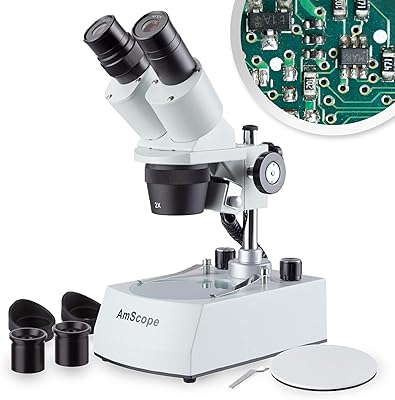
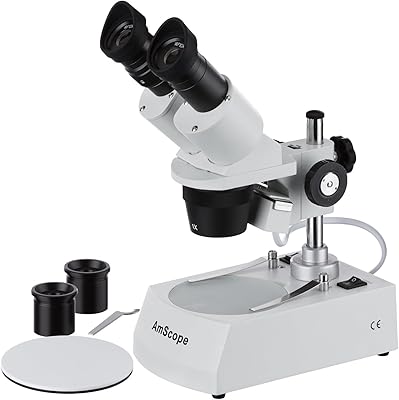
The box includes two eyepiece pairs, two objectives, a frosted stage plate, a reversible black-and-white stage plate, and stage clips — covering everything a beginner needs to start immediately across a variety of specimen types. The dual plate system in particular gives new users genuine contrast flexibility that entry-level competitors frequently omit entirely.
Stage clips are the most consistent accessory complaint; buyers find them flimsy and prone to slipping with any specimen that has an irregular surface. A number of reviewers also note that the secondary eyepiece pair delivers noticeably softer results than the primary set, and some buyers have reported minor quality control inconsistencies across accessory components between units.
Beginner Friendliness
86%
The AmScope SE306R requires almost no prior optical knowledge to begin using productively — users simply place a specimen on the stage and adjust focus. Parents of elementary and middle school students consistently highlight this immediacy as a key reason the scope holds a child's attention past the initial novelty, since early results are rewarding rather than frustrating.
The interpupillary distance adjustment trips up a meaningful portion of first-time users who mistake a misaligned binocular view for a defective scope. The relationship between objectives and eyepieces in setting magnification is also a concept that confuses some buyers early on, and clearer labeling or a short instructional card would reduce these avoidable early-use friction points.
Stage & Specimen Handling
71%
29%
The longer working distance between lens and stage is one of the most practically useful aspects of this binocular scope for hands-on users. Jewelry hobbyists, electronics inspectors, and small-item repair enthusiasts consistently note they can use tweezers, probes, or brushes to manipulate a specimen mid-observation — an interaction a standard compound microscope cannot accommodate.
There is no mechanical X-Y stage movement, so repositioning a specimen requires manually nudging it by hand, which regularly disrupts focus and requires re-centering. Users working with small or irregularly shaped items find the lightweight stage clips inadequate for maintaining steady positioning during fine repositioning or when the viewing head is adjusted.
Durability Over Time
79%
21%
Multi-year owners of this stereo microscope report that the core optical and mechanical performance holds up well under consistent educational or hobbyist use. The metal body resists the kind of cosmetic and structural degradation that tends to age plastic-bodied scopes badly within the first two to three years of regular handling.
Long-term users occasionally report that the focus mechanism develops looseness or play over time, requiring tightening that most buyers are not comfortable performing without guidance. LED illumination longevity is inherently strong, but because the light assembly is not user-serviceable, any LED failure essentially takes the scope out of service until professionally repaired.
Working Distance Practicality
83%
The generous clearance between the objective lens and the stage surface is one of the defining advantages of the stereo design for active inspection work. Gemstone hobbyists, small electronics inspectors, and coin collectors find this space essential for rotating or repositioning a specimen with tools while simultaneously observing it at magnification.
The fixed focal distance means users cannot extend the working space for unusually tall three-dimensional specimens without sacrificing image quality. Buyers working with irregular rock samples, layered insect mounts, or bulky jewelry pieces occasionally find the height constraint forces uncomfortable compromises between specimen placement and achieving acceptable focus.

Suitable for:

The AmScope SE306R-PZ-LED Binocular Stereo Microscope is a strong match for students, homeschool families, and hands-on hobbyists who want real optical capability without stepping into professional lab territory. Parents looking for a science gift that will outlast a passing phase will appreciate the durable metal construction and the brand credibility that AmScope has built over many years in this market. Hobbyists working with coins, stamps, gemstones, insects, or small circuit boards will find the longer working distance especially practical — there is enough clearance to rotate and handle a specimen while viewing, something a standard compound microscope simply does not allow. Jewelry hobbyists and small-item repair enthusiasts benefit from that same working clearance, making this binocular scope useful beyond pure observation. Teachers and group instructors will also value the battery-powered option, which removes the need for a nearby outlet and makes the scope genuinely portable for shared classroom use or light fieldwork.
Not suitable for:

If your goal is cell-level biology, microorganism identification, or any work requiring magnification well beyond 80x, the AmScope SE306R-PZ-LED Binocular Stereo Microscope will not meet your needs. This stereo microscope is designed around large-specimen, low-to-moderate magnification work, and pushing it toward its upper limit produces noticeably softer images that will frustrate anyone expecting precision optics. Serious researchers, university students with lab coursework requirements, or professionals in fields like pathology or materials science should look at dedicated compound or research-grade instruments instead. Advanced amateur microscopists who have already spent time in the 20x-80x range and are ready to go further will find they outgrow this binocular scope fairly quickly. Anyone expecting crisp, photographic-quality results at maximum magnification straight out of the box — without careful specimen preparation — may also come away disappointed.
Specifications

  • Brand & Maker: Manufactured by United Scope LLC under the AmScope brand, a company with an established track record in educational and hobbyist optical instruments.
  • Model Number: The official model designation is SE306R-PZ-LED, which identifies both the forward-mounted head configuration and the LED lighting system.
  • Magnification Range: Four discrete magnification levels are available — 20x, 40x, and 80x — achieved by combining the two objective lenses with the two interchangeable eyepiece pairs.
  • Eyepieces: Two pairs of widefield eyepieces are included: WF10x and WF20x, both interchangeable and designed to work with the paired objective lenses.
  • Objectives: Two achromatic objectives — 2x and 4x — are provided, offering low magnification with a longer focal length suited for larger or three-dimensional specimens.
  • Viewing Head: The binocular head is forward-mounted and inclined at 45 degrees, a design that reduces neck strain and makes prolonged viewing sessions more comfortable, particularly for younger users.
  • Interpupillary Distance: The interpupillary distance is fully adjustable, allowing the scope to be comfortably calibrated for a wide range of users, from children to adults.
  • Illumination: An LED light source provides both upper incident illumination for opaque specimens and lower transmitted illumination for thin or semi-transparent materials.
  • Power Source: The scope operates on either a 120V AC adapter for stationary use or two standard AA batteries, giving it genuine portability without requiring a dedicated power outlet.
  • Stage Plates: Two stage plates are included: a reversible black-and-white plate for contrast control with opaque specimens, and a frosted glass plate that allows light to pass through from below.
  • Stage Clips: Two stage clips are provided to secure specimens in place on the stage during observation, preventing drift or movement while viewing.
  • Stand Type: The microscope uses a pillar stand design, which keeps the overall footprint compact while providing a stable, vibration-resistant base for the optical assembly.
  • Body Material: The primary frame and stand are constructed from metal, distinguishing this scope from lower-tier plastic-bodied alternatives in terms of durability and feel.
  • Dimensions: The assembled unit measures 14.84 x 14.17 x 5.79 inches, making it suitable for placement on a standard desk, workbench, or classroom table.
  • Weight: The scope weighs 5.65 pounds, which is heavy enough to stay stable during use but light enough to be repositioned without difficulty.

Related Reviews

AmScope SE306R-P-LED Stereo Microscope
79%
83%
Optical Clarity
88%
Build Quality
79%
Illumination Quality
54%
Magnification Range
81%
Ergonomics & Comfort
More
AmScope SE305R-PZ Stereo Microscope
75%
86%
Build Quality
78%
Optical Clarity
71%
Lighting System
91%
Ease of Setup
82%
Ergonomics & Comfort
More
AmScope SE400-Z Binocular Stereo Microscope
77%
88%
Build Quality
79%
Optical Clarity
93%
Working Distance & Clearance
86%
Boom Arm Flexibility
81%
Eyepiece Comfort & Ergonomics
More
AmScope SE508 Binocular Stereo Microscope
77%
91%
Build Quality
83%
Optical Clarity
93%
Working Distance
52%
Magnification Flexibility
74%
Illumination Quality
More
AmScope SM-4B Stereo Zoom Microscope Boom Stand
76%
93%
Build Quality
88%
Optical Clarity
91%
Boom Stand Versatility
41%
Illumination
82%
Ergonomics
More
AmScope SM-3B Binocular Zoom Stereo Microscope
73%
88%
Optical Clarity
91%
Zoom Range & Versatility
83%
Boom Stand Design
86%
LED Ring Light
84%
Build Quality & Durability
More
AmScope B490B Compound Binocular Microscope
77%
86%
Optical Clarity
91%
Build Quality
63%
Illumination System
88%
Stage Precision
54%
High Magnification Performance
More
AmScope SW-3T24Z Trinocular Stereo Microscope
87%
92%
Magnification Quality
88%
Ergonomics & Comfort
84%
Boom Stand Adjustability
91%
Image Clarity
85%
Build Quality & Durability
More
AmScope B100B-MS Compound Binocular Microscope
69%
83%
Build Quality
74%
Optical Clarity
61%
Illumination
69%
Magnification Range
71%
Mechanical Stage
More
Swift S306S Binocular Stereo Microscope
79%
83%
Optical Clarity
79%
Build Quality
88%
Illumination System
71%
Magnification Range
91%
Head Design & Ergonomics
More

FAQ

Yes, it fits that age group well. The AmScope SE306R-PZ-LED Binocular Stereo Microscope is specifically designed for educational use, and the 45-degree inclined head makes it comfortable even for students who aren't used to extended viewing sessions. The four magnification levels cover most standard science projects, from inspecting leaf structures to examining insect specimens.
It works genuinely well on batteries — this isn't just a last-resort feature. Two AA batteries power the LED lighting for a reasonable session length, making the scope practical for classrooms without available outlets or for taking outside. That said, if you plan to use it at a fixed workstation, plugging in is the more economical long-term choice.

At 80x you can see surface textures, small crystal formations, fine print, circuitry traces, insect wing structures, and similar detail on solid objects. What you cannot see at 80x is anything requiring cellular or subcellular resolution — for that you need a compound microscope with magnification starting around 100x and going much higher. Stereo scopes like this one are built for three-dimensional, large-specimen work.

Most users have this binocular scope fully assembled and viewing their first specimen within about ten to fifteen minutes. The pillar stand and head assembly are straightforward, and no tools are required. Attaching the stage clips and swapping eyepieces is intuitive even without consulting the manual.

There is no dedicated camera port or trinocular head on this model. Some users do manage to hold a smartphone lens up to an eyepiece for casual shots, but the results are inconsistent and depend heavily on your phone's camera. If documentation is important to your workflow, you would need a scope with a camera-ready trinocular head or a dedicated eyepiece camera adapter.

Honestly, it depends on the specimen and how well it is prepared. At 20x and 40x, image clarity is quite good for this price tier. At 80x, results are more variable — flat, well-mounted specimens tend to look reasonably sharp, while thick or uneven objects can show some softness at the edges. It is usable, but do not expect the same crispness you get at lower settings.

Upper illumination shines light down onto the surface of a specimen from above — this is what you use for coins, rocks, insects, circuit boards, or anything solid and opaque. Lower illumination shines light upward through the frosted stage plate, which works for thin, semi-transparent materials like pressed leaves, thin mineral slices, or tissue paper. Many specimens look best with one or the other, and having both available without swapping accessories is genuinely useful.

It might require some adult help at first, but it is not excessively complex. The main adjustment kids need guidance on is the interpupillary distance, which needs to be set correctly for their eye spacing before the image clicks into binocular focus. Once that is dialed in, swapping magnifications and placing specimens on the stage are things most children pick up quickly.

The WF10x and WF20x eyepieces use a standard 30mm barrel diameter, which is common across much of the AmScope stereo line and compatible with many third-party widefield eyepieces. If you want to add eyepiece cameras or different magnification eyepieces down the road, it is worth verifying the barrel size before purchasing any accessories.

Always use lens tissue or a dedicated optical microfiber cloth — never paper towels or clothing fabric, which can scratch the coatings. For dust, a soft air blower is the safest first step before any physical contact. If there is smudging, a small amount of lens cleaning solution applied to the cloth works well; apply to the cloth first, not directly to the optic. Avoid pressing hard or using circular scrubbing motions.

Where to Buy