Overview

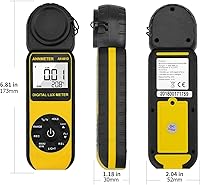
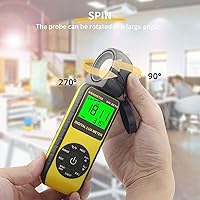
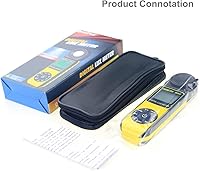
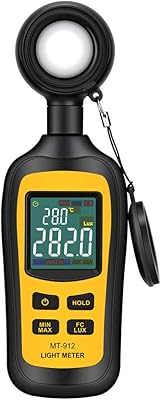
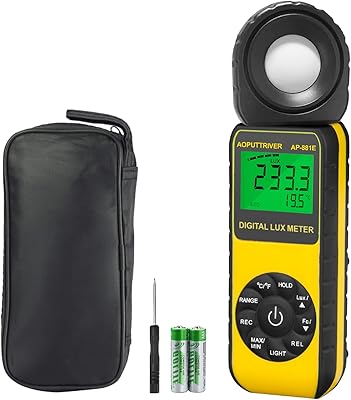
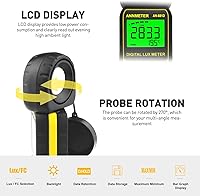
The AIOMEST AI-881D Light Meter is a handheld lux and foot-candle meter built for plant growers, photographers, and anyone who needs reliable light readings without spending a fortune. Its measurement range stretches from near-darkness to intensely bright grow-light environments — a span wide enough to cover most real-world scenarios. The 270-degree rotatable detector is the first thing you notice physically; it lets you angle the sensor toward a light source without contorting your wrist or repositioning your entire body. It ships with a carrying case and a screwdriver, small touches that suggest it was designed with portability in mind rather than as a stationary desk instrument.

Features & Benefits

The wide dynamic range is genuinely useful here, covering dim living-room corners all the way up to intense horticultural lighting that can exceed 100,000 lux. The AI-881D logs up to 33 measurement sets directly on the device, which is handy when comparing light levels across different spots in a greenhouse over time. The display reads in both lux and foot-candles simultaneously and also shows ambient temperature, reducing the need for a separate thermometer. One caveat worth noting: the unit is calibrated against an incandescent lamp at 2856K, so readings under LED or HID sources may carry slightly more error than the published spec implies.

Best For

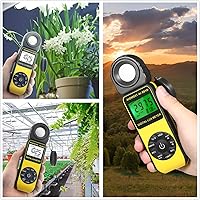
This handheld light tester makes the most sense for indoor plant growers who need to confirm that their fixtures are actually delivering the intensity their plants require at canopy level. Hydroponic hobbyists, in particular, tend to appreciate having logged readings they can compare week over week. Photographers and videographers will find it useful for verifying consistent light levels across a scene before shooting. Facility managers in offices and schools can use it to spot-check against recommended lux thresholds with minimal effort. It is less suited to professional lab or regulatory compliance work, where certified instruments are typically required.

User Feedback

With a 4.5-star average across more than 126 reviews, the general sentiment around this lux meter is positive without being uniformly glowing. Buyers consistently praise the rotatable sensor head as a practical design win and appreciate that the backlit display stays readable in dim environments. The included carrying case also gets mentioned often as a thoughtful addition. On the critical side, some users point out the absence of wireless connectivity or any way to export logged data to a computer, which limits detailed record-keeping. A smaller number question how well the stated accuracy holds up against calibrated reference meters under LED lighting. Overall, most buyers consider the value-to-performance ratio solid for a non-professional tool.

Pros

  • Measurement range easily handles everything from dim interiors to high-output grow lights without maxing out.
  • The 270-degree rotating sensor lets you angle toward any light source without repositioning your body.
  • On-device data logging stores up to 33 reading sets, genuinely useful for multi-zone greenhouse checks.
  • Simultaneous lux and foot-candle display removes the need for manual unit conversion during a session.
  • Ambient temperature readout adds useful environmental context without needing a second instrument.
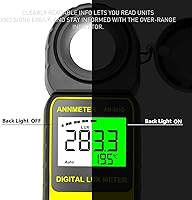
  • Backlit display stays readable in dark grow tents and dim studio setups where you need it most.
  • Ships with a carrying case, making it practical to toss in a tool bag without worrying about damage.
  • Auto power-off prevents dead batteries from greeting you at the start of your next session.
  • At its price point, the feature set outpaces most bare-bones competitors by a meaningful margin.
  • Refresh rate is fast enough to catch fluctuations from dimmer-controlled or PWM-driven LED fixtures.

Cons

  • No data export whatsoever — logged readings must be manually transcribed, which gets tedious fast.
  • Calibrated against incandescent light, so LED and HID readings carry more error than the spec sheet suggests.
  • The sensor joint can feel loose over time, raising doubts about durability under regular field use.
  • No IP rating means humidity in a greenhouse or an accidental splash is a genuine risk.
  • Low-battery indicator only appears when reserves are critically low, giving almost no advance warning.
  • The instruction manual is thin and poorly translated, leaving data logging steps unclear for new users.
  • No indexed click stops on the rotating sensor make holding a precise angle difficult during grid surveys.
  • Temperature readings reflect air near the meter body, not at the canopy, limiting their practical usefulness.

Ratings

The AIOMEST AI-881D Light Meter earns a solid overall standing among hobbyist and semi-professional light measurement tools, based on AI analysis of verified global buyer reviews with spam, bot, and incentivized submissions actively filtered out. Scores reflect the full picture — where this handheld tester genuinely delivers and where real users have consistently run into limitations. Both strengths and friction points are weighted transparently so you can make a confident purchase decision.
Measurement Range
93%
The ability to read from near-total darkness up to intensely bright horticultural fixtures covers practically every scenario a hobbyist or semi-pro will encounter. Growers running high-output LED arrays or double-ended HPS lamps particularly appreciate not having the meter max out mid-measurement, which cheaper single-range tools do regularly.
The upper range is largely irrelevant for standard indoor photography or office use, so some buyers feel they are paying for headroom they will never need. A few users also note that extremely low-end readings near the 0.01 lux floor can feel inconsistent in real-world conditions.
Measurement Accuracy
74%
26%
Under moderate indoor lighting and incandescent-adjacent sources, most buyers report readings that track closely with pricier reference meters, giving enough confidence for grow-light dialing and photography exposure checks. The stated repeatability holds up reasonably well when the same spot is measured multiple times in quick succession.
The calibration baseline is a 2856K incandescent lamp, which means LED and HID grow lights introduce additional spectral error beyond the published tolerance. Several technically oriented buyers who cross-checked against certified instruments found deviations that were noticeable, though not catastrophic, for professional-grade work.
Rotatable Sensor Design
91%
The 270-degree swivel on the detector head is consistently one of the most praised physical features across reviews. It lets users angle the sensor toward overhead grow lights or angled studio rigs without repositioning the entire unit, which saves real time when scanning multiple points across a canopy or lighting grid.
A handful of users report that the sensor joint feels slightly loose after extended use, raising questions about long-term durability. The rotation mechanism also lacks indexed click stops, so finding and holding a precise angle repeatedly can be mildly frustrating during systematic grid measurements.
Data Logging
78%
22%
Storing up to 33 measurement sets on-device is genuinely useful for greenhouse operators or growers who want to compare light levels at different canopy heights or times of day without relying on handwritten notes. It is a feature that competing tools at this price tier often omit entirely.
There is no way to export stored data to a computer or smartphone — no USB port, no Bluetooth, no companion app. Users who want to build a spreadsheet or track trends over weeks have to manually transcribe every saved value, which quickly becomes tedious.
Display Readability
88%
The backlit LCD is bright enough to read comfortably in dim grow tents or darkened photography studios, and displaying lux and foot-candles simultaneously removes the need to mentally convert between units. The auto zero-out function keeps the baseline clean without any button fiddling.
In very bright outdoor conditions, the backlight advantage disappears and the display can wash out somewhat. A small number of buyers also feel the font size is on the smaller side for users working at arm's length in a busy environment.
Build Quality & Durability
71%
29%
For its price tier, the AI-881D feels sturdy enough in hand — the housing does not flex noticeably under normal grip pressure, and the buttons have a tactile response that feels more considered than typical budget instruments. The included carrying case adds meaningful protection during transport.
The overall construction is still plastic throughout, and a few buyers have reported minor cracking near the sensor joint after drops or rough handling. It does not carry any IP rating, so moisture from a humid greenhouse or an accidental splash is a real risk.
Ease of Use
86%
Setup is minimal — insert batteries, power on, and the meter is reading immediately with no configuration required. The auto zero-out and auto power-off features reduce the number of things a user has to actively manage during a session, which non-technical buyers consistently appreciate.
The instruction manual is thin and reads like it was translated quickly, leaving some buyers uncertain about the finer details of the data logging workflow. Navigating between modes is not immediately intuitive for first-time users without some trial and error.
Sampling Speed
83%
Two to three readings per second is fast enough to catch fluctuations from dimmer-controlled or PWM-driven LED fixtures, which can fool slower meters into giving misleading averages. Photographers scanning across a scene also find the refresh rate responsive enough to move the sensor fluidly without waiting.
It is not quite fast enough to capture true flicker characterization on high-frequency drivers, so users trying to diagnose strobing issues in a video production context may find the refresh rate limiting. There is no peak-hold mode that captures instantaneous spikes independently of the logging function.
Temperature Display
67%
33%
Having ambient temperature on the same screen as lux readings is a small but practical bonus for greenhouse operators who monitor heat stress alongside light intensity. It removes the need to carry a separate thermometer for basic environmental checks.
The temperature sensor reads the ambient air near the meter body rather than at the canopy or subject plane, which can differ meaningfully in a grow tent with active airflow. Buyers expecting precision temperature data alongside their light readings tend to come away disappointed.
Battery Life & Power Management
81%
19%
Standard AA batteries keep running costs low and replacements easy to source anywhere. The auto power-off activates after a period of inactivity, which prevents the common frustration of finding a dead meter the next time you reach for it.
Heavy users who run extended logging sessions report that battery life is shorter than they expected, particularly with the backlight kept on. There is no battery percentage indicator, only a low-battery warning that appears when reserves are already critically depleted.
Value for Money
87%
Relative to professional-grade lux meters that cost several times more, the AI-881D delivers a feature set — wide range, data logging, rotatable sensor, dual units, temperature display — that would have been unusual at this price point even a few years ago. Most buyers feel the performance-to-cost ratio is genuinely strong for non-certified use cases.
Buyers who compare it directly to bare-bones competitors find the gap smaller than expected, since simpler meters handle basic readings at lower cost. Those who need certified accuracy or digital data export will still need to step up significantly in budget, making this a strong middle-ground option rather than a universal solution.
Portability & Form Factor
84%
At just under half a pound and compact enough to slip into a jacket pocket or grow-tent tool bag, the AI-881D is easy to carry between measurement locations. The carrying case keeps it protected without adding much bulk to a field kit.
The protruding rotatable sensor head makes the unit slightly awkward to store flat, and the case, while appreciated, does not have dedicated slots for spare batteries or accessories. It is slightly larger than the most compact competing models if pocket portability is a priority.
Accessories & Packaging
76%
24%
Including a carrying case and a screwdriver in the box is a thoughtful touch that many competing brands skip. Buyers who have purchased budget meters before tend to notice and appreciate that it arrives ready to use without an immediate trip to find a storage solution.
The screwdriver serves a narrow purpose — primarily for the battery compartment — and a few buyers find its inclusion slightly puzzling given that the batteries are already installed. The case material feels functional rather than premium, and its zipper has drawn durability complaints from a small number of reviewers.

Suitable for:

The AIOMEST AI-881D Light Meter is a natural fit for indoor plant growers and hydroponic hobbyists who need to verify that their fixtures are actually delivering the intensity their plants require at canopy level — not just trusting a manufacturer's lumen claim. Greenhouse operators who monitor multiple zones will appreciate the on-device data logging, which removes the need for handwritten notes during walk-throughs. Photographers and videographers who work in controlled studio environments can use this handheld light tester to confirm consistent exposure levels across a scene before committing to a shoot. Office and school facility managers tasked with basic lux compliance checks will find it more than capable for that purpose. It also makes a lot of sense for anyone currently using a low-end, single-range meter who keeps hitting the ceiling on intense light sources and needs more headroom without spending on professional-grade equipment.
Not suitable for:

The AIOMEST AI-881D Light Meter is not the right tool for anyone who needs certified, traceable accuracy for regulatory, research, or professional compliance work — that category requires instruments with NIST-traceable calibration certificates, which this lux meter does not provide. The calibration reference is a 2856K incandescent lamp, meaning that readings under modern LED or HID grow lights will carry additional spectral error beyond the stated tolerance, which matters more as measurement stakes increase. Users who want to export logged data to a computer or mobile app for trend analysis or record-keeping will hit a hard wall — there is no USB port, Bluetooth, or companion software of any kind. Videographers and cinematographers who need to diagnose LED flicker or characterize high-frequency PWM drivers will find the sampling rate insufficient for that task. If you are shopping for a precision instrument to justify equipment purchases in a professional context, the AI-881D is simply not built for that level of accountability.

Specifications

  • Measurement Range: Covers light levels from 0.01 up to 400,000 lux, or equivalently from 0.01 to 40,000 foot-candles, handling everything from near-darkness to intense horticultural lighting.
  • Accuracy (Low Range): Below 10,000 lux, the meter reads within ±4% of the measured value plus ±0.5% of full scale.
  • Accuracy (High Range): Above 10,000 lux, accuracy is rated at ±5% of reading plus ±10 digits.
  • Resolution: The smallest detectable increment is 0.01 lux, allowing fine distinctions at the lower end of the measurement range.
  • Repeatability: Successive readings of the same light source under stable conditions are consistent within ±2%.
  • Sampling Rate: The sensor captures two to three readings per second, fast enough to track fluctuations from dimmer-controlled or PWM-driven light sources.
  • Display: A backlit 3999-count LCD shows lux and foot-candle values simultaneously alongside ambient temperature, with an auto zero-out function.
  • Data Logging: Up to 33 individual measurement sets can be stored directly on the device for later reference, with no external app or connectivity required.
  • Sensor Rotation: The detector head rotates through 270 degrees, allowing the sensor to be aimed at virtually any angle without repositioning the meter body.
  • Temperature Display: Ambient temperature near the meter body is displayed on-screen alongside light readings, providing basic environmental context.
  • Calibration Reference: Factory calibration is performed against a standard incandescent lamp at a color temperature of 2856K, which may introduce additional error when measuring LED or HID sources.
  • Power Source: The meter runs on two standard 1.5V AA batteries, which are included in the box.
  • Battery Management: An auto power-off function activates after a period of inactivity, and a low-battery indicator appears when charge is critically low.
  • Dimensions: The packaged unit measures approximately 8.31 × 4.25 × 1.73 inches, making it compact enough for a tool bag or carry-on kit.
  • Weight: The complete unit weighs 7.4 ounces, light enough for extended handheld use without fatigue.
  • In-Box Accessories: Each unit ships with a protective carrying case and a small screwdriver for battery compartment access.
  • Warranty: AIOMEST covers the AI-881D with a 365-day quality warranty from the date of purchase.
  • Bestseller Rank: Ranked #26 in the Photographic Light Meters category on Amazon as of the listing date, reflecting consistent buyer demand.

Related Reviews
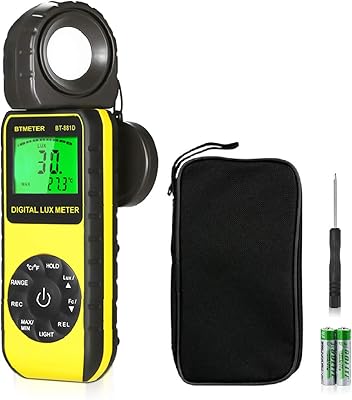
BTMETER BT-881D Digital Lux Meter
82%
83%
Measurement Accuracy
91%
Measurement Range
88%
Sensor Design
89%
Ease of Use
74%
Build Quality
More
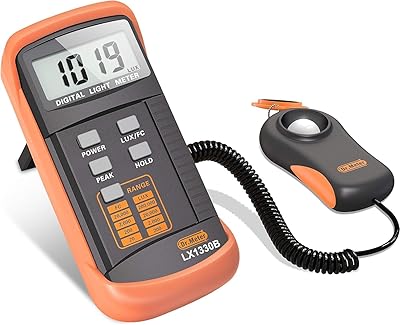
Dr.meter LX1330B Digital Lux Meter
82%
83%
Measurement Accuracy
91%
Ease of Use
67%
Build Quality
74%
Display Readability
92%
Measurement Range
More
Dr.meter 1332B Digital Light Meter
81%
91%
Ease of Use
78%
Measurement Accuracy
93%
Rotating Sensor
89%
Measuring Range
67%
Build Quality
More
URCERI SMT912 Digital Lux Light Meter
77%
82%
Measurement Accuracy
91%
Value for Money
88%
Display & Readability
67%
Build Quality
93%
Ease of Use
More
Extech LT300 Light Meter
75%
88%
Measurement Accuracy
91%
Sensor Design
86%
Display Readability
83%
Build Quality
74%
Ease of Use
More
TopTes TS-710 Lux Light Meter
78%
88%
Ease of Use
74%
Measurement Accuracy
91%
Rotating Sensor Design
86%
Display Readability
63%
Build Quality
More
AquaHorti AH-300 Light Meter
75%
76%
Measurement Accuracy
68%
App Experience
83%
LUX Range & Versatility
58%
Spectrum Test Capability
79%
CSV Export & Data Logging
More
LATNEX LM-50KL Digital Lux Light Meter
77%
78%
Measurement Accuracy
72%
Build Quality
88%
Sensor Cable Utility
69%
Display Readability
91%
Battery Life
More
AOPUTTRIVER AP-881E Digital Lux Light Meter
78%
93%
Measurement Range
91%
Rotating Sensor Design
72%
Accuracy & Reliability
74%
Ease of Use
66%
Build Quality
More
Extech LT505 Pocket Light Meter
79%
88%
Measurement Accuracy
93%
Portability
86%
Ease of Use
67%
Build Quality
74%
Display Legibility
More

FAQ

This is an important nuance to understand before buying. The meter is factory-calibrated against a 2856K incandescent lamp, which means its spectral sensitivity does not perfectly match the output of modern LED or HID fixtures. In practice, readings under LED grow lights will be in the right ballpark and useful for relative comparisons, but you should expect slightly more error than the published spec implies. For professional-grade accuracy under LEDs, you would need a spectrally corrected meter with a dedicated LED calibration factor.

No — and this is one of the most common frustrations buyers mention. The AI-881D stores up to 33 readings internally, but there is no USB port, Bluetooth, or companion app of any kind. If you want to track data over time in a spreadsheet, you will need to read the values off the screen and enter them manually.

The manual is admittedly thin, but the workflow is straightforward once you find it. While a reading is on screen, look for the record or hold function in the button sequence — typically you press a dedicated button to save the current value to memory. You can then scroll through stored readings using the mode or recall button. If you are still confused after the first attempt, a short search for the model number on YouTube usually turns up a practical walkthrough.

It measures lux and foot-candles only — it does not directly measure PAR (photosynthetically active radiation) or PPFD (micromoles per square meter per second), which are the units plant scientists and serious cultivators prefer. That said, many hobbyist growers use lux as a practical proxy for relative light intensity, especially for comparing fixtures or checking uniformity across a canopy. If you need true PPFD data, you would need a dedicated quantum meter.

The rotation mechanism works well out of the box, but a segment of longer-term users has noted that the joint can feel slightly looser after several months of regular use. It does not appear to fail completely in most cases, but it may not hold a precise angle as firmly as it once did. Handling it with some care rather than forcing it to extreme positions will help extend its useful life.

It runs on two standard AA batteries at 1.5V each — the kind you can find at any convenience store. Batteries are included in the box, so you can start using it immediately after unboxing.

No, it carries no IP or water resistance rating whatsoever. It will handle the ambient humidity of a typical greenhouse reasonably well during brief sessions, but you should keep it away from direct water exposure, misting systems, and splashes. If you plan to use it regularly in a very wet environment, consider storing it in the included case between uses to minimize moisture exposure.

At moderate light levels under incandescent-adjacent sources, most buyers find that readings track closely with pricier reference instruments — close enough for grow-light setup, photography checks, and facility lux compliance. The gap widens under LED lighting due to the spectral calibration mismatch, and professional-grade meters with NIST-traceable calibration will consistently outperform it in demanding or high-stakes scenarios. For hobbyist and semi-pro use, the accuracy is generally considered acceptable for the price.

Both units appear on the display simultaneously, which is one of the more convenient things about this handheld light tester. You do not need to toggle between modes or do any mental conversion — the screen shows both values at once alongside the ambient temperature reading.

The auto power-off activates after a set period of inactivity to conserve battery life, though the exact timeout duration is not specified in the product documentation. There is no documented way to disable the auto-off function through user settings. If you need the meter to remain on continuously for extended monitoring — for example, logging light levels throughout a full photoperiod — you would need to interact with it periodically to reset the inactivity timer.