Overview

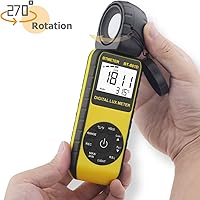
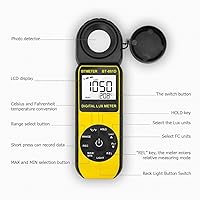
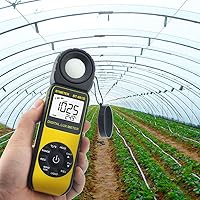
The BTMETER BT-881D Digital Lux Meter sits comfortably in the middle ground between a basic hobbyist tool and something you would find in a professional testing kit. It reads in both lux and foot candles, which is more useful than it sounds — photographers and growers often think in different units, and switching without mental math saves real time. The 270-degree rotating sensor is the most immediately noticeable design choice, letting you angle the sensor toward a light source while still reading the display face-on. It also logs ambient temperature, a small bonus most buyers overlook until they actually need it. Just don't expect lab-grade precision — this is a capable consumer device, not a calibrated scientific instrument.

Features & Benefits

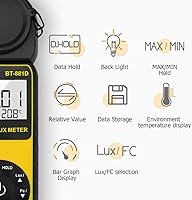
The measurement range here is genuinely wide — from 0.01 lux in near-darkness all the way to 400,000 lux, which covers harsh direct sunlight. That span is more than most users will ever need, but it means you're not fighting ceiling limits when testing high-output LEDs. The 0.4-second response time feels live, which matters when you're slowly sweeping the sensor across a grow tent canopy to find hot spots. Stored memory holds 33 readings, and the relative mode lets you compare a current measurement against a saved baseline — handy if you're testing whether a repositioned fixture actually made a difference. The backlit screen is a small but practical touch for dim grow rooms.

Best For

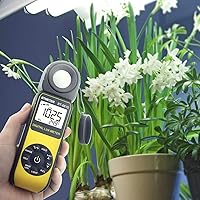
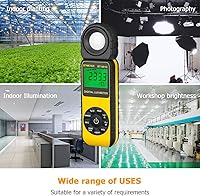
Indoor gardeners will find this lux meter most at home — particularly hydroponic growers trying to dial in LED intensity at canopy level. Hold the sensor about 12 inches above your seedling tray and you get an immediate read on whether your lights are delivering what your plants actually need. Beyond grow setups, facility managers checking classroom or office lighting for compliance audits will find the foot candle readout especially useful, since many building standards are expressed in FC rather than lux. Photographers use it for quick ambient checks before a shoot. Students studying photometry get solid, real-world data without spending on professional-grade equipment. It covers a surprisingly broad range of practical scenarios.

User Feedback

With over 850 ratings averaging 4.4 out of 5 stars, the BT-881D has clearly earned its audience. The rotating sensor draws consistent praise — buyers note it feels sturdy and actually changes how they work, rather than being a tacked-on feature. Repeatability also comes up often; people testing the same spot multiple times report consistent, trustworthy numbers. That said, a meaningful portion of reviewers flag that accuracy falls off at very high lux levels — above 200,000 lux, tolerances widen to plus or minus 8 percent, worth knowing if you're measuring intense outdoor sunlight. A few users also wished for a longer sensor cable to reach deep into tight canopy spaces without awkward repositioning.

Pros

  • The 270-degree rotating sensor is a genuine usability win — angle it toward the light while reading the display face-on.
  • Covers an impressively wide range from near-darkness up to 400,000 lux, handling most real-world lighting scenarios with ease.
  • Switching between lux and foot candles is quick, which saves time when working across different lighting standards.
  • The 0.4-second response feels nearly live, making it easy to sweep across a space and catch variations in real time.
  • Relative measurement mode lets you compare a current reading against a saved baseline — useful for testing whether a lighting change actually worked.
  • Ambient temperature display is a small but practical bonus that saves carrying a separate thermometer into a grow room.
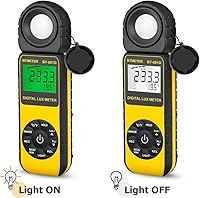
  • The backlit LCD stays readable in low-light environments like grow tents where ambient light is deliberately controlled.
  • Readings are consistent and repeatable across multiple tests, which builds genuine confidence in the data.
  • Ranked among the top sellers in its category with over 850 ratings at 4.4 stars, reflecting broad, sustained user satisfaction.
  • Compact and lightweight at 6.6 ounces, easy to carry between rooms or job sites without adding bulk.

Cons

  • Accuracy degrades noticeably above 200,000 lux — plus or minus 8 percent is a meaningful margin for high-intensity outdoor measurements.
  • The fixed, short sensor cable makes it awkward to reach deep into dense plant canopies or elevated ceiling fixtures.
  • Memory caps at 33 readings, which fills up fast during thorough multi-point lighting audits.
  • No wireless output or app connectivity, so transferring data means manually transcribing numbers from the display.
  • Not suitable for certified or regulatory testing — results cannot be used as formal documentation in professional compliance contexts.
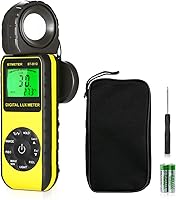
  • The device requires batteries that are not always included, adding an easy-to-overlook setup step out of the box.
  • No carrying case is included, which feels like a missed opportunity for a sensor-equipped tool that benefits from protection during transit.
  • At very high lux readings, the stated tolerance range is wide enough that two users comparing results might see meaningfully different numbers.

Ratings

The scores below were generated by our AI review engine after analyzing verified buyer feedback for the BTMETER BT-881D Digital Lux Meter from multiple global markets, with spam, incentivized, and bot-flagged submissions actively filtered out before any scoring was calculated. Each category reflects a transparent synthesis of both what users consistently praised and where real frustrations surfaced — no selective cherry-picking. The result is a balanced picture designed to help you make a genuinely informed decision.

Measurement Accuracy
83%
Within its sweet spot of 0 to 10,000 lux — which covers the vast majority of indoor grow rooms, offices, and photography setups — users report readings that feel solid and trustworthy. Multiple testers confirmed the meter holds consistent numbers across repeated measurements of the same surface, which builds real confidence during light-mapping sessions.
Accuracy degrades noticeably at the high end of the range, and the stated plus or minus 8 percent tolerance above 200,000 lux is not a minor caveat — it can mean a meaningful difference when measuring intense outdoor sunlight or commercial-grade horticultural lighting. Buyers expecting uniform precision across the entire range will be disappointed.
Measurement Range
91%
Spanning 0.01 all the way to 400,000 lux without switching probes or modes is a genuine strength that competing meters in this price tier often cannot match. Whether you are checking a dim reading corner, an LED grow tent, or an outdoor garden bed at noon, the BT-881D handles the transition without complaint.
The extreme upper ceiling is somewhat undermined by the widened accuracy tolerance, making those top-end readings less useful for precision work. A small number of users also noted that the display can take a moment to settle when jumping between very different light intensities in quick succession.
Sensor Design
88%
The 270-degree rotating sensor head is consistently called out by buyers as the standout physical feature — and it earns that praise. Being able to point the sensor upward toward a grow light canopy while reading the display at a natural angle removes the awkward body-twisting that plagues fixed-sensor meters during real fieldwork.
A recurring wish among growers is for a longer cable between the sensor and the body, particularly when measuring light deep inside a dense plant canopy or at ceiling height from a standing position. The current fixed attachment works for most scenarios but limits reach in tighter or taller growing spaces.
Ease of Use
89%
The interface is straightforward enough that most buyers report getting meaningful readings within minutes of unboxing, with no manual required for basic operation. Switching between lux and foot candles, saving readings, and activating relative mode are all accessible without digging through nested menus.
A handful of users found the relative measurement mode slightly unintuitive at first, needing a few attempts to understand what the displayed delta actually represents. The button labeling is minimal, which works once you know the functions but creates a short learning curve for first-time lux meter users.
Build Quality
74%
26%
The overall form factor feels appropriately sturdy for a handheld instrument in this price bracket, and the rotating sensor joint has drawn specific praise for feeling more robust than buyers expected. At 6.6 ounces, it is light enough for one-handed use without feeling flimsy.
The housing is plastic and does not inspire confidence for rough fieldwork — it is not rated for dust or moisture ingress, which becomes relevant when using it in humid grow tents over time. No protective case is included, and the lack of any rubberized grip coating means it can feel slippery when hands are damp.
Display & Readability
82%
18%
The backlit LCD is a practical inclusion that most users do not appreciate until they are trying to read a measurement inside a dark grow tent with the lights off. Font size is reported as comfortable, and the simultaneous display of both the lux reading and ambient temperature is genuinely useful for routine grow room checks.
The display does not adjust brightness automatically, and in very bright outdoor conditions some users found it harder to read from certain angles. The screen real estate is also modest, which means the relative mode readout can feel cramped when displayed alongside the primary measurement.
Response Speed
87%
Sampling 2 to 3 times per second gives the BT-881D a live, responsive feel when sweeping across a surface. Growers mapping light distribution across a grow bed find this particularly useful — you can move slowly and watch the reading shift in near-real time rather than waiting for the meter to catch up.
In some edge cases involving very rapid light changes — like passing a hand quickly over a sensor under a strobe-style cycling light — the reading can momentarily lag or jitter. This is a minor issue for the vast majority of use cases but worth noting for anyone testing flickering or pulsed light sources.
Data Memory & Logging
67%
33%
Having 33 storable readings is more than sufficient for casual spot-checking and small room audits, and the relative mode adds a layer of analytical utility that many single-function meters lack entirely. For a grower checking five or six spots in a tent, the memory capacity is perfectly adequate.
The 33-reading ceiling fills up quickly during thorough multi-point audits of larger spaces, and there is no way to export data digitally — no USB, no Bluetooth, no app. Users who want to build a lighting log over time or share data with a colleague have to transcribe numbers manually, which is a genuine workflow friction point.
Value for Money
86%
For the price tier it occupies, the BT-881D delivers a feature set that most buyers find difficult to match from competing options — rotating sensor, dual-unit display, data memory, and a wide measurement range together make a compelling package. Buyers consistently describe it as feeling like a fair or even generous exchange for what is included.
If your needs eventually outgrow its consumer-grade accuracy ceiling or its limited data logging, the upgrade path requires a significant jump in cost to professional-calibrated instruments. Buyers who discover this gap after purchase sometimes feel the value proposition was implicitly oversold by the wide lux range spec.
Repeatability & Consistency
84%
This is one of the most frequently praised aspects in verified reviews — users who test the same spot multiple times within a session consistently report getting the same reading back. That kind of reliability matters most when you are trying to track whether a lighting adjustment actually had a measurable effect.
A smaller subset of reviewers noted slight variation in readings when retesting after the unit has been powered off and back on, suggesting the meter may benefit from a brief warm-up period in extreme temperature conditions. Day-to-day drift is not a widely reported issue but is worth monitoring over extended ownership.
Portability
81%
19%
The compact dimensions and sub-7-ounce weight make this an easy meter to carry between rooms, floors, or job sites without dedicating a bag pocket to it. Facility managers doing multi-room audits appreciate being able to slip it into a jacket pocket between measurements.
The absence of a belt clip or carry case means there is no clean way to keep it accessible hands-free while working at height or in a dense grow space. The rotating sensor head, while durable, also adds a slight awkwardness when trying to store the unit flat in a toolbox or equipment bag.
Temperature Display Utility
72%
28%
Having ambient temperature visible on the same display as the lux reading is a small but genuinely appreciated bonus — particularly for indoor growers who monitor both light and heat stress simultaneously. It reduces the number of instruments needed in a routine grow room check.
The temperature display is basic and lacks the precision or logging capability of a dedicated thermometer, so it serves as a convenience indicator rather than a serious environmental monitoring tool. Users looking to track temperature trends over time will still need a separate device.
Setup & Out-of-Box Experience
78%
22%
Most buyers describe the initial setup as quick and painless — the meter is ready to take readings almost immediately. The dual-unit switching and memory functions are discoverable through basic button exploration, and the included documentation covers the essentials for new users.
Battery inclusion is inconsistent depending on the seller, which catches some buyers off guard on first use. The instruction manual, while adequate, is translated and reads awkwardly in places — a few technical explanations around the relative mode and memory functions required cross-referencing with online forums to fully understand.

Suitable for:

The BTMETER BT-881D Digital Lux Meter is a strong fit for anyone who needs reliable light measurements without the cost or complexity of professional-grade equipment. Indoor gardeners and hydroponic growers are probably the most natural audience — the wide lux range and fast sensor response make it genuinely useful for mapping light intensity across a grow tent or adjusting LED height for different plant stages. Facility managers handling office or classroom lighting audits will appreciate the foot candle readout, since many building standards are written in FC rather than lux. Photographers who want a quick ambient check before a shoot, or students studying photometry who need real-world data to back up coursework, will find the BT-881D punches well above its price tier. The dual-unit switching, data memory, and rotating sensor together make it a practical everyday tool rather than something you pull out once and forget.

Not suitable for:

Buyers who need certified, lab-grade accuracy should look elsewhere — the BTMETER BT-881D Digital Lux Meter is a consumer-grade instrument, and it behaves like one at extreme lux levels, with tolerances widening to plus or minus 8 percent above 200,000 lux. If your work involves scientific research, regulatory compliance testing, or calibrated photometric reporting, this device will not meet the documentation standards those fields typically require. The sensor cable is fixed and relatively short, so users who need to push a probe deep into dense plant canopies or hard-to-reach ceiling fixtures may find the physical design frustrating. It also lacks wireless connectivity or app integration, which rules it out for anyone building an automated or logged lighting system. And while the 33-reading memory is useful for spot checks, serious data loggers will hit that ceiling quickly.

Specifications

  • Lux Range: Measures illuminance from 0.01 to 400,000 lux, covering everything from dim indoor spaces to direct sunlight.
  • Foot Candle Range: Foot candle measurement spans 0.01 to 40,000 FC, switchable from the same unit without any additional hardware.
  • Accuracy (Low): At or below 10,000 lux, accuracy is rated at plus or minus 4 percent of reading plus or minus 1.0 percent of full scale.
  • Accuracy (High): Above 200,000 lux, tolerance widens to plus or minus 8 percent of reading plus 2.0 percent of full scale.
  • Sensor Rotation: The light sensor head rotates up to 270 degrees, allowing angled measurements without repositioning the main body.
  • Sampling Speed: The sensor samples 2 to 3 times per second, delivering a 0.4-second response that feels near-instantaneous during active testing.
  • Data Memory: Stores up to 33 individual light readings internally, with a relative measurement mode for comparing saved and live values.
  • Display: Features a backlit LCD screen that remains readable in low-light environments such as grow tents or dim server rooms.
  • Temperature Display: Shows ambient temperature alongside light readings, removing the need for a separate thermometer in most casual use cases.
  • Measurement Units: Users can toggle between lux and foot candles at any time, making the device compatible with different regional and professional standards.
  • Resolution: Minimum resolution is 0.01 lux and 0.01 FC, providing fine granularity at the lower end of the measurement range.
  • Dimensions: The unit measures 8.35 x 4.41 x 1.93 inches, compact enough to store in a tool bag or desk drawer without dedicated space.
  • Weight: At 6.6 oz, the meter is light enough to hold one-handed for extended measurement sessions without fatigue.
  • Manufacturer: Designed and sold by BTMETER, a brand focused on handheld environmental measurement instruments.
  • Model Number: The official model designation is BT-881D, which corresponds to ASIN B07JZ3ZZQ6 on major retail platforms.
  • Market Rank: Holds a top-10 position in the Photographic Light Meters category, reflecting sustained sales volume and buyer confidence.
  • Availability: The product has not been discontinued by the manufacturer and has been commercially available since October 2018.

Related Reviews
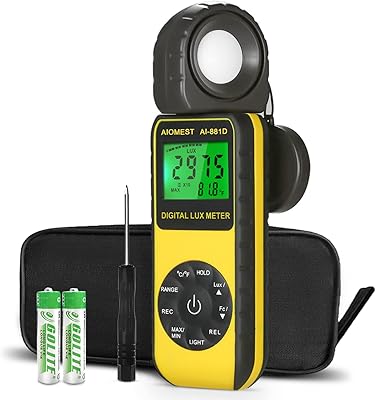
AIOMEST AI-881D Light Meter
81%
93%
Measurement Range
74%
Measurement Accuracy
91%
Rotatable Sensor Design
78%
Data Logging
88%
Display Readability
More
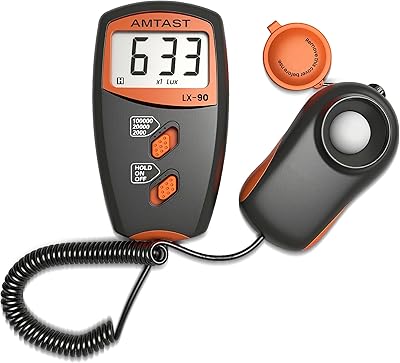
AMTAST LX-90 Digital Lux Meter
76%
88%
Sensor Design
74%
Measurement Accuracy
91%
Ease of Use
83%
Display & Readability
58%
Build Quality
More
Dr.meter LX1330B Digital Lux Meter
82%
83%
Measurement Accuracy
91%
Ease of Use
67%
Build Quality
74%
Display Readability
92%
Measurement Range
More
Extech 401025 Lux Light Meter
80%
93%
Display Readability
74%
Measurement Accuracy
91%
Ease of Use
78%
Build Quality
88%
Dual-Unit Display
More
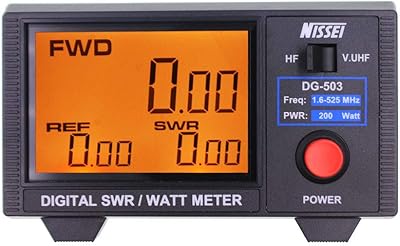
NISSEI DG-503 Digital RF Power Meter
85%
85%
Overall Performance
88%
Ease of Use
91%
Accuracy
87%
Portability
82%
Display Quality
More
LATNEX PM-120W Digital VHF UHF Power SWR Meter and Frequency Counter
86%
89%
Performance
92%
Ease of Use
88%
Accuracy
85%
Battery Life
90%
Portability
More
Dr.meter 1332B Digital Light Meter
81%
91%
Ease of Use
78%
Measurement Accuracy
93%
Rotating Sensor
89%
Measuring Range
67%
Build Quality
More
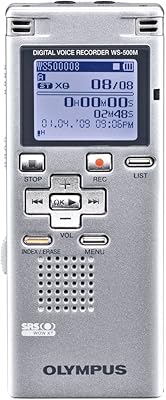
OM Digital Solutions WS-500 Digital Voice Recorder
81%
94%
Battery Life
91%
Ease of Use
78%
Sound Quality
96%
Recording Time
85%
Portability
More
Boytone BT-32W
Boytone BT-32W
80%
78%
Sound Quality
91%
Multi-Format Playback
69%
Build Durability
88%
Ease of Setup
85%
Bluetooth Connectivity
More
Western Digital WD10EURX 1TB
87%
88%
Performance
85%
Data Transfer Speed
91%
Reliability
89%
Durability
86%
Quiet Operation
More

FAQ

The BT-881D typically runs on standard AAA batteries. Whether they are included can vary by seller and fulfillment batch, so it is worth checking before your first use — keep a set handy just in case so you are not stuck waiting before you can start testing.

Yes, the measurement ceiling of 400,000 lux is high enough for most outdoor conditions including bright midday sun. Keep in mind that accuracy tolerance widens at those extreme levels — plus or minus 8 percent above 200,000 lux — so treat very high outdoor readings as ballpark figures rather than precise data.

Hold the sensor at the canopy level of your plants — roughly the height where the leaves receive the most light — and point it directly toward the light source. The rotating sensor head is handy here because you can angle it upward while keeping the display facing you. Take a few readings at different spots across the canopy to get a sense of evenness, and use the relative mode to compare areas side by side.

It is accurate enough for informal audits, workplace comfort checks, and compliance screening, but it does not carry the calibration certification that formal regulatory submissions typically require. For office or classroom lighting reviews where you just need to know whether levels are in a reasonable range, it performs well. If your work demands certified, traceable measurements, you will need a calibrated professional-grade photometer.

Relative mode lets you save a reference reading and then displays the difference between that baseline and your current live measurement. It is useful when you want to see how much brighter or dimmer one location is compared to another — for example, comparing the light levels directly under a grow light versus a foot to the side. Instead of doing mental subtraction between readings, the meter does it for you.

The sensor is calibrated to read accurately regardless of its rotated position within the 270-degree range, so you do not need to worry about the angle introducing error. Just make sure the sensor face is pointed cleanly at the light source you are measuring and that nothing is casting a shadow across it.

Yes, it works with any visible light source including HPS, CMH, fluorescent, and LED fixtures of all types. One thing to be aware of is that lux meters are calibrated to a standard daylight spectrum, so readings from grow lights with heavily shifted spectra — deep red or far red heavy LEDs — may not perfectly reflect the actual photon output relevant to plants. For a strict plant growth measurement, a PAR meter is more appropriate, but for general intensity comparisons between positions or fixture heights, this light meter does the job well.

The meter stores up to 33 readings in its internal memory. There is no wired or wireless data export function — no USB port, no Bluetooth, and no companion app. If you need to log more than 33 points or transfer data digitally, you will need to record readings manually or look for a meter with data output capabilities.

It works well for ambient light checks and getting a general sense of how a scene is lit before shooting. It reads in foot candles, which is the unit many photographers are familiar with. It is not a replacement for a dedicated photographic incident light meter that also measures flash, but for continuous light sources it gives useful, actionable readings at a fraction of the cost of camera-brand light meters.

It is built for regular indoor and light outdoor use but is not ruggedized or splash-proof, so you should not expose it to rain or dusty workshop conditions without protection. The rotating sensor joint feels solid based on user reports, and the body is compact enough to avoid accidental drops in most normal testing scenarios. Storing it in a small pouch when not in use will extend its lifespan considerably since no protective case is included in the box.

Where to Buy