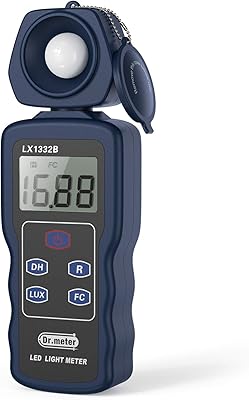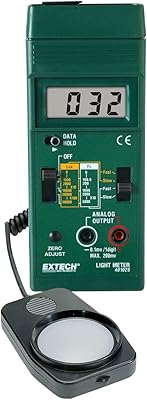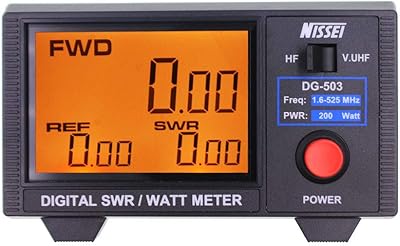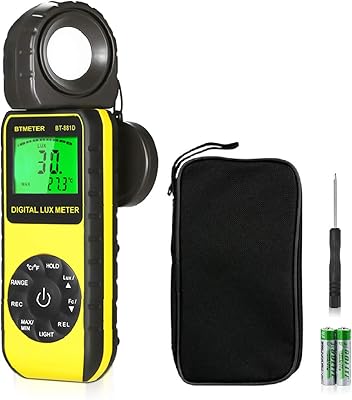



Overview

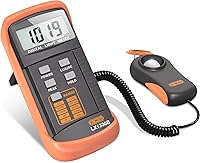
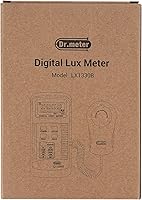
The Dr.meter LX1330B Digital Lux Meter has been a staple in the handheld light measurement space since 2007, which says something about its staying power in a market flooded with cheaper knockoffs. Made by Dr.meter, a brand that consistently targets the practical, budget-conscious buyer, this light meter sits comfortably in the mid-range tier — precise enough for real work, affordable enough not to feel like a risk. Physically, it is slim and light: an ABS plastic body, a tethered sensor head, and a 9V battery tucked inside. The 0 to 200,000 lux range covers everything from a dimly lit bedroom to a sun-drenched rooftop, making it genuinely versatile rather than just marketed that way.

Features & Benefits

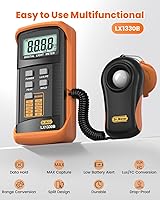
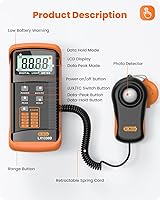
One of the more practical touches on the LX1330B is the ability to switch between lux and footcandles with a single button press. Lux is the metric standard; footcandles are what older American lighting specs often reference, and being able to flip between them without a conversion chart is genuinely useful. The PEAK hold function is another standout — it captures brief spikes in light intensity, which matters when testing a strobe or a flash unit. Readings update twice per second, fast enough to track changes as you reposition the sensor. A low battery warning symbol keeps you from losing data mid-session, and the 9V battery ships included.

Best For

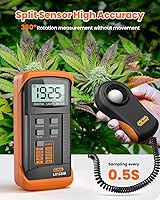
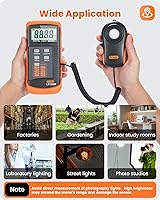
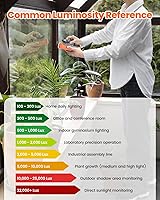
This lux meter is a natural fit for indoor plant growers who need to know whether their grow lights are actually delivering enough intensity at canopy level. That said, one important caveat: lux measures brightness as perceived by the human eye, not the wavelengths plants use for photosynthesis. If PAR or PPFD values are what you need, this meter won't provide them directly. Photographers and videographers will find it useful as a quick ambient light check without hauling out a full kit. Office and facilities managers can use it to verify workstation brightness standards. It is a practical, honest tool — not one built for professional spectral analysis.

User Feedback

The general consensus around this light meter is positive, particularly around ease of setup — most buyers report it working straight out of the box with no calibration fuss. Accuracy earns solid marks too, especially when cross-checked against controlled light sources. On the critical side, a handful of reviewers note that the sensor cable feels a bit delicate for rough, repeated handling. The display can wash out under intense outdoor sunlight, which is a fair limitation. Plant enthusiasts appreciate the FC-to-lux toggle but frequently wish the unit also measured PAR or PPFD. The battery door fit has drawn occasional criticism, though it appears isolated rather than a widespread defect.

Pros

  • Wide 0 to 200,000 lux range handles everything from a dim reading lamp to direct outdoor sunlight.
  • Switching between lux and footcandles is instant, making it practical for users who work with both metric and imperial lighting specs.
  • The PEAK hold function captures brief spikes in light intensity, useful for testing strobes or flash units.
  • Readings refresh twice per second, so repositioning the sensor gives you near-instant feedback.
  • Ships with a 9V battery included, meaning you can start measuring the moment it arrives.
  • A low battery warning appears on screen before the device cuts out, preventing unexpected mid-session failures.
  • At 12 ounces and a slim profile, this lux meter is easy to carry and handle for extended sessions.
  • Setup requires no calibration or configuration — just power it on and point the sensor.
  • Its long track record since 2007 and top-three sales ranking reflect consistent real-world reliability.
  • The LCD display is clear and easy to read in most typical indoor and outdoor conditions.

Cons

  • Does not measure PAR or PPFD, which limits its usefulness for serious plant growers focused on photosynthetic light quality.
  • The sensor cable feels thin and may not hold up well under frequent, rough handling over time.
  • The LCD display can wash out and become difficult to read under intense direct sunlight.
  • No data logging or connectivity features, so readings must be recorded manually.
  • Battery door fit has been noted as loose or imprecise by some users, which feels cheap on an otherwise functional tool.
  • Lux readings alone do not tell you about light spectrum or color temperature, which matters for photography and horticulture alike.
  • Consumer-grade accuracy means readings may drift slightly from calibrated reference instruments, so treat results as reliable estimates rather than laboratory-grade measurements.
  • No backlight on the display makes it harder to use in low-ambient or dim environments where you are trying to measure subtle light levels.

Ratings

Our AI-generated scores for the Dr.meter LX1330B Digital Lux Meter are based on thousands of verified global reviews, with spam, bot activity, and incentivized feedback actively filtered out before analysis. The result is an honest, balanced breakdown that reflects what real buyers consistently praise and where the frustrations actually show up. Both the strengths and the trade-offs are represented transparently so you can make a genuinely informed decision.

Measurement Accuracy
83%
Most buyers report readings that hold up well when cross-checked against known or controlled light sources, which is reassuring for a consumer-grade instrument at this price point. Plant growers and photographers alike note that the numbers feel trustworthy for practical decision-making, whether positioning a grow light or assessing ambient exposure.
Accuracy is solid but not laboratory-certified — readings carry the tolerance range inherent to consumer instruments, which means they should be treated as reliable estimates rather than absolute values. Users who need precision within a tight margin for professional or scientific applications have flagged this as a limitation.
Ease of Use
91%
Getting started requires essentially no learning curve: install the included battery, power on, and the readings begin immediately. The button layout is minimal and logical, and toggling between lux and footcandles is a single press, which even first-time users figure out within seconds.
There is no user manual depth for advanced functions like PEAK hold, and a few buyers found themselves guessing at the finer operational details. The lack of any digital guide or companion app means troubleshooting is limited to trial and error or hunting for online resources.
Build Quality
67%
33%
The ABS plastic housing feels solid enough for casual and hobbyist field use, and at 12 ounces it is light enough to hold comfortably during extended measurement sessions without fatigue. The overall form factor is practical and fits easily into a bag or jacket pocket.
The sensor cable is the most frequently cited structural concern, with several reviewers describing it as thin and potentially fragile under repeated daily stress. The battery compartment door has also drawn criticism for an imprecise fit that feels inconsistent with the rest of the unit.
Display Readability
74%
26%
Indoors and in moderately lit outdoor conditions, the LCD is clean and easy to read at a glance, with digits large enough that you do not need to squint while holding the sensor in position. For most typical use cases — plant rooms, offices, studios — this is more than adequate.
Under intense direct sunlight the display washes out noticeably, which is a real inconvenience since outdoor measurement is one of the advertised use cases. There is no backlight, which also makes readings difficult in dim environments where you are trying to detect subtle changes in light levels.
Measurement Range
92%
A 0 to 200,000 lux range is genuinely impressive at this price tier, covering everything from a candle-lit room to a sun-drenched outdoor field without needing to switch instruments. This versatility is one of the most consistently praised aspects across both plant grower and photography communities.
While the upper range is wide, the meter offers no sub-range precision adjustment, so very fine distinctions in low-light environments can feel imprecise. Users working specifically in very dim conditions have noted that granularity at the low end of the scale is not the unit's strongest suit.
Feature Set
78%
22%
The PEAK hold function stands out as a genuinely useful addition — it is not common at this price point and makes a real difference when measuring flash units or brief light bursts. The lux-to-FC toggle adds practical flexibility for users who regularly work with both metric and imperial lighting standards.
Beyond PEAK hold and unit toggling, the feature set is quite bare: no data logging, no memory, no connectivity, and no spectral or color temperature measurement. Plant growers in particular often wish the meter could also report PAR or PPFD values, which are more directly relevant to plant health than lux alone.
Value for Money
88%
For buyers who need a dependable light meter for everyday plant care, office assessments, or hobbyist photography work, the price-to-performance ratio is hard to argue with, especially given the wide measurement range and long market track record. It consistently outperforms cheaper alternatives in terms of reading stability and build.
Buyers who discover its limitations — particularly around PAR measurement or professional accuracy requirements — after purchasing may feel the money would have been better directed toward a more capable instrument. The value proposition weakens noticeably once use cases go beyond casual or semi-professional needs.
Portability
89%
At 12 ounces and slim enough to slide into a lab coat pocket or camera bag side pocket, this lux meter travels easily. The tethered sensor head actually aids portability by removing the risk of losing a separate accessory, while still giving you enough reach to position it precisely.
The sensor cable, while convenient, adds a small amount of awkward bulk when you are trying to store or wrap the unit neatly. There is no carrying pouch or clip included, which means loose storage in a bag risks putting pressure on that cable over time.
Setup & Out-of-Box Experience
94%
The included 9V battery is a small but genuinely appreciated touch that eliminates the frustration of unboxing an instrument and immediately needing a hardware store run. Virtually every buyer notes the unit was ready to use within a minute of opening the package, with zero configuration needed.
The packaging and included documentation are minimal — there is no quick-start card with measurement guidance or reference lux tables for common use cases. Buyers who are new to light measurement and want contextual guidance (such as recommended lux levels for specific plants) are left to find that information elsewhere.
Response Speed
87%
Readings that refresh twice per second feel responsive and smooth when you are slowly moving the sensor across a grow space or scanning an office ceiling grid. The update rate is fast enough that you never feel like you are waiting on the device while working methodically through a space.
For highly dynamic or rapidly fluctuating light environments — such as testing rapidly cycling grow lights or flickering strobes in rapid succession — two updates per second may still feel slightly sluggish. Professional light meters in higher price brackets typically offer faster sampling rates for such applications.
Battery Life
79%
21%
With a standard 9V zinc carbon battery, the meter runs for a respectable number of measurement sessions before needing a replacement, and the low battery warning symbol gives you adequate notice to avoid being caught off guard mid-session. Replacement batteries are cheap and universally available.
Zinc carbon chemistry is less energy-dense than alkaline or lithium alternatives, so heavy users may find themselves replacing batteries more often than expected. There is no rechargeable option or USB power input, which would have added meaningful convenience for users who measure frequently.
Sensor Cable Design
63%
37%
The cabled sensor head is a functionally smart design choice for precision placement — you can rest the meter body on a surface while positioning the sensor exactly where you need it, rather than awkwardly tilting the whole unit at a specific angle.
The cable itself is where design goodwill ends, as multiple reviewers describe it as feeling thin and less robust than the rest of the meter body. Long-term durability concerns are legitimate, particularly for anyone using the device daily or in environments where the cable might get snagged or bent repeatedly.
Brand Reliability
81%
19%
Dr.meter has maintained this product line since 2007 and holds a top-three sales ranking in its category, which signals sustained buyer satisfaction and at least basic supply chain reliability. Replacement units and support are not hard to access, which reduces buyer risk compared to lesser-known instruments.
Dr.meter is not a precision instrument brand in the way that professional metrology companies are, and some buyers feel the brand lacks the transparency around calibration tolerances and quality control documentation that would make it suitable for more demanding professional contexts.

Suitable for:

The Dr.meter LX1330B Digital Lux Meter is a strong fit for anyone who needs reliable light intensity readings without investing in professional-grade instrumentation. Indoor plant growers and hydroponic hobbyists will get the most out of it, since knowing actual lux levels at canopy height helps dial in grow light placement far more precisely than guessing. Photographers and videographers working in run-and-gun or documentary-style settings will appreciate having a quick, no-fuss ambient light check in their kit bag. Office managers, school administrators, or facilities staff tasked with verifying workstation brightness against occupational comfort standards will also find this lux meter more than adequate for the job. Educators teaching optics, environmental science, or horticulture can use it as a hands-on classroom instrument without worrying about the budget. Essentially, if your work or hobby involves understanding how much light is present in a space and you need a dependable starting point, this meter earns its place.

Not suitable for:

The Dr.meter LX1330B Digital Lux Meter has real limitations that certain buyers need to weigh honestly before purchasing. The most significant one for plant growers: lux is a human-eye-weighted measurement and does not directly translate to PAR or PPFD, which are the values that actually describe usable light energy for photosynthesis. If you are running a serious grow operation where dialing in micromoles per square meter per second is critical, this lux meter will give you an incomplete picture and you will need a dedicated quantum PAR meter alongside it or instead of it. Professional cinematographers, lighting designers, or lab researchers who need spectral data, color temperature readings, or calibrated accuracy within tight tolerances should look at purpose-built instruments that cost considerably more. The sensor cable also raises concerns for anyone who intends to use this device heavily in the field on a daily basis, as it is not built to withstand the wear of constant professional deployment. Buyers expecting ruggedized construction or weatherproofing will be disappointed.

Specifications

  • Brand: Manufactured by Dr.meter, a brand focused on affordable precision measurement instruments for consumer and semi-professional use.
  • Model Number: The unit is identified by model number 1330B-V, also listed as part number 1330B-V on the product.
  • Measurement Range: Measures illuminance from 0 to 200,000 lux, covering dim indoor environments through bright direct sunlight.
  • Measurement Units: Supports two display modes — lux (metric) and footcandles (FC) — switchable via a front panel button.
  • Sampling Rate: The sensor updates readings twice per second, providing responsive near-real-time light intensity feedback.
  • PEAK Function: A dedicated PEAK hold button captures and locks the highest detected light value, useful for brief flash or strobe events.
  • Display: Equipped with a digital LCD readout that shows current or held illuminance values clearly in most lighting conditions.
  • Low Battery Alert: A warning symbol appears on the display when the 9V battery is running low, prompting timely replacement before data loss.
  • Power Source: Powered by a single 9V zinc carbon battery, which is included in the package at the time of purchase.
  • Battery Type: Uses a standard 9V zinc carbon battery; common replacements are widely available at most hardware and electronics retailers.
  • Body Material: The housing is constructed from ABS plastic, offering a lightweight and reasonably impact-resistant enclosure for everyday field use.
  • Dimensions: The unit measures 4 x 1 x 8 inches (approximately 10 x 2.5 x 20 cm), making it compact enough to fit in a jacket pocket.
  • Weight: The complete unit weighs 12 ounces (approximately 340 grams), which is comfortable for extended single-hand operation.
  • Usage Environment: Rated for both indoor and outdoor use, though it is not weatherproofed or rated for exposure to rain or dust ingress.
  • Included Contents: The package contains one light meter unit with attached sensor head and one 9V battery; no carrying case or calibration certificate is included.
  • Sales Ranking: Holds a Best Sellers Rank of #3 in the Photographic Light Meters category on Amazon, reflecting sustained buyer demand over many years.
  • Market Availability: First listed for sale in June 2007 and confirmed as not discontinued by the manufacturer as of the most recent product data.

Related Reviews
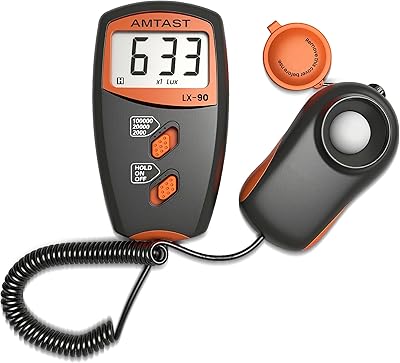
AMTAST LX-90 Digital Lux Meter
76%
88%
Sensor Design
74%
Measurement Accuracy
91%
Ease of Use
83%
Display & Readability
58%
Build Quality
More
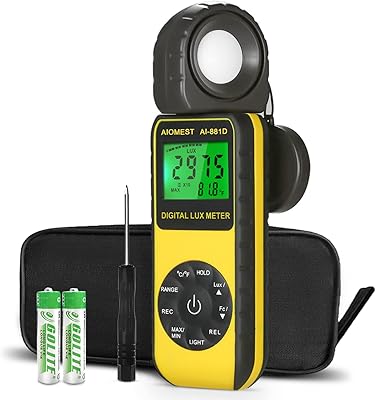
AIOMEST AI-881D Light Meter
81%
93%
Measurement Range
74%
Measurement Accuracy
91%
Rotatable Sensor Design
78%
Data Logging
88%
Display Readability
More
Dr.meter 1332B Digital Light Meter
81%
91%
Ease of Use
78%
Measurement Accuracy
93%
Rotating Sensor
89%
Measuring Range
67%
Build Quality
More
Tascam DR-05V2
Tascam DR-05V2
78%
88%
Sound Quality
92%
Ease of Use
87%
Battery Life & Power
54%
Handling Noise Isolation
89%
Value for Money
More
NISSEI DG-503 Digital RF Power Meter
85%
85%
Overall Performance
88%
Ease of Use
91%
Accuracy
87%
Portability
82%
Display Quality
More
Extech 401025 Lux Light Meter
80%
93%
Display Readability
74%
Measurement Accuracy
91%
Ease of Use
78%
Build Quality
88%
Dual-Unit Display
More
BTMETER BT-881D Digital Lux Meter
82%
83%
Measurement Accuracy
91%
Measurement Range
88%
Sensor Design
89%
Ease of Use
74%
Build Quality
More
LATNEX PM-120W Digital VHF UHF Power SWR Meter and Frequency Counter
86%
89%
Performance
92%
Ease of Use
88%
Accuracy
85%
Battery Life
90%
Portability
More
OM Digital Solutions WS-500 Digital Voice Recorder
81%
94%
Battery Life
91%
Ease of Use
78%
Sound Quality
96%
Recording Time
85%
Portability
More
DR Double Rock DR-2000.1 Monoblock Car Amplifier
74%
83%
Value for Money
71%
Power Output
86%
Installation Ease
62%
Build Quality
74%
Thermal Management
More

FAQ

It works straight out of the box — the 9V battery is included, so you just install it and power on. There is no user-calibration process required. Consumer-grade meters like this are factory calibrated, though keep in mind that readings may vary slightly from laboratory-certified instruments.

Yes, and many plant growers do exactly that. The Dr.meter LX1330B Digital Lux Meter gives you a clear picture of how much light intensity your plants are receiving at canopy level. One important thing to understand: lux measures brightness as perceived by the human eye, not the specific wavelengths plants use for photosynthesis. If you need PAR or PPFD values, you would need a dedicated quantum meter for that data.

Lux is the metric unit for illuminance, while footcandles are the imperial equivalent — one footcandle equals roughly 10.76 lux. In practice, most international and scientific contexts use lux, while older American building codes and some photography references still use footcandles. The ability to toggle between both means you can match whichever unit your reference chart or compliance standard requires without doing mental math.

It is accurate enough for practical, everyday use and holds up well when cross-checked against controlled light sources. That said, it is a consumer-grade instrument, so there is an inherent tolerance range in the readings. For critical applications where precision within a few percentage points matters — like certified occupational health audits or scientific research — a professionally calibrated instrument would be more appropriate.

When you press the PEAK button, the meter locks onto and displays the highest light value it detected during a measurement session rather than the current live reading. This is especially useful when measuring brief or intermittent light sources like camera flashes, strobe lights, or even lightning, where the peak intensity lasts only a fraction of a second and would otherwise be missed.

The sensor head is attached via a short cable, which is actually a useful design choice. It lets you position the sensor precisely at the point you want to measure — like directly above a plant canopy or at desk level — while keeping the display unit comfortably in your hand or resting on a nearby surface.

For occasional to moderate use it holds up fine, but some regular users have flagged the cable as a potential weak point under heavier or rougher daily handling. If you are using this multiple times a day in a demanding environment, treat the cable connection points with some care. For typical hobbyist or office use, it should last well.

In most outdoor conditions it reads reasonably well, but under very intense direct sunlight the LCD can wash out and become harder to read clearly. If you frequently measure in bright outdoor environments, you may want to shade the display with your hand or body when taking readings.

It is a solid option for checking ambient light conditions on set or on location, especially if you want a quick, portable reference without hauling out a dedicated photographic light meter. It will not give you color temperature or spectral data, so if those details matter for your work you will need additional tools. For basic exposure planning and ambient assessments, this lux meter does the job well.

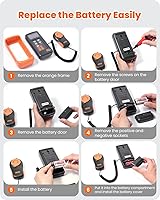
It runs on a standard 9V battery, and one is included in the box. Replacements are available at virtually any hardware store, supermarket, or online retailer, so you will never be stuck hunting for an obscure size. The battery compartment has received occasional comments about the door fit feeling a little loose, but functionally it works as intended.

Where to Buy