Overview

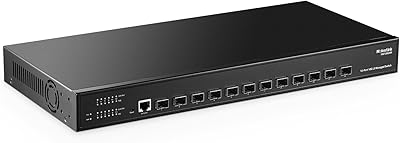
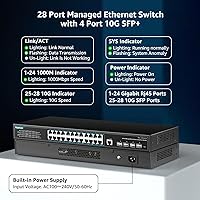
The YuanLey YS24040GSM 28-Port Managed Switch entered a crowded market in late 2023 as a genuinely affordable L3 option for small businesses, schools, and compact data center setups. With 24 Gigabit RJ45 ports and four 10G SFP+ uplinks packed into a fanless aluminum chassis, it punches well above its price class. YuanLey isn't a household name like Netgear or TP-Link, but this managed switch has quietly climbed the bestseller rankings — a sign that budget-conscious IT buyers are taking notice. The silent operation alone sets it apart in noise-sensitive environments.
Features & Benefits

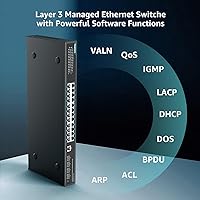
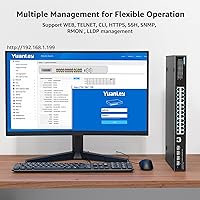
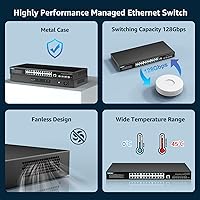
What makes the YuanLey 28-port switch compelling isn't just the port count — it's the depth of its L3 feature set at this price point. You get VLAN, QoS, and ACL support, IGMP snooping, and three spanning tree modes (STP, RSTP, MSTP), which is a full toolkit for anyone managing a real production network. The security options are serious: 802.1X port authentication, ARP protection, and IP source guard cover the basics without requiring an enterprise budget. On paper, the 128 Gbps switching capacity is theoretical, but for SMB workloads it's more than sufficient. Management is flexible — Web GUI, CLI, or SNMP v1/v2/v3 — so both generalists and power users can work with it comfortably.

Best For

This fanless L3 switch fits best in environments where silent rack-mount operation and real management features are both non-negotiable. Schools, hotels, and internet cafes will appreciate the VLAN segmentation and port security controls for isolating guest traffic. Small business IT teams get a capable aggregation layer without the price premium of Netgear or Cisco. Home lab enthusiasts chasing 10G connectivity will also find it appealing — four SFP+ uplinks in a fanless 1U chassis is a rare combination at this price tier. It's less suited to organizations that require enterprise-grade vendor support, guaranteed firmware cadences, or 24/7 phone-based TAC assistance.

User Feedback

Verified buyers consistently point to two strengths: quiet fanless operation and a surprisingly deep feature set given the cost. Several reviewers noted it running stably for months without intervention, which is encouraging for a newer brand. That said, a recurring theme is the learning curve on the Web GUI — it works, but it's not as polished as TP-Link's Omada or Netgear's interface, and the English documentation leaves gaps that force users to experiment. Compatibility with existing TP-Link and Netgear hardware has generally been positive. The main concern isn't performance — it's whether long-term firmware support will keep pace, a legitimate question for any lesser-known vendor.

Pros

  • Completely fanless operation keeps noise levels at zero, which is rare in a switch with this port density.
  • Four 10G SFP+ uplinks provide serious bandwidth headroom for aggregating Gigabit access switches.
  • The L3 feature set — VLAN, QoS, ACL, IGMP snooping, spanning tree — rivals switches costing significantly more.
  • Multiple management paths (Web GUI, CLI, SNMP v1/v2/v3) give both generalists and experienced admins options.
  • 802.1X authentication, ARP protection, and IP source guard make the security toolkit genuinely useful.
  • Energy Efficient Ethernet compliance meaningfully reduces idle-port power consumption over time.
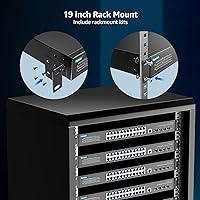
  • The 1U aluminum rack-mount chassis is solid and fits standard racks without adapters.
  • Compatibility with existing TP-Link and Netgear infrastructure has been broadly confirmed by buyers.
  • 16K MAC address table handles larger networks without entry-count bottlenecks.
  • Verified purchasers consistently report stable uptime over extended periods with no unexpected reboots.

Cons

  • YuanLey has no established history of long-term firmware support, which is a real risk for production deployments.
  • The Web GUI is functional but noticeably less polished than TP-Link Omada or Netgear ProSAFE interfaces.
  • English documentation has gaps, and the manual quality falls short of what experienced admins expect.
  • No dynamic routing protocol support beyond static routing limits use in more complex network architectures.
  • As a newer brand, warranty service and RMA experiences remain largely untested at scale.
  • The management interface has a learning curve that could slow down less experienced network staff.
  • No dedicated cloud management platform exists, which some SMBs increasingly expect.
  • Operating temperature ceiling of 45 degrees C may be a concern in poorly ventilated or high-ambient environments.

Ratings

The ratings below for the YuanLey YS24040GSM 28-Port Managed Switch were generated by our AI system after analyzing verified global buyer reviews, actively filtering out incentivized, duplicate, and bot-generated submissions to surface what real network administrators and IT buyers actually experienced. Scores reflect an honest synthesis of both the standout strengths and the recurring frustrations that matter most to purchasing decisions — nothing is smoothed over.
Value for Money
93%
This is consistently the category buyers lead with in their reviews. Getting a full L3 managed switch with 10G uplinks, VLAN, ACL, QoS, and a fanless chassis at this price point is genuinely difficult to match from established brands. IT managers at small schools and hotels repeatedly described it as the switch that finally made managed networking accessible on a tight budget.
A small segment of buyers felt the value calculation shifts once you factor in the uncertainty around long-term firmware support and the absence of a vendor support line. For buyers who have had to absorb replacement costs after a lesser-known brand quietly exited the market, the initial savings feel less compelling.
Feature Depth
89%
The breadth of L3 features packed into this switch — static routing, 802.1Q VLANs, IGMP snooping, STP/RSTP/MSTP, 802.1X authentication, ARP protection, and SNMP v3 — exceeds what most buyers expect at this tier. Home lab users and SMB network engineers consistently noted that they did not have to compromise on functionality to fit their budget.
Dynamic routing protocol support is absent, which is a hard stop for network architects who rely on OSPF or similar. A few power users also flagged that some advanced ACL configurations behave inconsistently and required workarounds that better-documented enterprise switches handle cleanly.
Noise & Cooling
96%
Zero fan noise is zero fan noise — and buyers in office environments, recording studios, and quiet server closets made a point of highlighting this. The fanless aluminum chassis genuinely delivers on its promise, with multiple verified reviewers confirming that the switch runs cool and silent even under sustained load over many months.
In poorly ventilated spaces or environments where ambient temperatures push past 40 degrees C, a handful of users noted the chassis running noticeably warm to the touch. The 45-degree ceiling is real, not just a paper spec, so rack placement and airflow still matter even without a fan.
Management Interface
67%
33%
The Web GUI covers all the core management tasks — VLAN setup, port mirroring, QoS configuration, SNMP integration — and works reliably once you orient yourself. CLI access via console and Telnet is available for admins who prefer working that way, and SNMP v3 support means it slots into monitoring platforms like PRTG or Zabbix without friction.
Compared to TP-Link Omada or Netgear ProSAFE, the interface feels dated and unintuitive in places. Navigation logic is not always obvious, and several reviewers described spending extra time figuring out menu structures that competitors handle more cleanly. It works, but it is not a UI you will enjoy using.
Documentation Quality
51%
49%
The included user manual covers the basics of initial setup, IP assignment, and primary feature access well enough to get the switch operational. For straightforward deployments — a flat VLAN structure, basic QoS — most experienced admins reported getting up and running without needing outside resources.
The English translation quality in the manual has recurring clarity issues, and advanced feature documentation is sparse. Buyers attempting to configure MSTP, complex ACL rules, or SNMP trap settings frequently reported turning to community forums and third-party guides rather than the official documentation, which is a meaningful gap for a managed switch.
Build Quality
82%
18%
The all-aluminum chassis feels solid and purpose-built for rack installation. At 2.55 kg, it has a density that inspires confidence, and the included rackmount kit is a practical inclusion rather than an afterthought. Port connectors are well-seated and buyers have reported no issues with physical port reliability after extended use.
A small number of buyers noted that the chassis finish shows minor machining imperfections on close inspection — nothing functional, but a visible reminder that this is not a premium-tier build. The external power supply is also considered a minor inconvenience compared to switches with internal PSUs.
Setup Experience
69%
31%
For IT professionals familiar with managed switches, initial setup is reasonably straightforward — assign a management IP, log into the GUI, and begin configuring. The Web GUI provides enough visual structure that experienced admins can move through VLAN and port configuration without referencing documentation for every step.
Less experienced buyers found the initial setup noticeably more challenging than expected, particularly around default IP addressing and first-login procedures that are not clearly documented. This is not a switch that guides you through setup with wizards or helpful defaults — it assumes you already know what you are doing.
Long-term Reliability
78%
22%
Verified buyers who have been running the switch for six months or more consistently describe stable uptime with no unexpected reboots or port failures. For a newer brand, this is an encouraging pattern and suggests the hardware itself is dependable under typical SMB traffic conditions.
The sample size of long-term reviews is still relatively small given the late 2023 launch date, so multi-year reliability remains an open question. Buyers also raised concerns about what happens if a unit fails outside the standard return window given YuanLey's limited service infrastructure.
Firmware & Software Support
54%
46%
The switch shipped with a reasonably complete firmware that enables all advertised features without requiring an immediate update. A handful of buyers confirmed that at least one firmware update was available post-launch, suggesting YuanLey is not entirely hands-off on the software side.
There is no published firmware roadmap, no formal release schedule, and limited community visibility into what updates are planned or when. For buyers who place importance on ongoing security patches and feature improvements — a reasonable expectation for a managed network device — this is a meaningful gap that established vendors do not share.
10G Uplink Performance
84%
The four SFP+ ports deliver real 10G throughput for users who have tested them with compatible transceivers, and the inter-switch links they enable are a genuine asset for anyone aggregating multiple Gigabit access switches. Home lab users in particular praised having this capability without paying the premium that branded alternatives demand.
YuanLey does not publish a validated transceiver compatibility list, which means buyers occasionally encounter SFP+ modules — particularly from off-brand suppliers — that require testing before deployment. Third-party 10G modules from reputable vendors have generally worked, but the lack of official guidance adds friction.
Security Feature Set
81%
19%
The security toolkit is more comprehensive than the price would suggest — 802.1X port authentication, ARP inspection, IP source guard, and ACL filtering give IT admins in schools and hospitality environments the controls they need to isolate guest traffic and lock down individual ports effectively.
Some admins noted that configuring the more advanced security features like quadruple binding required trial and error to get working correctly, partly because the documentation does not walk through real-world configuration examples in sufficient depth.
Brand Trust & Support
48%
52%
YuanLey's customer support has resolved some basic setup inquiries via email contact, and the brand's Amazon presence includes responsive seller communication that helped buyers with initial configuration questions. For low-stakes deployments, this level of support is often sufficient.
YuanLey does not have an established network of support technicians, a dedicated support portal, or the institutional trust that comes with years of market presence. Buyers deploying this switch in environments where vendor support access is a procurement requirement will likely find the brand's support infrastructure falls short of what is needed.
Energy Efficiency
86%
IEEE 802.3az Energy Efficient Ethernet compliance means ports in low-utilization or idle states draw meaningfully less power, which adds up across 24 active ports in always-on environments like hotel networks or school infrastructure running around the clock.
There is no publicly available power consumption specification at various load levels, which makes it difficult to predict actual power draw for rack power budget planning. Buyers who need precise wattage figures for UPS sizing have had to measure it themselves.
Interoperability
83%
Adherence to standard IEEE protocols means this fanless L3 switch plays well alongside TP-Link and Netgear hardware in mixed environments. Buyers who integrated it into existing multi-vendor networks reported normal VLAN trunking, LACP link aggregation, and spanning tree negotiation without compatibility issues.
A small number of buyers encountered edge-case interoperability quirks when mixing specific firmware versions of competing switches in complex MSTP configurations. These issues are not unique to this switch but are worth noting for anyone planning a particularly complex multi-vendor topology.

Suitable for:

The YuanLey YS24040GSM 28-Port Managed Switch is a strong fit for IT decision-makers who need real managed-switch capabilities without stretching the budget to enterprise territory. Small and medium businesses running segmented networks will get genuine value from the full VLAN, QoS, ACL, and spanning tree support — features that typically cost significantly more on branded hardware. Schools, hotels, and internet cafes managing guest and staff traffic separately will find the port security and 802.1X authentication particularly useful. Home lab builders who want 10G fiber uplinks in a silent, rack-mountable unit will struggle to find comparable options at this price point. Network engineers needing a reliable aggregation layer for a Gigabit access tier will also find it capable and flexible enough for the job.
Not suitable for:

Buyers who depend on long-term vendor support, guaranteed firmware update schedules, or enterprise-grade service agreements should look elsewhere — YuanLey is a newer brand with an unproven track record on those fronts. Organizations running mission-critical infrastructure where switch failure carries significant business risk may prefer the peace of mind that comes with established names like Cisco or HPE Aruba. The YuanLey YS24040GSM 28-Port Managed Switch also isn't the right choice for network administrators who prefer a polished, intuitive management interface out of the box, since the Web GUI has a steeper learning curve than more mature platforms. Buyers who require comprehensive, well-written documentation for onboarding junior staff will likely find the included materials frustrating. Finally, environments that need full dynamic routing protocol support beyond static routing — such as OSPF or BGP — will need to budget for a higher-tier device.
Specifications

  • RJ45 Ports: 24 auto-negotiating 10/100/1000 Mbps RJ45 ports support standard Cat5e or Cat6 copper cabling up to 100 meters.
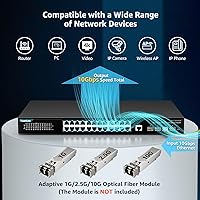
  • SFP+ Uplinks: 4 dedicated 10 Gbps SFP+ slots accept both multimode and single-mode fiber transceivers for high-speed uplink or inter-switch connections.
  • Total Ports: The switch provides 28 total network ports combining the 24 Gigabit RJ45 access ports and 4 ten-gigabit fiber uplinks.
  • Switching Capacity: Total theoretical switching capacity is 128 Gbps, supporting non-blocking forwarding across all ports under typical SMB traffic conditions.
  • Forwarding Rate: Packet forwarding rate reaches 95.232 Mpps, providing low-latency throughput for latency-sensitive applications such as VoIP and video.
  • MAC Table: The 16K MAC address table accommodates large networks with many endpoints without triggering flooding or address-table overflow.
  • Jumbo Frames: Supports jumbo frames up to 10KB, improving efficiency for storage traffic, NAS transfers, and virtualization workloads.
  • Management: Supports Web-based GUI, CLI via Console and Telnet, and SNMP versions 1, 2, and 3 for integration with network monitoring platforms.
  • Switch Layer: Operates as an L3 smart managed switch, supporting static routing, inter-VLAN routing, and a full suite of L2 and L3 protocols.
  • Security Features: Includes 802.1X port-based authentication, ARP protection, IP source guard, ACL filtering, and quadruple binding of IP, MAC, VLAN, and port.
  • Spanning Tree: Supports STP, RSTP, and MSTP spanning tree protocols along with static and dynamic link aggregation for redundancy and load balancing.
  • Cooling Design: Fully fanless aluminum chassis uses passive heat dissipation with real-time internal temperature monitoring, producing zero operational noise.
  • Dimensions: The unit measures 440 x 290 x 44.5 mm, fitting a standard 1U rack space and compatible with included rackmount kits.
  • Weight: The switch weighs 2.55 kg bare, with a packaged shipping weight of approximately 2.55 kg excluding packaging materials.
  • Power Input: Accepts universal AC input from 100 to 240V at 50-60Hz via an external power supply, suitable for worldwide deployment.
  • Lightning Protection: Built-in 4KV lightning protection on RJ45 ports provides a degree of surge resistance against electrical transients.
  • Operating Temp: Rated for continuous operation between 0 and 45 degrees C with relative humidity between 10% and 90% non-condensing.
  • Network Standards: Compliant with IEEE 802.3i, 802.3u, 802.3ab, 802.3x flow control, and 802.3az Energy Efficient Ethernet standards.

Related Reviews
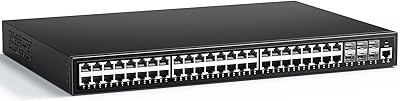
YuanLey YS48060GSM 48-Port Managed Network Switch

77%
93%
Value for Money
91%
Port Density & Uplink Capacity
86%
L3 Routing & VLAN Support
74%
Web Management Interface
52%
Documentation & Support Resources
More
TP-Link Festa FS328G 28-Port Gigabit Smart Managed Network Switch
84%
88%
Ease of Setup
85%
Performance and Reliability
91%
Cloud Management Features
80%
Build Quality
87%
Value for Money
More
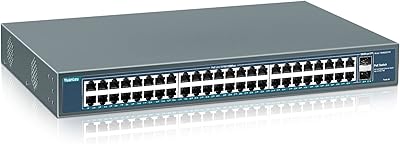
YuanLey 26-Port 400W Unmanaged PoE+ Switch
78%
91%
Value for Money
88%
PoE Performance
94%
Ease of Setup
79%
Build Quality
52%
Fan Noise
More
YuLinca 8-Port 10G Managed Network Switch
79%
92%
Port Speed & Auto-Negotiation
89%
Throughput & Switching Performance
88%
Build Quality & Chassis
71%
Web Management Interface
86%
L2 Feature Set Depth
More
Binardat 6-Port 10G L3 Managed Switch
77%
91%
10G Port Performance
88%
Multi-Speed Compatibility
84%
L3 Feature Depth
89%
Value for Money
77%
Web Management Interface
More
YuanLey 8-Port 10G Unmanaged Ethernet Switch
80%
93%
Setup & Ease of Use
89%
Throughput Performance
86%
Build Quality
88%
Value for Money
71%
Fan Noise & Acoustics
More
YuanLey YS100-0410TP 5-Port 10G PoE Switch
79%
91%
Value for Money
94%
Ease of Setup
78%
PoE Performance
88%
Multi-Gig Speed Performance
83%
Build Quality
More
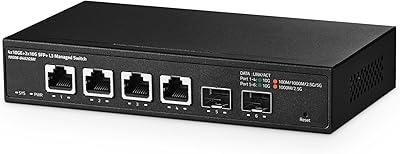
YuanLey YS4802GS-P8 48-Port Gigabit PoE Switch
79%
91%
Value for Money
93%
Ease of Installation
84%
PoE Performance
86%
Build Quality
52%
Fan Noise
More
MokerLink 8-Port 10G Managed Ethernet Switch
80%
91%
Throughput Performance
88%
Value for Money
93%
Feature Depth
74%
Web Interface Usability
86%
Build Quality
More
Tenda TEG208E 8-Port Managed Gigabit Switch
85%
94%
Value for Money
88%
Ease of Setup
91%
Build Quality
93%
Network Performance
97%
Noise Level
More

FAQ

Genuinely fanless — there is no fan at all. The aluminum chassis acts as a passive heatsink, so there are zero moving parts and zero noise. Multiple verified buyers have confirmed this, which makes it a practical choice for offices, classrooms, or any environment where rack noise is a real concern.

Yes, the Web GUI supports full 802.1Q VLAN configuration, so you can create, tag, and assign VLANs without ever touching a command line. That said, the interface has a learning curve — it is functional but not as intuitive as TP-Link Omada or Netgear's ProSAFE GUI. If you are comfortable with basic web-based switch management, you should be fine.

In practice, yes — the switch uses standard IEEE protocols for VLAN trunking, LACP, and spanning tree, so it interoperates normally with TP-Link and Netgear hardware. Buyers who have mixed it into existing infrastructures have generally reported no compatibility issues. Just treat it like any standards-compliant managed switch.

The SFP+ slots are designed for standard 10G modules and support both multimode and single-mode fiber. Most third-party 10G SFP+ transceivers should work, but YuanLey does not publish a formal compatibility list. It is worth testing your specific modules before deploying in production — a practice worth following with any value-tier switch.

No — this switch supports static routing for inter-VLAN traffic but does not run dynamic routing protocols like OSPF or BGP. For most SMB and small campus deployments that is perfectly adequate, but if your network design depends on dynamic routing, you will need a more capable L3 platform.

The aluminum chassis feels solid and rack-worthy — it is not flimsy plastic. At roughly 2.55 kg, it has some reassuring weight to it. Port connectors are well-seated and the rackmount kit is included in the box. It does not feel like a premium enterprise unit, but it is clearly built to be installed and left running, not handled daily.

Yes, the switch supports SNMP v1, v2c, and v3, so it integrates with standard network monitoring platforms including PRTG, Zabbix, and LibreNMS. SNMPv3 support is particularly useful since it adds authentication and encryption, which most modern monitoring setups prefer over the older versions.

It is manageable, but this is not a plug-and-play unmanaged switch — it is a full managed device that expects the user to understand concepts like VLANs, trunking, and management IP addresses. The Web GUI helps, but the documentation has gaps that can slow down less experienced admins. If you are setting up a basic network with minimal segmentation, the learning curve is modest. Complex configurations will take more effort.

No — the YuanLey 28-port switch does not have a cloud management platform or an official mobile app. Management is handled locally via the Web GUI, CLI over a console cable or Telnet, or SNMP. If centralized cloud management across multiple sites is a requirement, this switch is not the right fit.

This is a legitimate concern worth thinking through before purchasing. YuanLey is a newer brand without the established warranty service infrastructure of Netgear or Cisco. The product includes a standard warranty, but long-term firmware updates and responsive RMA processes are unproven at scale. For non-critical deployments or home labs, that trade-off is usually acceptable. For mission-critical infrastructure, the risk is worth weighing carefully against the cost savings.