Overview

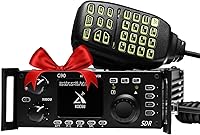
The Xiegu G90 HF Amateur Radio Transceiver sits in an interesting spot in the market — it's not a budget toy, but it won't drain your bank account like a flagship rig either. What sets it apart from most radios at this power class is its SDR-based architecture, which gives you a live spectrum waterfall rather than the blind-dial experience of traditional analog rigs. The detachable display head is a genuinely practical touch, especially for operators who want to run mobile or tuck the main body out of sight. With a 4.6-star rating across hundreds of real-world reviews, the G90 has earned its reputation — though it's worth being clear upfront: this is a 20W licensed amateur radio, not a plug-and-play consumer device.
Features & Benefits

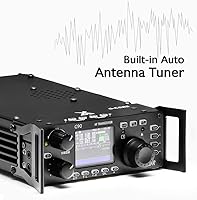
What makes this HF transceiver stand out isn't any single spec — it's how several thoughtful features work together in the field. The built-in auto antenna tuner (ATU) is arguably the headline: most rigs at this wattage force you to carry a separate tuner box, but the G90 handles a wide impedance range internally, letting you throw up a random wire antenna and get on the air fast. The 48 kHz SDR waterfall display — rendered on a readable color LCD — gives you genuine band awareness at a glance. Power output adjusts in 0.5W steps from a whisper to 20W, and firmware updates via the included cable mean Xiegu has continued refining the radio well past its initial release.

Best For

The G90 is squarely aimed at licensed hams — General class or higher — who want a compact, capable all-band HF station without hauling a full-size rig. It has become particularly popular in the SOTA and POTA communities (Summits on the Air and Parks on the Air — portable operating activities), where the internal ATU removes one more item from the pack. Vehicle installs are another strong use case: the detachable display head means the main body can hide under a seat while the screen mounts where it's actually useful. CW operators also tend to appreciate the granular power control. Complete newcomers to amateur radio should know, though, that there is a real learning curve here.

User Feedback

Community sentiment around Xiegu's compact rig is largely positive, with the spectrum waterfall display and the internal ATU drawing the most consistent praise. Operators repeatedly note that the tuner handles a broader impedance range than you'd expect for this price tier — a genuine advantage when experimenting with non-standard antennas in the field. On the flip side, two criticisms come up often enough to take seriously: the stock microphone audio is widely considered underwhelming and most buyers eventually replace it, and the menu system has a navigation logic that takes real time to internalize. The manual doesn't help much. Firmware updates have smoothed out early rough spots, but applying them requires the bundled cable and some technical comfort.

Pros

  • The built-in auto antenna tuner handles a wide impedance range, letting you use non-resonant wire antennas without a separate box.
  • A 48 kHz SDR waterfall display gives real-time band awareness that most analog rigs at this price simply cannot match.
  • RF output adjusts in 0.5W steps from near-zero to 20W, offering genuine flexibility for QRP experimentation.
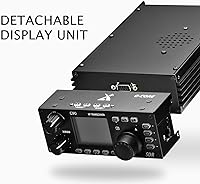
  • The detachable display head is a practical, well-executed feature for mobile installs and cramped operating positions.
  • Covers all major HF modes — SSB, CW, AM, and FM — plus 60 meters in the USA, making it a true all-band rig.
  • Firmware is actively updated and installable via the included cable, which means the radio has improved meaningfully since launch.
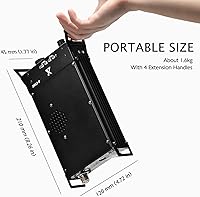
  • At roughly 2.2 lbs for the main body, it's light enough for serious backpack portable operations.
  • A strong community of users means troubleshooting help, firmware tips, and accessory recommendations are easy to find online.
  • The 18-month warranty provides reasonable coverage for a radio in this class.

Cons

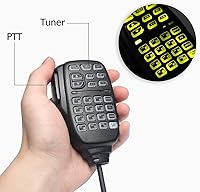
  • The stock microphone audio quality is consistently rated as mediocre — most buyers end up replacing it, which adds to the real cost.
  • Menu navigation logic is non-intuitive and takes meaningful time to learn, even for experienced ham operators.
  • The included operation manual is widely criticized for being unclear and insufficiently detailed.
  • Firmware updates require the bundled cable and a degree of technical comfort; it is not a simple automatic process.
  • 20W output is modest — under poor band conditions, home-station operators accustomed to 100W rigs will notice the difference.
  • The 1.8-inch LCD, while functional, is small enough that operators with vision issues may find it limiting in the field.
  • Operating at full 20W output requires input voltage between 13.8V and 15V DC — a constraint worth planning around for battery-based field setups.
  • No built-in battery means you must source your own power solution for truly off-grid portable use.

Ratings

The scores below reflect our AI-driven analysis of verified global user reviews for the Xiegu G90 HF Amateur Radio Transceiver, with spam, bot-generated, and incentivized feedback actively filtered out before scoring. Each category is evaluated on the aggregate of real operator experiences — from SOTA summit activations to vehicle mobile installs — so both the strengths and the frustrations are represented honestly. No score has been inflated to flatter the product, and no known pain point has been glossed over.

Value for Money
88%
Among portable HF transceivers with a built-in ATU and SDR waterfall display, the G90 occupies a price point that would typically buy you far fewer features. Operators consistently note that getting band-visibility and automatic antenna matching in one package, without flagship-level spending, feels like a genuine win.
Budget expectations need calibrating: once you factor in a replacement microphone and possibly a better power supply, the real out-of-pocket cost climbs noticeably above the sticker price. For some buyers that math erodes the perceived value somewhat.
Built-in Antenna Tuner
91%
The internal ATU is the feature that gets the most sustained praise across user communities. Field operators report that it handles impedance mismatches confidently — including long random-wire antennas thrown into trees — without the fuss of an external tuning box taking up pack space.
A small number of users working with extreme antenna mismatches note that the tuner does have limits and will occasionally fail to find a match that a high-end external unit would handle. It is wide-range, but not unlimited.
SDR Spectrum Display
89%
The 48 kHz waterfall display changes how operators interact with the bands — instead of tuning blindly, you can see activity clusters, filter noise visually, and identify signals before you even stop to listen. Newer HF operators especially praise it for accelerating their understanding of band conditions.
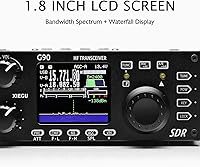
The 1.8″ LCD is physically small, and in bright outdoor sunlight some users find contrast and readability less than ideal. The display is functional rather than impressive by modern standards, and operators coming from larger-screen radios may notice the difference.
Portability & Form Factor
92%
At roughly 2.2 lbs for the main body, the G90 is genuinely backpack-portable in a way that most 20W radios simply are not. SOTA and POTA operators repeatedly cite the compact footprint as a decisive factor in choosing this rig for field activations where every ounce matters.
The extension handles, while useful for desktop use, add bulk during transport if left attached. A few users also note that the all-metal body, while solid, can get uncomfortably warm during extended transmit sessions in hot weather.
Remote Head / Mobile Install
84%
The detachable display head connected via a DB-9 cable is a well-thought-out feature for vehicle installs, letting operators tuck the radio body out of sight while keeping the screen and controls accessible. Mobile HF operators consistently highlight this as a practical differentiator over competing rigs.
The included DB-9 cable is relatively short, which can complicate installs in larger vehicles where more cable run is needed. A longer or extension cable must be sourced separately, which is an annoyance that users feel should have been anticipated.
Receiver Performance
78%
22%
On the HF bands the G90 receives well for its class, with solid sensitivity across the 0.5–30 MHz range. The built-in AM broadcast high-pass filter helps reduce intermodulation from strong MW stations bleeding into the HF receive experience, which is a thoughtful inclusion.
Experienced operators stepping down from higher-tier transceivers note that dynamic range and selectivity fall short under crowded band conditions, such as during contests. Close-in interference rejection is adequate but not exceptional.
Transmit Audio Quality
61%
39%
When paired with a quality third-party microphone, transmit audio reports from the G90 are generally positive — operators receive reasonable signal quality assessments on SSB, and the radio's RF output chain itself is not the problem.
The stock microphone bundled in the box is widely criticized as the radio's weakest included accessory, producing thin, uninspiring audio that results in mediocre signal reports. This is a consistent enough complaint that replacing the mic should be treated as a near-mandatory purchase.
Menu & User Interface
57%
43%
The Quick Mode function buttons do allow direct access to commonly used settings without diving into menus, which experienced operators appreciate once the layout becomes second nature. The physical control layout is logical for those already familiar with HF transceivers.
The menu system has a navigation logic that takes real time to learn, and new users frequently report confusion during initial setup. The included printed manual does little to resolve this — it is widely criticized for being too brief and poorly organized to serve as a reliable reference.
Firmware & Software Support
82%
18%
Xiegu has released multiple firmware updates since the G90 launched, addressing early operational bugs and refining features over time. The active development history gives buyers reasonable confidence that the radio will improve post-purchase, and the ham radio community has produced solid third-party guides for the update process.
Applying a firmware update is not a beginner-friendly process — it requires the included cable, a Windows PC, and careful attention to steps that are not always clearly documented. Operators who are not comfortable with basic PC tasks may find the process stressful.
Build Quality
81%
19%
The all-metal chassis feels solid and well-assembled for a radio at this price tier, and most operators report no issues with fit, finish, or connector integrity even after heavy field use. The unit inspires confidence when packed and transported repeatedly.
Some users note that the front-panel buttons have a slightly plasticky feel relative to the metal body, and a small number of long-term owners have reported wear on button legends after extended use. Build quality is good but not quite premium.
CW Performance
83%
CW operators are among the most consistently satisfied G90 users — the fine power stepping down to 0.5W, combined with the lightweight body, makes it an appealing rig for QRP CW portable work. The keyer functionality covers standard needs without requiring external accessories for most use cases.
Operators running high-speed CW in contest environments have noted that the keyer and sidetone options, while functional, lack some of the refinement found in radios marketed specifically toward CW enthusiasts. It handles typical field CW comfortably but does not excel at the high-performance end.
Power Flexibility
76%
24%
The wide operating voltage range of 10.5V to 16.5V DC means the G90 works across a variety of power sources, from regulated shack supplies to lithium field batteries. The adjustable output in 0.5W steps gives operators fine control over power consumption, which matters on extended battery-powered activations.
Reaching the full 20W output requires the supply voltage to stay between 13.8V and 15V — a tighter window that catches some operators off guard when running off a partially discharged battery in the field. Voltage sag under transmit load can push output noticeably below 20W.
Mode Versatility
86%
Supporting SSB, CW, AM, and FM across the full 1.8–30 MHz HF range — plus 60 meters in the US — makes this HF transceiver genuinely flexible. Operators who like to experiment across different operating styles do not feel constrained by missing mode support.
FM on HF is a niche use case that few operators actually use in practice, so the mode list is somewhat more impressive on paper than in daily operation. AM performance, limited to a 5W carrier, is functional but not a strength of the radio.
Accessories & Package Contents
67%
33%
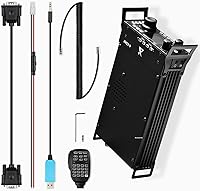
The package includes a reasonable set of cables and mounting hardware — the DB-9 remote head cable, firmware cable, and extension handles are all practical inclusions that reflect real-world use cases. Having the firmware cable in the box is a small but genuinely useful detail.
Beyond the cables and hardware, the included accessories disappoint. The stock microphone underperforms badly enough to require replacement, and the operation manual is thin and poorly written. Buyers should expect additional spending on accessories to get the most out of the radio from day one.

Suitable for:

The Xiegu G90 HF Amateur Radio Transceiver is a strong fit for licensed amateur radio operators — General class and above — who want a capable, compact HF station without committing to a full-size transceiver. It's especially well-suited for the growing SOTA (Summits on the Air) and POTA (Parks on the Air) communities, where the built-in automatic antenna tuner removes the need to pack a separate tuning unit, and the lightweight body makes the carry genuinely practical. Vehicle operators will appreciate the detachable display head, which solves a real problem in mobile HF installs where dashboard real estate is tight. CW enthusiasts who like to experiment with low-power operating will find the fine-grained 0.5W power stepping unusually flexible for this price range. If you're a budget-conscious ham upgrading from a basic entry-level rig and want SDR-style band visibility without spending flagship money, this HF transceiver makes a compelling case for itself.
Not suitable for:

The Xiegu G90 HF Amateur Radio Transceiver is not the right tool for everyone, and it's worth being direct about that. First and most importantly, this is a licensed amateur radio device — Technician-class operators with no HF privileges, CB radio users, and complete newcomers to the hobby should not expect to simply unbox it and start talking. At 20W maximum output, it's also not the rig for operators who prioritize punch and consistent long-range contacts under poor propagation conditions; experienced hams who run a home station where a 100W transceiver is practical may find this rig underwhelming. The menu navigation has a documented learning curve, and the included manual does not smooth that out significantly, so operators who prefer intuitive plug-and-play radios will likely feel frustrated early on. Anyone who relies heavily on voice operation should also budget for a third-party microphone, since the stock unit is widely considered a weak point worth replacing almost immediately.
Specifications

  • Operating Modes: The G90 supports SSB (upper and lower sideband), CW, AM, and FM modes across its full frequency range.
  • RF Output Power: Transmit power is continuously adjustable from 0.5W to 20W in 0.5W steps for SSB, CW, and FM; AM carrier output is fixed at 5W.
  • Receive Range: The receiver covers 0.5 MHz to 30 MHz, allowing reception of shortwave broadcasts as well as all amateur HF bands.
  • TX Frequency Range: Transmission is supported on all amateur HF bands from 1.8 MHz to 29.999 MHz, plus the 60-meter band for US operators.
  • Antenna Tuner: A built-in wide-range automatic antenna tuner (ATU) is included, enabling use of non-resonant and wire antennas without an external unit.
  • Spectrum Display: A 48 kHz wide SDR-based spectrum waterfall display is rendered on a 1.8″ color LCD, providing real-time band activity visibility.
  • Detachable Head: The display unit separates from the main radio body and connects via a DB-9 cable, supporting remote head mounting in vehicles or confined spaces.
  • Antenna Socket: The radio uses an SO-239 antenna connector with 50Ω impedance, compatible with standard PL-259 coaxial cables.
  • Operating Voltage: The G90 runs on 10.5V to 16.5V DC input; achieving the full 20W output requires a supply voltage between 13.8V and 15V.
  • Current Draw: Receive current draw is approximately 500mA; transmit current draw peaks at 8A maximum at full output power.
  • Frequency Stability: Frequency stability is rated at ±10 ppm after the unit reaches operating temperature following warm-up.
  • Main Body Dimensions: The radio body (without handles) measures 4.75″ wide by 1.75″ tall by 8.25″ deep.
  • Body Weight: The main radio body weighs approximately 2.2 lbs, making it practical for backpack portable and SOTA field use.
  • Total Package Weight: The complete retail package, including accessories, weighs 3.53 lbs.
  • Firmware: Firmware is user-updatable via the included programming cable; the latest release is available through Radioddity's official website.
  • Warranty: Xiegu provides an 18-month manufacturer warranty; this warranty is voided if the radio hardware is physically modified.
  • Operating Temperature: The G90 is rated for continuous operation in ambient temperatures ranging from -10°C to +50°C.
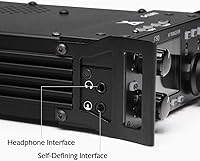
  • Included Accessories: The package includes a multi-function microphone, firmware cable, power cable, DB-9 remote head cable, operation manual, warranty card, mounting hardware, and extension handles.

Related Reviews
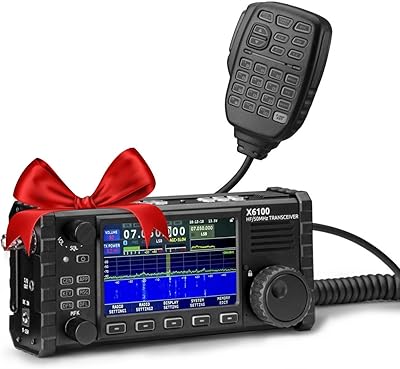
Xiegu X6100 HF Radio Transceiver 10W
86%
88%
Value for Money
85%
Performance
90%
Bluetooth Functionality
92%
Portability
89%
Ease of Use
More
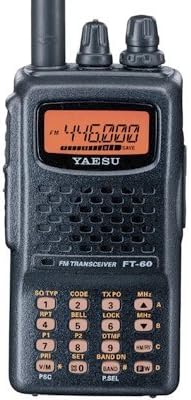
Yaesu FT-60R DualBand Handheld Amateur Radio Transceiver
87%
88%
Performance & Communication Range
90%
Build Quality & Durability
78%
Ease of Use & User Interface
94%
Portability & Size
85%
Battery Life
More
Icom ID-5100A Dual-Band Mobile Ham Radio Transceiver
79%
88%
D-STAR Performance
83%
Touchscreen Usability
86%
GPS & Position Reporting
81%
Audio Quality
58%
Ease of Setup
More
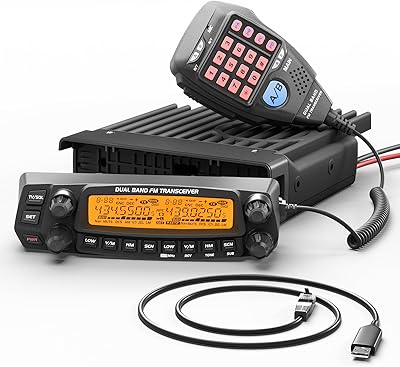
Radioddity DB50 Dual Band Mobile Radio Transceiver
79%
88%
Transmit Power & Range
91%
Receiver Coverage
86%
Audio Clarity
84%
Channel Management
89%
Chirp Compatibility
More
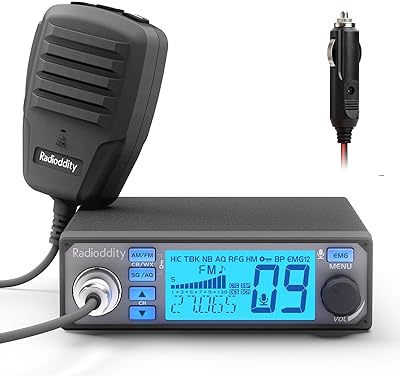
Radioddity CB-500 CB Radio Mobile Transceiver
79%
88%
Audio Clarity
86%
Noise Reduction Performance
67%
Transmission Range
83%
Ease of Installation
63%
Menu Navigation & Usability
More
AnyTone AT-778UV Dual Band Mobile Radio
79%
83%
Build Quality
88%
Audio Clarity
86%
Dual-Band Coverage
79%
Display & Interface
51%
Programming Software
More
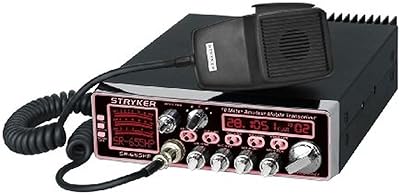
Stryker SR-655 10 Meter Amateur Radio
86%
89%
Transmission Range
91%
Build Quality
65%
Ease of Setup
87%
Display Visibility
93%
Power Output
More
Stryker SR-955HPC 10 Meter Amateur Radio
77%
94%
Frequency Stability
91%
Transmit Audio Quality
89%
Power Output
78%
DSP Noise Reduction
83%
Build Quality
More
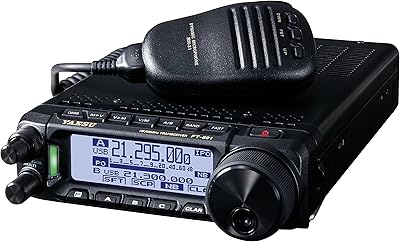
Yaesu FT-891 HF/50 MHz All Mode Transceiver
85%
89%
Performance
91%
Build Quality
84%
Ease of Use
87%
Portability/Size
90%
Power Output
More
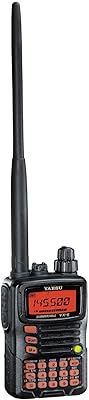
Yaesu VX-6R Tri-Band Ham Radio Transceiver
80%
93%
Build Quality & Durability
91%
Waterproofing & Weather Resistance
88%
Receiver Performance
86%
Audio Clarity
77%
Transmit Power & Range
More

FAQ

Yes, without question. The G90 is a transmitting radio that operates on frequencies exclusively allocated to licensed amateur radio operators. In the US, you need at least a General class license to access the HF bands this radio covers. Receiving only does not require a license, but you cannot legally transmit without one.

It depends on what you mean by beginner. If you are newly licensed at the General class level and comfortable learning radio concepts, the G90 is a reasonable first HF rig — especially given its SDR waterfall display, which actually helps new operators understand band conditions visually. That said, the menu system has a real learning curve, and the manual is not particularly clear, so expect to spend time with online communities and YouTube tutorials before everything clicks.

Yes, and this is one of the G90's genuine strengths. The built-in automatic antenna tuner handles a wide range of impedances, so you can throw up a simple wire antenna in the field and let the ATU do the matching work. Most portable operators report good results with end-fed wires and basic dipoles that are not cut to exact resonance.

Honestly, it depends heavily on band conditions, propagation, time of day, and your antenna setup. Under good conditions on HF, 20W is enough to make contacts across continents — many operators run far less with CW (Morse code). Under poor propagation, though, you will feel the limitation compared to a 100W station. Think of it as a capable but modest output level, not a powerhouse.

You need a regulated DC supply capable of delivering at least 8A at 13.8V to 15V for full 20W output. A standard 13.8V 20A ham shack power supply works well and gives you headroom. Running the radio from a 12V battery is possible, but you may not quite hit the full 20W output depending on the battery's voltage under load.

Most owners end up replacing it. The included microphone technically works, but audio reports from other operators are consistently described as thin or mediocre. A modest investment in a third-party hand mic designed for ham radio use makes a noticeable difference in how your signal sounds on air.

The display unit and the main radio body separate and connect via the included DB-9 cable. In practice, you can mount the main body under a seat or in a storage compartment and run the cable to the display head, which can sit on the dashboard or be bracket-mounted within easy reach. It is a clean solution for mobile installs where hiding the bulk of the radio matters.

Firmware updates are done through the included programming cable connected to a PC running the update tool available from Radioddity's official site. The process is straightforward if you follow the steps carefully, and the community has well-documented guides. It is not a one-click process, so if you are uncomfortable with basic PC tasks you should read through the instructions before attempting it. Bricking the radio through an update is rare but possible if the process is interrupted.

Yes, many G90 users run digital modes successfully. You will need a computer audio interface — something like a SignaLink USB or a similar sound card interface — connected between the radio and your computer. The radio itself does not have a built-in soundcard or USB audio port, so that external interface is a required addition for digital work.

The main advantages the G90 holds over most competitors in its class are the built-in ATU and the SDR waterfall display — two features you typically pay significantly more to get elsewhere. Trade-offs include the modest 20W ceiling and the menu usability issues. If you prioritize a cleaner user interface and do not need the ATU, there are alternatives worth considering. But for portable operators who want band visibility and antenna flexibility in one package, Xiegu's compact rig is hard to beat at its price point.

Where to Buy