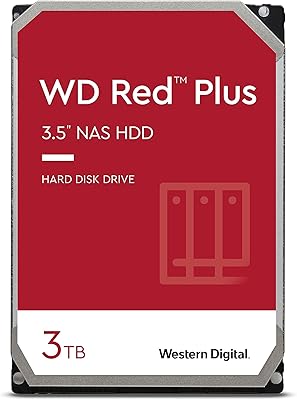
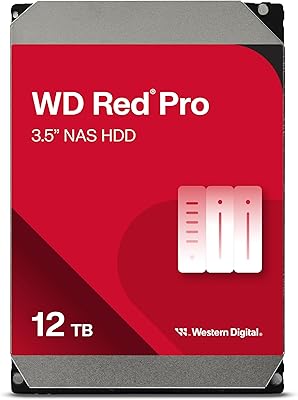
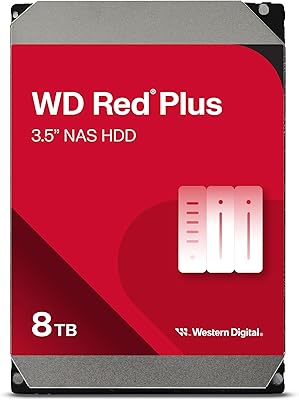
Overview

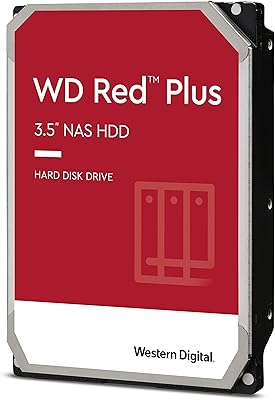
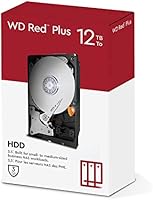
The WD Red Plus 12TB NAS Internal Hard Drive is Western Digital's answer to a real gap in the NAS market: a high-capacity drive built specifically for always-on enclosures, without the complexity or cost of enterprise hardware. At 12TB, it sits firmly in the upper tier of what home users and small businesses typically need. What separates this NAS drive from the standard WD Red is its use of CMR recording technology — Conventional Magnetic Recording — which delivers more consistent write performance than SMR-based alternatives. The Plus designation also brings a faster spindle class, making it a meaningfully different product, not just a rebranded sibling.
Features & Benefits

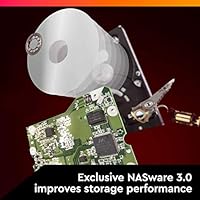
The speed advantage of a 7200 RPM spindle is tangible in a NAS context — you get noticeably snappier response times during simultaneous reads and writes compared to slower alternatives. Paired with a 256MB cache, this hard drive handles the mixed workloads a multi-bay NAS regularly sees without bottlenecking. One of the most practically important features is TLER, or Time-Limited Error Recovery. In plain terms, the drive communicates with a NAS controller during a read error instead of entering a prolonged recovery loop that causes the enclosure to drop it from a RAID array. The NASware firmware also adds vibration compensation, which matters when multiple drives spin in close proximity.

Best For

This NAS drive is a natural fit for home users running a Plex media server on a Synology or QNAP box, where high capacity and reliable throughput make a real difference. It also suits small businesses building a RAID-5 or RAID-6 array — the 24/7 workload rating and TLER support mean you are not relying on a desktop drive doing a job it was never designed for. Content creators storing large raw video libraries will appreciate the headroom that 12TB provides. It is equally a strong choice for IT-minded prosumers who specifically need CMR-based drives and want to avoid the SMR confusion that plagued earlier WD Red releases.

User Feedback

Buyers consistently praise the plug-and-play compatibility of this hard drive with Synology and QNAP enclosures, with most reporting immediate recognition by their NAS without any configuration headaches. There is also genuine appreciation that WD clearly identifies this as a CMR drive, given the frustration many users experienced when the company quietly shipped SMR units in older Red drives without disclosure. On the less positive side, some note that the 7200 RPM motor is audibly louder and produces more vibration than slower NAS alternatives, which can be a consideration in quieter home setups. Head-to-head comparisons with Seagate IronWolf at the same capacity tend to be close, with buyers usually choosing based on brand familiarity rather than a decisive performance gap.

Pros

  • CMR recording technology delivers consistent, predictable write speeds that RAID arrays depend on.
  • TLER support prevents the NAS from dropping this hard drive during a recoverable read error.
  • Broad compatibility with Synology, QNAP, and most major NAS enclosures right out of the box.
  • NASware firmware handles vibration from neighboring drives, reducing wear in multi-bay setups.
  • 12TB capacity provides ample headroom for media libraries, backups, and growing data sets.
  • Faster spindle speed translates to real-world performance gains over the standard WD Red line.
  • Western Digital clearly labels this as a CMR drive, removing the guesswork buyers faced with older Red models.
  • The 256MB cache smooths out the mixed read/write workloads typical in a home or small business NAS.
  • Validated for continuous 24/7 operation, which desktop drives simply are not designed to handle.

Cons

  • The 7200 RPM motor is noticeably louder than slower NAS alternatives, which can be an issue in quiet spaces.
  • Vibration at higher spindle speeds may require enclosure-level dampening in cheaper or older NAS chassis.
  • At 12TB, the per-drive cost is substantial — buying multiple units for a RAID array is a significant investment.
  • No included mounting hardware or accessories, which is a minor but real inconvenience for first-time builders.
  • The WD Red Plus line does not carry the extended warranty or higher workload rating of the Red Pro series.
  • Competing drives like Seagate IronWolf at the same capacity are closely matched, so brand switching costs you little but researching the comparison takes real time.
  • Power consumption under sustained load is higher than SMR or 5400 RPM alternatives, adding up over years of always-on use.
  • Heat output in fully populated NAS enclosures with multiple units may demand better airflow planning than casual users expect.

Ratings

Our AI-generated scores for the WD Red Plus 12TB NAS Internal Hard Drive were produced by analyzing verified buyer reviews from multiple global markets, with spam, bot activity, and incentivized feedback actively filtered out before any scoring took place. The results reflect a balanced picture — where this NAS drive genuinely excels and where real buyers have run into friction — so you can make a purchase decision based on honest signal rather than curated praise.
Recording Technology
93%
Buyers who previously dealt with WD's undisclosed SMR situation responded strongly to this drive's confirmed CMR design. In RAID environments, the consistent write behavior means no unexpected slowdowns during large file transfers or array rebuilds, which is exactly what multi-bay NAS users depend on day to day.
CMR is table stakes for serious NAS use, so it earns credit partly by contrast with WD's own controversial history rather than as an innovation. Users who never experienced the SMR controversy may not appreciate why this label matters as much as longtime WD buyers do.
RAID Compatibility
91%
TLER support is genuinely appreciated by users running RAID-5 or RAID-6 arrays, where a drive that goes silent during an error can trigger a costly and stressful rebuild process. Multiple reviewers noted that this hard drive integrated cleanly into existing arrays without triggering false failures, even under sustained load.
TLER primarily benefits RAID users — those running a simple single-drive or JBOD setup will never notice its presence, which means part of the engineering here goes unused depending on how the drive is deployed.
NAS Compatibility
92%
Plug-and-play recognition on Synology and QNAP enclosures is one of the most consistently praised aspects across buyer feedback. Users report that both DSM and QTS identify this NAS drive immediately on first boot, with no firmware workarounds or manual configuration required in virtually all modern enclosures.
A small number of buyers using older or less common NAS enclosures reported needing to check firmware updates before the drive was fully recognized. It is a minor friction point, but compatibility lists are always worth consulting before committing to a multi-drive purchase.
Sustained Performance
86%
The faster spindle speed delivers real-world throughput advantages that matter when multiple users are simultaneously reading and writing to the NAS — something a Plex server with several active streams or a shared business file server will expose quickly. The 256MB cache also helps absorb mixed workload spikes without visible slowdowns.
Peak sequential speeds are competitive but not class-leading; some users comparing benchmarks with enterprise-grade alternatives noted a ceiling in intensive write-heavy scenarios. For most home and small business workloads this is invisible, but power users running constant high-throughput applications may feel the limits.
Noise & Vibration
61%
39%
Users who house their NAS in a dedicated utility closet, server cabinet, or basement rarely mention noise as a concern, and most acknowledge that the 7200 RPM class is simply a louder mechanical design by nature. In those deployments, the performance trade-off is accepted without complaint.
In quieter home environments — a home office, a living room media setup, or a bedroom — the audible hum and occasional seek noise from this hard drive is a recurring complaint. Vibration in fully populated enclosures can also be noticeable, and cheaper NAS chassis without rubber dampening tend to amplify this problem.
Long-Term Reliability
84%
The majority of long-term buyers report no failures within the first two years of continuous operation, and the 24/7 workload rating gives confidence for always-on NAS deployments. Western Digital's established track record in NAS drives contributes meaningfully to buyer trust in this area.
A subset of reviewers reported early failures within the first few months, which is statistically expected across high-volume mechanical drives but still unsettling at this capacity tier. The three-year warranty provides a safety net, but a drive failure at 12TB means a significant and stressful data recovery situation if backups are not in place.
Heat Management
78%
22%
Under typical NAS workloads, operating temperatures remain within comfortable ranges when the enclosure provides adequate airflow, which most modern multi-bay NAS systems do by design. Users with well-ventilated setups report stable temperatures even during extended write sessions.
In densely populated enclosures with marginal cooling, the 7200 RPM motor generates enough heat that drive temperatures can climb under sustained load. Buyers who pack older four-bay or six-bay enclosures to capacity without upgrading fan configurations have noted higher-than-expected thermal readings.
Value for Money
74%
26%
For buyers who understand what they are getting — a purpose-built, CMR-based, TLER-enabled NAS drive with genuine 24/7 reliability credentials — the investment makes sense relative to what desktop drives cost when they fail prematurely in an always-on environment. The per-terabyte calculation also becomes more favorable at 12TB scale.
The pricing sits at a notable premium compared to desktop drives of similar capacity, which can feel steep to buyers new to NAS builds who are not yet familiar with why NAS-specific engineering carries a cost. Competitors like Seagate IronWolf occasionally undercut the WD Red Plus at this capacity, making the value case dependent on timing.
Setup & Installation
89%
Buyers consistently describe the physical installation as straightforward — standard SATA power and data connections, no proprietary tooling required, and immediate recognition by major NAS operating systems. For anyone who has installed a hard drive before, this is a no-friction experience.
Western Digital does not include mounting screws or drive trays in the box, which is standard practice across the industry but still a mild inconvenience for first-time NAS builders who may not realize they need to source those separately from their enclosure manufacturer.
RAID Rebuild Speed
79%
21%
When a RAID array requires rebuilding — after a drive swap or firmware event — the faster spindle speed means rebuild times are shorter compared to slower NAS alternatives, which reduces the window of vulnerability where the array is operating without full parity protection.
At 12TB capacity, even a fast rebuild is a lengthy process measured in hours, and some users reported the NAS running noticeably hot and slow during those windows. This is a mechanical HDD limitation at high capacity rather than a flaw specific to this drive.
Firmware Intelligence
82%
18%
NASware firmware handles the kind of background tasks that desktop drive firmware simply ignores — vibration compensation from neighboring drives, idle calibration tuned for always-on duty cycles, and error handling designed to cooperate with a NAS controller rather than fight it. Buyers rarely notice it working, which is exactly the point.
Unlike Seagate IronWolf's IronWolf Health Management feature, WD does not offer a comparable integrated monitoring tool bundled with this drive. Users who want proactive health analytics need to rely on their NAS enclosure's built-in S.M.A.R.T. reporting tools instead.
Workload Endurance
87%
This NAS drive is rated for the kind of sustained workload that would degrade a desktop drive within months — continuous operation, background scrubs, and simultaneous multi-user access are all within its design envelope. Small business users running shared storage for a team report it holding up well under daily pressure.
The workload rating, while appropriate for home and SMB NAS environments, falls below what WD's own Red Pro line offers for heavier enterprise-adjacent deployments. Organizations with particularly aggressive 24/7 write-intensive workloads may find themselves bumping against the ceiling over a multi-year lifespan.
Brand Trust & Transparency
77%
23%
Western Digital's decision to clearly label WD Red Plus drives as CMR restored credibility with technically informed buyers who had lost confidence after the undisclosed SMR episode. That transparency has translated into measurable goodwill in buyer feedback, particularly among the NAS enthusiast community.
The earlier SMR controversy still surfaces in reviews from buyers with long memories, and it has introduced a layer of verification behavior — cross-checking model numbers against spec sheets — that WD would not have faced before 2020. Trust was partially rebuilt, but it was not fully recovered for a segment of the audience.

Suitable for:

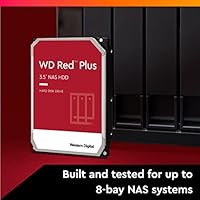
The WD Red Plus 12TB NAS Internal Hard Drive is built for people who take their storage seriously but do not need the overhead of a full enterprise solution. Home users running a multi-bay Synology or QNAP NAS will find it particularly well-suited, especially if that enclosure handles anything demanding — a Plex media server streaming to multiple devices, a large photo or video archive, or a local backup destination for multiple computers. Small business owners assembling a RAID-5 or RAID-6 array will appreciate that this drive is rated and validated for 24/7 operation, not simply adapted from a desktop design. Content creators who regularly work with raw footage and need a dependable place to archive projects without worrying about write consistency will also get real value here. The CMR recording technology makes it especially appropriate for anyone who lived through the WD SMR controversy and wants a straight answer about what is actually inside the enclosure.
Not suitable for:

The WD Red Plus 12TB NAS Internal Hard Drive is not the right choice for every storage need, and being honest about that matters. If you are looking for a simple external backup drive or a single-drive solution attached directly to a desktop, this hard drive is overbuilt for that purpose — you would be paying for NAS-specific engineering you will never actually use. Users in quiet home office or bedroom environments should think carefully, because the 7200 RPM motor produces more audible noise and vibration than slower NAS drives, which can become genuinely distracting in a silent room. Anyone who needs only a few terabytes of storage will find the 12TB capacity excessive, and smaller capacity options within the same family typically offer better value at that scale. Finally, if your workload demands true enterprise-grade endurance ratings, dual-plane balancing, or extended warranty tiers, purpose-built data center drives from WD's Gold or Red Pro lines would be a more appropriate fit.
Specifications

  • Storage Capacity: This hard drive provides 12TB of raw storage, making it well-suited for large NAS deployments handling media libraries, backups, or mixed file archives.
  • Form Factor: The drive uses the standard 3.5-inch form factor, compatible with virtually all desktop NAS enclosures and multi-bay towers.
  • Recording Technology: Western Digital uses CMR (Conventional Magnetic Recording), which writes data to non-overlapping tracks for consistent and predictable performance under sustained workloads.
  • Spindle Speed: The drive operates at the 7200 RPM class, delivering faster seek times and sequential throughput than the 5400 RPM alternatives in the standard WD Red lineup.
  • Cache Buffer: A 256MB DRAM cache helps manage simultaneous read and write operations, smoothing performance in multi-user or multi-drive NAS environments.
  • Interface: It connects via SATA 6 Gb/s, ensuring broad compatibility with modern NAS enclosures and backward compatibility with older SATA generations.
  • Drive Type: This is a traditional mechanical hard disk drive (HDD), not a solid-state drive, relying on spinning platters and read/write heads for data access.
  • Installation Type: Designed exclusively for internal installation inside a NAS enclosure or desktop tower — it is not an external or portable drive.
  • Error Recovery: The drive includes TLER (Time-Limited Error Recovery), which signals the NAS controller during read errors rather than entering a prolonged recovery loop that could cause a RAID array to drop the drive.
  • Firmware: NASware firmware is embedded to optimize behavior in always-on environments, including compensation for vibration caused by adjacent spinning drives in multi-bay setups.
  • Workload Rating: The WD Red Plus 12TB is rated for NAS and RAID workloads with continuous 24/7 operation, unlike desktop drives that are designed for intermittent use.
  • Dimensions: The drive measures 8 x 5.25 x 2.75 inches, following the standard 3.5-inch HDD physical specification used across the industry.
  • Weight: It weighs 1.65 pounds, which is typical for a high-capacity mechanical hard drive of this density.
  • Model Number: The official Western Digital model number is WD120EFBX, which can be used to verify specifications and check warranty status directly with the manufacturer.
  • Manufacturer: Western Digital, one of the longest-established names in hard drive manufacturing, produces and warranties this drive.
  • Compatible Systems: The drive is specifically tested and validated for use in NAS enclosures from major brands including Synology, QNAP, and other multi-bay systems.
  • Drive Series: This model belongs to the WD Red Plus family, which sits above the standard WD Red line in terms of spindle speed and performance headroom.

Related Reviews

WD Red Plus 6TB NAS Hard Drive
82%
89%
Reliability & Longevity
93%
NAS Compatibility
62%
Write Performance
91%
RAID Suitability
87%
Noise Level
More
Western Digital WD Red Plus 1TB NAS Hard Drive
84%
91%
Long-Term Reliability
93%
NAS Compatibility
88%
RAID Performance
83%
Noise & Vibration
77%
Heat Management
More
WD Red Plus 14TB NAS Hard Drive
82%
83%
Reliability & Longevity
91%
RAID Compatibility
67%
Value for Money
84%
Write Performance
93%
NAS Compatibility
More
Western Digital 4TB WD Red Plus NAS Internal Hard Drive
89%
91%
Performance
94%
Reliability
88%
Energy Efficiency
85%
Noise Levels
89%
Workload Handling
More
WD Red Plus 10TB NAS Hard Drive
80%
91%
Reliability & Endurance
93%
CMR Recording Integrity
84%
Read & Write Performance
88%
NAS Compatibility
74%
Noise & Vibration
More
WD Red Pro 10TB NAS Hard Drive
82%
88%
RAID Reliability
91%
NAS Compatibility
83%
Sustained Throughput
86%
Acoustic Performance
69%
Long-Term Durability
More
WD Red Plus 2TB NAS Hard Drive
80%
91%
Long-Term Reliability
88%
NAS Compatibility
86%
RAID Rebuild Performance
89%
Noise & Heat
72%
Sequential Read Speed
More
Western Digital 12TB WD Red Pro NAS Hard Drive
86%
92%
Performance in RAID Environments
89%
Data Transfer Speed
94%
Reliability for 24/7 Operation
88%
Workload Capacity (550TB/year)
70%
Temperature Management
More
WD Red Plus 8TB NAS Hard Drive
82%
88%
Long-Term Reliability
93%
NAS Compatibility
91%
CMR Recording Technology
83%
Value for Money
86%
Noise & Vibration
More
WD Red Plus 3TB NAS Hard Drive
78%
91%
Long-Term Reliability
93%
NAS Compatibility
87%
RAID Performance
67%
Sequential Read/Write Speed
48%
Random I/O Performance
More

FAQ

Yes, the WD Red Plus 12TB NAS Internal Hard Drive uses CMR (Conventional Magnetic Recording), and Western Digital now explicitly documents this on their product pages and packaging following significant backlash over undisclosed SMR use in earlier WD Red models. You can also confirm by checking the model number WD120EFBX against Western Digital's official drive specifications page.

In most cases, yes. This NAS drive is widely reported to be recognized immediately by Synology DSM and QNAP QTS without any special setup. That said, it is always worth checking your specific enclosure model against the manufacturer's hard drive compatibility list before purchasing, especially for older NAS units.

TLER stands for Time-Limited Error Recovery. When a drive encounters a read error, it normally tries to fix it on its own, which can take a long time. In a RAID array, a NAS controller may interpret that delay as the drive failing and drop it from the array. TLER tells the drive to report the error quickly so the NAS can handle recovery itself. If you are running any kind of RAID configuration — even a simple two-drive mirror — you want drives with TLER support.

Noticeably louder than 5400 RPM alternatives. The 7200 RPM motor produces more audible spin noise and slightly more vibration, particularly in enclosures without dedicated dampening. For a NAS tucked away in a closet or utility room it is a non-issue, but if your NAS sits in a bedroom or quiet office, it is worth factoring in.

Technically yes, it will work — it uses a standard SATA connection and any desktop will recognize it. However, you would be paying for NAS-specific features like TLER and NASware firmware that serve no purpose in a single-drive desktop scenario. A standard desktop or surveillance-class drive would be a more practical choice for that use case.

The two are closely matched in most real-world NAS workloads. Both use CMR, both support TLER, and both are rated for 24/7 operation. Seagate IronWolf drives include IronWolf Health Management (a firmware monitoring feature), while WD relies on its NASware firmware approach. Most buyers who have compared both report that day-to-day performance differences are minimal, and the choice often comes down to brand preference or pricing at the time of purchase.

This NAS drive is validated for use in RAID 0, 1, 5, 6, and 10 configurations. The TLER support is particularly important for RAID 5 and RAID 6, where a single drive drop during a rebuild can have serious consequences. For any parity-based RAID setup, using drives with proper NAS firmware like this one is strongly recommended.

The drive itself does not set a limit — that is determined by your NAS enclosure. The NASware firmware is specifically designed to handle the vibration and interference that comes from multiple drives spinning simultaneously, so running four, six, or even eight of them in a populated chassis is exactly the use case this drive was engineered for.

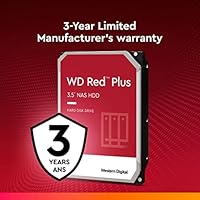
Western Digital typically covers the WD Red Plus line with a three-year limited warranty. You should register the drive through WD's website after purchase to make the warranty claim process smoother if you ever need it. Enterprise-class WD drives offer longer coverage, but three years is standard for this product family.

Not necessarily, if you expect your storage needs to grow. NAS storage is cumulative — backups, media libraries, and archives expand over time, and filling up a NAS forces either replacing drives or adding more bays. Buying larger capacity drives upfront is often more cost-efficient than upgrading sooner than planned. That said, if your data needs are genuinely modest and unlikely to scale, a smaller capacity in the same series might serve you just as well.